
You may be sitting with a translated spiritual book open on one tab, a chant playlist on another, and a dozen questions in your mind. Which text should you begin with. Why do some English versions sound poetic while others feel dry. And if these scriptures are so ancient, can they still help with your very modern need for calm, direction, and inner steadiness?
That confusion is normal. Many people feel a real pull toward the Vedas and related teachings, but the first contact is often overwhelming. The names are unfamiliar, the structure is unclear, and the internet tends to throw long reading lists at beginners without explaining how any of it connects to lived experience.
This guide takes a different route. It treats vedic scriptures in english not just as books to identify, but as wisdom to approach carefully, respectfully, and practically. You’ll learn what the Vedic scriptures are, how the larger body of literature fits together, how to choose translations with discernment, and how to turn study into a grounded spiritual practice that supports clarity, reflection, and personal transformation.
Table of Contents
- Your Journey Into Ancient Wisdom Begins Here
- What Are the Vedic Scriptures An Overview
- Exploring the Core Texts The Four Vedas
- Beyond the Vedas Brahmanas Aranyakas and Upanishads
- How to Choose the Best English Translations
- A Practical Roadmap for Studying the Scriptures
- Common Questions About Studying Vedic Texts
Your Journey Into Ancient Wisdom Begins Here
A lot of sincere seekers start in the same place. They’ve tried productivity systems, wellness routines, and even modern spirituality content, yet something still feels thin. They want a tradition with depth. They want words that don’t just motivate them for a day, but help them see life more clearly.
That’s often when the Vedic world appears. A person hears a mantra in a yoga class, finds an Upanishad quote in a journal, or stumbles across a discussion of sacred sound and feels a quiet recognition. Then the confusion begins. There are Vedas, Upanishads, epics, commentaries, chants, and many competing English translations.

If that’s where you are, you don’t need more noise. You need a path. The purpose of studying these texts isn’t to collect exotic terms or impress anyone with spiritual vocabulary. It’s to become steadier, more honest with yourself, and more sensitive to what brings peace rather than confusion.
Some readers come to these scriptures because they’re spiritually curious. Others come because they’re tired, anxious, or searching for a more grounded inner life. Both are valid starting points. Ancient wisdom has always met people where they are.
The best beginning is often simple. Choose one authentic text, read slowly, and let the words work on your life before you try to master the whole tradition.
If you’re already exploring broader spiritual practice, material on magick theory and practice can help you notice how intention, ritual, and disciplined inner work overlap with scriptural study. The Vedic path adds one essential quality to that search: a very old, very refined relationship to sound, memory, and truth.
What Are the Vedic Scriptures An Overview
The phrase Vedic scriptures usually points to a whole family of sacred texts rooted in ancient India. At the heart of that family are the Vedas, which tradition regards as Shruti, meaning “what is heard.” That phrase matters. It tells you these texts were not originally treated as ordinary books authored in the usual human way. They were received, preserved, recited, and transmitted with extraordinary care.
According to World History Encyclopedia’s overview of the Vedas, the Vedas were composed between c. 1500–500 BCE, are the oldest layer of Sanskrit literature, and were preserved orally for millennia before being written down. The same source notes that the Rigveda alone contains 1,028 hymns, preserved through a memorization system that carried them verbatim from teacher to student for over 35 centuries.
Why these texts can feel intimidating
Beginners often assume “the Vedas” means one single book. It doesn’t. The tradition is layered. There are foundational hymns, ritual explanations, meditative reflections, and philosophical teachings. If you don’t know how those layers relate, the whole field looks harder than it is.
Another point of confusion is the difference between Shruti and Smriti. Shruti refers to revealed texts at the core of Vedic authority. Smriti refers to remembered literature built upon that foundation. Both matter, but they don’t play the same role.
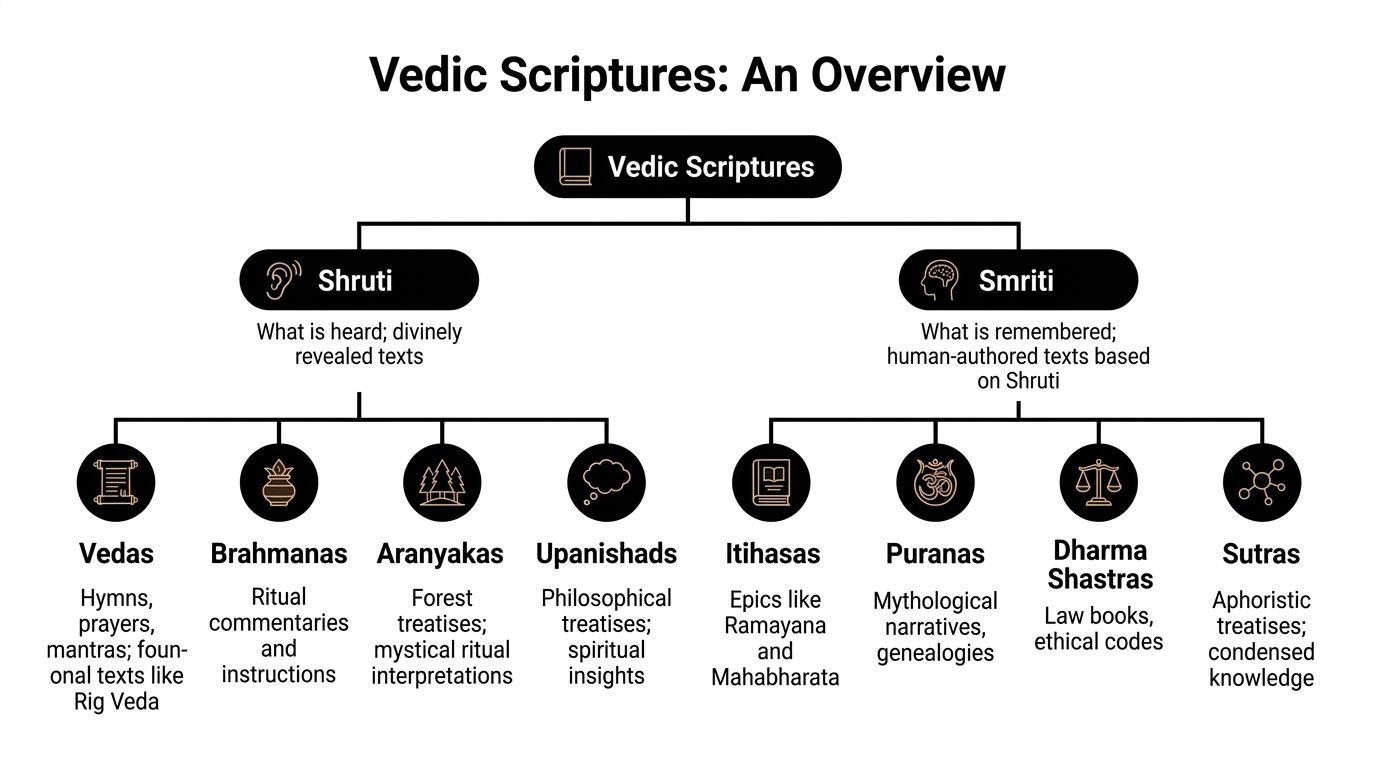
The tree model that makes the tradition easier to grasp
A tree is a helpful way to understand the structure.
- The roots are the Samhitas. These are the core Vedic collections, the foundational hymns and mantras.
- The trunk is the Brahmanas. These texts explain ritual performance and sacred procedure.
- The branches are the Aranyakas. These are the “forest texts,” where ritual begins to turn inward.
- The fruit is the Upanishads. Here the teaching ripens into direct philosophical inquiry about self, reality, and ultimate truth.
Then there is the wider canopy of Smriti literature, which includes epics, Puranas, Dharma Shastras, and Sutras. These texts are highly influential and often more familiar to modern readers, but they arise in relationship to the older Vedic foundation.
Practical rule: When you hear someone mention “Vedic wisdom,” ask whether they mean the original Vedas, the Upanishads, or later tradition. Those aren’t interchangeable.
This tree model helps because it keeps you from flattening everything into one category. It also shows a natural movement. The literature begins with sacred sound and communal ritual, then gradually opens into contemplation, metaphysics, and interior realization.
That movement is one reason these texts still matter. They don’t only tell people what to do. They ask what is real, who you are beneath the changing mind, and how sound, attention, and disciplined inquiry can reshape the way you live.
Exploring the Core Texts The Four Vedas
The four primary Vedas are Rig, Sama, Yajur, and Atharva. They’re all foundational, but they don’t serve the same function. Knowing the difference saves beginners from lumping them together and missing their distinct voices.
What makes each Veda distinct
The Rigveda is the oldest and most often discussed. It gathers hymns addressed to deities such as Agni and Surya. The text works on more than one level. As this overview of the Rigveda and its relevance today explains, its 1,028 hymns carry both literal and esoteric meaning, and include spiritual concepts such as ṛtam with 440 occurrences and amṛta with 500 occurrences.
The Samaveda is closely tied to chant and melody. It shows that Vedic transmission was not just about preserving words, but preserving sound patterns that shaped ritual and consciousness.
The Yajurveda is more procedural. It supports ritual action through prose formulas and liturgical guidance. If the Rigveda gives many of the hymns, the Yajurveda helps place them into ceremonial use.
The Atharvaveda feels different again. It contains material connected to ordinary life, protection, healing, and domestic concerns. Many readers find it especially interesting because it shows how sacred knowledge was not reserved only for grand rituals, but touched daily existence.
The Four Vedas at a Glance
| Veda | Primary Focus | Content Type | Spiritual Application |
|---|---|---|---|
| Rig Veda | Hymns of praise | Metrical hymns and mantras | Reflection on divine forces, inner meaning, sacred language |
| Sama Veda | Musical recitation | Chanted versions of hymns | Devotional absorption through sound and melody |
| Yajur Veda | Ritual performance | Prose mantras and liturgical formulas | Aligning action, intention, and sacred order |
| Atharva Veda | Everyday life and protection | Spells, charms, prayers, domestic ritual material | Bringing spiritual attention into healing, protection, and household life |
Why the Rigveda matters so much to beginners
The Rigveda matters because it corrects a common modern mistake. Many people think ancient scripture is either literal mythology or abstract philosophy. The Rigveda is neither of those alone. It holds ritual speech, symbolic language, and contemplative depth together.
That layered quality is important if your goal is personal transformation. A verse may speak outwardly to fire, dawn, or wind, while also pointing inwardly to illumination, awakening, and order within the self. This lets the text function in two ways at once. It can belong to an ancient ritual world and still speak to a modern reader seeking clarity.
A beginner doesn’t need to decode every symbol immediately. It’s enough to know that the surface meaning may not be the whole meaning.
Read the Vedas with patience. When a hymn seems strange at first, assume depth before you assume irrelevance.
Beyond the Vedas Brahmanas Aranyakas and Upanishads
Many readers first meet the word “Veda” and stop there. But the Vedic tradition didn’t remain fixed at the level of hymns and ritual formulas. It unfolded. The later layers show a deepening movement from outer ceremony to inner realization.
From outward ritual to inward reflection
The Brahmanas are prose texts that explain ritual in detail. They tell priests what to do, why a gesture matters, and how sacrifice fits into sacred order. For a modern beginner, they can feel technical. Yet they serve an important purpose. They show that Vedic religion placed great importance on precision, symbolism, and the connection between action and meaning.
The Aranyakas stand in a transitional place. Their name links them to the forest, and that image is fitting. Here the atmosphere changes. The concern is no longer only the correct performance of public rites. Reflection becomes more inward, more meditative, and more symbolic.
A helpful way to think about this shift is simple:
- Brahmanas ask what should be done in ritual.
- Aranyakas ask what the ritual means beneath the surface.
- Upanishads ask who the self is that seeks truth at all.
Why the Upanishads feel more accessible today
The Upanishads are often the point where modern readers feel the tradition become intimate. Their concern is not mainly external offering, but ultimate reality, consciousness, the self, and liberation. Questions like “What is the deepest self?” and “What is the ground of all existence?” become central.
For someone reading vedic scriptures in english for spiritual growth, the Upanishads often feel immediately relevant because they speak directly to identity, fear, death, stillness, and awakening. They don’t ask you only to observe a sacred act. They ask you to inquire into the knower.
The Upanishads are the ripened fruit of the Vedic tree. They don’t reject earlier ritual language. They draw out its deepest philosophical meaning.
This is why many teachers suggest beginning with selected Upanishads rather than opening the Rigveda at random. The movement of the literature itself supports that choice. The tradition matured from invocation and ceremony into profound interior inquiry, and many modern readers enter most naturally through that door.
How to Choose the Best English Translations
Not all English translations serve the same reader, and not all of them carry the same assumptions. This matters more with Vedic texts than many beginners realize. A translation isn’t just a neutral transfer of words from Sanskrit into English. It is an interpretation.
Why translation choice shapes your experience
A poetic translation may sound beautiful but smooth over difficult concepts. A scholarly translation may preserve precision but feel stiff and remote. A spiritually interpretive edition may open symbolic meaning, but it can also guide you toward one school’s reading without always making that obvious.
This isn’t a small issue. The Internet Archive page for the complete Rig Veda notes that evaluating translation bias is an underserved topic, and references over 500 threads in 2025 on Reddit’s r/hinduism showing widespread confusion around discrepancies in translations. It also points out that Ralph T.H. Griffith’s 1896 Rigveda remains widely available, yet may alter nuanced meanings compared with more modern scholarly work.
That tells you two things. First, confusion is common, so don’t treat your uncertainty as a sign of failure. Second, the oldest easy-to-find version is not automatically the best one for your purpose.
A simple test for comparing editions
When choosing among English versions, use a practical filter.
- Check the translator’s intent. Are they aiming for literary beauty, ritual accuracy, academic fidelity, or spiritual commentary?
- Look for transparency. Good editions often explain translation choices, key terms, and difficult passages.
- Prefer editions with Sanskrit support when possible. Even transliteration helps you see repeated terms and hear the shape of the original.
- Sample the same passage in more than one version. If one version feels vague and another suddenly makes the structure clear, that difference matters.
- Notice what happens to key words. Terms like dharma, rita, atman, brahman, and yajna are easy to oversimplify.
A sensible beginner’s rule is this: don’t marry the first translation you meet.
A few warning signs should also make you pause:
| Watch for this | Why it matters |
|---|---|
| Archaic Victorian English | It can create distance and hide meaning behind old literary style |
| No notes at all | You may not know where the translator is paraphrasing or interpreting heavily |
| Overconfident “definitive” claims | Vedic texts are dense, and honest translators usually acknowledge complexity |
| Highly selective excerpts without context | Beautiful snippets can distort the tone of the larger text |
The best translation for you depends on your aim. If you want philosophical clarity, choose a careful explanatory edition. If you want to pray or chant, you may also value rhythm and recitability. Many students eventually keep two kinds of texts close by: one more literal, one more meditative.
A Practical Roadmap for Studying the Scriptures
You don’t need to begin with the hardest text. You need a sequence that lets understanding deepen without discouraging you in the first week.
A gentle order for beginners
Start with a few shorter Upanishads in a reliable English translation. They’re often the most direct entry into the heart of the tradition for modern readers. Sit with one passage at a time. Don’t rush for coverage.
After that, add a broad overview of Vedic literature so you can locate what you’re reading within the larger tradition. Then approach selected hymns from the Rigveda with commentary. This order helps because it gives you philosophical orientation before you meet the denser symbolic language of older material.
A simple progression looks like this:
- Begin with one short Upanishad. Read slowly enough that a single page can be enough for one sitting.
- Keep a study journal. Write what a verse says, what it unsettles in you, and what practice it suggests.
- Add sound to study. Listen to recitation so the text is not only something you think about, but something you hear and feel.
- Move to selected Vedic hymns later. Read with notes, not in isolation.
How to study for transformation not just information
The Vedic tradition places unusual importance on sound itself. According to this discussion of Vedic epistemology and śabda pramāṇa, śabda pramāṇa or knowledge through revealed sound is treated as the supreme means of knowing in spiritual matters. That’s a major clue for how to study.
If sound matters, then silent reading alone is incomplete. Recitation, listening, and repetition become part of understanding. This is one reason mantra practice and chant can support inner steadiness. The words are not merely carrying concepts. Their sonic form also matters.
Study method: Read a short passage once with your eyes, once aloud, and once in silence afterward. The third reading is often where insight appears.
This is also where scriptural study meets modern spiritual goals. If you’re trying to become calmer, clearer, and less scattered, don’t treat the text like a textbook chapter. Let it become part of your rhythm. Read in the morning before your phone pulls your attention outward. Pause after one verse. Breathe. Journal. Repeat a key line.
A short video can help you feel that living dimension of practice before you over-intellectualize it.
You can also pair scriptural study with simple supportive habits such as quiet sitting, a clean study space, and reflective prompts about what increases peace in your life. If you’re already working with practices for raising your vibration, Vedic study can deepen that work by giving it a more stable philosophical and sonic foundation.
Common Questions About Studying Vedic Texts
What is the difference between Shruti and Smriti
Shruti refers to the revealed core, especially the Vedas and the texts directly attached to them. Smriti refers to remembered tradition, such as epics, Puranas, and law texts. Both matter, but Shruti holds the highest authority in the classical hierarchy.
Do I need a guru to begin
You don’t need to wait for a formal teacher before opening a reputable translation and beginning respectfully. You do, however, benefit from guidance as your questions become more subtle. Start sincerely, then seek informed teachers when you’re ready.
Do I need Sanskrit
No. You can understand many core ideas through good English translations. Sanskrit helps later because key terms often carry layers that no single English word captures, but it isn’t a barrier to meaningful beginning.
How do the Vedas relate to yoga and Ayurveda
They belong to the same wider civilizational and spiritual world. The Vedas provide foundational sacred authority, while yoga and Ayurveda develop practical paths for body, mind, conduct, and realization within that larger context.
If your spiritual reading has also led you toward broader esoteric texts, you may find it useful to compare frameworks carefully, such as in this guide to what the Kybalion is. The key is not to blend everything too quickly. Let each tradition speak in its own voice first.
If you’re ready to turn insight into daily practice, Spiritual Method offers a gentle step-by-step awakening guide for releasing negativity, raising your vibration, and living with more clarity, peace, and purpose. It’s designed for people who want practical support, including grounding rituals, reflection tools, sound and cleansing practices, and simple routines that help spiritual understanding become lived experience.