
Some nights you can feel it. You journal, meditate, pull a card, maybe sit with your tea, and still sense that life is following patterns you only partly understand. Why do certain lessons repeat? Why can one thought spiral you into fear while another thought steadies your whole day? Why do some spiritual teachings feel powerful, yet strangely hard to place in history?
That’s usually the moment people start asking, what is kybalion?
The Kybalion is often presented as an ancient book of hidden wisdom. In practice, many readers use it like a spiritual framework for understanding how mind, energy, and life patterns work together. Its central teaching is a set of seven Hermetic principles, and these ideas have influenced generations of seekers looking for clarity, self-mastery, and a more conscious way to live.
What makes this book so interesting is that both things can be true at once. Its history is more modern than many people realize, and its teachings can still be useful. You don’t have to be misled by grand claims to receive insight from it. You can approach it with open eyes and a grounded heart.
Table of Contents
- Introduction Unlocking the Universe’s Operating Manual
- The Mysterious Origins of The Kybalion
- Exploring the Seven Hermetic Principles
- Authorship Authenticity and Modern Criticism
- Applying Kybalion Wisdom in Your Daily Spiritual Practice
- Conclusion Integrating the Principles for an Empowered Life
Introduction Unlocking the Universe’s Operating Manual
A lot of people come to the Kybalion during a turning point. Maybe anxiety has made you more sensitive to your inner world. Maybe your old way of coping no longer works. Maybe you’ve started noticing that your reactions, relationships, and energy all seem linked by something deeper than chance.
The appeal of this book is simple. It suggests that life isn’t random chaos. It suggests there are principles at work, and if you learn to notice them, you can respond more wisely.
That’s why some readers think of it as an operating manual for reality. Not because it hands you easy answers, but because it gives language to patterns many people already feel. A thought shapes emotion. Emotion shapes action. Action shapes experience. The inner world and outer world keep speaking to each other.
Practical rule: If a teaching helps you become calmer, clearer, and more responsible for your choices, it’s worth examining closely.
At its heart, the Kybalion teaches seven principles: Mentalism, Correspondence, Vibration, Polarity, Rhythm, Cause and Effect, and Gender. These can sound abstract at first. The good news is that each one becomes easier when you connect it to daily life.
Think of a thermostat. It doesn’t argue with the weather. It senses conditions and adjusts accordingly. These teachings can work in a similar way. They help you notice the conditions of your mind, your energy, and your habits so you can respond instead of drift.
Many readers get confused because the book is often wrapped in mystery. They wonder whether they need to accept every claim around it for the teachings to matter. You don’t. You can be spiritually open and historically honest at the same time. That balance makes the wisdom easier to trust, not harder.
The Mysterious Origins of The Kybalion
The first thing to know is that The Kybalion is not a newly discovered ancient manuscript. According to Wikipedia’s history of The Kybalion, it was first published in 1908 by the anonymous “Three Initiates” and is widely identified with William Walker Atkinson (1862–1932), a major figure in the New Thought movement.

Many readers first encounter the book as if it came directly from remote antiquity. Its background is more layered. It emerged during the early twentieth-century occult revival, when interest in esoteric traditions was rising in the United States and Europe. That setting helps explain the book’s tone, language, and style.
Why the book feels older than it is
The book deliberately sounds timeless. It invokes Hermes Trismegistus, the legendary sage linked with Hermetic wisdom, and it speaks with the authority of secret teachings handed down through initiates. That literary choice gave the text an aura of age and depth.
Readers often hear “Hermetic” and assume “ancient Egyptian text.” That’s where confusion begins. The Kybalion draws on that symbolic lineage, but that doesn’t mean the book itself is ancient in origin.
A simpler way to hold this is:
| Question | Grounded answer |
|---|---|
| Is the book old? | Yes, but modern old, not ancient old |
| Does it use ancient themes? | Yes |
| Is it widely treated as an ancient source? | Often, yes |
| Should that stop you from reading it? | No, but it should help you read it more clearly |
Who were the Three Initiates
The name “Three Initiates” adds to the mystery. Anonymous authorship can make a text feel ceremonial, protected, even sacred. In this case, the anonymity also helped the work fit the spiritual culture of its time.
William Walker Atkinson is widely regarded as the main force behind the text. He was known for writing on mind, will, personal development, and metaphysical themes. When you know that background, the Kybalion starts to read less like a preserved relic and more like a New Thought interpretation of Hermetic ideas.
The symbolic link to Hermes can still be meaningful, even when the historical claim is taken more carefully.
Many spiritual readers experience tension. They worry that if the ancient claim weakens, the teachings lose their value. But wisdom doesn’t become useless because its packaging was dramatic. Plenty of modern books contain insight. Plenty of old books are misunderstood. What matters is learning to separate historical origin from practical usefulness.
If you keep that distinction in view, the Kybalion becomes much easier to understand. It isn’t a fossil from a hidden temple. It’s a modern spiritual text speaking in an ancient voice.
Exploring the Seven Hermetic Principles
You finish a stressful conversation and notice your whole inner world has shifted. Your body feels tight. Your thoughts speed up. The rest of the day starts to look harsher than it did an hour ago. That kind of moment helps explain why the Kybalion has held people’s attention for so long. It offers seven principles as a way to read experience, patterns, and change.
The clearest answer to what is kybalion is that it is a modern spiritual text organized around seven Hermetic principles. Readers often treat these principles as ancient secrets, but they are more useful when read as practical interpretive tools. You do not need to believe they dropped intact from antiquity to learn from them.
A visual overview helps before we examine them.
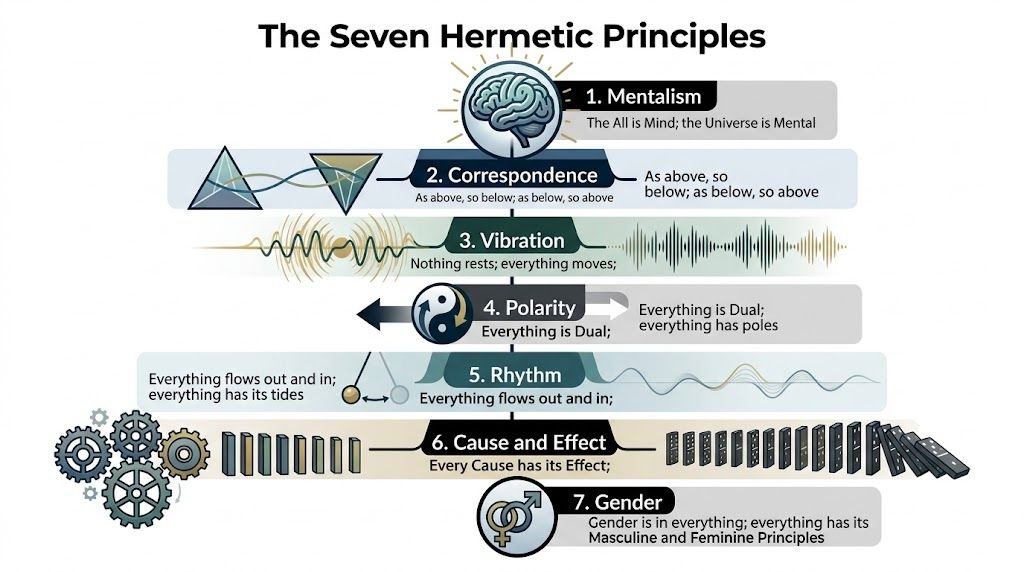
The principles in plain language
1. Mentalism
Mentalism says mind is fundamental. Many beginners hear that and assume it means the physical world is fake. A steadier reading is simpler and more practical. Your mind does not invent the whole universe, but it strongly shapes how you meet it.
A phone camera offers a helpful comparison. The scene in front of the lens is real, yet the filter changes what you see. Beliefs, attention, memory, and expectation work in a similar way. Two people can enter the same room and come away with very different experiences because their minds are framing the moment differently.
2. Correspondence
Correspondence is linked to the phrase “as above, so below.” The basic idea is that patterns repeat across different levels of life.
Small habits often echo larger patterns. A chaotic inbox can reflect scattered priorities. Care in daily routines can reflect care in relationships and long-term goals. This principle does not mean every detail is a mystical message. It suggests that inner and outer life often mirror each other more than we first notice.
3. Vibration
Vibration teaches that everything is in motion. In modern spiritual language, people often use this principle to talk about shifts in state, mood, and energy.
You can observe this without turning it into a grand cosmic claim. Anxiety feels different from calm. Grief moves differently through the body than gratitude. A person who is agitated tends to speak, breathe, and choose differently from a person who feels grounded. The principle becomes useful when it reminds you that a state can change.
A low-battery phone still works, but slowly and unreliably. Human energy can feel similar. When your internal state is heavy, your options seem narrower. When your state becomes steadier, you usually see more clearly and respond with more care.
For readers drawn to ritual, symbolism, and intentional inner work, magick theory and practice explores similar questions about how attention and symbolic action shape consciousness.
After that introduction, hearing the principle explained can help:
4. Polarity
Polarity says apparent opposites may be different degrees of the same thing. Hot and cold belong to one spectrum of temperature. Quiet and loud belong to one spectrum of sound.
This idea can be surprisingly healing. Fear and courage may feel completely separate, yet courage often appears while fear is still present. Sadness does not have to jump straight into joy. Sometimes growth means moving one degree toward balance, honesty, or steadiness.
Why these ideas still resonate
The last three principles usually make more sense when you watch them play out in ordinary life.
- Rhythm points to cycles. Motivation rises and falls. Relationships go through seasons. Healing has forward movement, pauses, and returns.
- Cause and Effect reminds you that patterns have consequences. Repeated thoughts train attention. Habits shape character. Choices made under pressure still create results.
- Gender is often the most misunderstood principle. In the Kybalion, many readers take it to mean complementary creative qualities, such as receptive and active or intuitive and directive, rather than a strict statement about biological sex.
A practical approach works best here. Test the principles against daily experience before turning them into doctrine.
| Principle | Plain-language meaning |
|---|---|
| Mentalism | Mind influences experience |
| Correspondence | Patterns repeat across levels |
| Vibration | Everything is in motion |
| Polarity | Opposites can be degrees of one thing |
| Rhythm | Life moves in cycles |
| Cause and Effect | Choices and conditions create outcomes |
| Gender | Creation involves complementary forces |
Readers get confused when they assume these must be accepted as fixed cosmic laws in a literal, unquestionable sense. The Kybalion becomes clearer when the principles are treated as lenses. A lens helps you notice structure. It does not force reality into a single formula.
That reading also fits the book’s modern origins. The principles can still offer spiritual value even if the book itself is not an untouched relic from ancient Egypt. Read with discernment, they become prompts for self-study. If your mood drops, Rhythm may encourage patience. If conflict repeats, Cause and Effect may point you toward habit change. If your inner state tightens, Vibration may remind you to use breath, movement, prayer, or reflection to shift it.
Authorship Authenticity and Modern Criticism
A mature reading of the Kybalion includes criticism, not because criticism kills spirituality, but because it keeps spirituality honest. One of the strongest critiques is that many readers are led to treat the book as ancient Hermetic scripture when that isn’t how scholars understand it.
According to this discussion of the text’s pseudepigraphic nature and modern framing, most sources present The Kybalion as authentic ancient wisdom without grappling with its 1908 publication and its distance from classical Hermetica. Scholarly consensus holds that it diverges from the older Hermetic writings, which place more emphasis on theology than on the Kybalion’s language of universal laws.
Why scholars question its ancient status
That difference is important. Classical Hermetic texts are generally devotional and philosophical in a way that differs from the Kybalion’s style. The Kybalion often sounds closer to New Thought, with its focus on mind, causation, and practical mental mastery.
This doesn’t mean the book is fraudulent in the shallow sense of “worthless.” It means the label attached to it can be misleading. It is more accurate to say the Kybalion is a modern spiritual synthesis inspired by Hermetic themes than to say it is a direct surviving voice from ancient Egypt.
How to read it without confusion
You don’t need to choose between blind belief and cynical dismissal. A better path is discernment.
Consider these questions when you read:
- What is the book claiming historically? Separate symbolism from literal origin.
- What is the book offering practically? Notice whether a principle improves self-awareness or action.
- What worldview does it reflect? Recognize its strong New Thought flavor.
- What happens when you test it gently? Use observation, journaling, and honest reflection.
A teaching can be modern and still be meaningful. A teaching can sound ancient and still need scrutiny.
This balanced approach protects you from two traps. The first is romanticizing a text because it appears mysterious. The second is throwing away useful insight because the myth around it doesn’t hold up cleanly. Spiritual maturity usually lives in the middle. Clear eyes. Open heart.
Applying Kybalion Wisdom in Your Daily Spiritual Practice
You wake up already tense, reach for your phone, and feel your mind scatter before the day has even begun. This is the kind of moment where the Kybalion can become useful. Its value shows up in ordinary life, in the small points where attention slips, emotions rise, and choice still remains.

The goal is not to perform an exotic spiritual system. The goal is to practice clear awareness. That matters even more once you understand the book’s modern origins, because it helps you use the teachings as tools instead of treating them like untouchable relics. A teaching does not need an ancient costume to be helpful.
A simple way to work with the teachings
A good starting point is to pair one principle with one part of your day. This gives the ideas somewhere to live.
Morning fits Mentalism well. Before email, messages, or news, sit for two or three minutes and ask, “What kind of mind am I bringing into today?” Choose one intention. One is enough. Calm, honesty, steadiness, patience.
Midday fits Correspondence. If your inner world feels noisy, check the outer one. A cluttered desk, shallow breathing, missed meals, and constant tabs open in your browser can mirror the same pattern. Your environment works like a dashboard. It shows you what your system is doing.
Evening fits Cause and Effect. Review the day gently. Which choice created more peace? Which habit fed confusion? This kind of reflection makes spiritual practice concrete.
Try this for one week:
- Choose one principle for the day.
- Notice one moment when it becomes relevant.
- Write one sentence at night about what you saw.
Small repetition teaches faster than occasional intensity.
When the principle of vibration becomes practical
Many readers connect first with Vibration because it speaks to something they can feel right away. Some days you are contracted, restless, and reactive. Other days you are steady, open, and clear. The principle gives language to that shift.
You do not need to force mystical wording if that is not your style. In daily practice, this principle asks a simple question: What changes your state in a healthy direction?
For many people, the answer is surprisingly ordinary:
- Breath: Slower breathing can calm emotional momentum.
- Posture: The body often reflects fear, confidence, fatigue, or openness.
- Words: Repeated inner language shapes mood and expectation.
- Environment: Light, noise, and clutter affect focus.
- Ritual: Repeated intentional actions train the nervous system to return to steadiness.
If you want a practical companion to this idea, raise your vibration with simple daily practices offers a grounded way to build that rhythm.
A short daily ritual might look like this:
| Moment | Practice | Related principle |
|---|---|---|
| Morning | Sit upright and set one intention | Mentalism |
| Afternoon | Step outside and reset with breath | Vibration |
| During conflict | Look for the spectrum, not extremes | Polarity |
| End of day | Reflect on choices and outcomes | Cause and Effect |
Work with one principle for several days before switching to the next. A principle is a little like a lens on a camera. If you keep changing lenses every minute, you never learn what each one helps you see.
One caution matters. Applying the Kybalion does not mean blaming yourself for every painful event. That misunderstanding harms people. Rhythm means energy rises and falls. Cause and Effect means choices matter. Neither principle says every hardship is a personal failure.
A mature practice holds two truths at once. You have influence over your inner life, and you also deserve compassion while you learn. Used that way, the Kybalion becomes less about chasing mystery and more about building steadiness, self-knowledge, and honest spiritual discipline.
Conclusion Integrating the Principles for an Empowered Life
So, what is kybalion?
It’s a modern spiritual text, published in 1908, that presents seven Hermetic principles as a framework for understanding mind, energy, and human experience. Its ancient aura has often been overstated, and that historical clarity matters. But the practical value of a teaching doesn’t depend entirely on a dramatic origin story.
The test is simpler. Does it help you become more aware of your thoughts, your patterns, your choices, and your energy? Does it help you move from reaction toward self-mastery? If it does, then the Kybalion has done meaningful work in your life.
Its strength isn’t that it arrives untouched from antiquity. Its strength is that it offers a language for mental alchemy. It invites you to notice how life moves, how your inner world shapes your outer experience, and how conscious practice can restore clarity.
If you want a beautiful companion teaching to this kind of inner work, Your Word Is Your Wand by Florence Scovel Shinn also explores the creative power of thought and speech in a practical spiritual way.
If you’re ready to turn spiritual ideas into grounded daily practice, Spiritual Method offers a gentle path for releasing negativity, raising your vibration, and building a steady rhythm of intention, reflection, and energy care.
Pingback: Best Books On Theosophy: Your Guide To Ancient Wisdom – Spiritual awakening guide
Pingback: Pythagoras Theory of Music: Sacred Ratios Explained - Spiritual awakening guide
Pingback: Sex Energy Transmutation: Boost Creativity & Life - Spiritual awakening guide