
You get through the day. You answer messages, solve problems, meet deadlines, support other people, and keep moving. Then the quiet moment arrives, and your body tells the truth. You’re wired, tired, and oddly hollow at the same time.
That state confuses a lot of people because it doesn’t always look like crisis from the outside. You may be functioning well, even succeeding, while your inner world feels frayed. Learning how to build emotional resilience starts there. Not with pretending you’re unshakable, but with noticing when your system is carrying more than it can process.
Emotional resilience isn’t about becoming harder. It’s about becoming steadier. It’s the ability to feel strongly without getting lost, respond without collapsing, and return to yourself after stress pulls you off center. The strongest version of resilience includes the mind, the body, and the spirit. If you train only one layer, the others eventually call for attention.
Table of Contents
- Redefining Resilience for a Modern World
- Master Your Mindset The Psychological Foundation
- Daily Micro-Practices for Grounding and Presence
- Deep Restoration with Energy Care Rituals
- Your Emergency Toolkit for Overwhelming Moments
- Weaving Resilience into Your Life for Good
Redefining Resilience for a Modern World

Resilience was commonly taught as “bouncing back.” That idea is too shallow for modern life. Many people aren’t recovering from one dramatic event. They’re carrying a steady drip of pressure, overstimulation, disappointment, and emotional labor.
That’s why resilience needs a broader definition. It isn’t a personality trait that a lucky few are born with. It’s a practice of recovery, regulation, and inner alignment that can be built over time.
The need is real. In 2022, one in five American adults experienced symptoms of anxiety and depression, and a UK study found that 32% of the working population has low emotional resilience levels, which points to increased risk for burnout and poor health, as summarized by TherapyRoute’s resilience statistics overview. These aren’t abstract issues. They show up as irritability, numbness, overthinking, disrupted sleep, and the feeling that even small demands now take too much energy.
What resilience actually looks like
A resilient person doesn’t avoid stress. They know how to work with it before it becomes their whole identity.
That often looks like:
- Emotional range: You can feel anger, grief, fear, or disappointment without assuming something is wrong with you.
- Recovery capacity: A hard moment doesn’t define the rest of your day.
- Internal safety: You know how to calm your own nervous system instead of waiting for external conditions to become perfect.
- Meaning and direction: You can reconnect with purpose when life feels mechanical.
Resilience isn’t emotional perfection. It’s the ability to return to center with less force, less fear, and less self-abandonment.
Why a holistic approach works better
Pure mindset work helps, but it has limits. If your thoughts improve while your body remains tense and your energy feels depleted, your resilience will stay fragile. The same is true in reverse. Ritual without reflection can become avoidance. Breathwork without honest thinking can become temporary relief instead of change.
A more grounded path combines three layers:
- Psychological skill so you can interrupt spirals and reframe stress.
- Somatic practice so your body learns what safety feels like.
- Spiritual care so your life doesn’t become one long performance of coping.
This is the version of resilience that lasts. It doesn’t ask you to be impressive. It asks you to be present, practiced, and honest.
Master Your Mindset The Psychological Foundation
Your mind doesn’t have to become endlessly positive. It does need to become more accurate, less catastrophic, and easier to guide under pressure.
The strongest evidence-backed methods for resilience are cognitive reappraisal and mindfulness, and structured reframing plus paced breathing can strengthen emotional regulation, even when practiced briefly, according to Mental Health Center’s guide to building emotional resilience. In plain language, this means your thoughts shape your stress response, and you can train that pattern.
The thought pattern that drains resilience
When people feel overwhelmed, they often treat the first thought as truth.
A stressful email arrives. Your mind says, “I’m in trouble.”
A conflict starts. Your mind says, “This always happens.”
You feel tired again. Your mind says, “I should be over this by now.”
Those thoughts create emotional spirals because they collapse the situation into a verdict. Reappraisal interrupts that collapse.
A simple 3-step reappraisal process
Use this when you feel your mind tightening around a situation.
Name the first thought clearly
Write the thought exactly as it appears. Keep it short.
Example: “I can’t handle this.”Check it for distortion
Ask: Is this fully true? What facts support it? What facts complicate it?
Most stress thoughts contain exaggeration, mind-reading, all-or-nothing thinking, or a rush to the worst conclusion.Replace it with a steadier statement
The new thought should be believable, not fake.
Shift from “I can’t handle this” to “This is hard, and I can respond one step at a time.”
That last step matters. Reappraisal is not spiritual bypassing. It isn’t “Everything is perfect.” It’s a more stable interpretation that gives your nervous system room to breathe.
Pair thought work with breath
Mindset work is stronger when the body gets the same message. After you reframe a thought, take a short round of paced breathing. Inhale through the nose slowly. Exhale through the mouth slowly. Keep the breath smooth instead of forceful.
Practical rule: If a thought makes your chest tighten, don’t argue with it for ten minutes. Reframe it, breathe, and move your body before the spiral deepens.
Language becomes emotional architecture
The words you repeat shape the emotional room you live in. That’s why coping statements matter. Choose phrases that calm without collapsing into fantasy.
Examples:
- For pressure: “I only need to handle this moment.”
- For self-doubt: “Uncertainty doesn’t mean incapacity.”
- For emotional flooding: “I can slow this down.”
If you want to explore how language affects inner state, your word is your wand is a useful reminder that repeated words often become repeated realities.
What works and what doesn’t
Here’s the trade-off frequently missed.
What works: short, repeated practice when stress is low enough that you can still think.
What doesn’t: waiting until you’re fully overwhelmed, then expecting one perfect affirmation to rescue you.
Mindset mastery is built in ordinary moments. That’s what makes it available in difficult ones.
Daily Micro-Practices for Grounding and Presence
Resilience grows faster through repetition than intensity. Individuals don’t need a dramatic life overhaul. They need a few reliable practices they’ll use on a busy Tuesday.
Small rituals are effective because they lower the threshold for starting. When a practice takes one minute, the mind has less room to resist it. When it fits into a workday, it becomes part of your real life instead of a fantasy wellness routine.
Daily Resilience Micro-Practice Menu
| Practice | Time Commitment | Core Benefit |
|---|---|---|
| Grounding ritual | 1 minute | Reduces overwhelm |
| Breathwork reset | 3 minutes | Settles reactivity |
| Morning intention setting | 5 minutes | Creates direction |
The 1-minute grounding ritual
This is the fastest way to come back into the body when your mind is scattered.
Stand or sit with both feet planted. Press your feet gently into the floor. Look around and name five objects you can see. Then notice the contact points between your body and the chair, floor, or wall. End by saying, aloud or to yourself, “I’m here now.”
This works because attention follows sensation. The moment you anchor awareness in the physical world, your mind has less fuel for runaway narratives.
The 3-minute breathwork reset
Set a timer. Inhale slowly through your nose. Pause briefly if that feels natural. Exhale through your mouth longer and softer than the inhale. Keep your shoulders relaxed.
Don’t aim for dramatic release. Aim for steadiness. A gentle breath pattern is more sustainable than aggressive breathing that leaves you lightheaded or tense.
If you want a broader spiritual framework for supporting your state through daily choices, raise your vibration complements this kind of practice well.
The 5-minute morning intention practice
Before checking messages, sit with a notebook or place a hand over your chest. Ask three questions:
- What quality do I want to embody today? Calm, courage, patience, honesty.
- What will protect my energy today? A boundary, a pause before replying, a walk without my phone.
- What must not lead today? Fear, urgency, people-pleasing, resentment.
Write one sentence that captures your intention. Keep it concrete. “Today I will move slowly enough to hear myself.” Or, “Today I will respond instead of rush.”
Tiny rituals beat occasional breakthroughs. A practice you repeat changes you more than a practice you admire.
The common mistake with micro-practices
People often dismiss small practices because they seem too simple. Then they wait for a long weekend, a retreat, or a breakdown to reset themselves. That pattern keeps resilience dependent on ideal conditions.
The better approach is quieter. Build a few repeatable anchors into your existing routine. One minute before a meeting. Three minutes after conflict. Five minutes before the day begins. Over time, these moments teach your system that support is available now, not later.
Deep Restoration with Energy Care Rituals
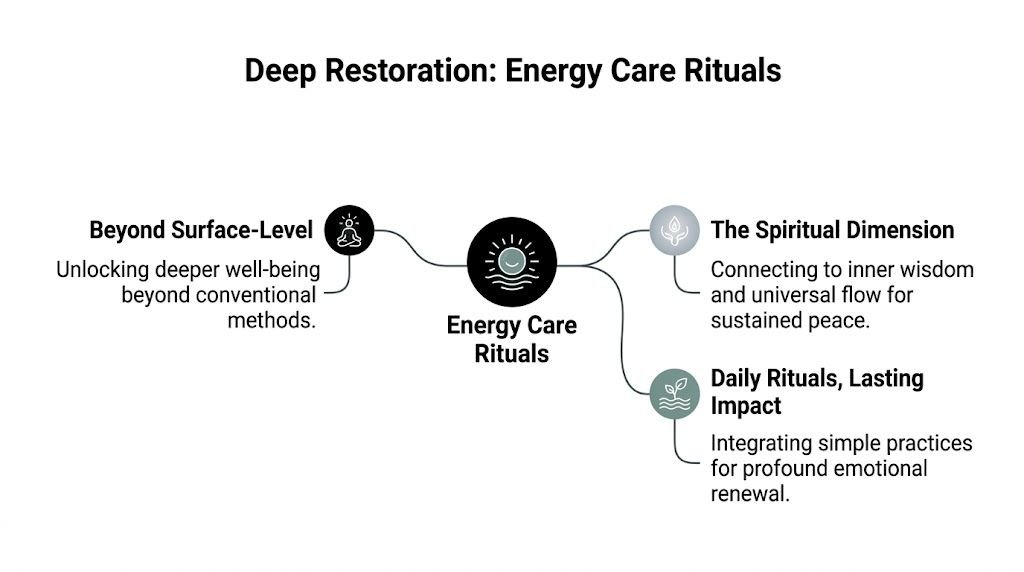
Mindset tools help you work with thoughts. Daily grounding supports the body in real time. But some seasons call for deeper restoration. When you feel spiritually dusty, emotionally heavy, or strangely “off” in your own space, energy care matters.
Mainstream resilience guidance often overlooks this dimension, even though intentional breathwork, grounding, and energy cleansing can influence the nervous system’s stress response and create a bridge between ancient practices and modern regulation, as discussed in Southlake Wellness on building emotional resilience.
Smudging for space and emotional reset
If your room feels tense after conflict, overwork, or emotional strain, a smoke cleanse can create a meaningful reset.
You’ll need a cleansing herb bundle if that practice is part of your tradition, or another preferred cleansing method, plus a fire-safe dish. Open a window first. Move slowly around the room and set a clear intention such as, “Only what supports peace remains here.”
The ritual isn’t magic because smoke exists. It works because attention, symbolism, and environment affect how the body feels in a space. When you cleanse with intention, you mark a transition. Your system recognizes that shift.
A sacred bath for emotional release
Bathing can become more than hygiene. It can be a structured unwinding ritual.
Try this sequence:
- Set the room first: Dim lights, silence notifications, and keep the space quiet.
- Prepare the bath: Add salts and herbs you personally associate with calming and release.
- Enter with a clear purpose: Name what you’re ready to put down. Mental noise. Bitterness. Social residue from the day.
- Close the ritual deliberately: Drain the water slowly and imagine the heaviness leaving with it.
What works here is not perfection. It’s symbolism plus sensory safety. Warmth, scent, privacy, and intention tell the body that it can soften.
Some exhaustion isn’t solved by pushing harder. It softens when your body and spirit both receive a signal to release.
A moon-aligned reset practice
A moon ritual gives resilience a rhythm. Instead of waiting until you’re depleted, you build in a regular moment for reflection and recalibration.
At the New Moon, keep it simple:
- Clean a small area of your home.
- Light a candle or sit in stillness.
- Write down what you want to cultivate emotionally.
- Write down what pattern you no longer want leading your choices.
- Read your intention aloud once.
This kind of cyclical practice helps people step out of all-or-nothing self-improvement. You’re not trying to transform your entire life in one burst. You’re returning, refining, and recommitting.
If you use supportive objects in ritual, crystals for healing and protection can offer ideas for choosing items that help you focus and settle.
What these rituals do better than pure productivity tools
A planner can organize your schedule. It cannot always restore your sense of sacredness. A reframed thought can reduce panic. It may not fully clear the heaviness of a room where you’ve been bracing for weeks.
Energy care rituals help when the issue isn’t only stress. It’s residue. Emotional residue. Environmental residue. Spiritual residue. When you tend to that layer with sincerity, resilience becomes fuller and less forced.
Your Emergency Toolkit for Overwhelming Moments
Even strong practices won’t prevent every overwhelming moment. Sometimes your body floods fast. Your chest tightens, your thoughts race, and everything feels too loud inside. In those moments, you don’t need an ideal routine. You need a fast response.
The 5-4-3-2-1 sensory reset
Use this when panic, dissociation, or emotional flooding starts pulling you away from the present.
Name:
- 5 things you can see
- 4 things you can touch
- 3 things you can hear
- 2 things you can smell
- 1 thing you can taste
Go slowly. Don’t rush to finish. The point is to redirect attention from fear loops into immediate sensory reality.
Bilateral tapping for nervous system settling
Cross your arms over your chest or place your hands on your thighs. Tap left, right, left, right in a slow alternating rhythm. Keep the pace gentle.
This works best when paired with a statement like, “I’m safe enough to slow down,” or “This feeling is intense, and it will move.” The rhythm gives the mind something structured to follow when internal chaos is rising.
When you’re flooded, reduce complexity. One body cue, one breath cue, one sentence.
For a guided moment of calm, this short practice can help you regulate in real time:
A coping mantra that actually helps
Choose a mantra before you need it. In distress, people rarely invent useful language on the spot.
Good coping mantras are:
- Short: easy to remember under stress
- Believable: not grandiose
- Regulating: they slow the system rather than hype it up
Examples:
- “This is a wave. I can ride it.”
- “I don’t need to solve everything right now.”
- “Slow body, softer jaw, longer breath.”
What not to do in acute overwhelm
Don’t force yourself to “figure it all out” while activated. Don’t pick a fight, send the long text, or make a dramatic life decision from a dysregulated state. Don’t shame yourself for having a nervous system.
The emergency toolkit is not your whole resilience practice. It’s the bridge that gets you through the surge so you can return to your deeper tools later.
Weaving Resilience into Your Life for Good
Long-term resilience comes from pattern, not intensity. A person can have insight, a beautiful journal, a meaningful ritual, and still stay stuck if none of it becomes repeatable. What changes people is rhythm.
This matters especially for high-functioning people who look fine from the outside but feel spiritually worn down inside. Many resilience conversations miss that audience. For those people, the issue often isn’t a single setback. It’s the slow loss of energy and meaning, and deeper restoration requires both inner purpose and energy care, as explored in Dr. Annise Mabry’s discussion of resilience gaps.
Build a personal resilience rhythm
You don’t need to do everything daily. You do need a structure that helps you return to yourself consistently.
A sustainable rhythm might look like this:
- Daily: one micro-practice, one intentional breath pause, one honest self-check
- Weekly: one deeper restoration ritual such as a bath, space cleanse, or extended reflection
- As needed: your emergency toolkit during acute overwhelm
This approach works because each layer serves a different function. Daily practices stabilize. Weekly rituals restore. Emergency tools interrupt escalation.
Use a simple reflection template
Daily, ask a few direct questions. Keep the process brief enough that you’ll do it.
Try this template:
- What challenged my resilience today?
- What did I feel in my body when that happened?
- Which tool did I use, if any?
- What helped, even a little?
- What do I need tomorrow?
This kind of reflection trains discernment. Instead of vaguely feeling “off,” you begin to notice patterns. Certain conversations may drain you. Certain times of day may make you more reactive. Certain rituals may restore you faster than others.
Track support, not perfection
A self-care tracker can be simple. Mark whether you practiced breathwork, grounded physically, paused before reacting, drank water, took a walk, wrote a reflection, or did an energy cleanse. The point isn’t control. It’s awareness.
You can also keep a short gratitude prompt, especially on hard days:
- What felt supportive today?
- Where did I show honesty?
- What beauty did I notice anyway?
Healing becomes durable when it moves from emergency response into identity. You stop “trying resilience” and start living like someone who returns to themselves.
When it feels like nothing is working
Many people quit too early. They expect resilience to feel dramatic. Often it feels subtle at first. You pause sooner. You recover faster after conflict. You speak to yourself with less cruelty. You notice depletion before collapse.
If you fall off track, don’t restart with punishment. Restart with one practice. One breath round. One page. One bath. One boundary. Resilience grows when you return without making your lapse into a moral failure.
The deeper reward isn’t just stress management. It’s self-trust. You begin to know that when life gets loud, you can meet yourself there with skill, care, and meaning.
If you want a guided way to put these practices into daily life, Spiritual Method offers a practical path for releasing negativity, building grounding rituals, working with sacred bathing, energy protection, reflection tools, and intention-setting in one place. It’s a strong fit for anyone who feels stuck, drained, or spiritually disconnected and wants a clear system for returning to calm, clarity, and purpose.
Pingback: Astrology For Kids: Fun & Mindful Star Guide – Spiritual awakening guide
Pingback: Self Care Practices for a Healthier Mind and Body
Pingback: Inner Calm: The Key to Letting Go and Finding Peace