
You’re probably here because you feel two things at once. First, a real pull toward magick. Second, a quiet frustration that most guidance seems to land at one extreme or the other. It’s either dense ceremonial writing that assumes you already know symbols, geometry, and old occult vocabulary, or it’s vague wellness advice that says “set an intention” without explaining what that does.
That gap can make sincere beginners feel clumsy for no good reason. You buy a candle, hold a crystal, say a few words, and then wonder whether any of it means anything. Or you open an old text, read a page about ritual movement and temple setup, and feel like you need a private library before you can begin.
Magick theory practice becomes much clearer when you treat it as both symbolic and practical. The symbols matter. Your body matters. Your attention matters. The sequence matters. When those parts work together, ritual stops feeling theatrical and starts feeling like a deliberate way to shape inner and outer change.
Table of Contents
- From Curious to Capable Bridging Magick Theory and Practice
- The Core Engine of Magick Understanding Will and Intent
- Your Energetic Toolkit Correspondences and Vibration
- Foundational Practices for Spiritual Safety and Clarity
- Putting Theory into Practice A Simple Manifestation Ritual
- Integrating Magick into Your Daily Life
- Troubleshooting Your Practice and Ethical Considerations
- Frequently Asked Questions
From Curious to Capable Bridging Magick Theory and Practice
Many people don’t struggle because they lack intuition. They struggle because the map they were given is incomplete. One source gives lofty theory. Another gives stripped-down tips. Neither shows how one becomes the other.
That disconnect is well known in ceremonial magick. Foundational texts often assume intermediate knowledge of Kabbalah and geometry, which leaves beginners without a clear, step-by-step framework for turning abstract ideas into a personal practice, as noted in this discussion of ceremonial foundations. If you’ve felt lost between “too complicated” and “too fluffy,” you’re not missing something obvious. You’ve run into a real teaching problem.
Here’s the practical issue. Theory tells you why a ritual works. Practice gives you what to do. If you only get the theory, you may admire magick without ever doing it. If you only get the practice, you may copy actions without understanding the mechanics behind them.
Magick gets easier when you stop asking, “What’s the perfect ritual?” and start asking, “What change am I directing, through which symbols, with what state of mind?”
A good working model is simple:
| Part | What it does | Common beginner mistake |
|---|---|---|
| Will | Sets the direction of change | Wanting six things at once |
| Correspondence | Gives the intention a symbolic form | Using tools randomly |
| State | Charges the work through focus and emotion | Practicing while scattered |
| Closure | Seals and releases the work | Ending abruptly and staying energetically open |
Dense occult systems often use more elaborate language for these same mechanics. A circle becomes a container. A candle becomes a signal. Breath becomes a way to shift consciousness. A spoken intention becomes a precise instruction.
You don’t need to reject ancient systems to make them usable. You need to translate them into lived actions. That’s what turns magick theory practice from an interesting idea into a stable craft.
The Core Engine of Magick Understanding Will and Intent
Aleister Crowley defined magick as “the Science and Art of causing Change to occur in conformity with Will” in Magick in Theory and Practice, and he also framed every intentional act as a magical act, with failure serving as feedback about unmet conditions, as summarized by this overview of the text. You don’t have to adopt his whole system to find this useful. The definition is practical on its own.
Think of Will as the steady hand on the wheel, not the passing mood of the moment. A desire says, “I want relief.” Will says, “I am choosing a clear direction, and I will organize my energy around it.”
Desire and Will are not the same
Beginners often confuse strong emotion with strong intention. They’re different.
- Desire is reactive. You feel lonely, so you want attention.
- Will is clarified. You recognize you want mutual, healthy connection.
- Desire jumps. It changes with your mood.
- Will holds. It stays coherent long enough to shape action.
A helpful analogy is a captain steering a ship. Wind, waves, and weather all matter. They affect the journey. But the captain still needs a destination. In magick, your emotional state is the weather. Your Will is the heading.
Why intention needs precision
If you say, “I want my life to get better,” your energy has nowhere exact to go. If you say, “I’m cultivating steady focus and calm communication at work,” the instruction becomes usable.
Practical rule: If your intention can’t be spoken in one clear sentence, it probably isn’t ready for ritual yet.
Try this short filter before any working:
- Name the change. What are you asking to shift?
- Check ownership. Is this about your life, your habits, your healing?
- Remove noise. Strip out panic, revenge, or the need to control others.
- State it plainly. One sentence. Present and direct.
This doesn’t make magick cold or mechanical. It makes it clean. Clear Will reduces spiritual fog the same way a clean recipe reduces kitchen mistakes. You still bring feeling, symbolism, and mystery into the work. You just stop asking them to compensate for confusion.
Your Energetic Toolkit Correspondences and Vibration
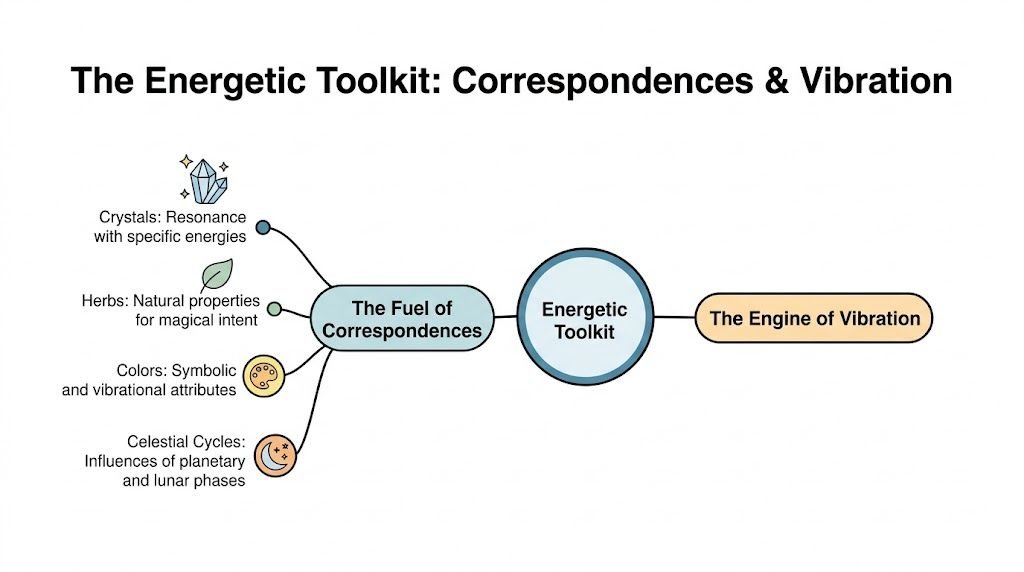
If Will is the direction, correspondences are the language you use to express it. Crystals, herbs, colors, and moon phases aren’t random decorations. They’re chosen because they help your mind, body, and symbolic imagination point toward the same result.
How correspondences actually work
Think of a ritual like cooking. Intention is the dish you want to make. Correspondences are the ingredients that create the flavor.
A white candle can suggest clarity, purification, or openness. A bowl of salt can suggest boundary and stability. A crystal can serve as a physical anchor for the quality you’re calling in. None of these items “do the magick” for you. They help shape, focus, and hold the pattern of your intention.
The word vibration often confuses people. You don’t need to force that term into something abstract. In practice, vibration points to the felt quality of a state. Calm has a different quality than panic. Devotion feels different from resentment. A peaceful space affects your body differently than a cluttered one.
Choosing tools without getting lost
You don’t need a giant cabinet of supplies. You need a few tools you can relate to clearly.
Use this simple selection guide:
- For clarity: Choose clean, simple symbols like a white candle, a tidy surface, plain water, or clear quartz.
- For grounding: Work with salt, a stone, steady breath, and seated posture.
- For emotional healing: Pick gentle, comforting items that help you soften and stay present.
- For protection: Use boundary-oriented symbols such as salt, a protective crystal, or a spoken statement of what may and may not enter your space.
A tool is useful when it helps you feel the intention more clearly, not when it looks impressive online.
If you want a broader look at practices that support energetic steadiness, this guide on how to raise your vibration connects well with a simple, embodied approach.
The best correspondence is the one you can understand, feel, and use consistently.
When in doubt, ask two questions. What quality does this item represent to me? Does that quality match the change I’m trying to create? If the answer is yes, you have enough to work with.
Foundational Practices for Spiritual Safety and Clarity
People often want to jump straight to manifestation, spirit contact, or moon rituals. That’s like trying to lift heavy weight without warming up your body first. Grounding, cleansing, and protection are not optional. They create the conditions that make deeper work stable.
Without grounding, you can become scattered or emotionally flooded. Without cleansing, yesterday’s stress can shape today’s ritual. Without protection, you may stay too open after the practice ends.
Grounding comes first
Grounding brings your awareness back into the body. It makes your energy less leaky and your mind less jumpy.
Try this basic method:
- Sit with both feet supported.
- Slow your breathing without forcing it.
- Feel the weight of your body on the chair or floor.
- Picture excess tension moving downward and out.
- Stay until your thoughts feel less sharp and more organized.
This works because attention follows sensation. When you return to breath, weight, and contact with the ground, you stop feeding mental static.
Cleansing and protection create good boundaries
Cleansing doesn’t mean your space is “bad.” It means you’re clearing residue. Protection doesn’t mean fear. It means discernment.
A healthy sequence looks like this:
| Practice | Purpose | Simple example |
|---|---|---|
| Cleansing | Clears emotional and energetic residue | Sound, smoke, salt, or open-window prayer |
| Protection | Sets boundaries for the work | Visualize light around your body |
| Closing | Ends the session cleanly | Thank, release, and return to ordinary awareness |
You can support these basics with physical tools too. Some practitioners like working with stones commonly used for energetic support. If that interests you, this article on crystals for healing and protection offers practical ideas without making the tools more complicated than they need to be.
A protected practice doesn’t feel tense. It feels calm, contained, and clear.
If you ever feel dizzy, overly emotional, or strangely depleted after ritual, don’t assume you “did magick wrong.” More often, you skipped foundational steps or rushed through them.
Putting Theory into Practice A Simple Manifestation Ritual
A simple ritual can teach more than a complicated one because you can feel each piece working. For this example, use a quiet new moon evening or any calm time when you want to plant a fresh intention.
Choose a small goal. Not “fix my entire life.” Try something like greater calm, stronger self-trust, or more consistency in a daily habit.
A simple new moon ritual
Gather a candle, a journal page, and one correspondence that feels clear to you, such as clear quartz or a small bowl of water.
Then move through the ritual in this order:
- Prepare the space. Tidy the area and remove distractions. This tells your nervous system that the work matters.
- Ground yourself. Use the body-based method from earlier until your breath feels steadier.
- State your intention. Write one sentence that names the change directly.
- Light the candle. Let the flame stand for focused awareness.
- Hold the tool. If you’re using a crystal or bowl of water, place your hands near it and repeat the intention slowly.
- Feel the condition. Don’t just say the words. Let your body sense the quality of the change you’re inviting.
- Seal it. Fold the paper, place it under the candle or beside the tool, and sit in silence for a moment.
Each action has a job. The cleaning removes noise. The grounding stabilizes your state. The intention sets direction. The tool gives form. The silence lets the pattern settle.
Here’s a guided visual if you want a supportive companion while learning rhythm and focus:
How to close the work well
Closing matters as much as opening. Many beginners finish the emotional peak of ritual and walk away. That leaves the experience fuzzy.
Use this short closing:
- Thank the space, your tools, and your own effort.
- Say aloud that the ritual is complete.
- Blow out the candle with intention, or snuff it if that feels more deliberate.
- Wash your hands or touch the floor to return to ordinary awareness.
Keep the first ritual simple enough that you can remember what each part felt like. Complexity can come later.
That’s magick theory practice in action. You directed Will, used correspondence, shaped state, and closed the circuit.
Integrating Magick into Your Daily Life
Formal ritual is powerful, but daily life is where practice becomes real. The strongest shift often comes from repeating small acts with care, not from waiting for the perfect moon phase and an hour of uninterrupted silence.

Small acts that carry power
A tired professional stirs morning coffee before work. Instead of doom-scrolling, she pauses and chooses one quality for the day: patience. She stirs slowly and thinks, “I speak clearly and stay steady.” That’s a small magical act because intention, repetition, and attention meet in one ordinary moment.
Another person keeps a stone in a pocket during tense meetings. He touches it when he notices himself spiraling into stress. The stone doesn’t solve the meeting. It reminds him to return to the state he chose earlier.
A third person steps outside after a hard conversation, plants both feet, and takes supported breaths until the body softens. That may sound simple, but it has deep roots. Ernst Schertel’s Magic: History, Theory, Practice, originally published in 1923, emphasized supported breathing and heightened body awareness in ritual, establishing a historical precedent for integrating physiological techniques into spiritual practice, as described in the background on Schertel’s work.
Body awareness as practice
Magick isn’t only something you think about. It’s something you embody.
Try weaving practice into moments you already have:
- Morning drink: Charge it with a single word such as calm, courage, or clarity.
- Doorways: Pause before entering work or home. Choose how you want to enter.
- Breathing breaks: Use slow, supported breaths when your energy starts scattering.
- Evening reset: Wash your hands or face with the intention of clearing the day.
If you want a structured way to support these daily shifts, the spiritual awakening guide may help you build rhythm around reflection, grounding, and intention.
Daily magick works because it trains consistency. You stop treating spiritual practice as a separate life and start making your life itself more deliberate.
Troubleshooting Your Practice and Ethical Considerations
When a ritual seems to “fail,” that doesn’t automatically mean magick isn’t real or that you aren’t gifted enough. It often means something in the working wasn’t aligned. Crowley’s framework treated unsuccessful acts as signs that some requirement hadn’t been met. That’s a useful mindset because it replaces drama with observation.
When a ritual feels flat
Check the practice like you’d check any craft.
- Your intention may have been muddy. If you wanted opposing outcomes at once, the work had no clean direction.
- Your state may have been unstable. Panic, exhaustion, and distraction can weaken focus.
- Your correspondence may not have matched. A tool that means nothing to you won’t carry much symbolic charge.
- Your timing may have been wrong for you. Even a good ritual can fall flat when you’re rushing.
Ask better questions afterward. Did I know what change I was making? Did my body feel present? Did I complete the working, or did I just stop?
Failure in practice is often information, not condemnation.
Ethics keep power clean
Ethics matter because magick amplifies direction. If your direction is tangled in obsession, domination, or vanity, the work becomes distorted.
A useful historical reminder comes from Aleister Crowley’s life. Despite founding Thelema, his expulsion from the Abbey of Thelema in Sicily in 1923 amid scandal is a cautionary milestone that highlights the difference between True Will and ego-driven behavior, as noted in this historical source on Crowley and his work.
Keep your practice inside a few steady boundaries:
| Ethical question | Healthy direction |
|---|---|
| Does this respect another person’s freedom? | Focus on your choices and your healing |
| Am I acting from fear or control? | Pause until you can work from clarity |
| Would I be willing to live with this intention openly? | If not, examine it more deeply |
Power without reflection becomes manipulation. Power with humility becomes practice.
Frequently Asked Questions
Do I need to believe in every occult system for magick to work
No. You need sincerity, focus, and a willingness to observe your own experience. Start with practices you can understand and repeat.
Can I practice magick without elaborate tools
Yes. Tools help, but they aren’t the source of your Will. A candle, a glass of water, breath, posture, and clear language are enough to begin.
What if I don’t feel energy strongly
That’s common. Many people expect dramatic sensations. Start by noticing simpler signals such as breath changes, emotional settling, bodily warmth, clearer focus, or a stronger sense of direction.
How often should I practice
Consistency matters more than intensity. A short daily act done with care is often more useful than occasional elaborate rituals done in a rush.
Is manifestation the same as controlling reality
No. A healthy practice doesn’t treat the world like a vending machine. It aligns your attention, behavior, and symbolic action toward a chosen change. It also asks for patience and responsibility.
What should I avoid as a beginner
Avoid copying complex rituals you don’t understand. Avoid practicing when highly distressed without grounding first. Avoid work aimed at controlling another person. Avoid treating every coincidence as proof and every delay as failure.
If you want a gentle next step, Spiritual Method offers a practical path for building grounding, cleansing, intention-setting, and daily spiritual rhythm. It’s designed for people who feel stuck, drained, or overwhelmed and want clear tools to release negativity, raise their vibration, and reconnect with peace, purpose, and steady inner clarity.
Pingback: What Is Kybalion? Master Hermetic Principles Today – Spiritual awakening guide
Pingback: Vedic Scriptures in English: A Beginner’s Guide (2026) – Spiritual awakening guide
Pingback: A Book of Ceremonial Magic Explained for Beginners – Spiritual awakening guide
Pingback: Sex Energy Transmutation: Boost Creativity & Life - Spiritual awakening guide
Pingback: How to Perform The Black Mirror Evocation Ritual – Black Witch Coven