
Your tabs are open, your shoulders are tight, and your mind keeps jumping between messages, errands, old worries, and the strange feeling that you’ve drifted a little too far from yourself. You may not be in crisis. You may feel overfull, overstimulated, or disconnected.
That’s often where interest in spiritual healing practices begins. Not with dramatic moments, but with a subtle inner nudge that says, “I need a different kind of care.”
For some people, that care looks like prayer. For others, it’s grounding, sound, breathwork, candle rituals, or sitting in silence for a few honest minutes. If you’re new to this world, you don’t need to adopt a belief system or become a different person overnight. You only need curiosity, a little patience, and a way to begin that fits your real life.
Table of Contents
- An Introduction to Spiritual Healing
- Understanding the Core Benefits of Spiritual Healing
- How Spiritual Energy Work Actually Functions
- A Guide to Common Spiritual Healing Modalities
- Simple Starter Rituals You Can Try Today
- How to Integrate Healing Practices into a Busy Life
- Practicing Safely and Taking Your Journey Deeper
An Introduction to Spiritual Healing
A lot of people arrive here after trying to fix exhaustion with productivity. They buy the planner, optimize the morning, answer the texts, and still feel spiritually wrung out. On the outside, life may look functional. Inside, something feels noisy, flat, or off-center.
Spiritual healing is a gentle way of returning to inner alignment. It doesn’t have to mean anything extreme. In everyday terms, it’s the practice of caring for your inner life so your thoughts, emotions, body, and sense of meaning can work together instead of pulling against each other.
That might look like prayer before bed, a hand over your heart when anxiety spikes, a sound bath after a draining week, or a small ritual that helps you feel steady again. The form matters less than the function. You’re creating conditions for calm, clarity, and connection.
This isn’t as unusual as many people think. A national survey from 1998 found that 35.1% of Americans used self-prayer for healing, more than double the rate of any other complementary therapy, and later National Survey of American Life data found 6.1% had consulted a psychic and 3.7% a faith healer for healing purposes, according to the National Survey of American Life review on spiritual healing use.
You don't need to know exactly what you believe before you begin. Many people start because they want relief, steadiness, and a stronger relationship with themselves.
If you’re also sensing a broader inner shift, a spiritual awakening guide for beginners can help put language to what you’re feeling. For now, the useful starting point is simple. Spiritual healing practices are less about escaping life and more about meeting life with a calmer nervous system and a clearer inner compass.
Understanding the Core Benefits of Spiritual Healing
Some readers worry that spiritual healing sounds vague. It can seem hard to define because people use the term for many different practices. A practical way to understand it is this. Spiritual healing helps you tune your inner instrument so you can respond to life with more balance.
What spiritual healing is and isn't
Think of your inner life like a guitar. When the strings are too tight, they strain. When they’re too loose, the sound gets muddy. Spiritual healing practices aren’t about becoming perfect. They’re about bringing yourself back into tune after stress, grief, conflict, burnout, or emotional overload.
It also helps to name what spiritual healing isn’t:
- It isn't a replacement for medical care. It can support well-being, but it shouldn’t stand in for treatment when you need a doctor, therapist, or crisis support.
- It isn't a performance. You don’t need expensive tools, a certain aesthetic, or encyclopedic knowledge of rituals.
- It isn't dogma. You can approach it through religion, personal spirituality, mindfulness, nature, or quiet reflection.
That’s why many people find it useful. The practices are flexible enough to meet you where you are.
Benefits you can actually feel
The benefits often show up in ordinary moments before they show up in grand breakthroughs. You may notice you react less sharply, rest more soundly, or recover faster after a stressful conversation. Those shifts matter.
A 2019 study on healers and clients documented short-term benefits such as greater relaxation, well-being, and pain intensity reduction, along with longer-term effects like positive life changes and improved relationships. The same source also notes a broader Harvard review linking spirituality and spiritual community participation with greater longevity and reduced depression and substance use.
Here’s a useful way to think about the benefits:
- For anxiety: spiritual healing practices can interrupt spirals by giving your attention somewhere safe to land.
- For emotional overload: they create pause, which helps you feel before you explode, shut down, or numb out.
- For meaning: rituals can restore a sense that your life has depth, not just deadlines.
- For relationships: inner steadiness often changes how you listen, speak, and repair after conflict.
Practical rule: Treat spiritual healing like emotional and energetic hygiene. You don’t wait until things are unbearable to begin washing off the day.
When people say these practices help them, they’re often describing this quieter kind of change. More room to breathe. More self-trust. Less internal static. Those are not small outcomes, especially when modern life keeps pulling your attention outward.
How Spiritual Energy Work Actually Functions
The language of “energy” can make some people lean in and others lean back. That’s understandable. The term gets used loosely. In spiritual healing practices, it usually points to the felt sense that your internal state affects your body, attention, emotions, and relationships.
A simple way to understand energy
You already recognize energy in daily life, even if you don’t use spiritual language. You know when a room feels tense after an argument. You know when a person’s calm presence helps you settle. You know the difference between scattered attention and grounded attention.
Many traditions name this life force in different ways, such as chi or prana. You don’t have to adopt any specific worldview to work with the basic idea. Your focus, breath, posture, intention, and environment influence how you feel. Spiritual healing asks you to work with those influences deliberately.
In practice, that can mean:
- Directing attention on purpose: placing awareness on the breath, heart, body, or a specific intention.
- Reducing inner noise: using silence, movement, prayer, or sound to settle agitation.
- Restoring coherence: helping your thoughts, emotions, and body feel less fragmented.
That’s why rituals often seem simple from the outside. A candle, a prayer, a bowl tone, a few deep breaths. The outer action is small. The inner effect can still be meaningful.
Where science enters the conversation
Some research has tried to measure what happens during healing interactions. Scientific research using EEG has shown that during energy healing, the practitioner’s brain often enters a state of high alpha wave activity, and the patient’s brain waves can synchronize with the healer’s. This neurological attunement occurs in the same electromagnetic frequency ranges used in medical electrotherapy for tissue repair, according to the Royal College of Psychiatrists document on spiritual healing in modern healthcare.
That doesn’t prove every claim people make about energy work. It does, however, offer a useful bridge for skeptical readers. Focused presence may not be “nothing.” Calm, intention, and attunement can have measurable correlates.
Some people experience spiritual healing as sacred. Others experience it as deep regulation. For many, it’s both.
This is also why consistency matters. If you regularly practice grounding, breathwork, prayer, or meditation, you train yourself to return to steadier states more easily. The “how” isn’t magic in the cartoon sense. It’s often a combination of attention, nervous system regulation, meaning, ritual, and relationship.
A Guide to Common Spiritual Healing Modalities
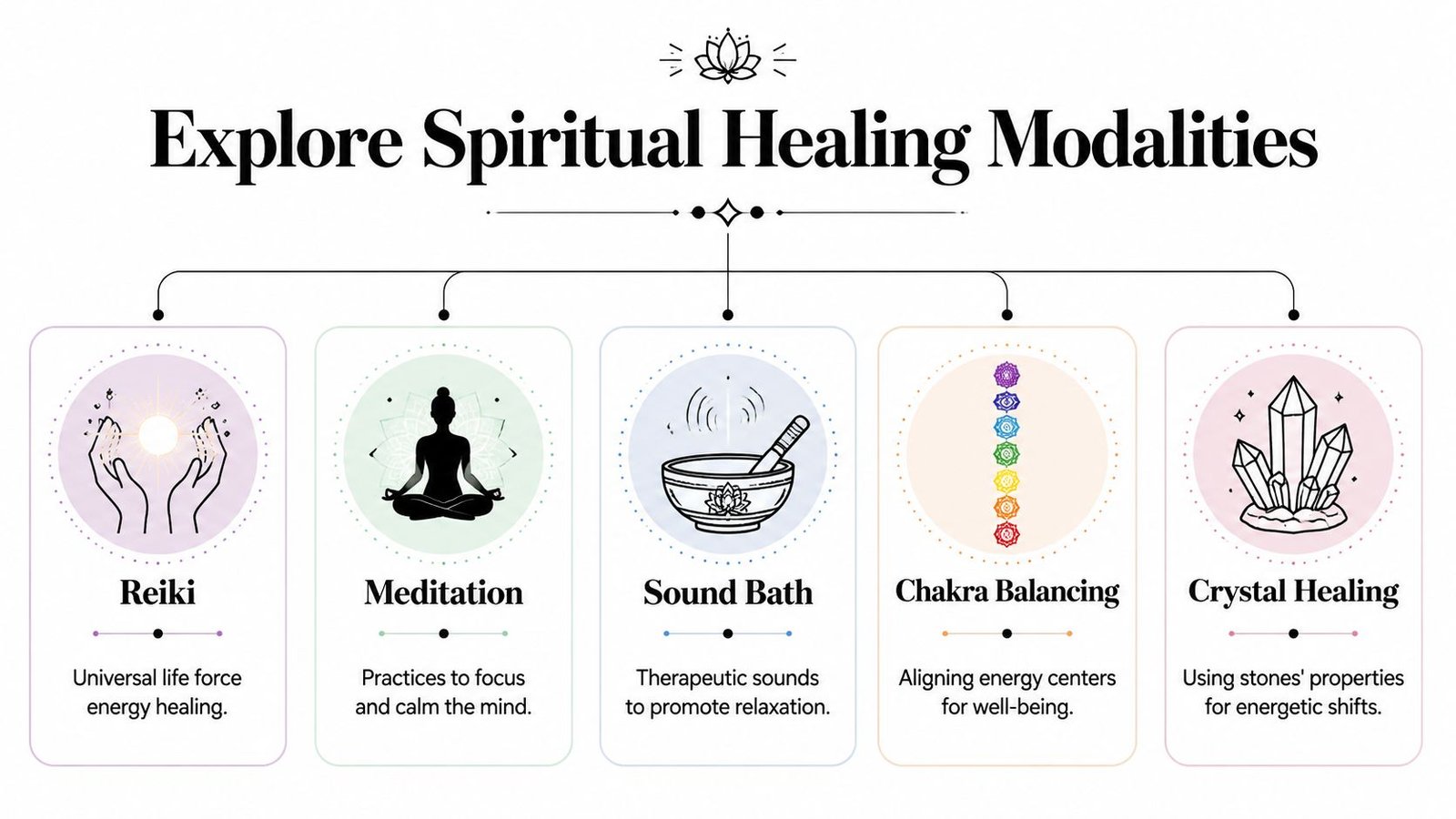
Once people feel curious, the next question is usually practical. What kinds of spiritual healing practices are available, and how do I know where to start? The easiest approach is to choose by need, not by trend.
The practices people return to most often
Grounding helps when you feel scattered, panicky, or “not fully here.” This can be as simple as standing barefoot on grass, holding a stone, or visualizing roots moving from your feet into the earth.
Energy protection is useful when you feel porous or drained by other people’s moods. Some people use prayer, visualization, salt baths, or a brief boundary-setting statement before entering stressful spaces.
Smudging is often used to clear the feeling of heaviness from a room or personal space. Many people use smoke from sacred plants for this purpose, but it’s important to approach culturally rooted practices with care and respect, especially if they come from traditions that aren’t your own.
Sound healing uses steady, resonant sound to shift your internal state. Singing bowls, chimes, tuning forks, humming, mantra, or even one sustained tone can help interrupt mental overactivity.
Crystal and herb work gives people a tactile way to focus intention. A crystal in your pocket or calming herbs in a bath won’t do the inner work for you, but they can act as anchors for attention and ritual. If you’re curious, this guide to crystals for healing and protection offers a grounded place to learn the basics.
Sacred bathing turns an ordinary bath or shower into a reset. People often pair water with intention, breath, salts, herbs, or prayer to symbolically wash off emotional residue.
Moon rituals invite reflection through natural cycles. A new moon might support intention-setting, while a full moon might be used for release, gratitude, or honest self-review.
There isn't one correct modality. The best practice is often the one you can return to consistently, without fear or pressure.
Spiritual Healing Practices at a Glance
| Modality | Primary Purpose | Good for When You Feel… | Supplies Needed |
|---|---|---|---|
| Grounding | Stabilize attention and reconnect to the body | Scattered, anxious, dissociated | None, or a natural object like a stone |
| Energy protection | Create a sense of emotional boundary | Drained, overexposed, overwhelmed by others | None, optional prayer or ritual object |
| Smudging | Shift the atmosphere of a space | Heavy, stagnant, emotionally cluttered | Smoke-cleansing tool or a smoke-free alternative |
| Sound healing | Calm the mind through vibration and rhythm | Mentally noisy, tense, restless | Bowl, chime, playlist, or your own voice |
| Crystal and herb work | Support intention through touch and symbolism | In need of comfort, focus, or ritual structure | Crystal, herb, pouch, tea, or bath ingredients |
| Sacred bathing | Encourage release and restoration | Emotionally tired, energetically “sticky” | Bath or shower, optional salts or herbs |
| Moon rituals | Mark intentions and release through reflection | Unclear, stuck, ready for a reset | Journal, candle, quiet time |
Some people love structured practices. Others do better with tiny, intuitive rituals. Both approaches count. The point isn’t to collect modalities. The point is to find one or two that help you feel more present in your own life.
Simple Starter Rituals You Can Try Today
When you’re overwhelmed, complicated rituals can become another thing on the to-do list. Small practices work better. They lower resistance, build trust, and give you a direct experience of what spiritual healing practices feel like in real life.

A five minute grounding reset
This is a good choice when your thoughts are racing.
- Stand or sit with both feet supported. If you can, place your feet on the floor or on the ground outside.
- Exhale longer than you inhale. Don’t force it. Just let the exhale soften your chest and jaw.
- Picture roots moving downward. Imagine them dropping from your feet deep into the earth.
- Name what is true right now. Try simple phrases like “I am here,” “I am safe in this moment,” or “My body is allowed to soften.”
- End with one clear intention. “I return to myself” is enough.
If visualization feels hard, skip it. Press your toes into the floor and notice the contact. Physical sensation can ground you just as well.
A gentle new moon intention ritual
This ritual works when you want a reset without making your inner life feel like a performance review.
Write down three prompts:
- What am I ready to welcome
- What kind of energy do I want to bring into this next chapter
- What support do I need from myself
Keep your answers short. One honest sentence under each prompt is plenty. Then sit for a minute and read what you wrote aloud or to yourself.
If your intention feels forced, make it smaller. “I want more peace in the mornings” is often more useful than a dramatic life declaration.
For readers who like guided support, this short practice can help you settle in before trying your own ritual:
A quick sound cleanse for heavy days
You don’t need a full sound bath. A simple sound cue can shift the mood of a room and your body’s sense of tension.
Try this:
- Choose one sound source. A bell, a singing bowl app, a chime, clapping, or your own humming all work.
- Set a brief intention. Something like “I release what isn’t mine to carry.”
- Make sound slowly. Move around the room, or stay still and let the sound wash over you.
- Pause afterward. Notice whether your breath, thoughts, or posture changed.
This kind of ritual is especially helpful after conflict, long screen time, or a day where you absorbed too much. It creates a transition point, and that transition is often what tired minds need most.
How to Integrate Healing Practices into a Busy Life
People often don’t struggle because they lack interest. They struggle because they assume spiritual healing practices only count if they happen in long, serene blocks of time. That belief stops more routines than lack of discipline ever will.
Think in energy snacks, not perfect routines
A better model is the energy snack. Small, repeatable moments of regulation and reconnection. One minute before a meeting. Three breaths in the car. A hand on the heart after reading a difficult message. These don’t look dramatic, but they can change the tone of a day.
Clinical research highlighted by the American Psychological Association shows that mindfulness-based spiritual practices can reduce anxiety levels by up to 30% in participants, according to this summary of evidence on spiritual healing types and stress management. The useful takeaway isn’t that your practice must be intense. It’s that intentional practice has measurable psychological value.
Here’s how busy people make it workable:
- Attach it to something you already do. Ground while waiting for coffee. Set an intention before opening your laptop.
- Use transitions. The minute after work, before sleep, after a shower, and before meals are often easier than trying to “find time.”
- Keep tools visible. A journal on your nightstand or a stone near your keyboard becomes a cue.
Where small rituals fit into a crowded day
You don’t need a spiritual lifestyle brand. You need a rhythm that fits your actual schedule.
Try a few examples:
- Before a call: one breath in, longer breath out, shoulders soften.
- During a commute: listen to calming music or sit in silence for part of the ride.
- At your desk: touch a grounding object and repeat a simple phrase like “one thing at a time.”
- Before sleep: place one hand on the chest and review the day without judgment.
A collection of daily spiritual practices for real life can help if you want ideas that don’t require a full routine overhaul.
Consistency beats intensity. A tiny ritual you actually do will support you more than an elaborate practice you avoid for weeks.
People often wait for the perfect mood to begin. It’s better to begin while imperfect, distracted, or doubtful. That’s usually the exact moment the practice is for.
Practicing Safely and Taking Your Journey Deeper
Spiritual healing can be supportive, moving, and very personal. It also needs healthy boundaries. If you’re dealing with trauma, severe anxiety, depression, medical symptoms, or a crisis, spiritual practices work best as a complement to qualified care, not a substitute for it.
A few boundaries that protect you
Pay attention to how a practitioner speaks about power, certainty, and dependency. Ethical guides don’t pressure, frighten, or claim exclusive access to your healing. They make room for your judgment.
Cultural respect matters too. A key trend in this space is the blending of spiritual healing with evidence-based therapies for diverse communities. For example, therapists have blended EMDR with traditional healing practices like mindfulness from Eastern traditions to offer more holistic care for BIPOC clients, as described in this piece on EMDR and traditional healing for BIPOC trauma care. That kind of integration works best when it is sensitive, informed, and respectful.
A few grounded reminders help:
- Check your body's response. If a ritual makes you feel more panicked or disconnected, pause and choose something simpler.
- Stay practical. Use spiritual insight to support daily life, not avoid it.
- Keep your agency. Good practice strengthens self-trust. It doesn’t ask you to surrender common sense.
Frequently Asked Questions
| Question | Answer |
|---|---|
| Do I need to be religious to try spiritual healing practices? | No. Some people approach them through religion, while others use them as reflective or mindfulness-based rituals. |
| What if I don't feel anything right away? | That’s common. Start with simple practices and notice subtle changes in breath, mood, or clarity over time. |
| Can I do this if I’m anxious? | Yes, but begin gently. Grounding, breath, and brief sound practices are often easier than intense visualization. |
| How do I choose a modality? | Choose based on your current need. Grounding for overwhelm, sound for mental noise, journaling or moon rituals for reflection. |
| Should I work with a practitioner? | You can start on your own. If you seek a practitioner, look for someone ethical, clear about boundaries, and respectful of other forms of care. |
If you’re ready for a structured next step, Spiritual Method offers a gentle path for people who feel drained, stuck, or ready to reconnect with themselves. Its awakening guide brings together grounding rituals, intention-setting, energy protection, sacred bathing, and practical tools for consistency in a way that fits modern life. It’s a supportive option if you want help turning curiosity into a steady personal practice.