
Your chest tightens in the middle of an ordinary moment. You are at your desk, in your car, or sitting on the edge of your bed, and your mind starts racing faster than your body can follow. Part of you knows you are safe. Another part feels scattered, overstimulated, and far from your center.
That disconnection is often what anxiety feels like.
Grounding techniques help restore contact with the present moment through the body, the breath, and the senses. In practice, I find that people do better when they have more than one path back. Some methods are clinical and structured, such as sensory orientation or breath regulation. Others are spiritual and ritual-based, such as holding a crystal, cleansing a room with smoke, or taking a salt bath with clear intention. Both can support the same nervous system goal. They help the body recognize safety again.
Accessible tools matter because anxiety is common and support is not always easy to get in the exact moment it is needed. Grounding can be used in a parked car, in a bathroom at work, beside your bed at night, or barefoot on the earth at sunset.
The most helpful approach is rarely one method alone. It is a personal set of practices that steadies your mind during acute stress and also tends your energy over time.
Table of Contents
- Returning to Your Center When Anxiety Spirals
- Emergency Grounding for Acute Anxiety Attacks
- Daily Practices to Build Proactive Resilience
- Spiritual Rituals for Deeper Energetic Grounding
- How to Choose the Right Grounding Technique for You
- Creating a Consistent Practice for Lasting Calm
Returning to Your Center When Anxiety Spirals
You're answering a text, making dinner, or standing in line at the store, and then the spiral begins. Your chest tightens. Your thoughts race ahead. Your body starts acting as if danger has already arrived.
This is the moment to return to the body before the mind builds a bigger story.
Grounding helps because anxiety is not only a pattern of thought. It is a full nervous system state. Muscles brace. Breathing gets shallow. Attention narrows. Some people feel heat, dizziness, numbness, or a strange sense of disconnection from the room around them.
A grounding practice gives the body something clear and believable to orient to. Pressure through the feet. A slower exhale. The cool surface of a glass. The weight of a stone in the palm. These simple cues tell the system, in plain physical language, that you are here, now, and supported.
As noted earlier, research on grounding points to benefits that may include steadier physiological regulation and a calmer stress response. In practice, what matters most is this. Grounding interrupts momentum. It shifts you out of mental forecasting and back into direct experience.
What grounding is actually doing
When anxiety spirals, regulation comes before reflection.
Grounding can help by:
- Lowering physical activation so the stress response has less fuel
- Bringing awareness back into the body when you feel scattered, unreal, or unsteady
- Softening muscle tension that keeps anxiety cycling
- Redirecting attention to what is present and verifiable instead of what fear predicts
I often tell clients to judge a technique by one standard. Does it help you inhabit your body more fully, or does it push you deeper into mental effort? If it sends you further into analysis, save it for later.
That is one reason silent meditation is not always the best first response during acute anxiety. For some people, closing the eyes and trying to relax creates more inner noise. Body-based grounding usually works better at the beginning. Once the nervous system settles, insight and prayer land more gently.
Start with contact, then add meaning
Begin with what is physically true. Place both feet on the floor. Press down just enough to notice support. Relax the tongue from the roof of the mouth. Let the exhale run a little longer than the inhale. Touch something with texture, such as linen, wood, denim, a cool countertop, or a grounding crystal you keep nearby.
Then, if spiritual practice is part of your path, add a layer of intention without making the moment complicated. Hold smoky quartz or black tourmaline as a tactile anchor. Place one hand over the heart and say, “I am safe in this moment.” If you want more support for racing thoughts, explore these practices for calming an overactive mind.
Grounding does not need to look dramatic to work. It needs to feel repeatable, honest, and close enough to reach when you are already activated.
That is the trade-off many people miss. The most beautiful ritual is not always the most useful one in the middle of a spiral. Save the longer bath, smoke cleansing, or altar practice for the moments when you have enough steadiness to receive them. In the first wave of anxiety, simple contact is often the kindest medicine.
Emergency Grounding for Acute Anxiety Attacks
When anxiety spikes fast, the best technique is usually the one that gives your mind a job and your body a rhythm. You're not trying to feel enlightened in that moment. You're trying to come back online.
One of the most reliable methods is the 5-4-3-2-1 sensory protocol. According to Cleveland Clinic grounding guidance, this approach can lead to an immediate 30-50% reduction in anxiety for 70-85% of individuals in distress. That's why it remains one of the first tools I recommend when someone feels the edge of panic.
Use the senses before the mind argues
Use this sequence exactly as written when possible:
Pause and take slow abdominal breaths
Begin with several slow breaths. If counting helps, use the ratio described in the Cleveland Clinic protocol: inhale for 4, hold for 7, exhale for 8. Don't strain. Gentle is better than perfect.Name 5 things you can see
Keep your eyes open. Pick distinct objects. Don't rush. Notice color, shape, edges, or shine.
Example: blue mug, cracked sidewalk, brass lamp, white sock, green leaf.Touch 4 things
Physically make contact if you can. Compare temperature, pressure, softness, or grain.
Example: cool table, textured sweater cuff, smooth phone case, solid chair arm.Listen for 3 sounds
Identify near and far sounds. Let your hearing widen.
Example: air vent, traffic, a bird, your own breath.Find 2 scents
This can be subtle. Soap on your hands, tea in a cup, clean fabric, fresh air through a window.Notice 1 taste
Sip water. Chew gum. Taste toothpaste, mint, tea, or the neutral taste in your mouth.
If your distress still feels high, repeat the cycle more slowly. Speaking the items softly out loud often helps keep attention from drifting.
If you can name what you see and feel in real time, anxiety has less room to narrate catastrophe.
A smooth stone, mala bead, or crystal can strengthen this practice because touch gives the body an anchor. If racing thoughts are your main symptom, these ways to calm an overactive mind pair well with sensory grounding.
Two discreet tools for public moments
The full sensory sequence is excellent, but sometimes you're in a meeting, on a train, or standing in a grocery line. You need something invisible.
Try box breathing when you need structure.
Inhale for a steady count, hold briefly, exhale for the same count, then pause. Keep the rhythm even. The value of this method is its predictability. When anxiety makes everything feel chaotic, rhythm gives the mind a rail to hold onto.
Try a rapid body scan when your body feels buzzy or unreal.
Press your toes into your shoes. Relax your calves. Drop your shoulders. Loosen your tongue from the roof of your mouth. Unfurrow your brow. This works well because anxious tension often hides in small muscles you stop noticing.
A guided visual can help if you learn better by watching. Use this when you're calm first, then return to it during higher-stress moments.
What usually doesn't work in acute anxiety is arguing with the fear, forcing positive thoughts, or shaming yourself for “overreacting.” Ground first. Interpret later.
Daily Practices to Build Proactive Resilience
Emergency tools matter, but they work best when your system isn't already running hot all day. Daily grounding techniques for anxiety lower the baseline. They give your body repeated experiences of tension leaving instead of accumulating.
Progressive Muscle Relaxation, or PMR, remains one of the strongest options for this. Studies from 2009-2021 consistently show PMR significantly reduces both acute and chronic anxiety by activating the parasympathetic nervous system, countering fight-or-flight hormones, and supporting emotional regulation, as summarized in this Psychology Today review of grounding techniques for anxiety.

A simple PMR script for daily release
Set aside a few quiet minutes. Sit or lie down. If tensing muscles aggravates pain, skip the tensing and focus only on the release.
Move from one area to the next:
Hands and forearms
Clench gently, hold briefly, then release completely. Notice the difference between effort and softness.Shoulders
Lift them toward the ears, then let them drop. Most anxious people are carrying more weight here than they realize.Jaw and face
Tighten the jaw or scrunch the face lightly, then let the mouth soften and the brow widen.Stomach and hips
Brace slightly, then let go. Feel the support under your body.Legs and feet
Tighten the thighs or point the feet, then relax.
The point isn't intensity. It's contrast. Your nervous system learns relaxation more clearly when it feels the shift from contraction to release.
Clinical insight: PMR works especially well for people whose anxiety feels physical before it feels mental.
A five minute movement and breath sequence
Some people don't want a script. They want a ritual that feels alive. Use this sequence in the morning, after work, or anytime your energy feels scattered.
Stand with both feet planted
Slight bend in the knees. Feel your weight drop.Sweep the arms up on an inhale
Reach without strain.Exhale and fold or bow slightly
Let the neck soften. Let the day drain downward.Roll the shoulders back slowly
Match the movement to your breath.Twist gently side to side
Keep it loose. Let your arms tap your ribs.Place one hand on heart, one on belly
Take several slow breaths and feel both hands move.
This style of practice helps people who freeze when they're told to “sit still and calm down.” Movement gives the anxiety somewhere to go.
If you're building a steadier emotional foundation overall, these resources on how to build emotional resilience can support the process between formal grounding sessions.
A daily practice doesn't need to be long to change your state. It needs to be familiar enough that your body recognizes it as a path back to safety.
Spiritual Rituals for Deeper Energetic Grounding
Anxiety can feel bigger than thoughts. For spiritually sensitive people, it often shows up as feeling too open, easily affected by other people's energy, or disconnected from the body. That language is not standard clinical terminology, but the experience is real. Ritual can help because it gives the nervous system sensory cues for safety while also restoring a sense of spiritual containment.
There is growing interest in combining evidence-based regulation with spiritual tools. Used well, ritual adds meaning, rhythm, touch, scent, and intention. Used poorly, it can become avoidance. The standard I use is simple. A grounding ritual should help you feel more present in your body, not farther away from it.

Smudging to clear the field around you
Smudging can be a steadying practice when it is done with care, cultural respect, and clear intention. It works best as a brief reset that engages breath, scent, movement, and attention all at once.
Open a window if you can. Light sage or palo santo safely, or use another cleansing herb that fits your tradition. Move the smoke around your body and then through the room, especially near doorways, corners, your bed, or your workspace. Keep the words plain and honest. “I release what is not mine.” “I call my energy back.” “Peace is allowed here.”
The benefit is not magic words alone. You are creating a sensory boundary. That matters for people whose anxiety comes with overstimulation or emotional spillover from the day.
There is also a real trade-off here. If smoke irritates your lungs, triggers headaches, or makes you lightheaded, skip it. Use a room spray, anointing oil, or open the window and pair the action with prayer or breath.
Working with crystals as tactile anchors
Crystals are most useful as tactile anchors. The stone gives the hand something cool, solid, and steady to hold while the mind settles and the breath slows. Black tourmaline, hematite, obsidian, and smoky quartz are common choices because many people experience them as weighty and stabilizing.
Keep the practice simple:
Choose by body response
Hold a few stones and notice whether your shoulders drop, your jaw softens, or your breath lengthens.Cleanse in a way that fits the stone
Smoke, moonlight, sound, or quiet intention can work. Avoid water if the stone is not water-safe.Give it a clear role
Protection, calm, containment, or returning to yourself are all workable intentions.Place it where anxiety tends to rise
A pocket, bag, bedside table, or desk keeps the cue close when you need it.
People often ask whether the crystal is doing the healing. My view is balanced. The object can carry symbolism, ritual meaning, and sensory comfort. Your nervous system is still the part learning regulation. If you want to explore supportive stones in more detail, this guide to crystals for healing and protection offers a helpful starting place.
If a spiritual tool makes you feel more spacey, obsessed, or dependent on the object, simplify the practice and return to the body.
Sacred bathing for nervous system reset
Water has a regulating effect for many anxious people because it creates warmth, privacy, and a clear physical boundary around the body. A bath or shower can become a grounding ritual without becoming elaborate.
You might add:
- Salts for a sense of release
- A gentle scent or herbs if fragrance feels calming
- Low light to reduce sensory input
- A spoken intention such as “I release today” or “I return to myself”
Then stay with the body. Feel the temperature on your skin. Notice where you are gripping. Let the exhale get longer as the water runs over the back of your neck, chest, or shoulders.
A shower works well too. Stand still for a moment before stepping out. Put both feet on the floor. Take one full breath and let that be the closing of the ritual.
Sacred practice does not need to be elaborate. Repetition matters more than complexity. The ritual becomes powerful because your body learns, over time, that these small acts mean safety, return, and reconnection.
How to Choose the Right Grounding Technique for You
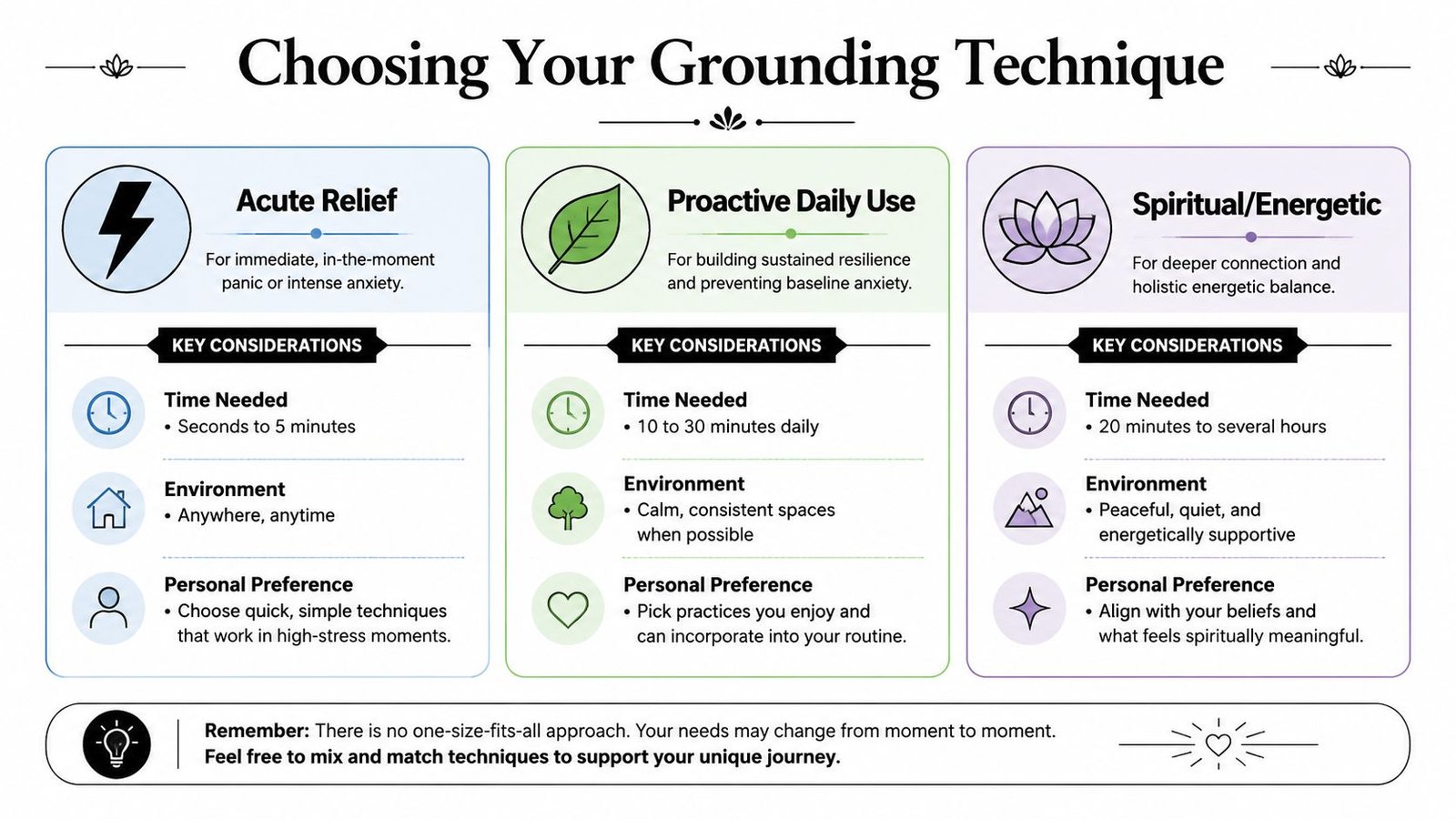
The right method depends less on what sounds impressive and more on what matches the moment. A technique can be excellent and still be wrong for your current state.
If your anxiety is sharp and escalating, use a method that directs attention outward. If it's low-grade and heavy, use a practice that releases stored tension. If the day has left you feeling energetically frayed, a ritual can help restore a sense of containment and meaning.
Grounding Technique Selector
| Technique | Best For (Anxiety Type) | Time Required | Ideal Environment | Key Benefit |
|---|---|---|---|---|
| 5-4-3-2-1 sensory grounding | Acute panic, racing thoughts, dissociation | A few minutes | Anywhere with sensory input | Redirects attention into the present |
| Box breathing | Fast stress in public or at work | Under a few minutes | Meetings, transit, waiting rooms | Adds rhythm and steadiness |
| Rapid body scan | Physical tension, shakiness, overwhelm | Very brief | Anywhere, especially seated | Releases hidden muscular bracing |
| Progressive Muscle Relaxation | Chronic tension, evening anxiety, stress buildup | Short dedicated practice | Home, therapy room, before bed | Teaches the body how to release |
| Movement and breath sequence | Restlessness, morning stress, mental fog | Brief daily practice | Bedroom, office, quiet corner | Reconnects breath with motion |
| Smudging ritual | Feeling heavy, energetically crowded, emotionally “stuck” | Flexible | Home or private space | Creates reset through scent and intention |
| Crystal grounding | Repeated anxiety cues throughout the day | Ongoing support | Home, work, travel | Gives tactile and symbolic anchoring |
| Sacred bath or shower | End-of-day depletion, overstimulation | Longer reset | Home | Combines warmth, privacy, and ritual |
The real trade offs to consider
A few patterns matter when choosing:
If you're in public, choose discreet tools
Box breathing and body scanning draw almost no attention. Full rituals can wait.If your senses are overloaded, reduce input
The sensory method is powerful, but some people do better starting with one sense, especially touch or sound.If you tend to dissociate, stay concrete
Open eyes, name objects, touch solid surfaces, and avoid drifting into abstract visualizations.If you crave meaning, include ritual
A grounded spiritual practice often improves follow-through because it feels personally resonant.
The best toolkit includes at least one fast technique, one daily technique, and one restorative ritual. That combination gives you something to use in the moment, something to build resilience, and something to help your system feel whole again.
Creating a Consistent Practice for Lasting Calm
You wake with a tight chest, remember to ground yourself, and then forget once the day starts pulling at you. By evening, the crystal is still on the nightstand, the journal is closed, and the only time you reach for a calming practice is when anxiety is already loud.
This is why consistency matters more than intensity. The nervous system responds well to repetition. A brief practice done at the same time each day can teach steadiness more effectively than a long ritual used only in moments of crisis.
Research on habit formation supports this approach. In a 2010 study published in the European Journal of Social Psychology, Phillippa Lally and colleagues found that repeated daily actions become more automatic over time, with simple habits tending to settle in more easily than complex ones. Grounding works the same way. Keep it simple enough that your body can trust it and your life can hold it.
Make grounding small enough to keep
Attach one grounding action to something that already happens every day. That reduces decision fatigue and gives your practice a natural home.
Try one of these:
After brushing your teeth
Place both feet on the floor. Take three slow breaths and feel the support beneath you.While coffee or tea brews
Hold your crystal or mug in both hands. Notice warmth, scent, and the pace of your breathing.Before opening your laptop
Relax your jaw, soften your shoulders, and name one clear intention for the day.Before bed
Write one line about your mood and one line of gratitude. If you prefer, close with a short prayer or place a hand over your heart in silence.
Keep the structure light. A useful weekly tracker can be as simple as four notes: what you practiced, when you practiced, how you felt before, and how you felt after.
If tracking starts to feel performative, stop tracking for a week and keep the ritual.
I often tell clients this: the practice that helps is the one you can still do when you are tired, skeptical, busy, or emotionally raw. Five honest breaths count. Touching a grounding stone before a hard meeting counts. A sacred bath once a week counts too, especially when it helps your body link rest with safety and your spirit link cleansing with release.
Lasting calm grows from rhythm. Grounding stops feeling like an emergency tool and becomes a daily act of returning to your body, your breath, and your inner steadiness.
If you want a guided path that brings these practices together, Spiritual Method offers a gentle framework for grounding, energy protection, sacred bathing, crystal and herb work, reflection, and daily consistency tools. It's designed for people who want practical support for anxiety while also honoring the spiritual side of healing.