
Transpersonal healing is defined as a therapeutic approach that addresses the whole person by integrating psychological, spiritual, and embodied dimensions of well-being, extending beyond the ego to include expanded states of consciousness. Rooted in the work of pioneers like Stanislav Grof and Abraham Maslow, this field draws from both modern psychology and ancient spiritual traditions to support deep personal transformation. Unlike conventional therapy, which focuses primarily on the ego and behavioral patterns, transpersonal healing recognizes that experiences beyond the ego are not symptoms to be managed but gateways to genuine healing. Spiritualmethod describes this as practical inner healing for the mind, body, and soul, and that framing captures the approach precisely.
What is transpersonal healing and how does it work?
Transpersonal healing works by addressing the person across multiple dimensions simultaneously. Transpersonal psychotherapy integrates psychological, physiological, cognitive, and spiritual levels rather than relying on a single modality. This multi-level structure is what separates it from both conventional talk therapy and purely spiritual practices.
The approach treats healing as a process of expanding identity. When a person begins to recognize themselves as more than their habits, wounds, or social roles, new possibilities for growth emerge. Transpersonal healing creates the structured framework within which that expansion can occur safely and with professional support.
Practitioners work with the full spectrum of human experience, including subconscious material, somatic awareness, spiritual insight, and cognitive patterns. The goal is not to eliminate psychological pain but to integrate it into a broader, more coherent sense of self. This integration is what produces lasting change rather than temporary relief.

The five dimensions addressed in transpersonal therapy
Transpersonal therapy explicitly works across five interconnected levels:
- Psychological: Processing subconscious material, expanding identity beyond ego boundaries, and resolving unresolved emotional patterns
- Spiritual: Cultivating connection to higher consciousness, intuition, and a sense of meaning or sacredness
- Cognitive: Challenging limiting beliefs and reframing narratives using cognitive-behavioral elements within a transpersonal context
- Behavioral: Building new patterns of response that reflect expanded self-awareness
- Physiological/energetic: Developing somatic awareness and recognizing the body as a site of stored experience and healing potential
Pro Tip: If you are new to transpersonal healing, start by identifying which dimension feels most blocked for you. Clients who enter therapy with a clear sense of where they feel stuck tend to engage more productively with the multi-level work.
How does transpersonal healing differ from traditional therapy?
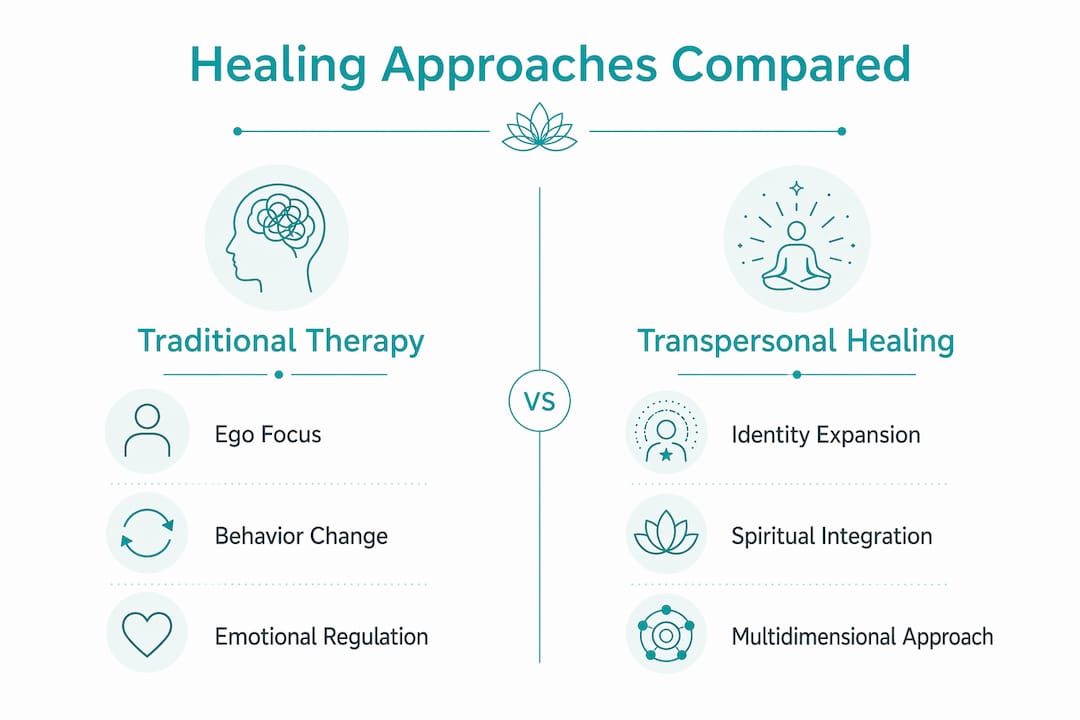
Traditional psychotherapy centers on the ego, focusing on thought patterns, behavioral change, and emotional regulation within the boundaries of the personal self. Transpersonal healing includes all of that work and then extends further, incorporating spiritual and existential dimensions that conventional therapy often excludes. This distinction matters most when a client’s distress is tied to questions of meaning, purpose, or spiritual experience.
Spiritual bypassing is the most common pitfall that distinguishes poor transpersonal practice from effective work. Spiritual bypass occurs when spirituality is used to avoid processing emotional pain rather than to deepen engagement with it. A person might pursue meditation retreats, energy healing, or mystical experiences as a way to sidestep grief, trauma, or relational conflict. Authentic transpersonal healing directly addresses this risk by requiring psychological grounding alongside spiritual exploration.
The table below clarifies the key distinctions between transpersonal healing and related approaches:
| Approach | Primary focus | Includes spirituality? | Risk of bypass? |
|---|---|---|---|
| Traditional psychotherapy | Ego, behavior, cognition | Rarely | Low |
| Transpersonal healing | Whole person, expanded consciousness | Yes, as core element | Low when practiced correctly |
| Spiritual bypassing | Spiritual experience only | Yes, exclusively | High |
| Holistic healing | Body, mind, energy | Sometimes | Moderate |
Pro Tip: When evaluating a transpersonal practitioner, ask directly how they handle psychological material that surfaces during spiritual practices. A qualified therapist will have a clear, grounded answer. Vague responses about “trusting the process” without psychological structure are a warning sign.
What techniques are used in transpersonal healing sessions?
Transpersonal healing sessions draw from a defined set of practices, each designed to access deeper layers of the psyche and support integration. Meditation, mindfulness, guided imagery, and visualization are among the most widely used tools in clinical transpersonal work. These are not supplementary additions. They are primary therapeutic instruments.
The following techniques represent the core methods you are likely to encounter:
- Holotropic breathwork: Developed by Stanislav Grof, this practice uses accelerated breathing patterns combined with evocative music to access repressed memories and subconscious material for integration and self-actualization. Sessions are typically facilitated in groups with trained practitioners present.
- Guided imagery and dream work: Carl Jung emphasized imagery as the language of intuition in healing. In transpersonal sessions, a therapist guides the client through sensory-rich inner experiences to access emotional insight that direct verbal processing cannot reach.
- Meditative and mindfulness practices: Structured meditation builds the capacity to observe thought and emotion without identification, which is the foundational skill for working with expanded states of consciousness.
- Ritual and prayer: When aligned with a client’s own spiritual tradition, ritual creates a container for meaningful experience. This might include ceremonial practices, prayer, or nature-based rituals such as moon work.
- Somatic awareness exercises: Body-centered practices help clients recognize where emotional and spiritual material is held physically, supporting release and integration.
Safety is a genuine consideration in transpersonal work, particularly with breathwork and altered states. Reputable practitioners screen clients for contraindications including certain psychiatric conditions and cardiovascular concerns before beginning intensive practices. The therapeutic alliance between client and practitioner is the primary safety structure in this work.
- Sessions typically range from 60 to 90 minutes for talk-based transpersonal therapy
- Breathwork sessions may run two to three hours and require integration time afterward
- Dream work and guided imagery can be practiced in shorter formats, including self-directed sessions with proper preparation
How to engage with transpersonal healing for personal growth
Engaging with transpersonal healing begins with identifying your intention. Whether you are processing trauma, seeking spiritual development, or working through existential questions, clarity of purpose helps you choose the right entry point. Transpersonal healing helps individuals access dormant qualities masked by limiting beliefs and life experience, which means the work is as much about uncovering what is already present as it is about building something new.
When choosing a practitioner, look for the following:
- Training in both psychological and spiritual frameworks, not exclusively one or the other
- Membership in a recognized professional body such as the Association for Transpersonal Psychology or equivalent national organizations
- Clear intake processes that assess psychological readiness before beginning intensive practices
- Explicit discussion of integration support, meaning what happens between sessions and after significant experiences
For self-directed practice, three approaches offer accessible starting points. Regular meditation, even 15 minutes daily, builds the observational capacity that underpins all transpersonal work. Reflective journaling after significant emotional experiences creates a record of patterns and insights over time. Breathwork practices, starting with gentler techniques before progressing to holotropic methods, develop somatic awareness and access to subconscious material.
Transpersonal healing complements rather than replaces conventional therapy. Many practitioners recommend working with both simultaneously, particularly when trauma is involved. Incorporating spiritual and existential dimensions into treatment addresses the full complexity of modern distress, and a skilled transpersonal therapist will know when to refer a client to additional psychological support.
Pro Tip: Keep an integration journal specifically for transpersonal work. Record not just what happened in a session but what shifted in your daily life in the days following. The most significant healing often appears in ordinary moments, not during the session itself.
The expected outcomes of sustained transpersonal healing practice include greater self-awareness, reduced reactivity, a stronger sense of meaning and purpose, and a more expansive sense of identity. For individuals navigating grief, existential crisis, or spiritual emergence, finding meaning through transpersonal methods can be a structuring force during periods of significant disorientation.
Key takeaways
Transpersonal healing is most effective when it integrates psychological grounding with spiritual exploration, working across cognitive, somatic, and spiritual dimensions rather than treating any one level in isolation.
| Point | Details |
|---|---|
| Core definition | Transpersonal healing extends beyond ego to integrate psychological, spiritual, and embodied dimensions. |
| Five therapeutic dimensions | Effective practice addresses psychological, spiritual, cognitive, behavioral, and physiological levels together. |
| Spiritual bypass risk | Spirituality used to avoid emotional work stalls healing; authentic practice requires psychological grounding. |
| Key techniques | Holotropic breathwork, guided imagery, meditation, ritual, and somatic awareness are the primary tools. |
| Practical entry point | Begin with daily meditation, reflective journaling, and a qualified practitioner who works across both psychological and spiritual frameworks. |
Why grounding matters more than transcendence
After working with transpersonal concepts for years, the pattern I see most consistently is this: people arrive seeking transcendence and leave having found groundedness. That inversion surprises almost everyone at first.
The popular image of transpersonal healing emphasizes expanded states, mystical experiences, and spiritual awakening. Those things are real and they matter. But authentic transpersonal work balances mystical experience with psychological integration, and in my observation, the integration is where the actual healing happens. A breathwork session that opens a profound experience is only the beginning. What you do with that experience in the weeks that follow determines whether it becomes a turning point or simply a memorable event.
The clients I have seen make the most durable progress are those who treat transpersonal practices as a structured framework for self-understanding, not as a collection of peak experiences to accumulate. They journal consistently. They work with practitioners who ask hard psychological questions alongside spiritual ones. They apply what they discover in sessions to their relationships, their work, and their daily choices.
The risk of spiritual bypass is real, and it is more common than most practitioners acknowledge openly. I have seen people spend years in meditation retreats, energy healing sessions, and ceremonial practices while the unresolved grief or relational trauma at the center of their distress remained untouched. Transpersonal healing done well does not allow that evasion. It brings the spiritual and the psychological into direct contact with each other, which is precisely what makes it both demanding and genuinely transformative.
If you are considering this path, approach it with the same seriousness you would bring to any significant therapeutic commitment. The rewards are proportional to the depth of engagement.
— Sean
Start your transpersonal healing practice with Spiritualmethod
Spiritualmethod provides structured, accessible resources for individuals ready to move beyond surface-level wellness into genuine mind, body, and soul healing.

The moon ritual for inner healing guide offers a practical, step-by-step framework for incorporating transpersonal ritual into your regular practice. For a broader foundation, the spiritual healing practices resource covers the full range of techniques used in transpersonal work, from breathwork to guided imagery, with clear guidance on how to apply each one. Both resources are designed to complement professional therapeutic support and support consistent reflective practice between sessions.
FAQ
What is transpersonal healing in simple terms?
Transpersonal healing is a therapeutic approach that addresses the whole person by integrating psychological, spiritual, and physical dimensions of well-being. It goes beyond ego-focused therapy to include expanded states of consciousness and spiritual experience as part of the healing process.
How does transpersonal healing differ from regular therapy?
Traditional therapy focuses on the ego, behavior, and cognition. Transpersonal healing includes those elements and adds spiritual and existential dimensions, making it particularly relevant when distress involves questions of meaning, purpose, or spiritual experience.
What does a transpersonal healing session involve?
Sessions may include guided imagery, meditation, breathwork such as holotropic breathwork developed by Stanislav Grof, somatic awareness exercises, and ritual practices. The specific methods depend on the practitioner’s training and the client’s needs and readiness.
Is transpersonal healing safe?
Transpersonal healing is safe when practiced by trained professionals who conduct proper intake assessments and provide integration support. Intensive techniques like holotropic breathwork have specific contraindications, so screening before sessions is a standard part of responsible practice.
What is spiritual bypass and how does it relate to transpersonal healing?
Spiritual bypass is the use of spiritual practices to avoid processing emotional pain rather than engaging with it. Effective transpersonal healing directly addresses this risk by requiring psychological grounding alongside spiritual exploration, ensuring that spiritual experience deepens rather than replaces emotional work.