
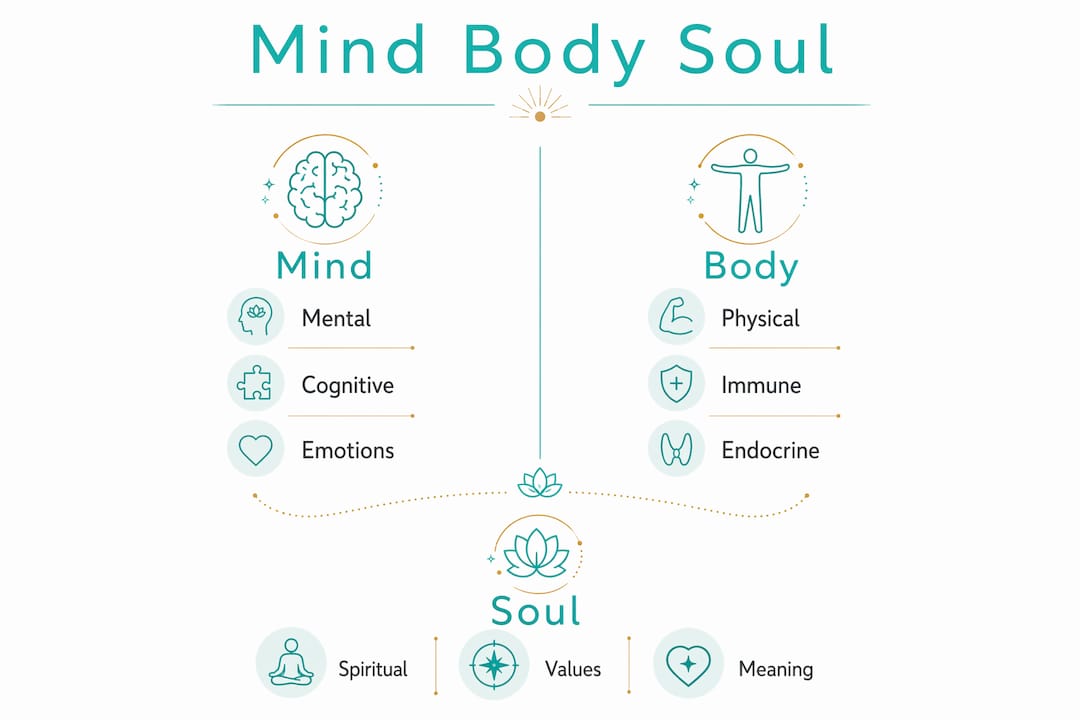
The mind-body-soul connection is defined as the integrated relationship among mental, physical, and spiritual well-being, where each dimension continuously influences the others. This is not a metaphor. Fields like psychoneuroimmunology and brain-body network research have produced measurable evidence that thoughts alter immune function, spiritual practice reduces pain, and physical states reshape cognition. Spiritualmethod has built its entire approach around this framework, recognizing that holistic healing requires addressing all three dimensions together. Understanding the mind body soul connection explained through both science and spiritual practice gives you a complete map for lasting well-being.
What scientific evidence supports the mind-body-soul connection?
Psychoneuroimmunology is the field that formally established how mental and emotional states alter immune function. It connects the CNS, endocrine, and immune pathways, demonstrating that stress hormones suppress immune response while positive emotional states enhance it. This means your thought patterns are not separate from your biology. They are active inputs into your body’s defense and repair systems.
Brain imaging research has added structural evidence. Researchers at Washington University discovered a Somato-Cognitive Action Network connecting movement control regions with goal-oriented cognitive networks and autonomic functions like breathing and heart rate. This finding revises traditional brain maps entirely. Areas once thought to control only physical movement are now understood to also govern thinking, planning, and emotional regulation simultaneously.

The practical implication is significant. Calming breathing and heart rate networks produces direct feedback effects on the brain regions responsible for thought and planning. This is why slow, deliberate breathing reduces anxiety within minutes. The body is not just responding to the mind. It is actively reshaping it.
A 2026 meta-analysis on mindfulness-based interventions and cognitive behavioral therapy found a standardized mean difference of −0.78 in reducing depression, anxiety, and stress across adults with chronic conditions. That effect size is clinically meaningful, comparable to many pharmaceutical interventions. Structured, consistent practice drives the result, not occasional effort.
| Mechanism | What it does | Example intervention |
|---|---|---|
| Psychoneuroimmunology | Links thoughts and emotions to immune and endocrine output | Stress reduction programs, CBT |
| Somato-Cognitive Action Network | Connects motor, cognitive, and autonomic brain regions | Breathwork, movement-based therapy |
| Gut-brain axis | Bidirectional signaling between digestive and nervous systems | Nutrition, probiotic protocols |
| Neuro-immune-metabolic axis | Integrates exercise, cognition, and immune resilience | Aerobic exercise, mindfulness |
Pro Tip: If you want to start understanding mind body connection in your own life, begin with a single daily breathwork session of five minutes. The neurological feedback loop between breathing regulation and cognitive clarity activates within weeks of consistent practice.
How do spiritual practices strengthen the mind-body-soul connection?
Spiritual health is defined as the dimension of well-being concerned with personal meaning, values, and transcendent experience. It is not reducible to religious affiliation. Clinical research now treats it as a measurable variable with real physiological outcomes.
A 2026 randomized controlled trial published in Annals of Family Medicine tested five-minute in-person intercessory prayer against a music control in primary care patients with moderate-to-severe pain and anxiety. The prayer group showed greater reductions in pain and anxiety than the music group, with benefits sustained at six weeks. This is a peer-reviewed, controlled study. The results position brief spiritual practice as a legitimate, low-cost adjunct to standard medical care.
Mindfulness-based interventions operate through a related but distinct pathway. Where prayer engages meaning and relational spirituality, mindfulness trains present-moment awareness through structured attention practice. Both approaches activate the mind-body-soul connection, but through different entry points. The 2026 meta-analysis confirmed that group-based MBIs over 8 weeks produce stronger outcomes than shorter or unstructured formats.
Key spiritual practices with documented clinical support include:
- Intercessory prayer: Reduces pain and anxiety in primary care settings with effects lasting up to six weeks
- Mindfulness meditation: Improves depression, anxiety, and stress with effect sizes comparable to CBT
- Nature-based rituals: Reduce cortisol and support parasympathetic nervous system activation
- Gratitude journaling: Associated with improved sleep quality and reduced inflammatory markers
- Breathwork: Directly modulates the Somato-Cognitive Action Network identified in 2026 brain imaging research
Consistency is the determining factor across all of these. The meta-analysis data shows that higher contact hours and structured homework components correlate directly with greater improvements. A daily spiritual practice routine produces compounding benefits that a weekly session cannot replicate.
What are the key differences and overlaps among mind, body, and soul?
Practitioners distinguish mechanistic mind-body science from the spiritual components of the soul. The distinction matters because it clarifies what each type of intervention targets and why combining them produces results that neither achieves alone.
The mind and body interact through nervous, endocrine, and immune systems, producing measurable biomarkers. Cortisol levels, inflammatory cytokines, heart rate variability, and immune cell counts all shift in response to mental states. These are objective, quantifiable changes. Cognitive behavioral therapy and mindfulness work primarily within this mechanistic layer, altering thought patterns and nervous system tone.
The soul operates through a different framework. It is best understood as the dimension of personal meaning, values, and spiritual experience. Clinical support for soul-level interventions comes from structured mindfulness retreats and prayer trials rather than direct biomarkers. The outcomes are real, but the pathway runs through meaning-making rather than molecular signaling.
| Dimension | Primary pathway | Measurable outcomes | Example practice |
|---|---|---|---|
| Mind | Cognitive and neurological | Cortisol, HRV, cognitive performance | CBT, journaling, meditation |
| Body | Physiological and metabolic | Immune markers, inflammation, pain levels | Exercise, nutrition, sleep |
| Soul | Meaning and spiritual experience | Anxiety scores, pain ratings, life satisfaction | Prayer, ritual, values clarification |
The overlap is where the most powerful outcomes occur. Integrated interventions targeting one node of the mind-body-soul loop produce measurable improvements across the others. Addressing sleep quality, for example, reduces inflammatory markers, improves mood, and creates the mental space for deeper spiritual reflection. No dimension operates in isolation.
Pro Tip: When assessing your own well-being, map each dimension separately. Rate your mental clarity, physical energy, and sense of meaning on a scale of one to ten. The lowest score almost always reveals the entry point where a targeted intervention will produce the fastest whole-system improvement.
How can you apply the mind-body-soul connection to improve your health?
Applying the mind-body-soul connection in daily life requires a structured framework rather than scattered effort. Integrative medicine combines conventional diagnosis and treatment with evidence-informed lifestyle strategies addressing sleep, nutrition, stress, inflammation, and recovery. This model provides the clearest practical template for whole-person care.
Follow this sequence to build a sustainable practice:
- Establish a morning mindfulness anchor. Five to ten minutes of breath-focused meditation activates the Somato-Cognitive Action Network and sets neurological tone for the day. Use a structured program like an eight-week mindfulness-based stress reduction course for measurable outcomes.
- Add a physical movement practice. Exercise directly supports the neuro-immune-metabolic axis, improving cognitive function, immune resilience, and emotional regulation simultaneously. Thirty minutes of aerobic activity five days per week is the evidence-supported minimum.
- Incorporate a spiritual practice. Prayer, gratitude journaling, or nature-based ritual each engage the soul dimension. Even five minutes of structured spiritual practice, as the 2026 prayer trial demonstrated, produces clinically significant reductions in anxiety and pain.
- Optimize sleep and nutrition. These two lifestyle factors set the biological floor for everything else. Poor sleep elevates cortisol and suppresses immune function, undermining every other intervention. Whole-food nutrition reduces systemic inflammation, supporting both cognitive and emotional stability.
- Build social connectedness. Relational health is a documented predictor of immune function and longevity. Structured community, whether through a mindfulness group, a faith community, or a wellness program, amplifies individual practice.
- Track and adjust. Use a weekly reflection practice to assess all three dimensions. Spiritualmethod’s grounding techniques for anxiety offer a practical starting point for readers who need immediate tools before building a longer-term routine.
Spiritual healing practices serve as the connective tissue in this framework. They are not supplementary. They address the meaning dimension that purely physiological interventions cannot reach, and they produce outcomes that show up in clinical data.
Key takeaways
The mind-body-soul connection is a scientifically supported, clinically actionable framework where mental, physical, and spiritual health each directly shape the others, and structured practice across all three dimensions produces the strongest outcomes.
| Point | Details |
|---|---|
| Scientific basis is established | Psychoneuroimmunology and brain imaging research confirm measurable mind-body pathways. |
| Spiritual practice has clinical support | A 2026 RCT showed five-minute prayer reduced pain and anxiety with effects lasting six weeks. |
| Consistency drives results | Meta-analysis data links higher contact hours in MBIs to greater improvements in depression and anxiety. |
| All three dimensions interact | Interventions targeting one node produce measurable improvements across mind, body, and soul. |
| Integrative medicine provides the framework | Whole-person care coordinates conventional treatment with sleep, nutrition, stress, and spiritual practice. |
Why I stopped separating science from spirituality in my practice
For years, I treated the scientific and spiritual sides of this work as parallel tracks. I would share the psychoneuroimmunology research with one group of clients and the prayer and meditation practices with another, as if the two audiences could not hold both at once. That was a mistake.
What I have observed consistently is that clients who engage both tracks simultaneously progress faster than those who work only one. The person who adds a five-minute prayer practice to their CBT homework does not just feel better spiritually. Their anxiety scores drop faster. Their sleep improves. They report a sense of coherence that the cognitive work alone never produced.
The uncomfortable truth is that most wellness frameworks still treat the soul as optional. They acknowledge it politely and then return to biomarkers and behavioral protocols. The 2026 research on intercessory prayer and the Somato-Cognitive Action Network makes that position harder to defend. The soul dimension is not a soft add-on. It is a functional component of the system.
My advice is to resist the urge to wait until you understand the science fully before engaging the spiritual practices. The evidence is sufficient. Start with what you can do today, whether that is five minutes of breath-focused meditation, a brief prayer practice, or a daily spiritual routine that grounds your morning. The integration happens through practice, not through preparation.
— Sean
Start your mind-body-soul practice with Spiritualmethod
Spiritualmethod provides structured resources designed to support inner healing across all three dimensions of well-being. The site’s guides on spiritual healing practices draw on both clinical research and time-tested spiritual methods, giving you a practical path rather than abstract theory. Whether you are beginning with breathwork, exploring prayer, or building a complete integrative routine, Spiritualmethod’s resources meet you at your current level and support consistent, reflective practice. Explore the holistic healing guide to understand how mind, body, and soul work together in a whole-person framework, and take the next step toward a practice that is both evidence-informed and personally meaningful.
FAQ
What is the mind-body-soul connection?
The mind-body-soul connection is the integrated relationship among mental, physical, and spiritual well-being, where each dimension directly influences the others through neurological, physiological, and meaning-based pathways.
How does science explain the mind-body connection?
Psychoneuroimmunology demonstrates that mental and emotional states alter immune and endocrine function, while brain imaging research has identified the Somato-Cognitive Action Network linking cognitive, motor, and autonomic brain regions.
Can spiritual practices like prayer actually improve physical health?
A 2026 randomized controlled trial found that five-minute in-person intercessory prayer reduced pain and anxiety more effectively than a music control, with benefits sustained at six weeks in a primary care setting.
How long does it take to see benefits from mind-body-soul practices?
A 2026 meta-analysis found that structured mindfulness-based interventions over eight weeks produce clinically significant improvements in depression, anxiety, and stress, with consistency and contact hours being the primary drivers of outcome.
What is the difference between mind-body medicine and integrative medicine?
Mind-body medicine focuses on how mental states influence physical health through biological pathways, while integrative medicine coordinates conventional treatment with lifestyle strategies including sleep, nutrition, stress management, and spiritual practice for whole-person care.