
Spiritual awakening is defined as the conscious recognition of your true self beyond ego, habitual conditioning, and automatic perception. This shift in awareness is not a new identity you acquire. It is the uncovering of what has always been present beneath the layers of learned behavior and mental filters. Researchers and spiritual teachers across traditions describe it as one of the most transformative experiences a person can undergo, with effects that reshape how you see yourself, others, and reality itself. Understanding what does spiritual awakening mean is the first step toward recognizing it when it arrives in your own life.
What does spiritual awakening mean and why does it matter?
Spiritual awakening, also referred to in psychology and philosophy as a higher state of consciousness or spiritually transformative experience, is the process of becoming aware of a deeper reality that normal perception obscures. The term appears across Buddhism, Hinduism, Christian mysticism, and modern psychology, each framing it slightly differently but pointing to the same core shift: you stop identifying exclusively with your thoughts, roles, and fears.
According to research published by Psychology Today, awakening undoes psychological filters that restrict awareness, revealing that normal perception is limited and constructed rather than objective. This matters because most people operate their entire lives inside a mental framework they never examine. Spiritual awakening breaks that framework open.

Experts emphasize that awakening is a return to your true nature by removing illusions and conditioning, not a process of becoming someone new or special. This distinction separates genuine awakening from spiritual ego, which is the trap of believing you have achieved something others have not.
What triggers spiritual awakening and how does it begin?
Spiritual awakening rarely begins as a calm, scheduled event. Research identifies several categories of triggers that initiate the process:
- Psychological turmoil: Grief, burnout, depression, or a major life loss can strip away the structures that keep the ego intact, creating an opening for deeper awareness.
- Significant life events: Near-death experiences, the birth of a child, or a serious illness frequently precede awakening reports.
- Contact with nature: Extended time in natural environments, particularly in silence, can dissolve habitual mental noise and produce vivid, expanded awareness.
- Spiritual practices: Meditation, yoga, and prayer are among the most documented facilitators of awakening. Mental quietness created by these practices lowers the threshold for higher states of consciousness.
Research confirms that awakening experiences can last from minutes to hours, yet their effects can influence a lifetime. A single afternoon of profound clarity during a meditation retreat, for example, can permanently alter how a person relates to anxiety or personal identity.
Early signs that an awakening process has begun include heightened sensitivity to your environment, a sudden disinterest in conversations or activities that once felt satisfying, and an unexplained pull toward solitude or reflective practice. You may also notice increased emotional sensitivity, a questioning of long-held beliefs, and a growing sense that life holds more meaning than your current routine reflects.
Pro Tip: If you suspect you are in an early awakening phase, begin a brief daily journaling practice. Five minutes of written reflection each morning builds self-awareness and helps you track shifts in perception before they become overwhelming.
What are the common signs and phases of spiritual awakening?
The signs of spiritual awakening include heightened self-awareness, emotional release, questioning of personal beliefs and identity, and increased sensitivity to energy and the emotions of others. These signs are not random. They follow a recognizable pattern that most people move through in stages.
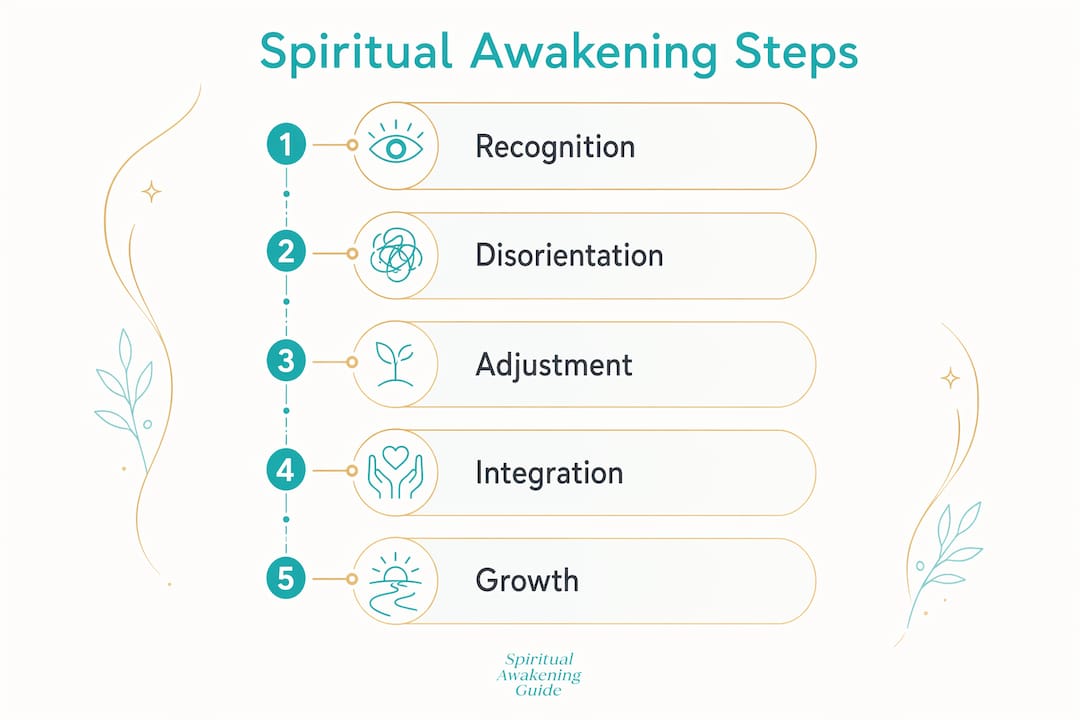
The four primary phases of the spiritual awakening process are:
- Initial awakening: A sudden or gradual shift in perception occurs. You begin to see your thoughts as separate from your identity. Many people describe this as “waking up inside a dream they did not know they were having.”
- Disorientation: Old frameworks no longer hold. Relationships, careers, and belief systems that once felt solid may feel hollow or misaligned. This phase is frequently the most difficult and is sometimes misidentified as depression or anxiety.
- Integration: You begin adapting your daily life to reflect your new awareness. This phase, according to IANDS research, can last months to years and involves functioning in an external world that has not changed while embodying a fundamentally different internal orientation.
- Ongoing growth: Awakening is not a destination. The process continues as you deepen your self-understanding, refine your values, and develop greater compassion for yourself and others.
Emotional challenges during phases two and three are normal and expected. Increased intuition, a desire for deeper meaning, and a reduced tolerance for superficial interaction are all common awakening experiences documented across religious and philosophical traditions including Buddhism, Sufism, and Christian contemplative practice.
Pro Tip: During intense disorientation phases, grounding practices are more effective than intellectual analysis. Walking barefoot on grass, spending time near water, or following a nature healing walk ritual can stabilize your nervous system and reduce emotional overwhelm.
How does spiritual awakening change your perception and worldview?
The most significant outcome of spiritual awakening is a fundamental change in how you perceive reality. This is not a metaphor. Research on higher states of consciousness confirms that normal perception is a constructed filter, shaped by memory, expectation, and social conditioning. Awakening removes or loosens that filter, producing an experience of reality that feels more direct, vivid, and interconnected.
“Spiritual awakening is about gently uncovering what has always been within you, not about becoming someone special.”
This shift is categorically different from adopting a new belief system. A person can read every book on Buddhism or attend years of church services without experiencing awakening. Conversely, someone with no formal spiritual background can undergo a profound shift during a walk in the forest or a moment of crisis. The change is perceptual, not intellectual.
The table below illustrates the contrast between ordinary perception and awakened perception across key dimensions:
| Dimension | Ordinary perception | Awakened perception |
|---|---|---|
| Self-identity | Defined by roles, history, and thoughts | Awareness itself, beyond roles and labels |
| Relationship to thoughts | Identified with thoughts as “me” | Observing thoughts without full identification |
| Sense of connection | Separate from others and environment | Interconnected with people and the natural world |
| Relationship to suffering | Suffering as personal failure or threat | Suffering as part of the human experience, held with compassion |
| Sense of meaning | Derived from external achievement | Found in presence, relationships, and inner alignment |
Spiritually transformative experiences also change views on life, death, and life’s purpose in ways that can be sudden or gradual. The practical implication is that awakening does not make life easier. It makes life more honest, and that honesty requires adjustment.
How to navigate and integrate spiritual awakening into daily life
Integration is the phase most people underestimate. The experience of awakening can be profound, but adapting to post-awakening life requires deliberate, sustained effort. The world around you does not change. Your relationships, job, and responsibilities remain. What changes is your internal relationship to all of them.
Practical methods that support the integration process include:
- Grounding in nature: Regular contact with natural environments reduces the emotional intensity that often accompanies awakening. A structured nature-based practice provides a reliable anchor during periods of internal upheaval.
- Consistent meditation: Daily meditation, even ten to fifteen minutes, maintains the mental quietness that supports continued awareness. Spiritualmethod’s guide to daily spiritual practices offers a structured framework for building this routine.
- Honest communication in relationships: Awakening often creates distance between you and people who knew the previous version of you. Naming the changes you are experiencing, without expecting others to understand fully, preserves relationships while honoring your growth.
- Professional support when needed: Intense awakening experiences can overlap with symptoms of anxiety or dissociation. A therapist familiar with transpersonal psychology or spiritual emergence can provide grounded, clinical support without pathologizing the experience.
- Sacred rituals: Structured spiritual rituals create a repeatable container for processing and integrating new awareness. Practices tied to natural cycles, such as moon rituals or seasonal reflections, are particularly effective for building a rhythm of ongoing inner work.
Managing emotional intensity during integration is not about suppressing what arises. It is about creating enough stability in your daily structure to hold the experience without being overwhelmed by it. Routine-based activities, regular sleep, and physical movement all contribute to that stability.
Key takeaways
Spiritual awakening is the conscious recognition of your true self beyond ego and conditioning, and its integration into daily life requires structured practice, grounded routines, and sustained self-awareness over months or years.
| Point | Details |
|---|---|
| Core definition | Spiritual awakening is the uncovering of your true nature, not the creation of a new identity. |
| Common triggers | Psychological turmoil, nature contact, and practices like meditation or yoga initiate awakening. |
| Recognizable signs | Heightened self-awareness, emotional release, and questioning of beliefs are documented early signs. |
| Perception shift | Awakening removes mental filters, producing a more direct and interconnected experience of reality. |
| Integration is ongoing | Adapting to post-awakening life can take months to years and requires deliberate daily practice. |
What I have learned from watching people walk this path
I have spent years studying and working with people at various stages of the spiritual awakening process, and the pattern I see most consistently is this: people underestimate how ordinary the experience actually feels from the inside. They expect a dramatic revelation. What they get is a quiet, persistent sense that the story they have been telling about themselves is incomplete.
The misconception that troubles me most is the idea that awakening is a finish line. People reach a moment of clarity and assume the work is done. Then life continues, old patterns resurface, and they conclude the awakening was not real. It was real. The integration simply had not begun yet.
The other thing I would say directly is this: the disorientation phase is not a sign that something has gone wrong. It is a sign that something has gone right. When the structures that once organized your identity begin to feel hollow, that is not a crisis. That is the process working exactly as it should.
Spirituality, at its core, is not about transcending ordinary life. It is about meeting ordinary life with a different quality of attention. That shift in attention, built through reflective practice and honest self-examination, is what Spiritualmethod is designed to support.
— Sean
Deepen your practice with Spiritualmethod

Spiritual awakening explained is only the beginning. The real work happens in the integration, and that work is most sustainable when it is supported by structured, repeatable practices. Spiritualmethod provides practical methods for healing the mind, body, and soul through guided frameworks that meet you where you are. Explore how sacred rituals support healing and provide a reliable container for ongoing inner work. For a broader foundation, the spiritual healing practices resource library covers meditation, prayer, and ritual-based approaches designed to support every phase of the awakening process.
FAQ
What does spiritual awakening mean in simple terms?
Spiritual awakening is the conscious recognition of your true self beyond ego, conditioning, and automatic thought patterns. It is the experience of seeing through the mental filters that normally shape your perception of reality.
How long does a spiritual awakening last?
Individual awakening experiences can last from minutes to hours, but the broader process of transformation and integration can continue for months or years. The integration phase is often the longest and most demanding part of the process.
What are the first signs of spiritual awakening?
Early signs include heightened self-awareness, emotional sensitivity, a questioning of long-held beliefs, and a growing desire for deeper meaning. Many people also report increased intuition and a reduced interest in activities that once felt fulfilling.
Is spiritual awakening the same as spiritual enlightenment?
Spiritual awakening and spiritual enlightenment are related but distinct. Awakening refers to the initial and ongoing shift in perception and self-awareness. Enlightenment, as described in traditions like Buddhism, refers to a more complete and sustained liberation from ego-based suffering.
Can spiritual awakening be triggered intentionally?
Regular spiritual practices such as meditation, yoga, and prayer increase the likelihood of awakening experiences by creating the mental quietness that supports expanded awareness. However, the experience itself cannot be forced or scheduled.