
Spiritual grief is defined as a deep inner conflict that disrupts a person’s core beliefs, sense of meaning, and connection to something greater than themselves. Clinically, this experience is recognized as spiritual distress, a condition that threatens belief, purpose, and connection while producing profound emotional and physical symptoms. Spiritual grief differs from ordinary sadness because it strikes at the foundation of how you understand life, loss, and your place in the world. Understanding what does spiritual grief mean is the first step toward healing the mind, body, and soul. Spiritualmethod offers holistic grief healing practices that address this layered experience with structure and compassion.
What does spiritual grief mean, and how does it show up?
Spiritual grief is not simply feeling sad after a loss. It is the collapse of the internal framework that once gave life meaning, order, and comfort. When that framework breaks, people often experience what therapists call spiritual distress, a state where belief, purpose, and connection are all threatened at once.

The symptoms are wide-ranging and do not follow a straight line. Spiritual grief symptoms include guilt about lost faith, anger toward a higher power, numbness during rituals, and existential anxiety that can fluctuate over years as the psyche integrates trauma. That fluctuation is significant because it means you may feel fine for weeks and then be blindsided by a wave of spiritual emptiness.
What separates spiritual grief from general emotional grief is its target. Emotional grief mourns a person, a relationship, or a circumstance. Spiritual grief mourns the belief system itself. The loss of faith, the silence of prayer, and the feeling that the universe has turned indifferent are all signs that spiritual grief is at work.
What are the common signs and emotional patterns of spiritual grief?
Recognizing spiritual grief requires knowing its specific emotional signatures. These patterns are distinct from standard depression or situational sadness.
Common signs include:
- Persistent guilt about doubting or abandoning previous beliefs
- Anger directed at God, the universe, or a higher power after a painful loss
- Numbness or disconnection during prayer, meditation, or religious rituals
- Existential anxiety about the purpose of life and what happens after death
- Loss of community when your spiritual group no longer feels like home
- Shame about questioning beliefs that once felt certain
The anger deserves special attention. Many people interpret anger at God as a sign of spiritual failure. Research shows the opposite is true. Anger at God in grief is a protective sign of a continued relationship, not a failure of faith. You do not argue with something you have fully abandoned. The anger itself proves the relationship still matters.
Pro Tip: If you feel angry at God or the universe, write it down without editing yourself. Expressing that anger privately is a recognized form of spiritual engagement, not rejection.
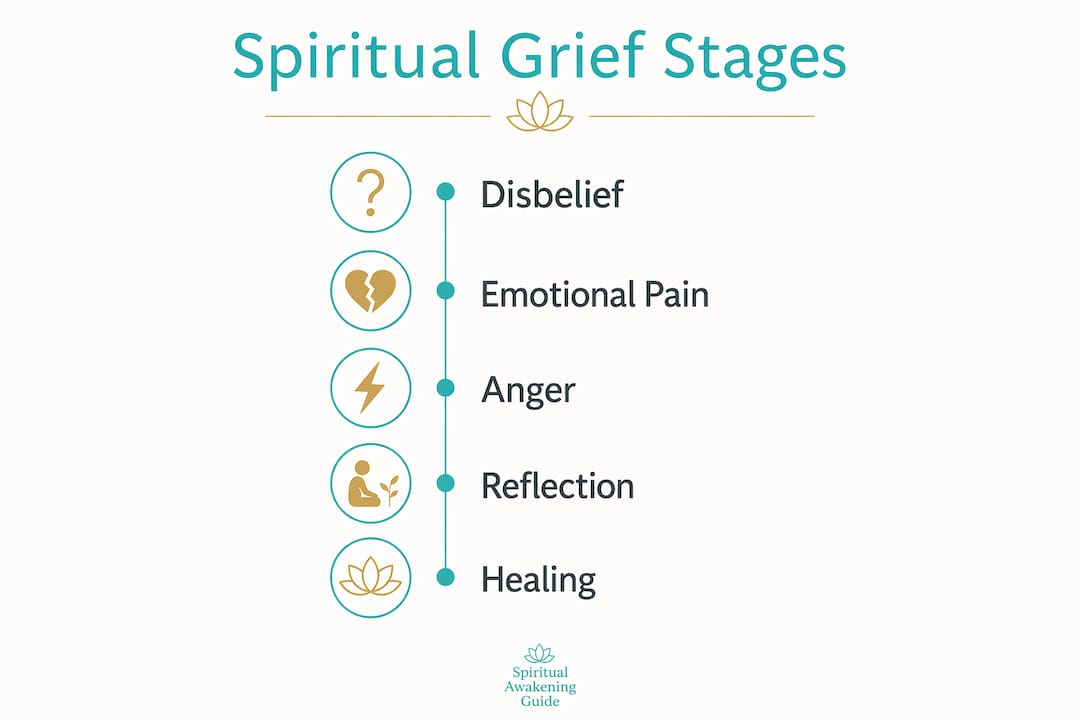
The nonlinear nature of these symptoms catches many people off guard. You may experience numbness for months, then feel sudden clarity, then fall back into existential anxiety. This is normal. The psyche processes spiritual trauma in layers, not in a single clean arc.
How does spiritual grief influence your spiritual practices and beliefs?
Spiritual grief changes the way you relate to the practices that once sustained you. Prayer may feel hollow. Meditation may feel impossible. Rituals that previously brought comfort may now feel like empty performances.
Practices that formerly brought spiritual relief can feel hollow or impossible during spiritual grief because the nervous system protects itself from overload by shutting down emotional access. This is not a personal failure. It is a physiological response to overwhelming loss.
The specific changes people report include:
- Prayer feeling one-sided or unanswered, creating a sense of divine abandonment
- Rituals losing their symbolic weight, so attending a service or lighting a candle feels mechanical
- Spiritual community becoming a source of pain rather than comfort, especially when others offer platitudes
- Previous beliefs feeling inadequate to explain the suffering being experienced
- A pull toward questioning doctrines or frameworks that were previously accepted without examination
These changes are part of the grief process, not evidence that your spiritual life is over. The role of sacred rituals in healing shifts during spiritual grief. Rituals may need to be adapted, simplified, or temporarily set aside before they can be reclaimed with new meaning.
Seeing these disruptions as information rather than failure changes how you respond to them. Each hollow prayer or numb ritual is telling you something about where the grief lives and what needs attention.
What is spiritual bypassing and why does it hinder healing?
Spiritual bypassing is defined as using spiritual beliefs and practices to avoid facing painful emotions rather than processing them. The term was first described by psychologist John Welwood as a defense mechanism that uses spiritual frameworks to skip the difficult inner work that genuine healing requires.
The trap is subtle. Spiritual bypassing looks like healing from the outside. A person may attend services regularly, speak confidently about divine purpose, and appear at peace. Internally, the raw grief remains unprocessed. Spiritual bypassing increases long-term distress precisely because it creates a gap between the performed spiritual state and the actual emotional reality.
The distinction between healthy spiritual coping and bypassing comes down to whether the practice opens you to your pain or closes you off from it.
| Approach | What it looks like | Outcome |
|---|---|---|
| Healthy spiritual coping | Sitting with grief while using prayer or ritual for support | Gradual emotional integration |
| Spiritual bypassing | Using “everything happens for a reason” to avoid grief | Prolonged distress and emotional suppression |
| Authentic expression | Naming anger, doubt, and confusion directly | Deeper connection and genuine healing |
Research by Pargament et al. confirms that positive religious coping leads to better health outcomes, while negative coping through spiritual bypassing leads to increased spiritual crisis and distress. The difference is not how much you practice spirituality, but whether that practice includes honest emotional engagement.
Pro Tip: Ask yourself honestly: “Am I using this spiritual practice to feel my grief, or to avoid it?” The answer tells you whether you are healing or bypassing.
How can you compassionately navigate and heal through spiritual grief?
Healing from spiritual grief requires integrating mind, body, and spirit rather than treating each in isolation. Healing from spiritual grief involves therapeutic support, authentic emotional expression, and structured rituals that create space for the full range of grief responses.
A practical healing framework includes these steps:
Name the grief explicitly. Compound or disenfranchised grief, which is unseen by your community, benefits from naming grief explicitly and expressing it privately to the divine. Naming transforms vague suffering into something you can engage with directly.
Allow anger as relationship, not rejection. Acknowledging anger at the divine as a form of continued relationship rather than abandonment keeps the spiritual connection alive even through pain.
Engage the body. Grief lives in the body as much as the mind. Breathwork, movement, and somatic practices help release grief that words cannot reach. The mind, body, and soul connection is not metaphorical during grief. It is physiological.
Adapt your rituals. Rather than abandoning practices that feel hollow, simplify them. Light a single candle. Sit in silence for two minutes. Small, consistent acts rebuild the bridge between you and your spiritual life.
Seek integrative support. A counselor trained in transpersonal healing can hold space for both the psychological and spiritual dimensions of your grief simultaneously.
Journal without a goal. Writing without editing or resolving externalizes the internal chaos. Spiritual journaling prompts can guide this process when you do not know where to start.
Do not rush this process. Spiritual grief integrates over time, not on a schedule. Pushing for resolution too quickly is itself a form of bypassing.
How does spiritual grief relate to personal growth and spiritual awakening?
Spiritual grief and spiritual awakening are more connected than they appear. The same disruption that causes suffering also creates the conditions for deeper self-knowledge and renewed meaning.
Grief forces introspection that comfort never requires. When the old framework collapses, you are compelled to examine what you actually believe, what genuinely matters, and what kind of spiritual life you want to build going forward. That examination, while painful, produces a more personally authentic spirituality than inherited belief systems often allow.
Signs that spiritual grief is moving toward growth include:
- Increased compassion for others who are suffering, because you now understand suffering from the inside
- Reduced certainty paired with greater openness, replacing rigid belief with genuine inquiry
- New meaning-making frameworks that account for loss rather than denying it
- Reconnection with practices that now feel chosen rather than obligatory
- A quieter, more personal relationship with the sacred that does not depend on external validation
The 7 steps to inner peace outlined by Spiritualmethod reflect this arc. Spiritual awakening triggered by grief is not a comfortable process, but it tends to produce a more grounded and resilient spiritual life than one that was never tested.
The critical warning here is premature closure. Reaching for spiritual meaning too quickly, before the grief has been fully felt, is bypassing in disguise. Growth through spiritual grief requires staying present with the pain long enough for genuine integration to occur. Understanding spiritual integration for healing helps clarify what that integration actually looks like in practice.
Key Takeaways
Spiritual grief is a disruption of core beliefs and meaning that requires honest emotional engagement, not spiritual performance, to heal.
| Point | Details |
|---|---|
| Spiritual grief defined | It is the collapse of your belief framework, not just sadness, requiring targeted healing approaches. |
| Anger is relationship | Anger at God or the universe signals a continued connection, not a failure of faith. |
| Avoid spiritual bypassing | Using spirituality to skip painful emotions increases long-term distress rather than resolving it. |
| Healing integrates all dimensions | Effective recovery addresses mind, body, and spirit together through ritual, expression, and support. |
| Grief can catalyze growth | When processed honestly, spiritual grief often leads to a more authentic and resilient spiritual life. |
What I have learned from walking through spiritual grief
Spiritual grief is the most disorienting form of loss I have encountered, because it removes the very tools most people reach for when they are hurting. When prayer feels hollow and community feels distant, the usual comfort systems are gone.
What I have observed consistently is that the people who heal most fully are not the ones who resolve their doubt fastest. They are the ones who stay honest about what they are feeling, even when that honesty is uncomfortable. Naming the anger, sitting with the emptiness, and refusing to perform a peace they do not yet feel. That willingness to be truthful with themselves creates the conditions for real integration.
The most common trap I see is spiritual bypassing dressed up as strength. Saying “I’m at peace with it” six weeks after a devastating loss is rarely true. It is usually a way of protecting yourself and others from the full weight of what happened. The problem is that the grief does not disappear. It goes underground and surfaces later as anxiety, numbness, or a quiet disconnection from life.
My honest recommendation is to treat spiritual grief as a structured process, not a crisis to escape. Give it time, give it language, and give it the support of someone who understands both the psychological and spiritual dimensions. The path through is not around.
— Sean
Practical healing resources for spiritual grief recovery
Spiritual grief asks more of you than most healing processes. It requires working at the level of belief, meaning, and identity, not just emotion. Spiritualmethod has built a set of practical, structured resources specifically for this kind of deep inner work.

The soul retrieval healing examples guide walks through eight concrete cases where people recovered lost parts of themselves after spiritual crisis. For those who find writing more accessible, the journaling for soul healing guide provides a step-by-step framework for using expressive writing as a healing practice. Both resources are grounded in the mind, body, and soul approach that Spiritualmethod applies across all its healing programs. They are designed for people who want practical methods, not abstract theory.
FAQ
What does spiritual grief mean in simple terms?
Spiritual grief is the loss of your belief system, sense of meaning, or connection to a higher power following trauma or loss. It is recognized clinically as spiritual distress and affects emotional, physical, and spiritual well-being simultaneously.
Is anger at God a sign of spiritual failure?
No. Anger at God during grief is a sign of continued relationship, not abandonment or failure. Research shows it is a protective emotional response that keeps the spiritual connection active through pain.
What is the difference between spiritual grief and spiritual bypassing?
Spiritual grief is the honest experience of losing meaning and belief. Spiritual bypassing is the use of spiritual practices to avoid feeling that grief. One leads to healing; the other prolongs distress.
How long does spiritual grief last?
Spiritual grief does not follow a fixed timeline. Symptoms fluctuate over months or years as the psyche integrates the underlying trauma. Healing accelerates when emotional expression and structured support are part of the process.
Can spiritual grief lead to spiritual growth?
Yes. When processed honestly without bypassing, spiritual grief often produces deeper compassion, more authentic belief, and a more personally grounded spiritual life than existed before the loss.