
What self help really means for mind, body, and soul
Self help, in its deepest form, is intentional personal transformation that addresses the full spectrum of human experience: mental, physical, emotional, and spiritual. For spiritual seekers, this goes well beyond managing symptoms or adopting productivity habits. It means actively engaging with inner healing through practices that integrate all dimensions of the self.
The Personal Growth Process model describes this kind of growth as a sociocognitive embodied process, one that unfolds over time through multiple mental shifts, including self-awareness, existential courage, self-compassion, and a deepened sense of social responsibility. Growth, by this definition, is not a destination. It is an ongoing, fluctuating process rooted in psychological safety.
Within a holistic spiritual context, personal development draws on several interconnected dimensions:
- Mental: Reflective practice, cognitive reframing, and mindfulness-based awareness
- Physical: Nutrition, rest, movement, and body-centered healing
- Emotional: Processing grief, fear, and relational wounds with compassion
- Spiritual: Connection to a Higher Self, sacred ritual, energy healing, and meaning-making
What separates authentic self improvement from surface-level self-optimization is the focus on healing rather than performance. The goal is not to become a better-functioning machine. It is to become more fully yourself.
Table of Contents
- How therapy and spiritual guidance work together
- Core principles that make personal growth authentic
- Practical methods for healing mind, body, and soul
- How reframing suffering opens the door to growth
- Daily routines that sustain holistic self improvement
- Spiritualmethod offers a structured path to inner healing
- Key Takeaways
How therapy and spiritual guidance work together
Traditional therapy and spiritual guidance are distinct in their methods and aims, yet they serve the same person. Understanding how they complement each other helps spiritual seekers build a more complete approach to inner healing.
Therapy, particularly evidence-based modalities like cognitive-behavioral therapy (CBT) or dialectical behavior therapy (DBT), focuses on symptom relief, psychological safety, and measurable mental health outcomes. Research confirms that therapy centers on mental health and symptom management, while spiritual guidance centers on existential meaning, personal transformation, and connection to a higher purpose. These are genuinely different aims, and both matter.
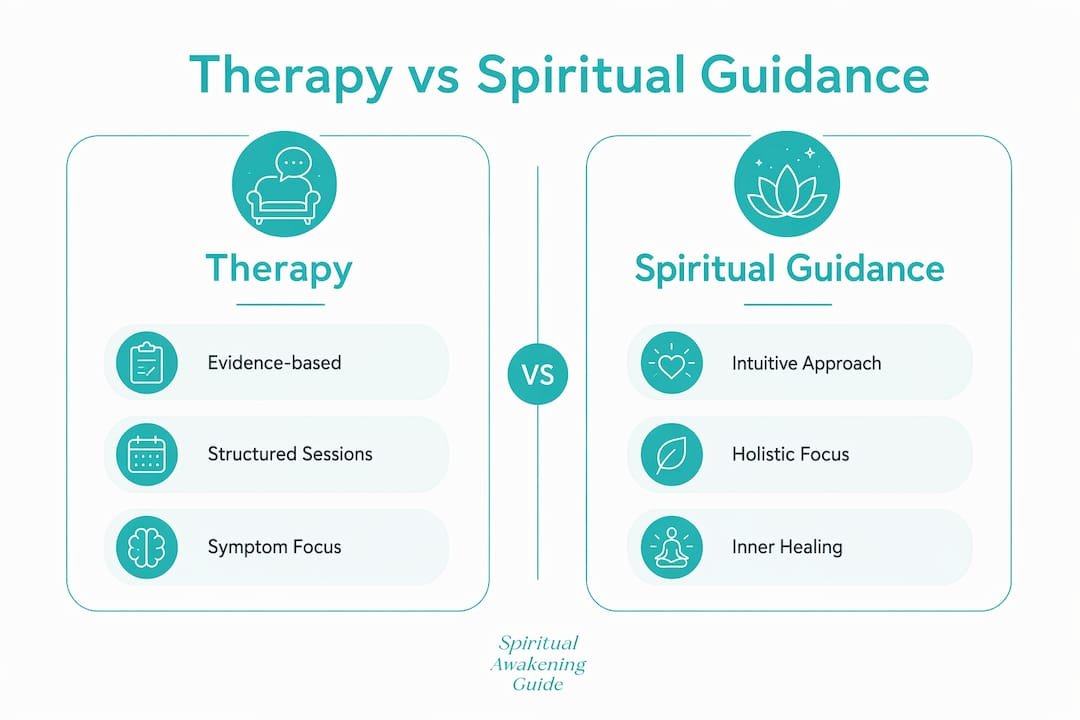
Spiritual guidance, by contrast, addresses questions therapy rarely touches: Why am I here? What does this suffering mean? How do I reconnect with something larger than myself? These questions are not pathological. They are deeply human.
The most effective approach for many spiritual seekers integrates both:
- Therapy provides: A structured framework for processing trauma, anxiety, and depression with evidence-based tools
- Spiritual guidance provides: A context of meaning, purpose, and transcendence that sustains long-term motivation
- Integration benefits: Addressing root causes at both psychological and existential levels, reducing the risk of relapse or spiritual bypassing
- Practical examples: CBT combined with meditation, somatic therapy paired with energy healing, or psychotherapy alongside transpersonal practices
Notably, well-structured self-help interventions can produce outcomes broadly equivalent to therapist-guided treatment, which means self-guided spiritual practice, when structured and intentional, carries real therapeutic weight.
Core principles that make personal growth authentic
Authentic personal growth does not come from a 30-day challenge or a motivational strategy applied for a week. It emerges from a sustained, honest engagement with yourself and your life. Several principles distinguish genuine healing from the kind of self-improvement that eventually makes you feel worse.

Growth is a process, not a product. The Personal Growth Process model frames development as a long-term, fluctuating journey, not a linear progression toward a fixed goal. Expecting steady upward movement sets up unnecessary self-criticism.
Suffering is data, not failure. Spiritual psychology consistently frames difficulty as a signal pointing toward unmet needs, unresolved wounds, or areas calling for deeper attention. This reframe alone shifts the entire orientation of self-guided healing.
Compassion outperforms criticism. Practitioner research warns that self-help fails when it becomes a tool for self-optimization rather than compassionate self-understanding. The shift from “fix yourself” to “know yourself” is foundational.
The transpersonal Self is a healing resource. Transpersonal psychology identifies a calm, clear inner presence, often called the Higher Self or transpersonal Self, as a foundational resource in effective healing. Reconnecting with this presence is not mystical abstraction; it is a practical anchor during difficulty.
Sustained change requires structure. Volitional change depends on motivation, repeated practice of new patterns, and a supportive environment. Intention without structure rarely produces lasting results.
Practical methods for healing mind, body, and soul
Holistic self improvement works when practices address all three dimensions simultaneously, rather than treating the mind, body, and soul as separate projects. The mind-body-soul connection is not metaphor; it is the operating principle of integrative healing.
Mindfulness and meditation for inner healing:
- Body scan meditation to reconnect with physical sensations and release stored tension
- Breath-focused awareness practices to regulate the nervous system
- Open-monitoring meditation to observe thoughts without identification, supporting emotional resilience building
- Loving-kindness (metta) practice to cultivate self-compassion and reduce self-critical patterns
Body-centered practices:
- Anti-inflammatory nutrition to support mood regulation and cognitive clarity
- Consistent sleep rhythms to stabilize emotional processing
- Gentle movement, yoga, or walking in nature to discharge stress and restore physical grounding
Spiritual practices for soul healing:
- Journaling for soul healing to process emotions, track patterns, and deepen self-awareness
- Energy healing modalities such as Reiki, sound healing, or breathwork to address energetic imbalances
- Sacred ritual and ceremony to mark transitions and reinforce intentional living
- Tarot as a reflective tool; a shadow and healing spread can surface unconscious patterns that journaling alone may not reach
Assessing progress: Track shifts in emotional reactivity, sleep quality, and the frequency of self-critical thoughts rather than measuring against an external ideal. Progress in spiritual self help often shows up as greater ease, not greater achievement.
Pro Tip: Combine a body-centered practice with a spiritual one in the same session, such as a brief body scan followed by a short period of free-form journaling. This pairing activates both somatic and reflective processing, deepening the integration that makes healing sustainable.
How reframing suffering opens the door to growth
Most people approach suffering as a problem to eliminate as quickly as possible. This is understandable, but it often short-circuits the very process that leads to lasting healing. Spiritual psychology offers a more productive frame.
Viewing suffering as a catalyst for growth rather than solely as a problem enables the integration of spiritual and psychological regulation, resulting in more sustainable mental health outcomes. The shift is not about romanticizing pain. It is about extracting meaning from it.
Practical techniques for reframing suffering include:
- Meaning-making inquiry: Asking “What is this experience asking me to learn or release?” rather than “How do I stop feeling this?”
- Narrative reframing: Writing the story of a difficult period from the perspective of your future, healed self
- Community witnessing: Sharing your experience in a trusted group or with a spiritual guide, which reduces shame and reinforces the sense that suffering is a shared human condition
- Tarot for personal growth reflection: Using structured card spreads to externalize and examine emotional patterns that feel too close to see clearly
Common obstacles in this process include spiritual bypassing (using spiritual practice to avoid rather than process emotion), isolation, and the pressure to “heal faster.” Recognizing these patterns early, and returning to the core principles of compassion and sustained practice, keeps the process honest.
Daily routines that sustain holistic self improvement
Consistency is what separates a healing practice from a healing intention. Sustainable routines do not need to be elaborate. They need to be repeatable.
A grounded morning practice might include five minutes of breath-focused meditation, a brief body check-in, and one written reflection question. This takes under fifteen minutes and activates mindfulness, somatic awareness, and reflective practice before the day’s demands take over. Evening routines that include a short gratitude practice and a review of emotional tone across the day reinforce the habit of self-observation without adding pressure.
Physical self-care routines, including regular movement, consistent sleep timing, and intentional nutrition, are not separate from spiritual growth. They are its infrastructure. A depleted body makes sustained inner work significantly harder.
Community matters as much as individual practice. Spiritual growth that happens only in isolation tends to stagnate. Whether through a meditation group, an online spiritual community, or a trusted circle of peers, relational accountability and shared meaning-making accelerate the process. The THRIVE Spiritual Health Framework identifies relationships and community as one of six core facets of spiritual thriving, alongside transcendence, habits and rhythms, identity and narrative, vocation and purpose, and ethics and virtues.
Weekly practices worth building in: a longer meditation or breathwork session, a nature walk with no devices, and a review of the week’s emotional and spiritual patterns in a journal.
Spiritualmethod offers a structured path to inner healing
For spiritual seekers who want more than a reading list, Spiritualmethod provides practical, structured methods for healing mind, body, and soul, organized around the real work of inner transformation rather than motivational content.
Where most self-improvement resources focus on mindset or productivity, Spiritualmethod addresses the full integration of spiritual practice and psychological healing. Guides on inner child healing, soul retrieval, the role of the Higher Self in healing, and holistic healing fundamentals give readers concrete frameworks rather than abstract inspiration. Each resource is designed to be self-guided, accessible, and grounded in both spiritual wisdom and evidence-informed practice. If you are ready to move from intention to structured practice, start with Spiritualmethod’s mind-body-soul connection guide as your foundation.
Key Takeaways
Authentic self help for spiritual seekers requires integrating mindfulness, body-centered care, spiritual practice, and community support within a sustained, compassionate framework rather than a quick-fix approach.
| Point | Details |
|---|---|
| Self help is integrative | Genuine personal growth addresses mental, physical, emotional, and spiritual dimensions together. |
| Therapy and spiritual guidance complement each other | Therapy targets symptom relief; spiritual guidance addresses meaning and transformation. Both serve the whole person. |
| Compassion over optimization | Self-help fails when it becomes self-criticism in disguise; sustainable growth requires compassionate self-understanding. |
| Suffering can catalyze growth | Reframing difficulty as meaningful data, rather than a problem, produces more durable healing and resilience. |
| Spiritualmethod provides structured methods | Spiritualmethod offers self-guided resources for inner child healing, soul retrieval, and mind-body-soul integration. |