
To calm down now, interrupt your body’s fight-or-flight response with a brief physiological reset, then follow a short grounding routine to stabilize thought and feeling. That sequence works whether you are mid-panic, overwhelmed at work, or lying awake at 2 AM with a racing mind.
Three immediate actions to take right now:
- Temperature cue: Splash cold water on your face or hold an ice cube briefly. This triggers the mammalian dive reflex, which activates the parasympathetic nervous system faster than slow breathing alone when distress is extreme.
- 30 seconds of intense movement: Do jumping jacks, sprint in place, or do push-ups until you feel your heart rate spike, then stop. DBT clinicians note that this brief exertion uses existing agitation to produce a drop in heart rate and a rise in endorphins once the movement stops.
- Paced exhale: Inhale for 4 seconds, hold for 2, exhale for 6. Repeat three times. Banner Health recommends this protocol for rapid calming in crisis moments.
After the reset, move into a 5–20 minute stabilizing routine: a body scan, a grounding exercise, or a brief journaling prompt to process what just happened.
Table of Contents
- How to stay calm in the moment: micro-techniques that work in under 5 minutes
- When breathwork isn’t right for you: safe alternatives to try
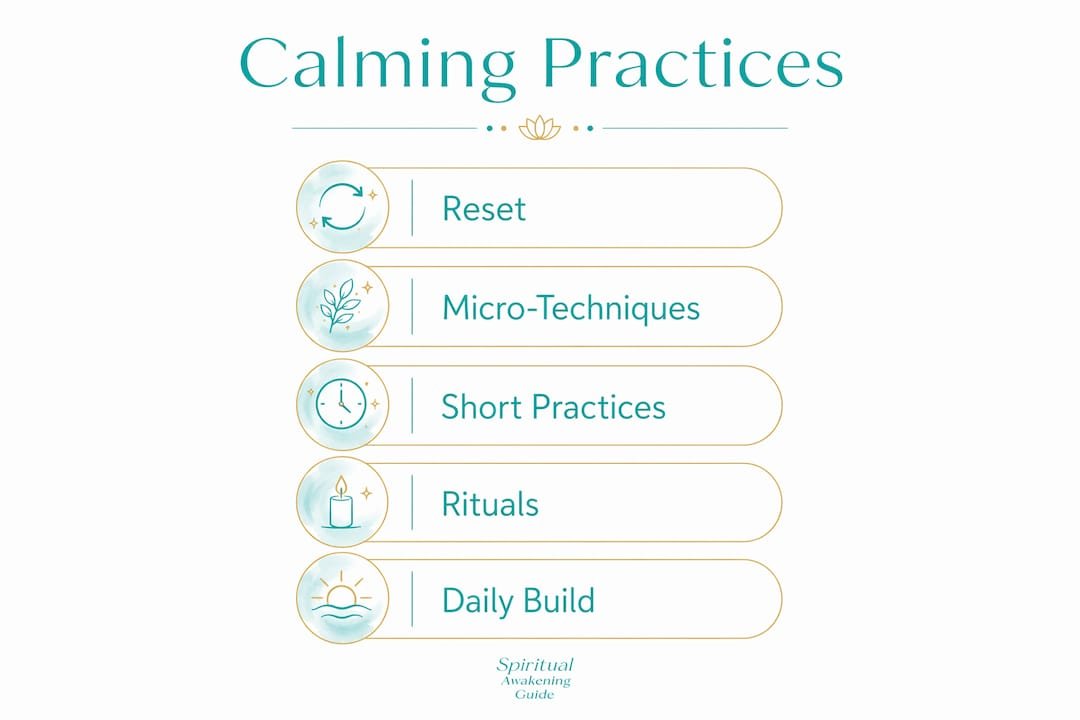
- Short practices that reliably change your physiology in 10–30 minutes
- Rituals, journaling, and spiritual tools that build lasting calm
- How to build a daily practice and when to seek professional help
- Key Takeaways
- Why the conventional wisdom on calm gets it backwards
- Spiritualmethod’s guided path for inner healing
- Useful sources
How to stay calm in the moment: micro-techniques that work in under 5 minutes
The TIP skill set from Dialectical Behavior Therapy gives you four physiological levers to pull when distress is too high for cognitive reasoning to work. Here is how to apply each one:
- Temperature: Fill a bowl with cold water and submerge your face briefly, or hold a cold pack to your forehead and cheeks. This activates the dive reflex and can shift your nervous system within seconds.
- Intense exercise: Brief intense exercise such as sprinting, jumping jacks, or vigorous stair climbing. Stop completely and notice the shift.
- Paced breathing: Inhale through your nose for 4 counts, hold for 2, exhale through your mouth for 6. Repeat for 3–5 minutes. The NHS recommends this style of belly-focused, counted breathing for stress and panic.
- Paired muscle relaxation: Tense a muscle group while inhaling, then release on the exhale while silently repeating a calming phrase. Over time, that phrase becomes a conditioned cue that triggers relaxation faster.
Beyond TIP, sensory anchoring techniques offer a gentler entry point:
- 5-4-3-2-1 grounding: Name 5 things you see, 4 you can touch, 3 you hear, 2 you smell, 1 you taste. This grounding technique for anxiety pulls attention into the present moment and interrupts racing thoughts.
- Object anchor: Carry a small stone, crystal, or meaningful object. When distress rises, hold it and focus on its texture, weight, and temperature for 60 seconds.
- Scent cue: Keep a small vial of lavender or eucalyptus oil nearby. A single slow inhale while focusing on the scent can interrupt a stress loop quickly.
Contraindication note: Face submersion in cold water is not appropriate for people with heart conditions, low blood pressure, or certain cardiac arrhythmias. Breath restriction techniques may be unsafe for those with respiratory illness or a history of panic triggered by breathwork. See the next section for safe alternatives.
Pro Tip: Match the technique to your body state. High agitation (racing heart, tight chest, urge to flee) responds best to temperature and intense movement. Numbness or dissociation responds better to sensory grounding and gentle movement rather than cold plunges.
When breathwork isn’t right for you: safe alternatives to try
Harvard Health notes that paced breathing is powerful but not universally appropriate. People with respiratory conditions, certain cardiac diagnoses, or a history of panic attacks triggered by breath awareness may find breathwork counterproductive or unsafe.
Safe alternatives that sidestep breath restriction entirely:
- Guided imagery: Close your eyes and mentally walk through a calm, detailed scene (a forest path, a quiet beach). Engage all five senses in the visualization.
- Body scan: Slowly move attention from the crown of your head to your feet, noticing sensation without judgment. No breath control required.
- Repetitive prayer or mantra: Silently or aloud repeat a meaningful phrase or prayer. The rhythm itself produces a calming effect similar to paced breathing.
- Gentle movement: Slow walking, stretching, or qigong. Movement does not require breath control and can shift physiology effectively.
- Sensory grounding: The 5-4-3-2-1 technique described above, or simply holding a warm cup of tea and focusing entirely on the sensation.
To sample techniques safely, follow this three-trial method:
- Choose one technique and practice it for 2–5 minutes.
- After each trial, note on a scale of 1–10 how calm you feel and whether any discomfort arose.
- Repeat the same technique for three separate sessions before drawing conclusions. One uncomfortable session does not mean a technique is wrong for you.
Safety note: If you experience chest pain, dizziness, or worsening anxiety during any practice, stop immediately and consult a physician before continuing. People with a history of trauma may find body-based practices activating; working with a trauma-informed therapist is strongly recommended in those cases.
Short practices that reliably change your physiology in 10–30 minutes
Physiological change requires more than a 30-second reset. Harvard Health recommends practicing relaxation techniques for at least 20 minutes a day to train the body’s relaxation response. Mayo Clinic confirms that regular practice lowers blood pressure, reduces stress hormones, and improves sleep and focus.
| Practice | Session length | Ideal frequency | Short-term effect |
|---|---|---|---|
| Body scan + progressive muscle relaxation | 20 minutes | Daily | Reduced muscle tension, lower heart rate |
| Guided imagery | 15–20 minutes | 3–5x per week | Reduced anxiety, improved mood |
| Yoga or qigong flow | 20 minutes | Daily or alternate days | Endorphin release, improved breath regulation |
| Paced breathing protocol | 20 minutes | Daily or as needed | Slower heart rate, reduced panic |
Three practical routines to use immediately:
- 10-minute work break reset: Sit away from screens. Do 3 minutes of paced breathing (4-2-6 count), 4 minutes of body scan from head to feet, and 3 minutes of free journaling. This sequence interrupts cortisol buildup mid-day.
- 20-minute de-escalation after conflict: Begin with 30 seconds of intense movement, then 5 minutes of paced breathing, then 15 minutes of guided imagery in a mentally safe place. This sequence addresses both the acute spike and the residual tension.
- Pre-sleep 15-minute sequence: 5 minutes of gentle yoga or stretching, 5 minutes of progressive muscle relaxation with a paired phrase, and 5 minutes of gratitude journaling. This prepares the nervous system for restorative sleep.
Rituals, journaling, and spiritual tools that build lasting calm
Science-based resets work faster when they are embedded in a meaningful ritual. A short micro-ritual creates a structured container for practice and signals to the nervous system that a shift is intentional.
A 5-step micro-ritual for inner calm:
- Light a candle or place a meaningful object (crystal, stone, or sacred item) in front of you.
- Take three slow breaths with your hands resting on your heart.
- Set a brief intention aloud or in writing: “I am choosing to return to calm.”
- Complete your chosen practice (body scan, paced breathing, or guided imagery).
- Close by placing both hands on the object, taking one final breath, and saying “complete.”
Journaling after a reset deepens the benefit. These prompts are designed for the 5–10 minutes immediately following a physiological reset:
- “What was my body telling me before I paused?”
- “What do I actually need right now, beneath the surface reaction?”
- “What is one thing I can release, and one thing I want to carry forward?”
For journaling as a soul-healing practice, consistency matters more than length. Three focused sentences after a reset outperform a lengthy entry written once a week.
Crystals and sacred objects function as ritual anchors rather than clinical tools. Amethyst, blue lace agate, and lepidolite are commonly used in calm-focused rituals. The mechanism is intention and attention: holding an object while breathing slowly focuses the mind and reinforces the association between the object and a calm state. For a science-informed approach to crystal healing for anxiety, Spiritualmethod offers detailed guidance on responsible use and ceremony.

Pro Tip: Pair your sacred object with your paired muscle relaxation phrase. Over time, simply holding the object will begin to cue the relaxation response, even without the full practice.
How to build a daily practice and when to seek professional help
Sustainable calm is built through small, repeated actions rather than occasional intensive sessions. A practical daily checklist:
- Morning (2–5 minutes): One micro-reset (paced breathing or body scan) before checking your phone.
- Midday (5–10 minutes): A brief grounding exercise or the 10-minute work break reset described above.
- Evening (15–20 minutes): A longer practice (yoga, guided imagery, or progressive muscle relaxation) plus journaling.
- Weekly (30–45 minutes): A full ritual session incorporating your sacred object, a longer body scan, and reflective journaling.
Benefits typically accrue on this timeline:
| Timeframe | Expected development |
|---|---|
| 2 weeks | Improved ability to notice stress earlier; micro-resets feel more natural |
| 4–6 weeks | Relaxation response activates more quickly; sleep quality often improves |
| 3 months | Conditioned cues (paired phrases, objects) reliably trigger calm; baseline anxiety tends to decrease |
Customizing for your triggers: social settings respond well to pre-performance routines and mental rehearsal, where you visualize yourself calm before entering a stressful situation. Sleep issues respond best to the pre-sleep sequence and a consistent wind-down ritual. For reducing stress and anxiety naturally, Spiritualmethod provides structured frameworks for both contexts.
Red flags that indicate professional support is needed: suicidal ideation, severe dissociation, functional impairment lasting more than two weeks, or trauma responses that worsen with body-based practice. In these cases, please contact a licensed mental health professional or call the 988 Suicide and Crisis Lifeline.
This guide provides general information for educational purposes. It is not a substitute for professional medical or mental health advice. Please consult a qualified clinician for your specific situation.
Key Takeaways
A consistent daily practice of at least 20 minutes, combining physiological resets with ritual and reflective journaling, builds the relaxation response that makes staying calm reliable under pressure.
| Point | Details |
|---|---|
| Start with the body | Use temperature, movement, or paced breathing to interrupt distress before attempting cognitive strategies. |
| Match technique to state | High agitation calls for cold or intense movement; numbness or dissociation calls for sensory grounding. |
| Practice daily, at least 20 minutes | Regular practice trains the relaxation response so quick interventions work better in crises. |
| Embed practice in ritual | A micro-ritual with a sacred object and journaling deepens and sustains the physiological benefit. |
| Spiritualmethod resources | Spiritualmethod offers structured mind-body-soul frameworks, journaling guides, and ritual templates to support your daily practice. |
Why the conventional wisdom on calm gets it backwards
Most advice on staying calm focuses on thinking your way out of distress: reframe the thought, challenge the belief, choose a positive perspective. That advice is not wrong, but it is poorly sequenced. When the nervous system is in high-alert mode, the prefrontal cortex, the part of the brain responsible for rational thought, is functionally offline. Telling someone to “think differently” in that state is like asking them to solve a math problem while running from a fire.
The more useful sequence is physiological first, cognitive second. A 30-second temperature cue or burst of movement can restore enough prefrontal access to make reflection possible. Only then does journaling, reframing, or spiritual practice land with any depth.
The second thing most guides underestimate is the role of ritual. Ritual is not decoration. A consistent micro-ritual, the same object, the same phrase, the same sequence, trains the nervous system to associate those cues with safety. That conditioning is what makes calm accessible under pressure, not just in a quiet room on a good day. The mind-body-soul connection is not a metaphor. It is a physiological reality that responds to structured, repeated practice.
Spiritualmethod’s guided path for inner healing
Spiritualmethod offers a practical, structured path for spiritual seekers who want to move beyond occasional resets and build a genuine daily practice. The Mind Body Connection Exercises guide provides step-by-step routines you can begin today, and the Journaling for Soul Healing guide gives you the exact prompts and timing frameworks referenced in this article.
For readers ready to go deeper, the Inner Child Healing Practices guide pairs naturally with the ritual and journaling work covered here. Visit Spiritualmethod to explore the full library of mind-body-soul resources and find the structured framework that fits your practice.
Useful sources
- Staying calm in turbulent times — Harvard Health, Dr. Ann Epstein
- Six relaxation techniques to reduce stress — Harvard Health
- Relaxation techniques — Mayo Clinic
- Feeling distressed? 4 skills to quickly lower emotional intensity — NPR, DBT clinicians
- How to stay calm under pressure — Mindful
- Tips to stay calm in a crisis — Banner Health
- Breathing exercises for stress — NHS
For clinical concerns, always consult a licensed mental health professional or your primary care physician rather than relying solely on self-guided resources.