
The higher self is defined as the wise, authentic core of your being that exists beyond ego, fear, and conditioned thought patterns. Its role in healing is direct: it provides a clear, compassionate perspective that allows you to see emotional wounds without being controlled by them. Practices like meditation, bypass-journaling, and body-based techniques such as self-muscle testing create reliable access to this inner guidance. Clinical frameworks like FICA and HOPE now recognize spiritual integration as a legitimate part of whole-person care. When you connect with your higher self, healing shifts from a struggle against pain to a conscious process of awareness and choice.
What is the role of higher self in healing?
The higher self functions as an inner guide that sees your life patterns from an elevated, neutral vantage point. Where the ego reacts, defends, and contracts, the higher self observes with clarity and compassion. This distinction matters because most emotional suffering is maintained by unconscious, reactive patterns rather than by the original wound itself.
Connecting with higher wisdom shifts perspective from victimhood to resilience, enabling clearer emotional navigation during trauma and grief. That shift is not passive. It is an active reorientation of how you interpret and respond to your own experience.

Healing from the higher self level is not about forcing resolution. It is about awareness and choice, not forceful fixing, emphasizing forgiveness and openness to truth. When you stop trying to fix a pattern and simply observe it from a higher vantage, its grip on your behavior weakens naturally. This is why spiritual guidance in healing consistently emphasizes presence and witnessing over analysis and control.
How does the higher self disrupt negative patterns?
The higher self sees recurring life patterns neutrally, without the charge of personal identity attached to them. That neutral observation is itself a healing mechanism. When you recognize a pattern from this elevated perspective, you stop identifying with it as “who you are” and begin relating to it as something you can change.
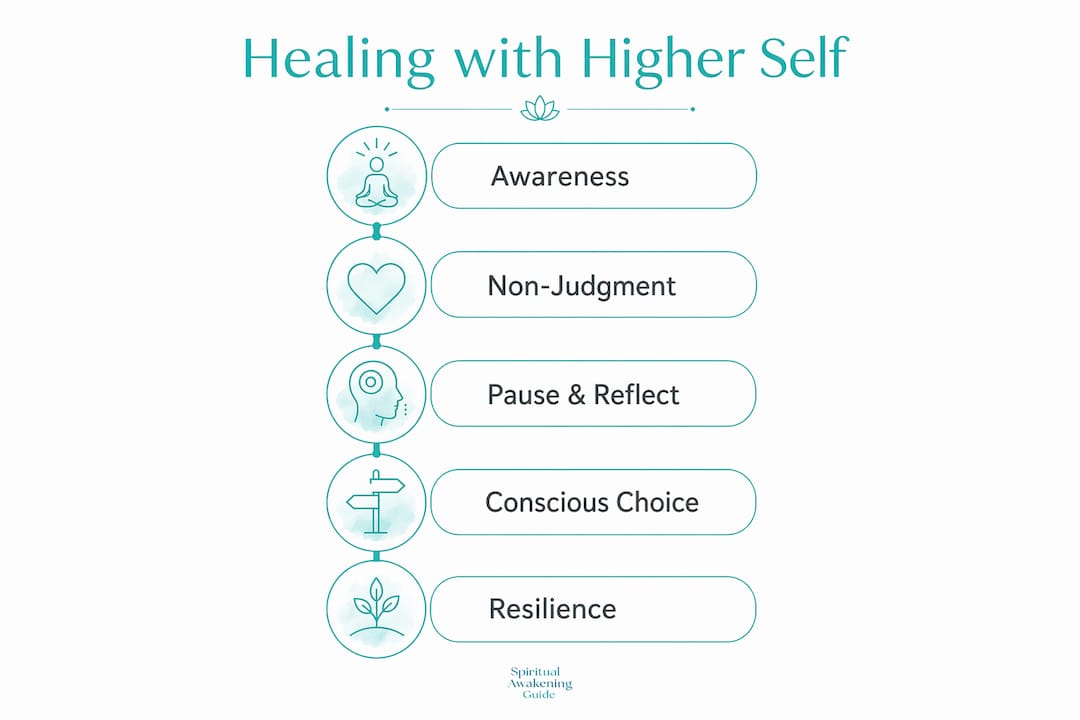
Healing at this level focuses on “seeing rather than fixing” patterns, enabling conscious choices and reducing unconscious reactions. The practical result is that automatic responses, such as shutting down during conflict or catastrophizing under stress, begin to lose their automaticity. You gain a moment of choice where there was none before.
The higher self also carries a natural orientation toward forgiveness. This is not a moral instruction but a structural feature of consciousness at that level. Forgiveness from the higher self is not about excusing harm. It is about releasing the energetic cost of carrying resentment, which frees attention and emotional resources for genuine recovery.
Key mechanisms the higher self activates in healing:
- Neutral observation: Sees patterns without judgment, reducing their emotional charge
- Expanded compassion: Extends understanding to yourself and others, loosening blame
- Conscious choice: Creates a pause between trigger and reaction, enabling deliberate response
- Forgiveness orientation: Releases stored resentment as a natural byproduct of elevated perspective
- Clarity over confusion: Replaces fear-based interpretation with grounded insight
Pro Tip: When a reactive emotion arises, pause and ask: “What would my wisest self see here?” That single question activates the higher self perspective and interrupts the automatic pattern before it runs.
What are the best higher self healing techniques?
Practical connection with the higher self requires consistent, structured practice. The techniques below are ordered from foundational to more advanced, and each addresses a different layer of access.
Meditation. Meditation quiets competing mental voices and allows inner wisdom to surface. Even 10 minutes of silent, breath-focused meditation daily creates measurable shifts in mental clarity and emotional regulation over time. The goal is not to empty the mind but to stop feeding every thought that arises.
Bypass-journaling. Writing without editing for 20 minutes disables the ego’s analytical filter and allows raw intuitive input to emerge. The rule is simple: write continuously, do not stop to correct or review, and do not censor. What surfaces often bypasses the fear-based mental patterns that block genuine insight.
Setting clear intentions. Before meditation or journaling, state aloud or in writing: “I am open to truth and guidance from my highest self.” This primes your attention toward receptivity rather than problem-solving, which is the correct orientation for higher self communication.
Self-muscle testing. This body-based technique helps bypass intellectual resistance and trust inner guidance by turning the body into a feedback instrument. A simple form involves holding a statement in mind and noticing whether your body sways forward (yes) or backward (no). Beginners often err by treating the higher self as an external entity. Self-muscle testing grounds the practice by making the body the receiver, not the mind.
Daily spiritual practice. Consistency matters more than duration. A daily spiritual practice of 15–20 minutes, combining meditation with brief reflective journaling, builds the neural and energetic pathways that make higher self access progressively easier.
Pro Tip: For bypass-journaling, set a timer and write the prompt “My higher self wants me to know…” at the top of the page. Do not stop writing until the timer ends. The first three minutes will feel forced. The insight usually arrives in minutes four through seven.
How do clinical frameworks support spiritual healing?
Spiritual integration in healthcare is no longer a fringe concept. Clinical frameworks FICA and HOPE help caregivers structure spiritual conversations for patient-centered healing, giving providers a structured tool to assess and support a patient’s spiritual life without imposing beliefs.
The FICA framework assesses Faith, Importance, Community, and Address in care. The HOPE framework covers sources of Hope, Organized religion, Personal spirituality, and Effects on care. Both frameworks emphasize patient autonomy and integrating spirituality only upon patient preference. This positions spiritual practice as a patient-led resource, not a clinical prescription.
“Whole-person care recognizes that biological, behavioral, social, and spiritual well-being are not separate systems. They are integrated dimensions of a single human experience.” This framing aligns directly with what higher self work addresses at the personal level.
The table below compares the clinical and spiritual approaches to healing integration:
| Dimension | Clinical Framework (FICA/HOPE) | Higher Self Approach |
|---|---|---|
| Primary tool | Structured assessment questions | Meditation, journaling, body awareness |
| Goal | Identify and support spiritual needs | Access inner wisdom and shift perspective |
| Practitioner role | Healthcare provider or chaplain | Self-directed practice |
| Evidence base | Patient-centered care research | Mindfulness and stress reduction studies |
| Core principle | Patient autonomy and informed consent | Openness, truth, and compassionate observation |
Spiritual practices like meditation support stress reduction and spiritual distress relief in healing contexts. The convergence of clinical and spiritual models confirms that inner wisdom in recovery is not a metaphor. It is a recognized, structured component of effective whole-person care.
What are the signs your higher self is supporting your healing?
Recognizing higher self involvement in your healing process helps you reinforce the practices that are working. These signs are distinct from ego-driven states, which tend to feel urgent, contracted, or self-referential.
Higher self manifests through intuition, compassionate perspective, creative flow, calmness amid chaos, and honest self-reckoning. These are not dramatic experiences. They are quiet, steady, and often easy to overlook if you are not watching for them.
Common signs of active higher self connection in healing:
- Calm certainty: A quiet knowing that does not require external validation
- Spontaneous forgiveness: Releasing resentment without effort or deliberate decision
- Increased intuition: Accurate gut responses that arrive before logical analysis
- Creative flow: Ideas and solutions that feel received rather than constructed
- Spaciousness in the chest: A physical sense of openness replacing tightness or constriction
- Reduced mental chatter: Longer periods of mental quiet between reactive thoughts
- Honest self-reckoning: Willingness to see your own role in patterns without self-attack
The contrast with ego-driven states is sharp. Ego states feel pressured, defensive, and comparative. Higher self states feel grounded, open, and self-sufficient. Journaling these experiences as they occur builds a personal record that reinforces the practice and makes the connection easier to return to. For readers working through loss, holistic grief healing practices offer a structured complement to higher self work during particularly difficult periods.
Key Takeaways
The role of higher self in healing is to provide a stable, compassionate perspective that transforms unconscious reactive patterns into conscious, chosen responses through consistent spiritual practice.
| Point | Details |
|---|---|
| Higher self defined | The wise, authentic core beyond ego that observes patterns without judgment or fear. |
| Core healing mechanism | “Seeing rather than fixing” patterns reduces their automatic grip and creates space for choice. |
| Most effective techniques | Meditation, bypass-journaling, and self-muscle testing each access higher self guidance differently. |
| Clinical recognition | FICA and HOPE frameworks integrate spiritual assessment into whole-person patient care. |
| Signs of connection | Calm certainty, spontaneous forgiveness, and reduced mental chatter indicate active higher self support. |
What I have learned about higher self work that most guides miss
Most writing on this subject frames the higher self as a destination you reach after enough practice. That framing creates a subtle but damaging expectation: that you are not yet connected, and that connection is a future reward. In my experience, the higher self is already present. The work is not to create the connection but to stop interrupting it.
The “seeing rather than fixing” principle is the most practically useful insight in this entire field, and it is also the most frequently abandoned. People come to higher self work with a problem they want solved. When the practice does not solve it quickly, they conclude the practice is not working. What is actually happening is that the ego is still running the session, looking for a fix rather than allowing awareness.
The other common error is expecting the higher self to feel extraordinary. Most people report their first genuine higher self contact as almost disappointingly ordinary: a quiet sense of knowing, a slight physical relaxation, a thought that feels different in quality from the usual mental noise. If you are waiting for a dramatic experience, you will miss the real ones.
Patient, consistent practice that integrates both clinical tools like mindfulness and personal methods like soul retrieval healing produces the most durable results. The higher self does not respond to urgency. It responds to openness.
— Sean
Deepen your higher self healing practice with Spiritualmethod
Spiritualmethod provides structured guides that complement the practices covered in this article, giving you concrete next steps for each stage of your healing work.
The soul retrieval healing examples guide on Spiritualmethod walks through eight documented approaches to recovering fragmented emotional energy, a process that works directly alongside higher self awareness. The journaling for soul healing guide provides step-by-step prompts designed to access deeper insight through the bypass-journaling method. For readers drawn to ritual-based practice, the sacred rituals in healing guide outlines specific practices that reinforce mind-body-soul connection. Each resource is built for practical use, not passive reading.
FAQ
What is the higher self in spiritual healing?
The higher self is the wise, authentic aspect of your consciousness that exists beyond ego-driven fear and reactive thought. In healing, it functions as an inner guide that provides clarity, compassion, and perspective on emotional patterns.
How does connecting with the higher self support emotional recovery?
Connecting with higher wisdom shifts perspective from victimhood to resilience, enabling better emotional management during grief and uncertainty. This shift reduces the unconscious grip of reactive patterns and creates space for conscious healing choices.
What is bypass-journaling and how does it help?
Bypass-journaling means writing continuously without editing for 20 minutes to silence the analytical mind and access higher self guidance directly. It disables ego-based mental filters, allowing authentic insight to surface without fear-based interference.
Are there clinical tools that support spiritual healing?
Yes. The FICA and HOPE frameworks are structured clinical tools used by healthcare providers to assess and support a patient’s spiritual life as part of whole-person care. Both frameworks prioritize patient autonomy and do not impose spiritual beliefs.
How do I know if my higher self is guiding my healing?
Signs of genuine higher self connection include calm certainty, spontaneous forgiveness, increased intuition, and reduced mental chatter. These experiences feel quiet and grounded rather than dramatic or emotionally charged.
Recommended
- The Role of Sacred Rituals in Healing Mind and Soul
- Discover Spiritual Healing Practices for Inner Peace
- What Is Transpersonal Healing: A Practical Guide
- Explore mind-body medicine and holistic wellness with guides on meditation, yoga, spiritual detox, and transformative healing. Read practical insights now. – Spiritual Awakening Guide: Clarity, Peace, Growth