
By the time individuals start searching for your invisible power, they’re not trying to become mystical. They’re trying to feel like themselves again.
They’re tired in a way sleep doesn’t fix. Their mind is noisy. Their body is tense. They keep doing all the sensible things, yet something still feels off, as if their energy leaks out faster than they can restore it. In that state, spiritual language can sound either comforting or frustrating. Comforting because you sense there’s more to life than pressure and performance. Frustrating because vague advice doesn’t help when you’re overwhelmed on a Tuesday afternoon.
That’s why Geneviève Behrend’s Your Invisible Power still matters. Behrend, born in 1881, became the only personal student of Thomas Troward, and her book was published in 1921, a milestone in spiritual self-help that came 85 years before The Secret and taught that conscious visualization can “attracts to you multiplied resources” according to this book reference for Your Invisible Power. Her central insight still lands today. You are not only reacting to life. You are participating in it.
Table of Contents
- The Untapped Energy Within You
- Recognize Your Power with Grounding Rituals
- Cultivate Your Power Through Daily Micro-Practices
- Protect Your Energetic Field from External Drains
- Amplify Your Intentions with Moon-Aligned Rituals
- Living an Empowered and Authentic Life
The Untapped Energy Within You
Individuals often misread depletion. They assume they need more discipline, more motivation, or a better morning routine. Often they need something simpler first. They need to reconnect to the part of themselves that has become scattered by stress, people-pleasing, overstimulation, and constant decision-making.
That’s where your invisible power becomes useful. Not as a dramatic force. Not as a promise that every wish appears instantly. It’s better understood as your inner capacity to direct thought, feeling, attention, and intention with purpose. When those four are split in different directions, you feel weak. When they align, you feel coherent.
Behrend’s work gave spiritual language to that alignment. She didn’t frame power as domination or control over other people. She framed it as inner authorship. Her teaching points you back to the idea that your mind is not a passive receiver. It is creative, directive, and consequential.
Ancient principle, practical consequence
If you’ve ever walked into a room and felt your shoulders tighten before anyone spoke, you already understand invisible power in a lived way. If you’ve ever thought about a problem so intensely that your body stayed braced for hours, you also understand it. Thoughts affect posture. Attention affects breath. Emotion affects energy.
This is why spiritual practice works best when it becomes embodied. The point isn’t to think prettier thoughts while your nervous system stays flooded. The point is to bring your inner life into a steadier arrangement.
Practical rule: Power feels less like intensity and more like steadiness.
Behrend is often associated with visualization, but the deeper lesson underneath it is responsibility. You don’t control every event. You do shape the quality of attention you bring to events. That trade-off matters. People who ignore their inner state often become highly efficient and internally exhausted. People who learn to direct their inner state don’t escape life’s demands, but they meet them with more clarity.
What this looks like in real life
A person with scattered energy usually shows familiar patterns:
- Mental overreach: They think about ten outcomes at once and can’t commit to one.
- Emotional leakage: They keep carrying conversations long after they end.
- Physical disconnection: They don’t notice tension until it becomes fatigue.
- Spiritual numbness: They want meaning, but everything feels flat.
A person reclaiming their invisible power doesn’t become perfect. They become more deliberate. They pause sooner. They notice sooner. They recover faster. They stop handing their entire inner climate over to every text, meeting, mood, and demand.
You don’t need more force. You need less internal contradiction.
That shift begins with grounding.
Recognize Your Power with Grounding Rituals

Grounding is the first practice I recommend because ungrounded spirituality tends to stay theoretical. You can journal beautifully, pull cards, say affirmations, and still feel frazzled if your body never gets the message that you are safe and present.
A grounded person isn’t someone who never feels stress. A grounded person notices stress without becoming fully possessed by it. That’s a major difference. If you’ve felt pulled in too many directions, start with sensory contact instead of trying to leap straight into manifestation. If you want a broader foundation for that journey, this spiritual awakening guide offers a helpful next layer of practice.
Why grounding comes first
Stress pulls energy upward. It crowds the head, speeds up thought, and disconnects you from the body. Grounding reverses that pattern. It brings attention down into breath, feet, skin, temperature, and touch. Once that happens, spiritual work becomes more reliable because you’re no longer practicing from panic.
There’s also a trade-off here. Grounding can feel unimpressive at first. People often skip it because it doesn’t feel dramatic. But the practices that seem plain are often the ones that restore your baseline fastest.
Three rituals that make energy tangible
Try one of these today. Don’t do all three at once unless you want a longer reset. The point is consistency, not performance.
1. The five-minute earth connection
Sit or stand with both feet on the floor or on the ground outside. Relax your jaw. Unclench your hands. Then imagine roots moving from the soles of your feet down into the earth.
Stay with the image until your breath slows a little. You may feel warmth, heaviness, or a subtle settling in your hips and legs. If your mind wanders, return to one sentence: “I am supported.”
2. The mindful breath anchor
This works well before meetings, after difficult messages, or when anxiety spikes for no obvious reason.
- Inhale slowly: Let the breath move into the belly first, then the ribs.
- Pause gently: Don’t strain. Just notice the still point.
- Exhale longer than you inhale: That longer exhale helps discharge agitation.
- Name the present moment: Think, “I am here now.”
Grounding is often less about adding energy and more about stopping the unnecessary loss of it.
After a few rounds, look around and identify three ordinary objects. A chair. A window. A cup. This simple orienting step brings the mind back from spiraling.
A short guided practice can help when your own focus feels slippery:
3. The water cleansing ritual
Use a shower, a sink, or even hand-washing. As water runs over your skin, give your mind a job. Picture what you want released moving off your body and down the drain.
This works best with clear language, such as:
- For stress: “I release what doesn’t belong to this moment.”
- For other people’s energy: “I return what is not mine.”
- For emotional heaviness: “I choose lightness, clarity, and peace.”
The ritual isn’t powerful because water is magical on its own. It’s powerful because your body can feel the action while your mind names the intention. That combination makes energy work feel real.
Cultivate Your Power Through Daily Micro-Practices
You wake up already behind. Before your feet hit the floor, your mind is answering messages, replaying yesterday, and bracing for what might go wrong. By noon, you feel scattered. By evening, you call it a lack of discipline, when the underlying issue is that your inner state never got anchored.
This is the gap Geneviève Behrend pointed to in Your Invisible Power. She taught that thought, held with feeling and direction, becomes creative. The Spiritual Method approach brings that idea down to earth through repeatable daily actions, so your practice supports your nervous system instead of staying trapped in theory.
Small, steady rituals change your baseline. If you want more ideas to build consistency, this collection of daily spiritual practices offers simple routines you can keep.
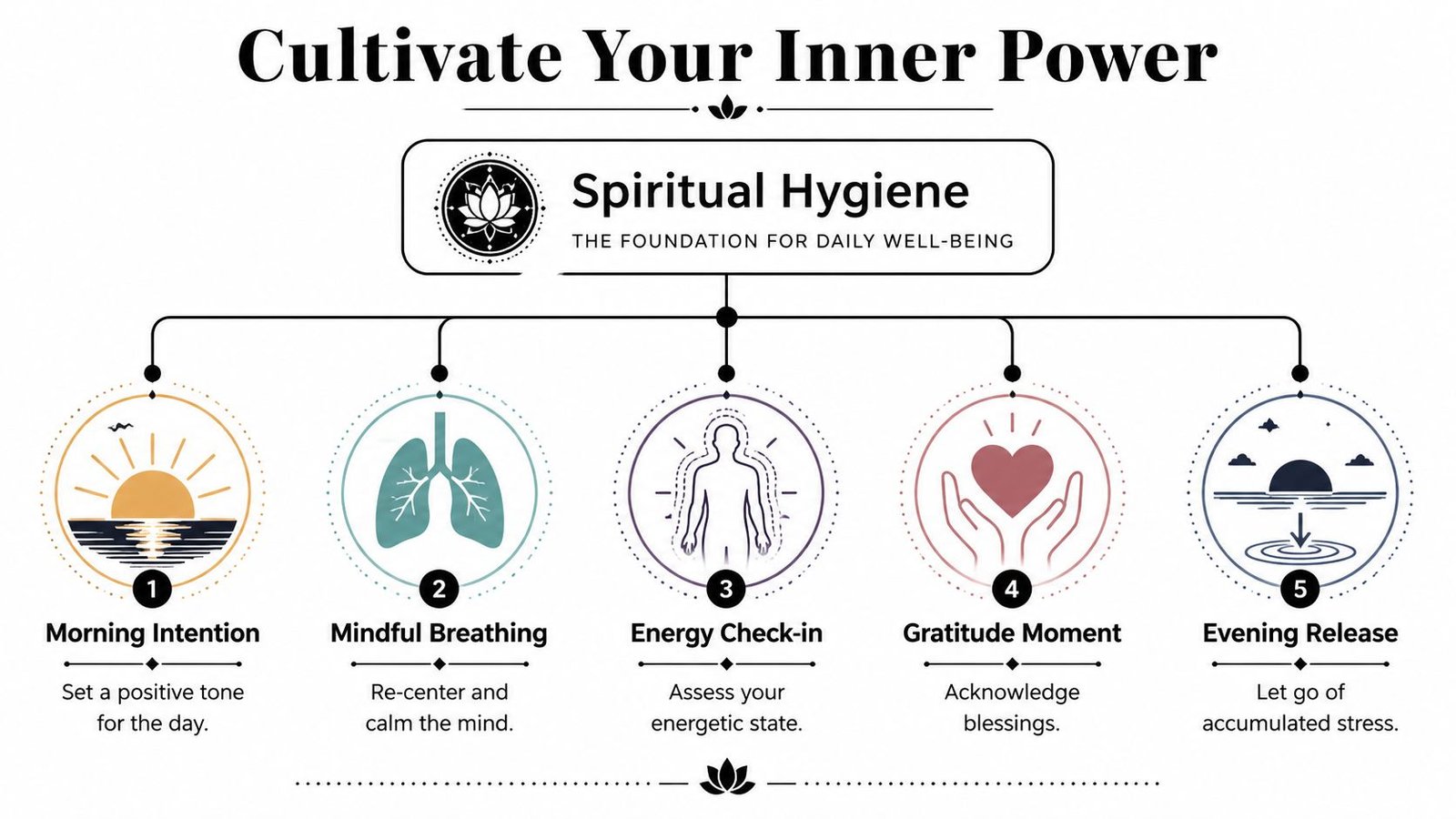
A simple spiritual hygiene rhythm
You do not need an elaborate schedule. You need a few moments that return you to yourself before stress takes over your attention.
Here is a pattern that works well for tired, overextended people.
| Time of day | Practice | What it does |
|---|---|---|
| Morning | Intention-setting | Gives your energy a direction before outside demands take over |
| Midday | Energy check-in | Helps you notice what you’ve absorbed and reset quickly |
| Evening | Release practice | Clears accumulated stress so you don’t carry it into sleep |
Morning can take less than two minutes. Stand near a window, place a hand on your chest, and choose one quality to embody for the day. Calm. Courage. Discernment. Focus. That gives the mind something clear to organize around.
Midday has a different job. Ask, “What state am I in right now?” If your jaw is tight, your shoulders are raised, or your thoughts are speeding up, pause for one minute. Breathe. Loosen your hands. Return to sensation before you return to tasks.
Evening is where many sincere people lose the thread. They close the day with stimulation, unfinished emotion, and mental noise. A short release practice works better. Wash your hands slowly. Stretch your back and neck. Write three lines about what you are ready to put down for the night.
That rhythm may look modest. In practice, it builds trust with yourself.
How to use visualization without drifting into fantasy
Behrend gave visualization a central place because it trains the mind to hold one clear pattern instead of scattering power across fear, doubt, and contradiction. The Spiritual Method framework keeps that practice grounded. Inner vision sets direction. Concrete action gives it form.
A modern summary of Behrend’s work reports 65 to 78 percent goal attainment when visualization is paired with consistent action, compared with 32 percent for intention-setting alone (positive psychology findings on visualization alongside Your Invisible Power). Use that carefully. Visualization supports follow-through. It does not replace effort, timing, skill, or honest self-examination.
Use this sequence:
- Get quiet first: Sit for a few minutes until your breath settles.
- Choose one result: Keep it singular and specific.
- Picture it as complete: See the scene after the shift has happened.
- Add feeling: Bring in relief, gratitude, steadiness, or confidence.
- Close with one real action: Send the email. Make the appointment. Clean the space. Have the conversation.
The last step is what keeps the practice honest. Visualization without action becomes avoidance. Action without inner coherence often turns into force, fatigue, or busy work.
Use imagery to organize your energy and support clear action.
A practical example makes the difference clear. If you want a calmer workday, do not hold a vague image of “success.” See yourself answering messages without panic, staying steady in one difficult conversation, and finishing the day with enough life left in you for your own home, body, and relationships. That is specific enough for your mind, emotions, and behavior to start moving in the same direction.
Protect Your Energetic Field from External Drains
You leave a meeting and feel heavier than when you walked in. Your body is home, but your mind is still carrying someone else’s irritation, urgency, or need. That is often what an unprotected energetic field feels like in ordinary life.
Geneviève Behrend taught that thought directs power. The Spiritual Method approach adds something many modern readers need. Protection has to become a daily practice, not just an inspiring idea. If your stress keeps rising because other people’s energy keeps landing in your system, theory alone will not help. You need a way to stay open-hearted without staying porous. If you want physical supports for that work, this guide to crystals for healing and protection offers grounded options.

Protection is self-respect
Energetic protection is an act of self-respect. It helps you keep your clarity, your stamina, and your emotional honesty in places that would otherwise scatter all three.
That can be understood spiritually and psychologically at the same time. Spiritually, you are tending the integrity of your field. Psychologically, you are choosing what gets access to your attention, nervous system, and emotional bandwidth. Those are not competing views. They describe the same experience from different angles.
I have seen many people resist this because they associate boundaries with coldness. In practice, the opposite is usually true. Clear boundaries make real compassion possible because you are no longer offering yourself from depletion.
A commonly cited future-dated framing in manifestation spaces says that a 2025 meta-analysis describes mental "shield" practices as supportive for goal-related focus through prefrontal cortex engagement, and that 70 percent of searchers pair manifestation with a search for science according to 2025 Google Trends, as summarized in a summary of research on visualization and science. Treat that as a modern interpretation, not a reason to postpone simple protective habits until every mechanism is explained.
Practical ways to stop absorbing everything
Before a draining setting, pause for one minute.
Close your eyes and create a bubble of light around your body. Keep it clear, steady, and permeable to what is good for you. Let kindness in. Let truth in. Keep out pressure, hostility, and emotional residue that does not belong to you.
Then support that inner boundary with visible behavior:
- Shorten unnecessary exposure: Compassion does not require prolonged access.
- Name your limit early: “I have ten minutes.” “I can help with this part.”
- Reset your body afterward: Step outside, wash your hands, drink water, or change clothes when you get home.
- Notice where your fatigue began: This helps you separate your own feelings from what you picked up in the room.
Protection is selective openness.
After a heavy conversation, use a simple cord-cutting meditation. Sit still and bring the interaction to mind. Notice where it still feels active in your body. Then picture the cord between you and that moment releasing. You are not erasing the relationship. You are ending the after-effect that keeps replaying inside your system.
Physical tools can support this work. Black Tourmaline is often used for grounding and boundary support. Selenite is commonly used to clear a room or refresh the feel of a space. The trade-off is simple. Tools can reinforce intention, but they cannot replace discernment, rest, or honest limits. Use them as supports for your practice, not substitutes for it.
Amplify Your Intentions with Moon-Aligned Rituals
There’s a reason many people find moon work easier than abstract manifestation language. The moon gives the mind a rhythm. Instead of trying to hold an intention in a vague, endless way, you place it inside a living cycle of beginning, building, releasing, and resting.
Behrend wrote that success requires a “will sufficiently steady to inhibit every thought and feeling contrary,” and that teaching appears in the PDF edition of Your Invisible Power. For this, lunar ritual is useful. A timed practice gives your will a focal point. It turns a wish into a deliberate appointment with yourself.
Why lunar timing helps
The New Moon carries a quieter quality. It’s a good moment for planting, naming, and choosing. The Full Moon has a brighter, more revealing quality. It helps with release, closure, gratitude, and emotional clearing.
The trade-off is important. Moon rituals can support intention, but they can also become a way to postpone responsibility if you use them superstitiously. The moon doesn’t do your choosing for you. It gives your choosing a container.
Rituals for the New Moon and Full Moon
For the New Moon, keep the practice simple and clean.
Try one of these:
- Write an intention list: Focus on what you want to grow, not on what you fear.
- Create a manifestation box: Place written intentions or symbolic items inside.
- Set one aligned action: Choose one practical move that matches the desire.
For the Full Moon, work with release.
A candle ritual works well. Write down what you’re ready to let go of, then read it slowly and safely burn the paper in a fire-safe container or tear it up if fire isn’t practical. A sacred bath also fits this phase. Use warm water, quiet lighting, and clear language about what you’re releasing from your mind and body.
Here’s a beginner-friendly guide:
| Moon Phase | Energy | Actionable Ritual |
|---|---|---|
| New Moon | Quiet, fertile, inward | Write intentions, build a manifestation box, choose one aligned action |
| Full Moon | Bright, revealing, releasing | Take a sacred bath, do a candle release ritual, clear emotional residue |
You don’t need to do this perfectly. You do need to do it sincerely. A short, focused ritual done with attention carries more weight than an elaborate ceremony performed while distracted.
If your intention is blurry, your energy will usually be blurry too.
Moon work is especially helpful for people who struggle to stay engaged with spiritual practice over time. The cycle itself becomes the reminder.
Living an Empowered and Authentic Life
Working with your invisible power isn’t about becoming untouchable or endlessly positive. It’s about becoming more honest with your energy. You notice what restores you, what scatters you, what belongs to you, and what doesn’t. That’s where authenticity begins.
The path is simple, even if it isn’t always easy. Ground yourself so you can feel what’s real. Build daily practices so your inner life has structure. Protect your field so your energy isn’t spent carelessly. Use natural cycles when you want added focus and meaning.
What works is steadiness. What doesn’t work is chasing intensity while neglecting basics. People often want the advanced ritual before they’ve learned how to breathe, sense, release, and choose clearly. Lasting spiritual growth usually moves in the opposite direction. It gets simpler, cleaner, and more embodied.
You already have the raw material. Attention. Intention. Feeling. Breath. Choice. Those aren’t small things. They are the instruments through which a life becomes coherent again.
If you’re ready for a more guided way to put this into practice, Spiritual Method offers a compassionate step-by-step path for releasing negativity, protecting and recharging your energy, and building daily rituals that support clarity, peace, and purpose. It includes instant access, practical tools for consistency, and a gentle structure that’s especially helpful if you’ve been feeling stuck, drained, or unsure where to begin.