
Grounding after meditation means deliberately bringing your attention back to your body, your breath and the room around you before you return to your day. A few minutes is usually enough. The most dependable methods are slow breathing with your feet on the floor, a short sensory exercise such as 5-4-3-2-1, gentle movement, and a small physical action like drinking water. If you regularly finish a session feeling dizzy, detached, tearful or simply not quite back, this transition step is the part of your practice worth adding.
This guide explains why the transition matters, how to tell ordinary after-effects from signals that call for a different approach, and how to build a closing routine you will keep using.
TL;DR
- Grounding is the bridge between inner awareness and ordinary activity. Spend two to five minutes on it at the end of each session, not only when something feels wrong.
- Pick one method from three families: sensory (5-4-3-2-1), breath and body (feet, slow exhale, body scan), or movement and nature (walking, hands in water, barefoot on grass).
- Feeling lightheaded, emotional or detached afterward is common enough to be documented in research. Shorter sessions and more active grounding often help.
- If distress is intense, lasts, or you have a trauma history, speak with a licensed mental health professional before continuing long sessions.
- A repeatable written routine works better than improvising each time.
Table of Contents
- Why meditation can leave you feeling ungrounded
- Signs you may need to ground
- Five grounding methods to use right after meditation
- Choosing a method: a quick comparison
- How long should you ground, and when?
- Our perspective: grounding is part of the practice
- Build a closing routine you will actually use
- A structured guide for your daily routine
- Common mistakes to avoid
- FAQ
- Sources
Why meditation can leave you feeling ungrounded
Meditation asks you to turn attention inward, soften your muscles, slow your breathing and loosen your grip on planning thoughts. That is the point. The side effect is that the return to a busy environment can feel abrupt, much like standing up quickly after lying down for a long time.
There is also an emotional layer. Cleveland Clinic’s guidance, as relayed in a podcast with Melissa Young, MD, describes grounding as a set of simple strategies that bring us back into the present moment and away from painful or difficult emotions. Beginners sometimes use meditation to force calm, and when the effort stops, whatever was being held back can surface. A closing step gives that material somewhere to settle instead of following you into your next meeting.
What the research says about after-effects
The idea that meditation is always soothing is incomplete. A systematic review of adverse events in meditation practices reported that 8.3% of meditators experienced some form of adverse event, with anxiety (33%), depression (27%) and cognitive anomalies (25%) among the most commonly reported symptoms.
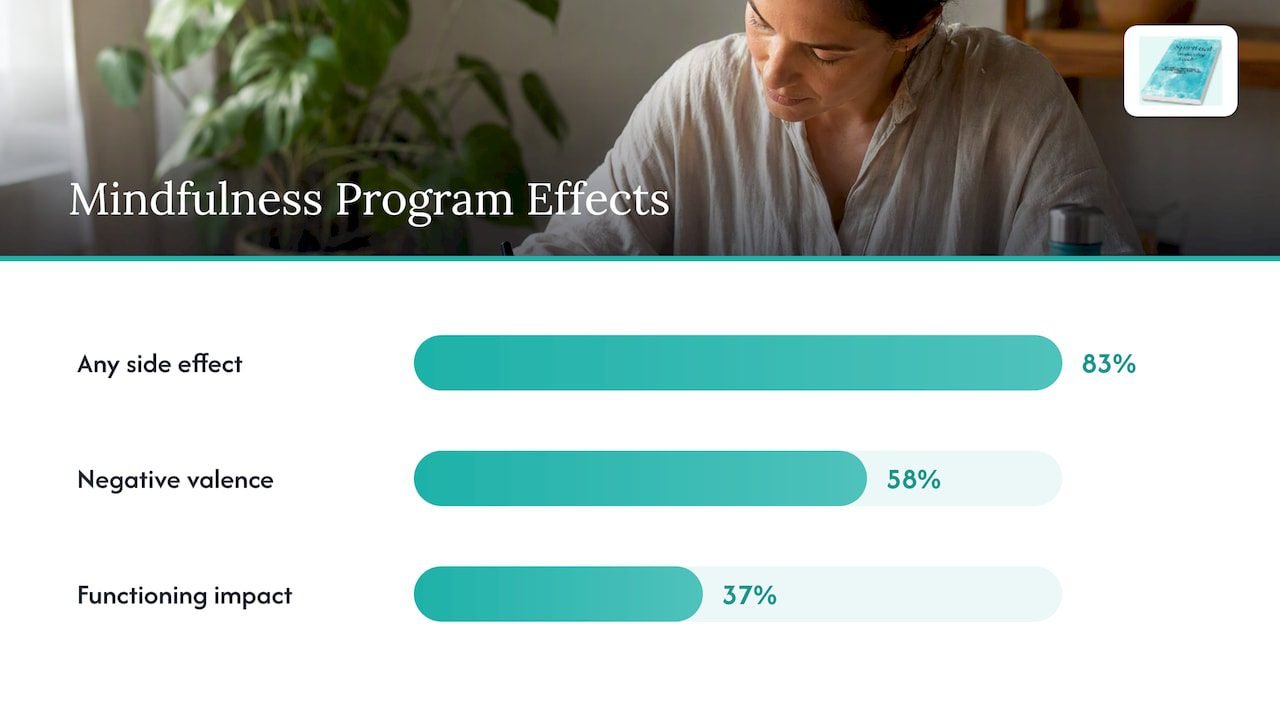
A separate study of mindfulness-based programs, published in 2021, found that 83% of participants reported at least one meditation-related side effect, 58% reported effects with negative valence, and 37% reported negative impacts on their functioning. These studies cover a range of programs and definitions, so the numbers should not be read as a prediction for any one person. They do show that a thoughtful exit from practice is a reasonable precaution, not an overreaction.
Physical sensations that are easy to misread
Dizziness, tingling, a pull toward deep breaths and a floaty feeling are sometimes interpreted as spiritual breakthroughs. One practical guide, Clear Body Guide, makes the case that such sensations often reflect a change in breathing pattern, and that treating them as physiological signals lets you adjust, for example by shortening the session or choosing more active grounding. Whatever meaning you give your practice, that is a steady way to handle the body’s feedback.
Signs you may need to ground
Not everyone needs a long routine. Look for these cues at the end of a session:
- Lightheadedness or a slightly floaty, “not in my feet” feeling
- Difficulty finding words or following a simple instruction
- Sudden sadness, irritability or restlessness
- Feeling distant from your surroundings or your own body
- A strong urge to sleep, or the opposite, jittery energy
- Clumsiness when you stand up or walk
Mild versions usually pass within minutes of a grounding step. If any of these are severe, frequent or last for hours, the answer is not a longer meditation. See a licensed therapist or your physician, particularly if you have a history of trauma, panic attacks or dissociation, and tell your meditation teacher what is happening.
Five grounding methods to use right after meditation
The methods below take between one and ten minutes. Try each at least three times before judging it, because the goal is a reliable habit, not a dramatic result. Experts quoted by Cleveland Clinic stress that the value lies in the process of building awareness of bodily sensations, not in producing a particular feeling.
1. Feet, seat and slow exhale (1 to 2 minutes)
Before you open your eyes, notice where your body meets the floor or chair. Press your feet down gently. Take five breaths in which the exhale is a little longer than the inhale. Then wiggle your fingers and toes, roll your shoulders, and open your eyes slowly, letting them rest on one object before you take in the whole room.
If breathwork is part of your sit, our 30-second breathwork reset for grounding shows a compact version you can use anywhere.
2. The 5-4-3-2-1 sensory check (2 to 3 minutes)
This is the most widely taught option, and the easiest to remember. Cleveland Clinic describes it as a mindfulness exercise that engages each of your five senses to interrupt overwhelming emotions such as anxiety, anger or sadness. The steps are:
- Name 5 things you can see.
- Name 4 things you can touch or feel.
- Name 3 things you can hear.
- Name 2 things you can smell.
- Name 1 thing you can taste.
Say them quietly or silently, and move slowly. NHS inform offers a similar exercise and notes that grounding aims to take your mind off uncomfortable symptoms or thoughts. The UW-Madison STAR study frames it as a way to notice your immediate environment by focusing outward. After meditation, that outward turn is exactly what you need.
3. A short body scan in reverse (3 to 5 minutes)
A body scan helps you notice how you feel in each region of the body. Cleveland Clinic’s body scan guide describes it as a way to become more in tune with yourself. Used for grounding, begin at the top of your head only if that feels comfortable, and move down to the feet, ending with the soles. Finish by feeling your weight settle. If scanning increases discomfort, skip it and use the sensory method instead.
4. Movement and touch (2 to 10 minutes)
Stand, stretch your arms overhead, and walk slowly around the room, noticing each heel and toe contact. Wash your hands under cool or warm water, paying attention to temperature. Hold a mug and feel its warmth. Eat a few bites of something with strong flavor. These actions use ordinary objects to anchor attention in the here and now, and they suit people who feel too restless for another seated exercise.

Some people extend this idea to deliberate water immersion after quiet time, and there is an article on plunge pools and mindfulness that explores how cooling off can support relaxation. A sink, a shower or a bowl of water gives you a similar sensory contrast at no cost.
5. Nature contact (5 to 15 minutes)
Walking barefoot on grass or sand is the classic option. A review of practical applications of grounding notes that research in this area is still developing, so treat it as a pleasant, low-risk habit rather than a proven treatment. If you cannot go outside, place your palms on a wooden table or a houseplant’s pot and focus on texture and temperature for a minute.
Choosing a method: a quick comparison
| Situation | Best fit | Time |
|---|---|---|
| Lightheaded, floaty | Feet, seat and slow exhale, then stand slowly | 1 to 2 min |
| Racing thoughts or emotion rising | 5-4-3-2-1 | 2 to 3 min |
| Numb or detached | Movement and touch, cool water | 2 to 5 min |
| Restless, buzzing energy | Walking, stretching, barefoot contact | 5 to 15 min |
| Quiet day, no problems | Short body scan, then a sip of water | 3 to 5 min |
The table is a starting point drawn from how these techniques work, not a clinical protocol. Adjust based on what you notice over a week or two.
How long should you ground, and when?
Search results for this topic include advice to wait a set number of minutes before grounding or to ground for a fixed period each day. We have not found an authoritative source that sets such a number, so we suggest a practical rule: ground for roughly as long as your session felt intense. A ten-minute sit might need two minutes. A long retreat-style session or an emotional one might need ten or more, plus a quiet half hour before demanding tasks.
Build a buffer into your schedule. Avoid driving, operating machinery or making important decisions directly after a deep session until you feel fully alert.
Our perspective: grounding is part of the practice
We built our materials around one conviction: a spiritual or mindfulness practice should leave you more capable in daily life, not less. That is why our guides place grounding, energy clearing and journaling around the sit, not only inside it. A closing ritual tells the nervous system the session is over, and writing a line or two afterward turns a vague impression into something you can review later.
We also encourage compassion in habit-building. If you skip a day, the routine is still there. Our trackers are designed to be forgiving for this reason. Consistency usually grows from small, repeatable steps, and a two-minute closing routine is far easier to keep than a forty-minute one.
Finally, we want to be plain about limits. Our guides are self-guided learning tools, not therapy. If a practice brings up something heavy, slowing down and seeking professional support is a sign of good judgment, not failure.
— Sean
Build a closing routine you will actually use
A routine works when it is specific enough to follow without deciding anything. Here is a sample five-minute template:
- Stay still for 30 seconds. Do not open your eyes yet. Notice your breath.
- Feel contact. Press your feet down and feel your seat or back against the support.
- Breathe out slowly. Five breaths with longer exhales.
- Use the senses. Open your eyes and name three things you see, two you hear and one you feel.
- Move. Stand, stretch and take ten slow steps.
- Drink water. A simple signal that you are returning.
- Write one line. Note the length of your sit, how you felt on exit and which grounding step you used.
After two weeks, read your notes. You will likely see which steps help most and whether certain session lengths leave you more unsettled. That is useful data for adjusting practice.
If you want more detail on individual techniques, these pages on our site go deeper: grounding visualization scripts from one to fifteen minutes, a five-step grounding ritual with a short script, and grounding exercises for healing. For background, see what spiritual grounding is and why it matters.
Pairing grounding with a root-centered practice
If you work with energy centers, a brief root chakra sequence is a natural closing step. Our root chakra grounding ritual takes under two minutes and focuses on feeling steady through the legs and base of the spine. Whether you see this as an energetic practice or as a structured way to focus on weight and support, the effect on attention is similar: you return to your body.
When grounding is for anxiety
Sometimes the feeling after meditation is not spaciness but anxiety. The same tools apply, with an emphasis on outward attention and slow breathing. Our guide to grounding techniques for anxiety relief covers these in more detail. Persistent anxiety deserves attention from a licensed clinician, and grounding should support that care, not replace it.
A structured guide for your daily routine
If you prefer a complete framework to piecing methods together, our Spiritual awakening guide is a downloadable PDF available for a one-off $20. It includes structured practices in grounding, energy clearing, sacred bathing rituals, intention-setting and journaling, along with progress tracking templates. Related materials include a spirituality planner and journal and a moon manifesting ritual guide. The guide is built for self-paced use, so you can add a closing routine to your current meditation without changing everything else.
Common mistakes to avoid
- Skipping the transition when you feel fine. Grounding is part of a balanced practice, not only a remedy when something goes wrong.
- Chasing a feeling. Using grounding to reach a special state misses the purpose, which is awareness of ordinary sensation.
- Extending sessions when you feel unsettled. If long sits leave you uneasy, shorten them and add movement.
- Interpreting every sensation as spiritual. Dizziness and tingling can be linked to breathing. Notice, adjust and keep your interpretation flexible.
- Going straight to a screen. Phones pull attention outward in a scattered way. Give yourself a few minutes of deliberate re-entry first.
- Ignoring warning signs. Strong or persistent distress calls for professional support.
FAQ
What are the symptoms of lack of grounding?
Common signs include feeling lightheaded, spacey, scattered or detached from your surroundings, and having trouble concentrating after a session. Some people also feel unexpectedly emotional or restless. If these are intense or last for hours, speak with a licensed mental health professional or your physician.
Is meditation considered grounding?
Some meditation styles, such as body scans or mindful breathing, can feel grounding because they draw attention to physical sensation. Others, especially visualization or practices that direct energy upward, can leave you feeling more floaty. Adding a short closing step covers both cases.
What is the 5-4-3-2-1 grounding rule?
It is a sensory exercise in which you name five things you see, four you can touch, three you hear, two you smell and one you taste. Cleveland Clinic describes it as a way to anchor your attention and interrupt overwhelming emotions. It takes about two to three minutes.
How many minutes a day should you ground?
No authoritative source sets a fixed number. A practical approach is to spend two to five minutes at the end of each meditation, and longer after emotionally intense sessions. Track how you feel for two weeks and adjust.
Does meditation not work without grounding?
Meditation can still be useful, but a transition step helps you carry its benefits into daily life and manage after-effects. Research shows that side effects are reported by a meaningful share of practitioners, which is a sound reason to include a closing routine.
Sources
- Adverse events in meditation practices and meditation-based therapies: a systematic review
- Defining and measuring meditation-related adverse effects in mindfulness-based programs
- Grounding Techniques to Reduce Anxiety with Melissa Young, MD, Cleveland Clinic
- 5-4-3-2-1 Grounding for Anxiety: How To Do It, Cleveland Clinic
- How to Do a Body Scan Meditation, Cleveland Clinic
- Grounding exercises, NHS inform
- 5-4-3-2-1 Grounding Exercise, STAR Study, UW-Madison
- Practical applications of grounding to support health, PMC
- Feel Weird After Meditation: Relaxation, Anxiety, or Dissociation?, Clear Body Guide