
Grounding the root chakra, known in yogic tradition as Muladhara, means restoring a felt sense of safety and physical steadiness. The fastest reliable actions are simple: standing with bare feet on the earth, a short attention-to-breath practice, and a brief body-based ritual done in sequence. Research on combined attention-based mind-body methods supports this approach for reducing anxious states, which makes these first steps worth trying today.
TL;DR:
- Grounding practices such as barefoot earthing and attention-to-breath exercises effectively reduce anxiety by regulating the nervous system and increasing interoception.
- Signs of a blocked root chakra include physical tension, persistent worry, financial or relationship instability, and difficulty sensing the body in space.
- Combining attention to breath, body, and cognition yields more reliable anxiety reduction, with an effect size of g = -0.91, compared to breath-only methods.
- Movement and yoga poses like Mountain and Garland pose help strengthen interoceptive awareness and support root chakra stability.
- Consistent daily habits, including short rituals, sensory grounding, and movement, foster long-term balance and prevent the need for complex routines.
Table of Contents
- What the root chakra represents and why grounding matters
- Signs your root chakra is blocked, underactive, or overactive
- Practical grounding methods: a categorized toolkit of quick wins and longer practices
- Movement, yoga, and body-awareness practices that root the base
- Meditation and breathwork scripts optimized for grounding
- Crystals, foods, and lifestyle supports commonly used for root chakra balance
- Daily integration: a realistic weekly plan to keep your root chakra grounded
- Practical 5-step grounding ritual you can use today
- Sean’s perspective on grounding as a foundation
- How Spiritual Method’s downloadable guide supports ongoing grounding
- Sources
- FAQ
What the root chakra represents and why grounding matters
Muladhara sits at the base of the spine, the point where the body meets the earth both literally and symbolically. In most chakra systems, it governs themes of safety, stability, belonging, and physical survival. When this energy center feels steady, a person tends to experience a baseline sense of security even when circumstances around them are uncertain.
An imbalance here rarely stays abstract. It shows up in the body as tension in the hips, lower back, or legs, along with fatigue or disrupted sleep. Psychologically, it often appears as persistent worry, a feeling of being unmoored, or difficulty trusting that basic needs will be met. These physical and emotional signals are connected, not separate symptoms competing for attention.
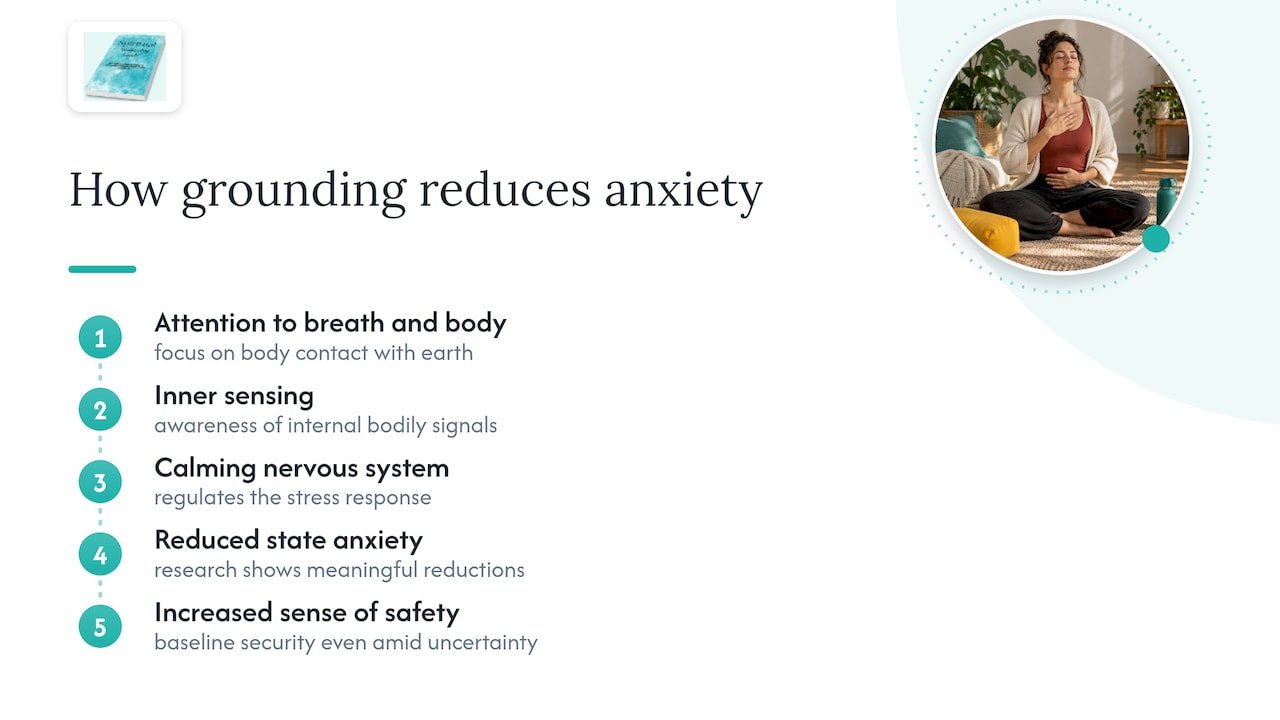
Grounding practices work by directing attention back to the body and its contact with the physical world. This taps into interoception, the internal sense of what is happening inside the body, and helps regulate the nervous system’s stress response. A systematic review of brief mind-body interventions found that combined attention-to breath, body, and cognition approaches produce meaningful reductions in state anxiety, which lends practical support to grounding as more than a metaphorical exercise. Understanding this link between attention and physiology gives grounding work a clearer purpose: it is not about chasing a feeling, but about training the body to recognize safety when safety is actually present.
Signs your root chakra is blocked, underactive, or overactive
A blocked or imbalanced root chakra tends to announce itself through a mix of physical, emotional, and behavioral patterns. Recognizing the pattern is the first step toward addressing it directly rather than treating each symptom in isolation.
- Physical signals: poor sleep, tension across the hips or lower back, or a low-grade fatigue that does not resolve with rest.
- Emotional signs: ongoing anxiety, a sense of insecurity about the future, or a feeling of disconnection from your own body.
- Behavioral clues: instability in how you handle money or relationships, a heightened startle response, or a tendency to hoard resources out of fear of scarcity.
A quick self-check can clarify where you stand. Sit or stand for one to two minutes, notice your feet against the floor, take three slow breaths, and observe whether you can sense your body’s position in space without effort. Difficulty settling into that awareness, or a persistent restlessness during the exercise, often signals that grounding work would help.
Practical grounding methods: a categorized toolkit of quick wins and longer practices
Grounding techniques generally fall into a few categories: contact with the earth, sensory redirection, breath and attention combinations, and physical release. Choosing from each category gives you options for different situations, whether you have thirty seconds or ten minutes.
- Earthing: stand or walk barefoot on grass, sand, or soil for five to ten minutes, letting your attention rest on the sensation of contact.
- Sensory grounding: use the 5-4-3-2-1 method, naming five things you see, four you feel, three you hear, two you smell, and one you taste.
- Cold-water grounding: run cool water over your wrists or splash your face to interrupt a spiral of anxious thought.
- Grounding objects: hold a smooth stone, a piece of red jasper, or any object with texture and let your fingers trace its surface.
- Progressive muscle relaxation: tense and release each muscle group from feet to head, which gives the body a clear signal of tension leaving.
Combined attention-based methods, those that direct focus to breath, body, and thought together, show a large and consistent reduction in state anxiety, with one meta-analysis reporting an effect size of g = -0.91 compared to control conditions. That distinction matters when choosing a technique: breath-only exercises produced more mixed results in the same review, while combined approaches performed more reliably.
Rather than trying every technique, pick two or three that fit your daily rhythm, one for acute moments and one for a longer wind-down. For a deeper dive into these methods, our guide on grounding techniques for anxiety relief walks through additional variations.
Pro Tip: Start with the technique that takes the least effort to remember under stress, sensory grounding or feet-on-floor work best when your mind is already racing.
Movement, yoga, and body-awareness practices that root the base
Physical postures that emphasize weight-bearing through the feet and legs are among the most direct ways to engage the root chakra. Yoga traditions offer several poses built specifically for this purpose.
- Mountain Pose (Tadasana): stand with feet hip-width apart, pressing evenly through all four corners of each foot, and hold for five slow breaths.
- Garland Pose (Malasana): lower into a deep squat with feet flat, hands in prayer position, which stretches the hips while reinforcing a low center of gravity.
- Standing weight shifts: rock gently from heels to toes, noticing how your balance adjusts, for about one minute.
- Simple grounding sequence: move from Mountain Pose into Malasana and back, repeating slowly for three to five minutes.
These practices work in part because they heighten interoceptive awareness, the same mechanism behind attention-based breathing exercises. A review of mind-body interventions found that embodiment approaches, those involving deliberate changes in body position and awareness, produced consistent reductions in anxiety during brief interventions.
Pro Tip: If standing poses are not accessible, seated variations work just as well: press your feet firmly into the floor while seated and apply the same attention to contact and weight.

Meditation and breathwork scripts optimized for grounding
A short meditation script can anchor attention quickly. Sit comfortably, bring attention to the soles of your feet, and silently note the sensation of contact for ten breaths, then slowly expand awareness to the rest of the body.
- 30-Second Reset: inhale for four counts, hold for four, exhale for six, and repeat three times, a compact option detailed in our breathwork for grounding guide.
- Three-minute grounding breath: extend the same pattern for three minutes while keeping attention on the breath and the feeling of feet against the floor.
Research suggests combined attention methods, those pairing breath awareness with body and cognitive focus, tend to produce stronger and more consistent reductions in anxiety than breath-only techniques that actively change breathing patterns, according to the same systematic review, which found attention-based combined approaches reaching g = -0.91 compared to g = -0.24 for active-change combined methods.
A brief caution: some breathing exercises can cause lightheadedness, and people with respiratory conditions should approach active breath-holding patterns carefully or check with a clinician first. For more on how grounding differs from related practices, see our explainer on grounding versus centering.
Crystals, foods, and lifestyle supports commonly used for root chakra balance
Physical supports can reinforce grounding work, though they function best as complements rather than substitutes for consistent practice.
- Red jasper and hematite: often carried in a pocket or placed near the bed as tactile reminders to return attention to the body.
- Black tourmaline: commonly used for its grounding association, sometimes placed near entryways or workspaces.
- Root vegetables and warming spices: foods like sweet potatoes, beets, and ginger appear frequently in root chakra nutrition guidance.
- Ashwagandha: an herb associated with stress reduction, though the ODS health professional fact sheet notes it requires attention to dosing and potential interactions, so consulting a clinician before use is worthwhile.
None of these replace the more foundational supports: consistent sleep, a stable daily routine, and steady habits around money and relationships tend to do more for a settled nervous system than any single object or ingredient. A broader look at evidence-based stress relief, including supplement considerations, is available through Nutribliss.
Daily integration: a realistic weekly plan to keep your root chakra grounded
Building a sustainable practice starts with selecting a small number of micro-habits rather than an ambitious overhaul. Pick one one-minute practice, one five-minute practice, and one fifteen-minute practice, then repeat them across the week.
- One minute: feet-on-floor check paired with three slow breaths, done first thing in the morning.
- Five minutes: sensory grounding or the 30-Second Reset repeated several times during a stressful afternoon.
- Fifteen minutes: a full movement sequence or journaling session in the evening, drawing on ideas from our grounding exercises for healing guide.
Progress often shows up as better sleep, steadier reactions to minor stressors, and a general sense of settledness that carries through the day rather than a single peak moment of calm.
Practical 5-step grounding ritual you can use today
This short ritual blends breath, body awareness, and a brief mental anchor, designed to work whether you have privacy or need something discreet in public.
- Step 1: stand or sit, feet flat on the ground, and take one slow breath.
- Step 2: press your feet down deliberately, noticing the floor’s resistance.
- Step 3: silently name three things you can feel touching your skin.
- Step 4: place a hand on your chest or stomach and take three breaths at a natural pace.
- Step 5: set a one-word intention for the next hour, such as “steady” or “present.”
The full sequence takes under two minutes and works seated at a desk or standing in a crowded room. For an expanded version with habit-tracking tools, our essential guide to spiritual awakening offers additional structure.
Sean’s perspective on grounding as a foundation
Grounding is not a one-time fix, it is a baseline you return to before any deeper healing work makes sense. In my view, people often chase advanced energy practices while skipping the basic skill of feeling steady in their own body first. Grounding supports that other work, but it does not replace clinical care. If anxiety or trauma symptoms feel severe or persistent, a licensed therapist should be part of the plan alongside any personal practice.
— Sean
How Spiritual Method’s downloadable guide supports ongoing grounding
Building a grounding habit that lasts takes more than a single article, it takes scripts you can return to and a way to track what is working. The Spiritual awakening guide ($20 one-off) includes structured ritual scripts, breathwork instructions, and habit trackers designed to extend the practices covered here into a full routine.

It suits readers who have tried a few grounding techniques and want a more organized framework to build on, without needing to design the structure themselves. The guide complements the free practices in this article rather than replacing them, giving you scripts for the days when motivation runs low. You can find it on our downloads page and start using it right away.
Sources
The anxiety research cited above comes from a systematic review of brief mind-body interventions and a review of scalable mind-body programs. For supplement safety, the ODS ashwagandha fact sheet offers clinician-reviewed guidance.
- A systematic review of brief respiratory, embodiment, cognitive, and mindfulness interventions to reduce state anxiety – PMC
- Ashwagandha – Health Professional Fact Sheet | ODS
FAQ
How do you ground your root chakra?
Standing barefoot on natural ground, practicing slow attention-to-breath exercises, and using a short body-based ritual are among the most direct ways to ground the root chakra. Combined attention-based methods, those that pair breath awareness with body focus, show the most consistent research support for calming an activated nervous system.
What trauma is stored in the root chakra?
Chakra traditions associate Muladhara with experiences tied to safety, survival, and early security, including instability around basic needs, home, or caregiving. This is a symbolic framework rather than a clinical diagnosis, so anyone processing trauma symptoms should also seek support from a licensed mental health professional.
What are signs of a blocked root chakra?
Common signs include physical tension in the hips or lower back, persistent anxiety or insecurity, and behavioral patterns like financial instability or hypervigilance. A quick self-check, noticing your feet on the floor and your breath for a minute or two, can help you gauge whether grounding work would help.
What are the signs that my root chakra is opening?
Improved sleep, a steadier emotional baseline, and reduced reactivity to minor stressors are common markers that grounding practices are taking hold. Many people also notice an easier time feeling settled in their body during daily activities rather than only during dedicated practice sessions.