
A grounding ritual works when it follows a repeatable order: plant your feet, complete one slow breath cycle, run a 5-4-3-2-1 sensory scan, touch something textured, then close with a short phrase and a sip of water. The full version takes 5 to 15 minutes; the emergency version takes 2 to 5. Full grounding ritual steps, including exact counts and scripts, follow below.
TL;DR:
- Grounding routines are most effective when practiced daily for 5 to 15 minutes, ideally before distress peaks, to build familiarity and resilience.
- The full ritual includes five steps: grounding posture, slow breathing with extended exhalation, sensory scanning using the 5-4-3-2-1 technique, physical reconnecting with textured objects, and ending with a grounding phrase.
- During acute panic, a shorter 2 to 5-minute script that emphasizes pressing against surfaces and quick sensory checks effectively calms the mind and body.
- Consistent rehearsal of the grounding script in calm moments enhances automatic response during crises, rather than trying to remember steps in the moment of distress.
- Long exhale breathing patterns, like the 4-2-6 count, directly shift the nervous system toward calm, while sensory focus distracts the mind from racing thoughts.
Table of Contents
- Grounding Ritual Steps for a Full 5 to 15 Minute Practice
- What Do You Do When Panic Hits Right Now?
- Why Does Longer Exhale Breathing Calm You Down?
- How Often Should You Practice Grounding Rituals?
- How Do You Build Grounding Into an Ordinary Day?
- What Does the Research Actually Say About Grounding?
- A Personal Note on Making Grounding Stick
- Turn These Steps Into a Repeatable Ritual
- Sources
- FAQ
Grounding Ritual Steps for a Full 5 to 15 Minute Practice
A complete grounding ritual has five parts, and skipping the order tends to blunt the effect. Each step below builds on the last, moving from posture to breath to sensory attention and back to the body.
Prepare. Sit or stand with both feet flat on the floor. Choose a space where you will not be interrupted for at least five minutes. Rest your hands on your thighs or at your sides, palms open.
Breathe. Inhale through your nose for a count of 4, hold for 2, then exhale slowly through your mouth for a count of 6. Repeat this for 3 to 5 rounds. The longer exhale is not arbitrary. It signals the parasympathetic nervous system to slow the heart rate, which is why breath work tends to precede sensory grounding rather than follow it.
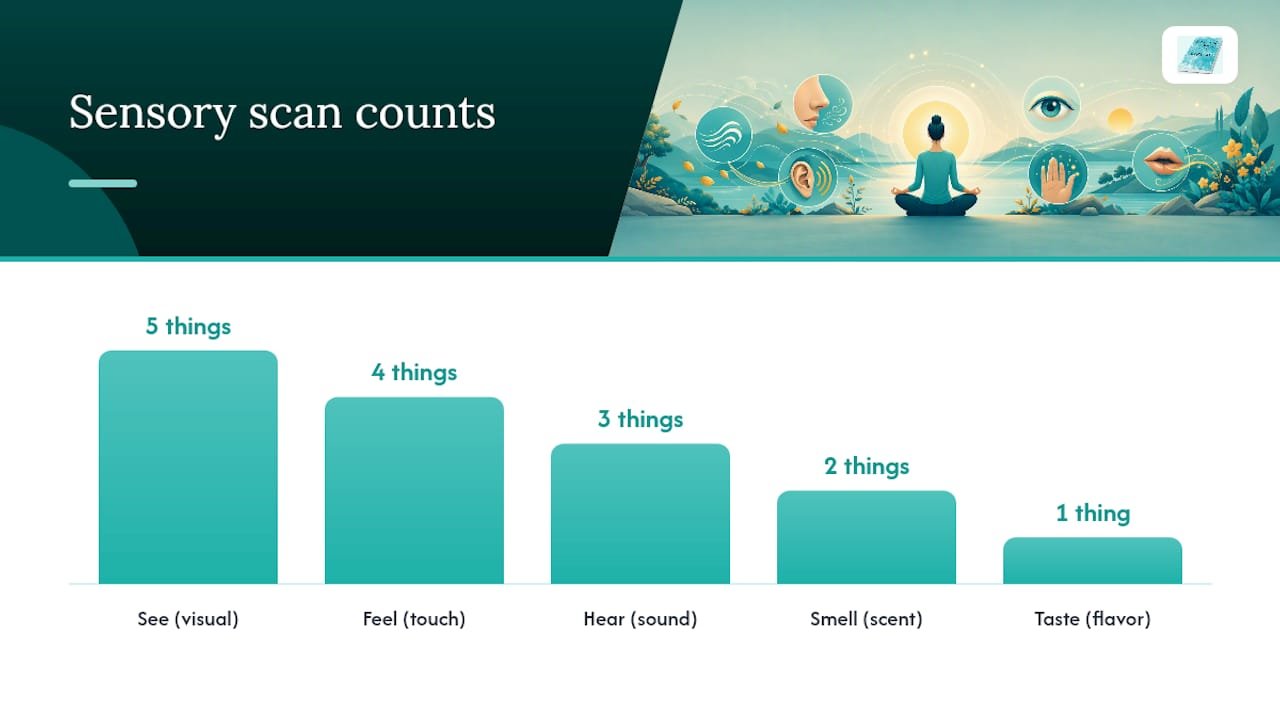
Run the sensory scan. This is the 5-4-3-2-1 technique that Cleveland Clinic describes as a way to interrupt racing thoughts by engaging all five senses in sequence. Name 5 things you can see, moving your eyes toward each one. Name 4 things you can physically feel, touching each if possible. Name 3 things you can hear. Name 2 things you can smell. Name 1 thing you can taste. Moving your head and eyes toward each item, rather than just listing them mentally, gives the exercise a physical dimension it otherwise lacks.
Reconnect with your body. Press your feet firmly into the floor for 5 seconds, then release. Clench both fists for 5 seconds, then let go. Pick up a textured object, a stone, a piece of fabric, a coffee mug, and hold it for 10 seconds while noticing its temperature and surface.
Close the ritual. Say a short grounding phrase out loud or silently: “I am here. This moment is enough.” Take a sip of water. Do one small, deliberate action, straighten your desk, open a window, before returning to your day.
If your mind is still racing after step 5, repeat steps 3 and 4 once more rather than starting over from the beginning. Most people need only one full pass, but a second sensory scan rarely hurts and often finishes the job.
What Do You Do When Panic Hits Right Now?
Full rituals are for calm moments. Panic needs something faster. This script runs 2 to 5 minutes and works standing in a grocery line as easily as it does at your kitchen table.
- Press both feet into the ground, or both palms against a wall or table. Say silently: “I am [your name]. I am in [place]. It is [day of week].”
- Breathe for 3 rounds: inhale 4, hold 2, exhale 6.
- Scan fast: 5 things you see, 4 things you feel, 3 things you hear, 2 things you smell, 1 thing you taste.
- Hold a tactile object, a pocket stone, a keychain, a piece of fabric, and press your thumb against it.
- Say once, out loud if you can: “I am here. This will pass.”
The National Center for PTSD recommends exactly this kind of rehearsed, simple sequence for acute distress, since a script you have practiced beforehand is far easier to execute when your thinking is already impaired by panic.
Pro Tip: Practice this script three times a week when you are calm, not distressed. A script rehearsed only during crisis rarely sticks; one rehearsed in advance becomes close to automatic.
Why Does Longer Exhale Breathing Calm You Down?
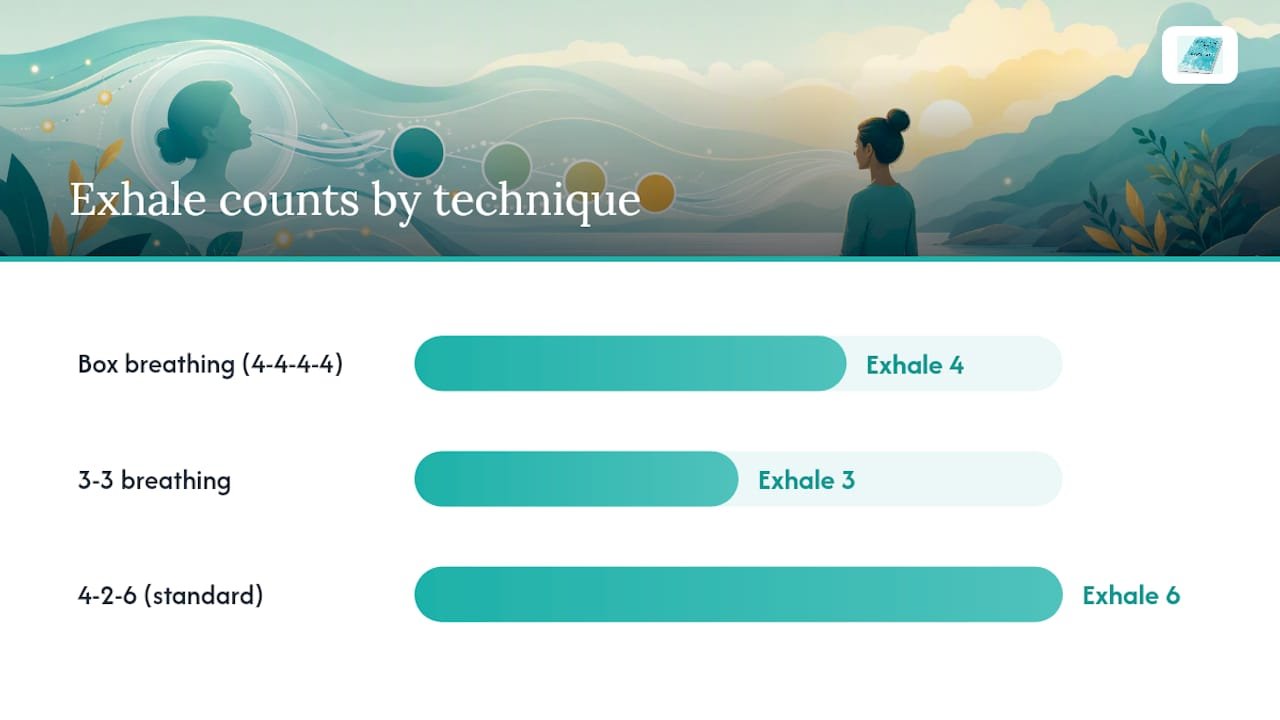
The 4-2-6 breath count is not the only option, but it illustrates a principle worth understanding: exhaling longer than you inhale nudges the nervous system toward its calming branch. Some breathing coaches suggest this inhale-hold-exhale pattern specifically because the extended exhale is what triggers the shift, more than the total breath length does.
Variations work just as well once you understand the mechanism:
- Box breathing (4-4-4-4): equal counts for inhale, hold, exhale, hold. Useful when a longer exhale feels hard to sustain.
- 3-3 breathing: a simpler count for beginners or children.
- 4-2-6: the standard version used in the full ritual above.
The 5-4-3-2-1 scan works through a different channel entirely: attention redirection. Naming concrete sensory details helps distract the brain from racing thoughts. Psychology Today notes that moving your head and eyes toward each item you name engages the body more directly than mentally listing them from a fixed stare, which is why physical movement is built into the steps above rather than treated as optional.
When distress is primarily physical (racing heart, tight chest), start with breath. When it is primarily mental (spiraling thoughts, dissociation), start with the sensory scan.
How Often Should You Practice Grounding Rituals?
Grounding works best as a daily habit, not just an emergency tool. Cleveland Clinic suggests starting the technique when distress is still low, rather than waiting until it peaks, since early intervention is far easier on the nervous system than trying to interrupt a full spiral.
- Daily maintenance: 5 to 15 minutes, once a day, ideally at a consistent time.
- Proactive practice: run the full ritual on ordinary days, not just hard ones, so the sequence becomes familiar before you need it.
- When it is not enough: if grounding rituals leave you feeling worse, if distress persists past 20 to 30 minutes, or if panic episodes are increasing in frequency, that is a signal to talk with a therapist or contact a crisis line rather than relying on self-guided steps alone.
How Do You Build Grounding Into an Ordinary Day?
A grounding ritual sticks best when it is attached to something you already do. Pair a 3 to 7 minute version with brushing your teeth, making coffee, or the first few minutes after you sit down at your desk.
- Barefoot contact (“earthing”): standing barefoot on grass, sand, or bare floor for a few minutes. WebMD describes emerging evidence suggesting short daily sessions of physical grounding may ease stress and support sleep, while noting the research base remains limited, so treat it as a pleasant add-on rather than a proven remedy.
- Pocket objects: a smooth stone, a small piece of textured fabric, kept in a pocket or bag for the tactile step.
- Short audio cues: a two-minute playlist or a single scented item (essential oil, tea) can serve as a sensory anchor if you build one into the morning grounding routine.
- Bath rituals: for an evening version, a short relaxing bath ritual can double as sensory grounding through temperature and scent.
What Does the Research Actually Say About Grounding?
Grounding is not a cure, and no credible clinical source frames it that way. It works as an attention anchor and a short term interruption of distress, which is precisely how it should be used.
Grounding techniques fall into physical, mental, and soothing categories, body scans, sensory lists, clench and release exercises, and short walks, all of which work by anchoring attention to the present moment rather than resolving the underlying cause of distress.
That framing comes from Healthline’s overview of grounding techniques, and it matches guidance used in clinical settings for acute symptom management.
- Cleveland Clinic: step-by-step 5-4-3-2-1 script and clinical notes on early intervention.
- Ptsd: grounding strategies for acute distress and safety planning.
- Spiritualmethod’s essential guide to spiritual awakening and grounding rituals expands these steps into a multi-day practice with journaling prompts.
A Personal Note on Making Grounding Stick
My own quick ritual takes about ninety seconds: feet flat, one long exhale, name three things I hear. I pair it with the kettle boiling, so it happens whether I remember to plan it or not. Rehearse yours on an ordinary Tuesday, not during a crisis. That is when the habit actually forms.
— Sean
Turn These Steps Into a Repeatable Ritual
You can find scripts, prompts, and tracking pages that a five-step list on a webpage cannot provide: a structured, repeatable framework instead of steps you have to remember on your own.

If the steps above resonated but you know you will not remember the exact counts next Tuesday at 3 p.m., that is exactly the gap Journaling for Soul Healing is built to close. The guide includes ritual scripts for daily and emergency grounding, reflective journaling prompts to track what triggers distress, and simple progress pages so you can see which version of the ritual actually works for you over time. It is built for readers who want the structure of a written plan rather than trying to reconstruct five steps from memory during a hard week. Download the guide and start your first entry tonight.
Sources
- 5-4-3-2-1 grounding for anxiety: how to do it — Cleveland Clinic
- Grounding: Techniques and benefits — WebMD
- Managing strategies — PTSD: National Center for PTSD (VA)
- 30 grounding techniques to quiet distressing thoughts — Healthline
FAQ
What Are the 5 Steps to Grounding?
The five steps are: get into a stable posture with feet flat, complete a slow breath cycle, run the 5-4-3-2-1 sensory scan, reconnect physically by pressing your feet or holding a textured object, then close with a short phrase.
How Long Should You Ground Each Day?
A daily maintenance practice runs 5 to 15 minutes, while an emergency grounding script for acute distress takes just 2 to 5 minutes.
What Is the 5-4-3-2-1 Grounding Rule?
It is a sensory technique where you name 5 things you see, 4 you feel, 3 you hear, 2 you smell, and 1 you taste, moving your eyes or body toward each one as you name it.
How Do I Ground Myself Immediately?
Press your feet or hands against a solid surface, state your name, location, and the day out loud, then complete three rounds of breathing with a 4 count inhale and a 6 count exhale before running a quick sensory scan.