
A daily grounding practice is a short, repeatable routine that anchors your attention in the present moment through your body and senses. It takes about ten minutes a day, needs no yard, park or special equipment, and works best when you rehearse it on ordinary days so that it is familiar when a hard moment arrives. This guide sets out a structured routine for morning, midday and evening, explains how to adapt it indoors, and notes where caution is appropriate.
TL;DR
- Grounding means anchoring yourself in the here and now, and guidance from public agencies recommends practicing it regularly, even when you do not need it.
- A workable daily structure is three short blocks: 3 minutes in the morning, 2 to 5 minutes at midday, and 3 to 5 minutes in the evening.
- You can ground indoors with your senses, your breath and simple objects. Contact with the earth is optional, not required.
- Rate your mood from 0 to 10 before and after each practice for two weeks to see what actually helps you.
- Grounding is not a substitute for care. If you experience dissociation, panic or trauma symptoms, work with a licensed mental health professional.
Table of Contents
- What a Daily Grounding Practice Is, and What It Is Not
- Why Practice Daily Instead of Only in a Crisis
- A 10-Minute Daily Grounding Routine
- How to Ground Indoors, Without Nature
- If You Want to Add Earth Contact
- Track What Works for You
- Adjusting for Trauma Sensitivity
- Making the Habit Stick
- Our Perspective on Daily Grounding
- A Structured Companion for Your Routine
- FAQ
- Sources
What a Daily Grounding Practice Is, and What It Is Not
Grounding techniques are a set of simple strategies for detaching from emotional pain such as panic, anger or intense sadness. The Washington, D.C. Office of Victim Services and Justice Grants describes them as working by shifting focus from internal emotional states to the external environment. The same guidance notes that this is sometimes called “centering.” If you want to explore how the two ideas differ, our article on grounding versus centering covers it in detail.
It helps to be precise about what grounding is not. It is not the same as general relaxation, which can invite you to get in touch with your feelings. Grounding is closer to an active, intentional break from them. The goal is not to analyze an emotion but to step out of its intensity and return to the room you are actually in.
That distinction shapes how you practice every day:
- Keep observations neutral. If you name what you see, say “the wall is blue,” not “the wall is blue and I don’t like it.” Judgmental language can reconnect you to the very associations you are trying to set down.
- Postpone reflection. Journaling or talking through the source of a difficult feeling is best done after you reach a state of calm, not during the grounding itself, because premature reflection can re-trigger the state you were soothing.
- Start early. Grounding tends to work best when you begin at the first sign of a strong emotion rather than waiting for it to peak.
A related clinical point is worth knowing. A 2025 critical review by Hammond and Brown found that grounding is widely used for dissociative episodes but has lacked a unified, measurable definition, and it proposed an operational definition centered on physiological equilibrium. In plain terms, the field is still maturing, so it is sensible to treat grounding as a practical skill and not as a guaranteed cure.
Why Practice Daily Instead of Only in a Crisis
A skill used only under pressure is a skill you have not yet learned. The public guidance cited above recommends practicing grounding regularly, even when you do not need it, so that the technique is more effective when you are acutely distressed. This mirrors how most learned routines work: the first attempt happens on a calm morning, not in the middle of an overwhelming afternoon.
There is also research context. A 2026 systematic review in Current Neuropharmacology reported that non-pharmacological approaches such as mindfulness-based stress reduction and cognitive behavioral therapy reliably reduced PTSD symptom severity, with some trials showing improvements of up to 45%. Grounding techniques were identified as components that support present-moment concentration within those interventions. That finding concerns structured clinical programs, not a ten-minute home routine, so it supports the value of the underlying skills without promising the same results for a self-guided habit.
A 10-Minute Daily Grounding Routine
The routine below uses three short blocks. Each block has a single purpose, which keeps the practice easy to remember and easy to repeat.
| Time of day | Length | Focus | Example practice |
|---|---|---|---|
| Morning | 3 minutes | Setting a steady baseline | Feet on the floor, slow breathing, naming five things you see |
| Midday | 2 to 5 minutes | Resetting between tasks | Hands pressed against a desk, 5-4-3-2-1 senses check |
| Evening | 3 to 5 minutes | Releasing the day | Body scan from feet upward, one grounding object held in hand |
Morning: Establish a Baseline (3 minutes)
Before you pick up your phone, sit on the edge of the bed or a chair with both feet flat on the floor.
- Notice the pressure of your feet against the floor and the weight of your body on the seat.
- Breathe in slowly for a count of four, hold for four, and exhale gently through your mouth. Repeat for six to eight breaths.
- Silently name five things you can see in the room, using neutral descriptions.
- Rate your mood from 0 to 10 and write the number down.
If you want a shorter breath-focused option, our 30-second breathwork for grounding guide offers a compact version.
Midday: Reset Between Tasks (2 to 5 minutes)
This block is for the point in the day when attention scatters. Stand up, press your palms flat against a desk or wall, and push gently for ten seconds, then release. Then run the 5-4-3-2-1 sequence: five things you see, four you feel, three you hear, two you smell, one you taste. Go slowly. The point is to be present with each sense, not to finish quickly.
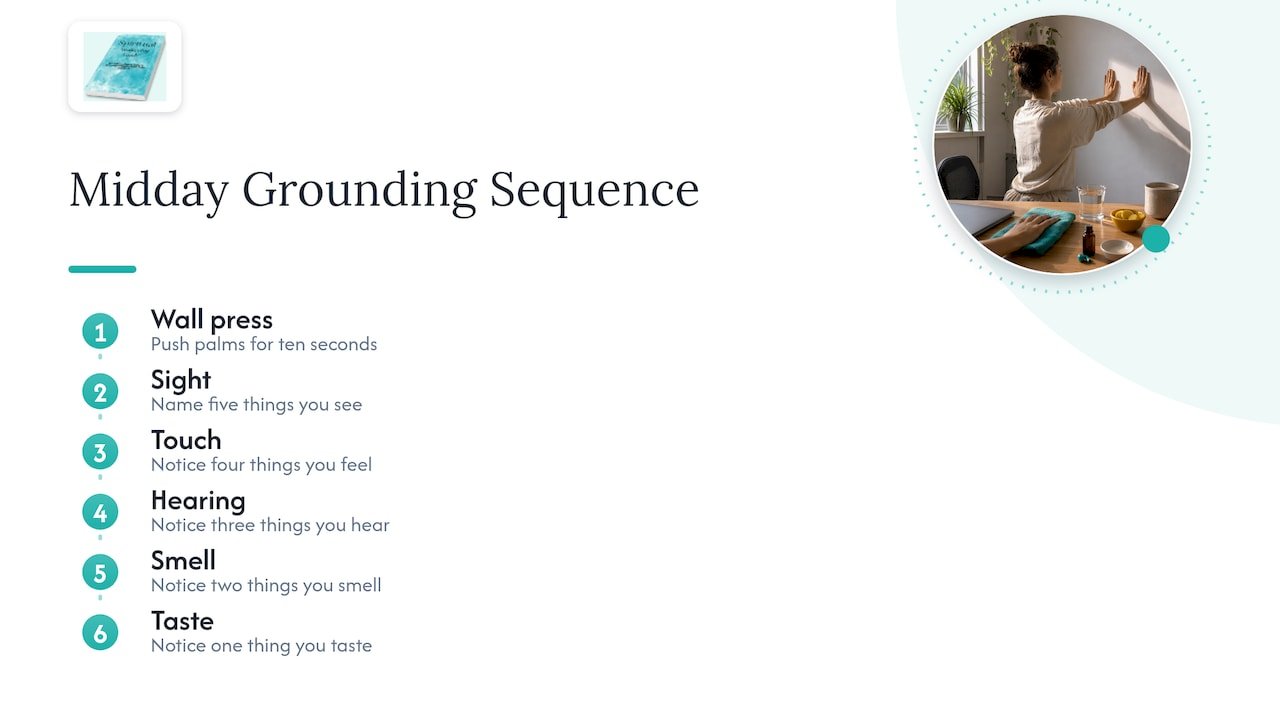
If you prefer a guided structure, the five-step grounding ritual with a 2 to 5 minute script can be read aloud or recorded and played back to yourself.
Evening: Release the Day (3 to 5 minutes)
Sit or lie down comfortably. Move your attention slowly from your feet to the top of your head, noticing contact points such as heels, calves, the back of your hips and shoulders. Hold a small grounding object, such as a smooth stone, a ring or a piece of cloth. Practitioners note that simple objects tend to work better than complicated ones, because there is less to interpret and less to go wrong.

Finish by rating your mood again. If you want to reflect on the day in a journal, do it only after you feel calm, not as part of the grounding itself.
How to Ground Indoors, Without Nature
Many people assume grounding requires grass, soil or a beach. It does not. The mechanism described in public guidance is attention anchored in the present environment, and that environment can be a kitchen, an office or a bedroom. These indoor options are reliable:
- Pressure and contact. Press your hands against a solid wall, the edge of a table, or the arms of a chair. Feel the firmness and temperature of the surface.
- Temperature. Hold a warm mug in both hands, or run cool water over your wrists, and describe the sensation neutrally.
- Texture. Keep a small object in a pocket and focus on its weight, surface and edges.
- Sound. Identify three distinct sounds, from the nearest (your own breathing) to the farthest (traffic, a neighbor, the refrigerator).
- Movement. Stretch slowly, roll your shoulders, or walk a short loop around the room, feeling each footstep.
- Counting and categories. Name all the items of one color in the room, or list animals alphabetically. Mental exercises like these take effort, which is precisely what holds your attention in the present.
Indoor grounding also gives you more control. You can adjust the lighting, choose your posture, and keep the practice private. For readers who find a visual approach easier than a physical one, our grounding visualization scripts, which run from 1 to 15 minutes, work well seated at a desk or on a couch.
If You Want to Add Earth Contact
Some people enjoy walking barefoot on grass or sitting on the ground, a practice often called earthing. A 2012 review in the Journal of Environmental and Public Health explored potential anti-inflammatory and antioxidative effects of direct skin contact with the Earth and suggested that 30 to 40 minutes of daily barefoot contact might reduce stress and pain. The authors framed these as early findings, and the evidence base is still limited, so treat this as an optional addition and not as the foundation of your routine.
One safety point deserves clear attention. The same source notes that people taking blood thinners such as coumadin (warfarin) should be supervised by a physician, because grounding may add to the blood-thinning effect and may require monitoring of INR levels. If you take an anticoagulant, speak with your prescribing clinician before starting a regular earthing practice. Our overview of spiritual earthing and its benefits discusses the ritual side of the practice.
Track What Works for You
A routine you cannot evaluate is hard to sustain. The public guidance recommends rating your mood on a 0 to 10 scale before and after practice. Keep it simple:
- Write the date and time of day.
- Record your before rating and your after rating.
- Note the technique in two or three words, such as “5-4-3-2-1” or “stone and breath.”
- After two weeks, look for patterns. Which technique lowers your rating most reliably? At which time of day do you most need it?
Do not expect a dramatic drop each time. A change of one or two points is meaningful, and a day with no change still tells you something. Some higher-intensity practices can take 20 to 30 minutes, so you may sometimes need more time than the routine above allows. If a technique raises your distress, stop and switch to a shorter, gentler one.
Adjusting for Trauma Sensitivity
Grounding is often recommended for people who have experienced trauma, but it should be done with care. University of Michigan researchers writing in Current Treatment Options in Psychiatry describe mindfulness-based grounding as a skills-based approach that can be an accessible alternative for patients who find standard trauma-focused therapy too arduous. They emphasize trauma-sensitive practice: invitational language and the freedom to choose your own posture, so that you feel in control of your own regulation.
In practice, that means:
- Keep your eyes open if closing them feels unsafe.
- Choose shorter exercises with clear instructions to avoid overwhelm.
- Stop at any time without needing a reason.
- Work with a licensed therapist if you experience flashbacks, dissociation or panic that interferes with daily life. If you are in crisis in the United States, call or text 988, the Suicide and Crisis Lifeline.
For a broader look at techniques aimed at anxious moments, see our guide to grounding techniques for anxiety.
Making the Habit Stick
Consistency matters more than duration. Attach each block to something you already do: the morning block to getting out of bed, the midday block to your first break, the evening block to brushing your teeth. Keep your grounding object where you will see it. Allow yourself to miss a day without treating it as a failure, because a forgiving approach is easier to maintain than a rigid one.
Many people also find it helpful to place grounding within a wider set of daily habits, such as reflection, community and meaningful routines. This overview of ten daily faith practices offers one perspective on building regular habits of attention, and you can adapt the ideas to your own beliefs. For a more structured framework on the healing side, our inner healing exercises for four weeks guide sets out a 20-minute daily plan.
Our Perspective on Daily Grounding
We built Spiritualmethod around one belief: practical methods for inner healing should be structured enough to follow and gentle enough to sustain. Grounding is the clearest example. People often come to it looking for a dramatic experience, and what serves them better is a small, repeatable routine with a way to see progress.
That is why our guides emphasize forgiving habit trackers, accessible templates and routine-based practice over perfection. A missed day should not erase a week of effort. We also encourage readers to treat grounding as one component of a mind, body and soul approach, which includes reflection, intention-setting and self-care, introduced in a sensible order and at a pace they choose.
We would add one caution of our own. Spiritual practice and clinical care can sit side by side, but one does not replace the other. If you are managing trauma, a dissociative condition or a medical issue, let your practitioner know what you are doing, and use our material as a complement to that care.
— Sean
A Structured Companion for Your Routine
If you would prefer a complete framework instead of assembling your own, our spiritual awakening guide is a downloadable PDF available for a one-time price of 20 USD. It brings together practices in grounding, energy clearing, intention-setting and journaling, with progress tracking designed for daily use. You can also read more about the underlying approach in our essential guide to spiritual awakening and energy.
FAQ
How long should you ground yourself in the morning?
Three minutes is enough for most people to establish a baseline: feet on the floor, slow breathing, and naming a few things you see. Higher-intensity practices can take 20 to 30 minutes, but they are not necessary for a daily routine. Start short and extend only if it helps.
How can you ground yourself indoors?
Use your senses and your body. Press your hands against a solid surface, hold a warm mug, carry a smooth stone, or work through the 5-4-3-2-1 sequence. None of these requires contact with the outdoors.
What does it mean to ground yourself?
It means deliberately anchoring your attention in the present environment so that intense emotions, panic or a sense of detachment lose some of their grip. Public guidance describes it as shifting focus from your internal state to external reality. It works as a skill you practice, not as a feeling you wait for.
Is it safe to practice grounding every day?
For most people, brief daily practice is considered low-risk, and public guidance encourages regular rehearsal. Stop any exercise that increases distress, and consult a licensed professional if you have trauma or dissociation. Anyone taking blood thinners should speak to their physician before beginning a regular barefoot earthing practice.
Sources
- Grounding Techniques, Washington, D.C. Office of Victim Services and Justice Grants
- Building an Operational Definition of Grounding, Trauma, Violence, & Abuse (2025)
- The Role of Non-Pharmacological Interventions in Attenuating Anxiety and Stress Symptoms in PTSD: A Systematic Review (2026)
- Earthing: Health Implications of Reconnecting the Human Body to the Earth’s Surface Electrons (2012)
- Mindfulness-Based Interventions for Psychological Trauma and PTSD, Current Treatment Options in Psychiatry (2025)