
An intention candle ritual is a short, deliberate practice in which you choose one clear intention, say or write it, and light a candle as a visible marker of your attention. The flame does not carry out the work. You do, and the candle gives you a calm, structured moment in which to begin. This guide explains how to prepare, how to perform the ritual in seven steps, how to keep it safe, and how to connect the intention to a concrete next action.
TL;DR
- Choose one intention, phrase it in the present tense, and write it down before you light anything.
- Treat the candle as a focal point for attention. Its value is in the pause it creates, not in any outside force.
- Keep a clear space around the flame: fire safety agencies advise keeping candles at least 12 inches from anything that burns, and blowing them out when you leave the room.
- If you cannot stay for the whole burn, snuff the flame and relight it later. Never leave it unattended.
- Finish with one small, specific action within 24 hours so the intention becomes a habit rather than a wish.
Table of Contents
- What an intention candle ritual actually is
- Why a flame helps you focus
- What you need before you begin
- Safety comes first
- The intention candle ritual in seven steps
- What to do if you cannot let it burn down
- Reading the flame without fooling yourself
- Common mistakes and how to fix them
- Making it a repeatable practice
- Our perspective
- Take the practice further
- Frequently asked questions
- Sources
What an intention candle ritual actually is
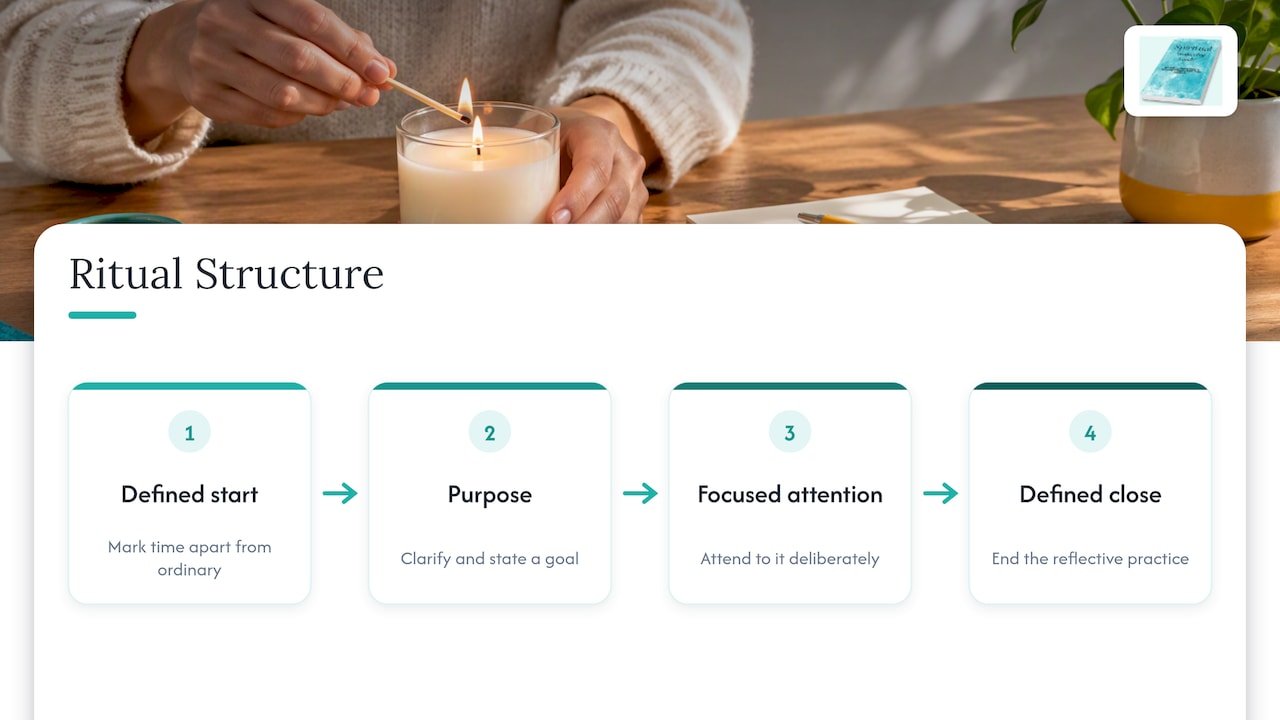
Candles have been used in many traditions to mark a moment as set apart from ordinary time. Contemporary guides to the practice describe setting intentions with candles as a way of creating a quiet space, clarifying a goal, and focusing on it deliberately. Popular versions add carving words into the wax, dressing it with oils or herbs, and choosing colors for particular themes such as money, protection or love. Those additions are optional, and they differ between traditions and teachers.
What remains constant is the structure: a defined start, a statement of purpose, a period of focused attention, and a defined close. That structure is what makes the ritual useful for personal development. It resembles other reflective practices, such as a morning check-in or a weekly review, in that it gives a repeatable frame to something that is otherwise vague.
A practical way to think about it: the candle is a cue. Lighting it tells your mind that for the next ten or fifteen minutes you are doing one thing. Many people find that this cue is more reliable than willpower alone.
Why a flame helps you focus
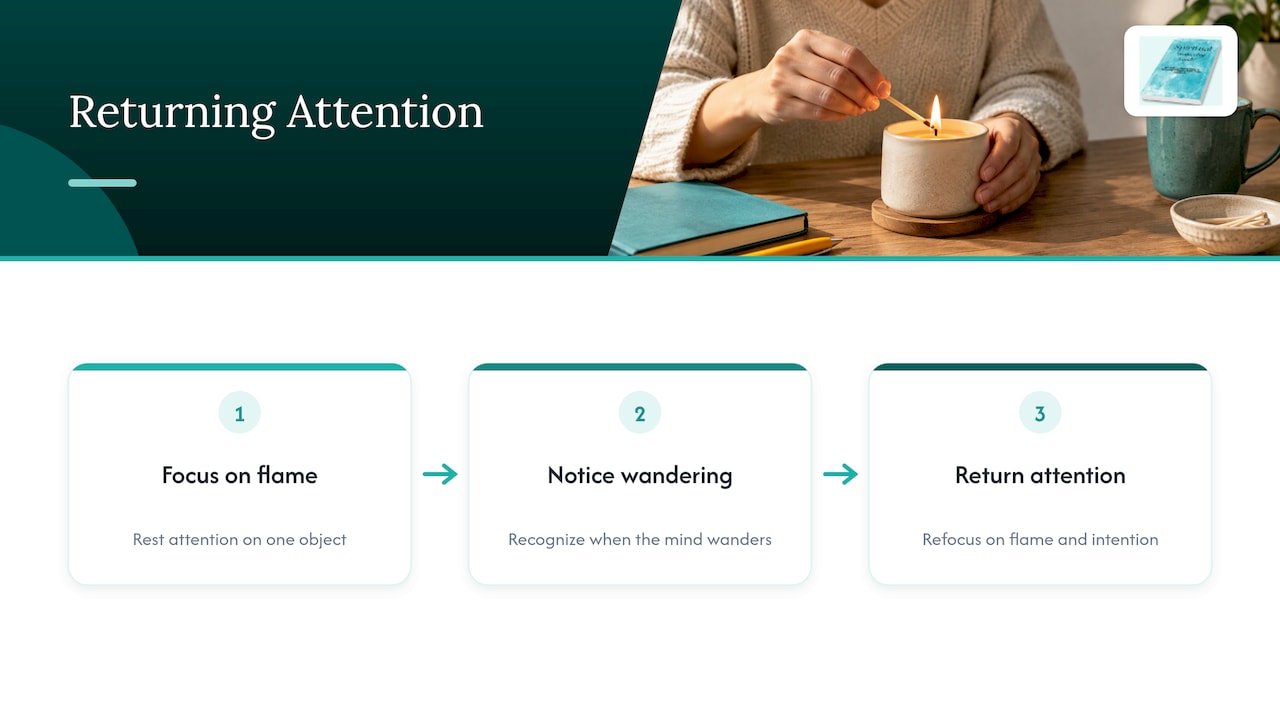
There is a plain, non-mystical reason the practice appeals to so many people. A single flame is an easy object to rest your attention on. Research on focused attention meditation, such as this study of meditation-induced states and attentional control, describes the practice as repeatedly noticing when the mind has wandered and returning it to a chosen object. A candle flame is one such object. Each time you bring your attention back to the flame and to your intention, you are rehearsing the skill of returning to a goal.
That is a modest claim, and it is worth keeping modest. Candle work will not guarantee an outcome. It can help you slow down, name what you want, and notice what you are avoiding. If you want a deeper look at using the flame this way, a guide to building focus and concentration offers a broader set of attention-training ideas that pair well with a candle practice.
What you need before you begin
Keep the setup simple. You can add more later.
- One candle. A small container candle or a taper in a stable holder works. Color is a matter of personal meaning; white is a common neutral choice.
- A heat-safe, stable surface. A table, shelf or altar space that cannot be knocked over easily, away from curtains, paper and bedding.
- A snuffer or a lid. This lets you extinguish the flame without blowing on it, which is useful for pausing the ritual.
- Paper and pen. For writing the intention and the next action.
- A trimmed wick. Experts recommend trimming the wick to about a quarter inch before each burn, which keeps the flame smaller and reduces soot, particularly in container candles.
- Ten to twenty minutes without interruptions, and with phones set aside.
If you are still arranging a place for practices like this, our seven day sacred space setup for small homes shows how to build a minimal, portable corner that works in an apartment or a shared room.
Safety comes first
Safety is part of the ritual, not an interruption of it. A calm mind is hard to find when part of you is watching the curtains.
The numbers explain why. According to the U.S. Fire Administration’s report on candle fires in residential structures, U.S. fire departments responded to roughly 7,400 home fires started by candles each year from 2015 to 2019. Those fires caused about 90 deaths, 670 injuries and $291 million in direct property damage annually. The same report finds that candles placed too close to combustibles account for 55 percent of these fires, which makes placement the single most useful thing you can control.
What to do with that information:
- Create a circle of safety. Clear everything that can burn from at least 12 inches around the flame, in every direction including above it.
- Use a stable holder. The U.S. Fire Administration advises placing candles in stable holders where they cannot be knocked down easily.
- Do not leave the room. Blow out or snuff the candle when you leave, and never fall asleep with one burning. The same guidance recommends against lit candles in bedrooms, bathrooms and sleeping areas, so choose a living room, kitchen table or dedicated space instead.
- Keep children and pets out of reach. A CPSC investigation of candle incidents lists tipped candles, including some tipped by pets, among the hazard patterns it identified.
- Consider a flameless option. If your home has small children, curious cats or a power-outage routine, a battery-operated candle is a reasonable substitute. The intention does the work, and the ritual structure below works the same way.
A note on the “8:10 rule” some readers ask about: it is not an established fire-safety standard that we can point you to. Rely instead on the official guidance above: distance from combustibles, a stable holder, and never leaving a flame unattended.
The intention candle ritual in seven steps
This sequence takes about fifteen minutes. It is adapted from common practice and organized for beginners.
1. Decide on one intention
Choose a single, specific focus. “I want a better life” is too broad to act on. “I am building a calm start to my mornings” or “I am speaking up in meetings” gives you something to practice. Write it in the present tense and in positive terms: state what you are building, not what you are trying to escape.
If you want help sharpening the wording, our guide on how to set intentions for the day walks through a morning version, and Your Word Is Your Wand looks at how the language you use shapes the commitment.
2. Prepare the space and the candle
Clear the surface, set up the circle of safety, trim the wick, and place your paper nearby. If you like to carve a word or short symbol into the wax, do it now, slowly, while thinking about the intention. Carving is a way to slow down and attach meaning. It is not required, and it should never weaken the candle or its holder.
3. Ground yourself
Sit comfortably. Take five slow breaths, letting the exhale run a little longer than the inhale. Notice your feet on the floor and your hands in your lap. This brief grounding step separates the ritual from the rest of your day.
4. Light the candle and state your intention
Light the flame, then read your intention aloud or silently. Many people say it three times. Keep your voice steady and your wording short. This is the moment the ritual officially begins.
5. Rest your attention on the flame
Look at the flame for several minutes with a soft gaze. When your mind wanders, which it will, notice that without judgment and bring your attention back to the flame and then to your intention. That return, repeated, is the real exercise. You can add a visualization: picture yourself already doing the thing you have named, in ordinary detail rather than in grand imagery.
6. Write one concrete next step
Before closing, write a single action you can take within 24 hours that supports the intention. Make it small enough to be almost easy: send one email, set out your clothes, schedule a twenty-minute block. Rituals without a next step tend to evaporate. Our article on writing one intention and one concrete next step explains this pairing in more detail, and the intention board ritual shows how if/then plans keep a vision from staying abstract.
7. Close the ritual
Thank yourself for showing up. Snuff the candle with a tool or a lid rather than blowing it out, then take a moment to note how you feel. Keep your paper somewhere visible.
What to do if you cannot let it burn down
Many beginners believe a candle must burn all the way down in one sitting. It does not. A practical alternative described in a candle ritual guide from Tiny Ritual is pausing: snuff the flame to mark a pause in the work, and relight it when you can return with focus. That keeps the ritual tied to your presence rather than to the object.
This matters for safety too. If the phone rings, a child wakes or you need to leave the room, put the candle out. Resume the next day. Relighting the same candle across several evenings is also a simple way to build a short series, such as seven days of the same intention.
Reading the flame without fooling yourself
Some traditions interpret how a candle burns: a tall flame, a wavering one, soot on the glass. Those interpretations belong to specific cultural and spiritual practices, and you are free to explore them. A guide to reading ritual candle flames from a botanica supplier notes that drafts and vents can make a flame behave in ways that have nothing to do with your intention, so a stable, draft-free spot matters before you read anything into it. It also suggests checking the candle at natural points, after lighting, partway through and at the end, rather than staring constantly.
Our view is practical. Flickering is usually airflow. Soot is usually a long wick. If you notice either, trim the wick, move the candle away from the vent, and carry on. Treat the flame as a reminder to pay attention, not as a verdict on whether your intention will work.
Common mistakes and how to fix them
| Mistake | Why it matters | A better approach |
|---|---|---|
| Setting several intentions at once | Attention splits and nothing is actionable | Choose one per candle |
| Vague wording | Nothing to practice or measure | Use a specific, present-tense statement |
| Placing the candle near fabric or shelves | Placement near combustibles is the leading factor in candle fires per USFA data | Clear 12 inches in every direction |
| Leaving the room while it burns | Unattended flames are a major risk | Snuff the candle and resume later |
| Blowing out the flame abruptly | Can scatter hot wax and smoke | Use a snuffer or lid |
| Skipping the next step | The ritual becomes a one-off feeling | Write one action for the next 24 hours |
| Waiting for “signs” | Drafts can mislead | Trust your plan, not the flicker |
Making it a repeatable practice
One candle session can be meaningful, but the benefit usually comes from repetition. Three simple rhythms work well:
- Weekly. Light the candle on the same evening each week and review what you did toward your intention. The weekly reflection ritual offers a twenty-minute format with one lesson and three priorities.
- Monthly. Use the new moon as a natural date to reset an intention, or the full moon to review it. If you prefer to avoid open flame entirely, our beginner full moon manifestation guide with no fire options gives alternatives.
- At a transition. Starting a job, ending a relationship, moving house. A short ritual gives the change a clear beginning. For career transitions, see the three minute career intention rituals.
Keep a brief log: date, intention, next step, and whether you did it. A forgiving log, which allows missed days without turning them into failure, is more sustainable than a strict one.
Our perspective
We approach candle work as a reflective practice first and a symbolic one second. The flame is a beautiful and effective prompt, and we see no conflict between honoring a ritual and honoring common-sense fire precautions. A clear, stable space helps the mind settle precisely because you are not half-watching for danger.
What we emphasize in our guides is the step after the candle. An intention that is lit, spoken and then left alone rarely changes a routine. An intention paired with one small, repeatable action does. That is why our materials combine rituals such as grounding, intention setting and journaling with simple trackers that forgive missed days. The aim is compassionate, sustainable habit-building rather than perfection.
If you try only one thing from this article, make it this: write the next step before you blow out, or rather snuff out, the flame.
— Sean
Take the practice further
If you would like a structured framework rather than assembling a routine yourself, our spiritual awakening guide is a downloadable PDF package with step-by-step practices in grounding, energy clearing, intention setting and journaling, plus progress tracking. It is available as a one-time purchase of $20, with instant online delivery. The practices pair naturally with a candle ritual, and the templates make it easier to log your intentions and next steps week after week.
Frequently asked questions
How long should an intention candle burn?
There is no required duration. A focused session of ten to twenty minutes is enough for most people, and you can snuff the flame and relight it on another day. Only burn a candle while you are in the room and attentive.
Do I need a special candle or color?
No. Any candle in a stable holder works, and white is a common neutral choice. Colors carry meanings in some traditions, so choose one that is personally meaningful if that helps you focus, but the practice does not depend on it.
Can I do a candle ritual without fire?
Yes. A battery-operated flameless candle gives you the same visual focal point with no fire risk, which is a sensible option around small children, pets or in a shared home. The U.S. Fire Administration suggests flameless candles as a safer alternative. The steps stay the same.
How do I use a candle for meditation?
Sit a comfortable distance from the flame, soften your gaze, and rest your attention on it. When your mind drifts, notice it and return. Start with five minutes and extend gradually. If your eyes feel strained, close them briefly or look away.
What should I do after the ritual?
Take one small action tied to your intention within 24 hours, and record it in a notebook or planner. Review it weekly. The action is what turns a quiet moment into a changed routine.
Sources
- Candle Fire Safety, U.S. Fire Administration
- Topical Fire Research Series Vol. 6, No. 1: Candle Fires in Residential Structures, USFA
- Preliminary Report on In-Depth Investigations of Incidents Involving Candles, CPSC
- Meditation-induced states predict attentional control over time
- How to Perform a Candle Ritual, Tiny Ritual
- Candle Flame Meanings: A Guide to Reading Ritual Candles, Original Botanica
- Setting Intentions: Candle Magic For Beginners, CyCandle
Pingback: Altar Cleansing Ritual: A Step-by-Step Guide