
You wake up tired, check your phone, answer a few messages, and move through the day with a low hum of pressure in your chest. Nothing is dramatically wrong. But something feels unbuilt inside you. You want clarity, steadiness, and a deeper sense that your life is connected to a pattern larger than deadlines, errands, and noise.
That’s where the lost keys of freemasonry can be surprisingly helpful.
Not because you need to join anything. Not because you need to decode a secret society. But because Manly P. Hall’s book offers a symbolic language for inner work. It points to discipline, self-knowledge, and spiritual awakening as something lived, not merely discussed. Many modern readers are looking for exactly that bridge between symbol and practice. A noted gap in spiritual content is the lack of guides that turn this philosophy into daily rituals, even as searches for “Freemasonry symbols meditation” rose 40% in major markets like the US and UK in 2025, according to the background summarized with Hall’s book listing on Google Books.
Table of Contents
- An Ancient Map for a Modern Awakening
- The Mind Behind the Mystery Manly P Hall and His Quest
- The Core Philosophy What Are the Lost Keys
- A Journey Through the Degrees Symbolism of Inner Growth
- Turning Keys into Practice Rituals for Modern Awakening
- Myths and Misconceptions About Masonic Teachings
- Conclusion You Are the Architect of Your Own Temple
An Ancient Map for a Modern Awakening
A lot of spiritual frustration comes from having fragments but no framework. You may have a journal, a meditation app, a few books on symbolism, and an honest desire to heal. Yet without a map, the practices can feel scattered.
Hall’s vision gives that map a shape. He treats spiritual life like a form of building. Not building a public identity, but building character, perception, and integrity. That image lands because the feeling of living in an inner house that needs repair is a familiar one. One room is overworked. Another is full of old grief. Another is bright, but neglected.

Why this old text still speaks
What makes the lost keys of freemasonry useful for modern seekers is that the symbols are practical when read inwardly. A square can become a prompt for honest conduct. A compass can become a reminder to set wise limits. A temple can become an image of the self you are shaping through daily choices.
Many people today want spiritual tools that are gentle but serious. They don't want empty inspiration. They want a practice they can return to when their thoughts are racing, when their energy is scattered, or when they’ve forgotten what they value.
Practical rule: If a symbol doesn’t help you live better, calmer, and more truthfully, you haven't finished meditating on it yet.
The hidden key is often attention
Readers sometimes get confused here and assume “lost keys” means hidden passwords or secret objects. Hall’s symbolic method points in a different direction. The essential loss is inward. People lose contact with purpose, discipline, reverence, and self-command. The key is not possession. The key is awakening.
Think of someone who keeps buying notebooks to “get organized” but never sits still long enough to listen to their own mind. The notebook isn’t the issue. The missing key is attention. In the same way, a spiritual symbol isn’t magic by itself. It becomes useful when you bring sincere reflection to it.
A modern reading of Hall doesn’t require costume, lodge language, or specialized knowledge. It asks for willingness. Sit with a symbol. Let it question your habits. Let it show you where your life is out of alignment. Then make one honest adjustment.
That’s how ancient philosophy becomes living practice.
The Mind Behind the Mystery Manly P Hall and His Quest
Before you can trust a spiritual text, it helps to know who is speaking through it. Manly P. Hall was a Canadian-born author and mystic whose work moved across symbolism, philosophy, religion, and esoteric traditions. He approached these topics as a student of patterns, not as a promoter of one narrow system.
What gives The Lost Keys of Freemasonry its unusual flavor is timing. Hall published it in 1923 as his first book, and he wrote it more than 30 years before he joined a Masonic lodge, as noted in this account from The Square Magazine on Hall and The Lost Keys of Freemasonry. That means the book began as an outsider’s philosophical reading of Masonic symbolism, not an official statement from within the fraternity.
Why that distance matters
That distance matters because it changes how you read the book. Hall isn’t saying, “Here is what members must believe.” He is asking, “What does this symbolic system reveal about the soul, duty, and awakening?”
For a beginner, that’s freeing. You don't need to sort through institutional details before engaging the ideas. You can meet the text the way you might meet a sacred myth, a philosophical poem, or a symbolic manual for inner development.
A simple way to place Hall is this:
| Aspect | Why it matters for readers |
|---|---|
| Mystic | He looks for the spiritual meaning behind outer forms |
| Scholar | He compares traditions instead of reducing everything to one slogan |
| Independent interpreter | He invites reflection rather than demanding conformity |
A writer interested in universal wisdom
Hall’s later book, The Secret Teachings of All Ages, became his most famous work, but this earlier book is still important because it shows his first major effort to interpret Freemasonry as a path of moral and spiritual development. If you’ve spent time with esoteric traditions, his approach will feel familiar. He reads symbols as containers of layered meaning.
That broad style overlaps with streams of thought many readers explore through books on Theosophy. The point is not that all systems are identical. It’s that Hall reads Freemasonry as part of a larger human search for wisdom.
Hall’s early position outside formal membership gave him room to treat Masonic imagery as a universal language of inner transformation.
That doesn’t mean you must agree with every interpretation he offers. It means you can approach the book with a clear frame. You are reading a philosophical mystic trying to uncover the spiritual architecture beneath ritual language.
The Core Philosophy What Are the Lost Keys
The central idea is simple once you strip away the mystery. The lost keys of freemasonry are not physical keys, hidden artifacts, or coded phrases waiting to be discovered by the clever. Hall presents them as inner ethical and spiritual disciplines that make a person capable of real transformation.
Here, many readers relax, because the teaching becomes human. The problem isn’t that wisdom has vanished from the earth. The problem is that people can perform forms without awakening their meaning.
Speculative versus operative
Hall argued that the principal crisis in Masonry was its shift from inner growth to the merely formal. In the wording preserved in the text hosted by the Regular Grand Lodge of England PDF of The Lost Keys of Freemasonry, a Mason’s true initiation is spiritual, not physical, and “each brother within Masonry contains the keys and plans long lost to the organization.”
That line turns the whole subject inside out.
Instead of asking, “Who will give me the keys?” you start asking, “What in me has gone dormant?” Instead of treating symbolism as a code from the outside, you treat it as a mirror. The temple becomes consciousness. The builder becomes conscience. The work becomes your life.
What “initiation” means in plain language
People often hear the word initiation and imagine a ceremony. Hall pushes toward a deeper reading. Initiation is an awakening into responsibility. It happens when you stop borrowing values and begin living by them.
Here’s a plain comparison:
- Outer ritual: You attend, observe, and receive form.
- Inner initiation: You recognize a truth about yourself and start living differently.
- False completion: You think understanding a symbol intellectually is enough.
- Real change: The symbol alters your choices, speech, and conduct.
This is one reason the book still feels useful. It shares a principle found in many symbolic traditions, including ideas readers may know from an introduction to the Kybalion. The outer teaching points inward. The symbol is not the destination. It is the doorway.
The keys are lived, not collected
If you want the shortest trustworthy summary, it’s this:
The lost keys are the virtues and disciplines that unlock spiritual perception.
That includes restraint, honesty, study, humility, and conscious use of time. Hall’s symbols matter because they train the imagination to serve character. They help you notice that spiritual growth is architectural. A stable life needs foundation, proportion, boundaries, and a center.
Once you see the idea this way, the subject becomes much less intimidating. You’re not standing outside a locked door begging for admission. You’re standing inside your own unfinished temple, holding tools you may not have learned to use.
A Journey Through the Degrees Symbolism of Inner Growth
Hall presents the Masonic degrees as stages of inner development. Read symbolically, they describe the way a person grows from rough potential to disciplined intelligence to deeper self-mastery. In this context, the lost keys of freemasonry become a path, not just a theory.
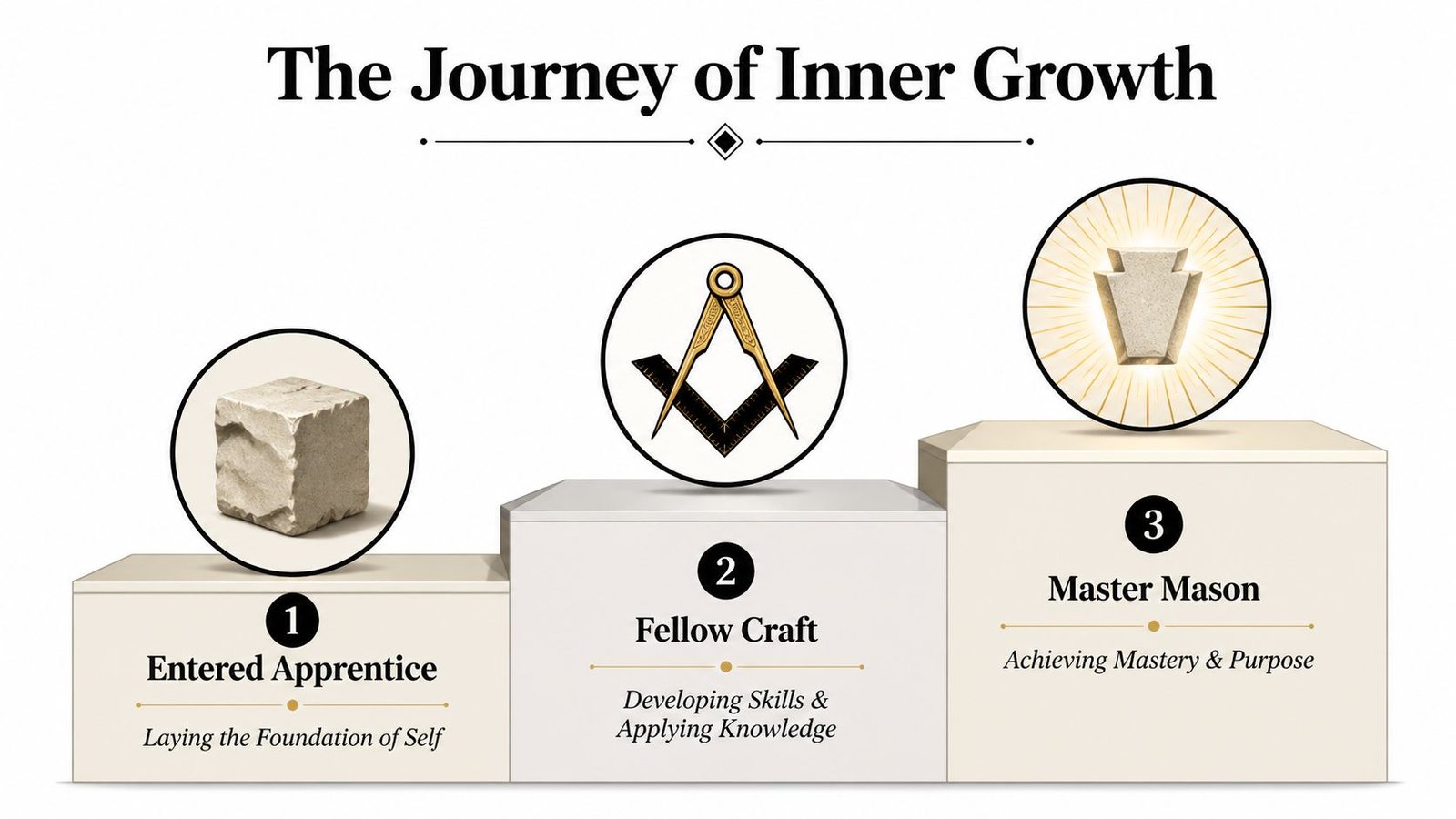
Entered Apprentice and the work of foundation
The first stage is the Entered Apprentice. Hall links this degree with the building of foundational virtues. Here, a seeker learns basic inner reliability. It isn’t glamorous. It’s simple and demanding.
In Hall’s symbolic framework, the apprentice begins to order life through discipline. One example is the 24-inch gauge, which he uses as a symbol for the right division of time. In modern terms, this asks a painful but healing question: where does your energy go each day?
If you say you want peace but spend your waking hours in distraction, the gauge exposes the mismatch.
A beginner can work with apprentice symbolism through ordinary acts:
- Time discipline: Set aside a fixed quiet period each day, even if it’s short.
- Speech discipline: Notice when you exaggerate, gossip, or speak against your own values.
- Body discipline: Treat sleep, meals, and rest as part of spiritual order, not separate from it.
Fellow Craft and the training of the mind
The second stage is the Fellow Craft. Here the work becomes more intellectual. According to Hall’s framework summarized by the Philosophical Research Society page for The Lost Keys of Freemasonry, this degree develops inner strength through fields such as geometry and logic, and the journey culminates later in the recovery of the lost word through the annihilation of the ego.
For modern readers, Fellow Craft energy is about education in the deepest sense. Not just consuming information, but learning how to think clearly and proportionately. A person in this stage starts noticing patterns, causes, and consequences.
A short table helps here:
| Degree | Inner task | Modern expression |
|---|---|---|
| Entered Apprentice | Build virtue | Set rhythms, keep promises, simplify habits |
| Fellow Craft | Develop understanding | Study, reflect, reason carefully, observe patterns |
| Master Mason | Surrender false self | Release ego fixation and live from deeper truth |
Master Mason and the recovery of meaning
The Master Mason stage is easy to misunderstand. It doesn’t mean domination, status, or spiritual superiority. Hall points toward a transformation in which ego loses its throne. The “lost word” becomes a symbol of divine truth recovered through inner death and renewal.
That sounds dramatic until you see it in daily life. Every time you stop defending an image that no longer serves your growth, something false dies. Every time you choose truth over vanity, something essential returns.
Some symbols teach by comfort. Masonic symbols often teach by demand. They ask for honesty before they offer light.
The square and compasses fit across this whole journey. The square points toward upright conduct. The compasses suggest limits, measure, and the wise governance of desire. Together they remind you that spiritual growth isn’t vague expansion. It is shaped growth.
If you’ve ever felt torn between your ideals and your impulses, you already understand the symbol. One part of you reaches toward what is good. Another part wants immediate relief, applause, or escape. Inner work begins when those tensions become conscious and workable.
Turning Keys into Practice Rituals for Modern Awakening
Symbols become useful when they change the atmosphere of a day. Hall’s ideas invite a kind of practice that is simple, reverent, and steady. You don’t need formal Masonic training to work with the underlying principles. You need intention, quiet, and consistency.
The symbol pair that helps most beginners is the square and compasses. Hall uses them as a core image of moral rectification. In the text available through Wikisource’s edition of The Lost Keys of Freemasonry, the square stands for righteousness and the compasses for limiting desire within proper bounds. That’s a direct spiritual lesson: grounding comes from right measure.
A grounding practice with the square and compasses
Try this when you feel mentally noisy or emotionally pulled in too many directions.
- Sit upright with both feet on the floor.
- Place one object with straight edges near you, such as a book, to represent the square.
- Place one round object nearby, such as a small bowl, to represent the compasses.
- Take a slow breath in and ask, “Where am I out of alignment?”
- Take a slow breath out and ask, “Where do I need a boundary?”
- Write one sentence for each question.
- Choose one action for the day that restores order.
Use ordinary examples. “I’m out of alignment because I say yes when I mean no.” “I need a boundary around my phone in the evening.” Keep it plain. The practice works because it brings symbolism into conduct.
A lot of readers want a broader structure for this kind of work. If that’s you, a practical companion to these ideas is a step by step spiritual awakening guide that supports grounding, intention, and consistent self-reflection.
A quiet meditation on the inner flame
Hall’s general approach encourages readers to look for the living principle behind the symbol. One useful meditation is to work with the idea of an inner flame. This is not a claim about literal fire in the body. It’s a contemplative image for awareness, conscience, and spiritual vitality.
Try this for a few minutes at dusk or before sleep:
- Dim the room: Let the body register a shift from activity to inwardness.
- Light a candle if you want: If not, imagine a steady flame at the center of the chest.
- Breathe evenly: Don’t force depth. Aim for calm rhythm.
- Ask one question: “What part of me needs more light and less performance?”
- Sit without rushing to answer: Let the question work on you.
After you sit, write down whatever arises. One word is enough. “Fear.” “Delay.” “Tenderness.” “Truth.” That word becomes the theme of your next day.
This short video can deepen your sense of symbolic reflection before practice:
An architects journal for purposeful living
Another strong practice is to journal as if you are designing an inner temple. Don’t make this abstract. Build with specifics.
Use three prompts:
| Prompt | What to write |
|---|---|
| Foundation | What value must hold my life steady right now |
| Walls | What protects my peace and focus |
| Doorway | What new way of being am I ready to enter |
You might answer like this. Foundation: honesty. Walls: fewer reactive conversations. Doorway: patient leadership at home. Notice how practical the symbolism becomes.
Write plans you can live, not ideals you can only admire.
A weekly reset ritual
Once a week, bring the ideas together in a slightly fuller ritual.
- Clear the space: Open a window, tidy one small area, and remove obvious clutter.
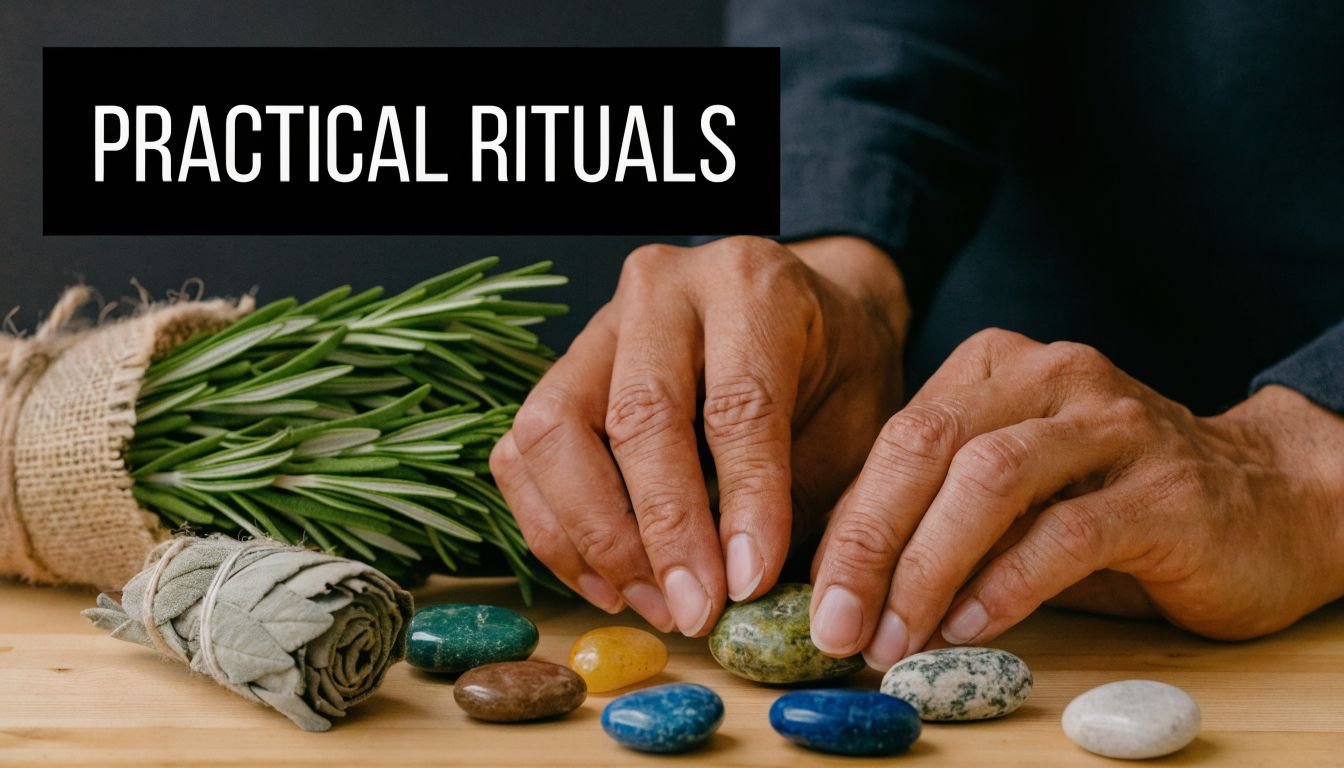
- Set out simple tools: A journal, a candle, a stone, a sprig of rosemary, or any object that helps you become attentive.
- Review the week: Where did you act from integrity. Where did you leak energy.
- Choose one repair: An apology, a boundary, a better schedule, a postponed truth finally spoken.
- Close with gratitude: Name one part of yourself that is learning, even if slowly.
This kind of practice is gentle on purpose. The lost keys of freemasonry do not need to become another performance. They are strongest when they help you become more sincere, more measured, and less divided within yourself.
Myths and Misconceptions About Masonic Teachings
A lot of hesitation around this subject comes from the word “Freemasonry” itself. People hear it and assume conspiracy, exclusion, or hidden control. That reaction is understandable. The symbolism is old, the language can feel closed, and popular culture has piled on dramatic stories for years.
But Hall’s philosophical reading points in another direction. He treats the symbols as guides to inner work, not as proof of a sinister system. If you approach the lost keys of freemasonry as a manual for self-discipline and spiritual interpretation, much of the fear begins to soften.
What secrecy usually means in spiritual traditions
In many traditions, secrecy doesn’t mean danger. It means depth. Some truths only make sense when a person has matured enough to live them.
A simple example is silence. To a restless person, silence feels empty. To a ripening person, silence becomes instruction. The practice did not change. The practitioner did.
That’s often how esoteric symbolism works. It isn’t hidden because it is evil. It is protected because premature interpretation turns living wisdom into trivia, ego display, or fantasy.
Common assumptions that need correction
- “It’s all about external ritual.” Hall’s symbolic emphasis pushes the reader inward. Ritual without transformation is incomplete.
- “You must belong to a lodge to benefit from the ideas.” The ethical and contemplative lessons can be studied as philosophy.
- “Symbols are manipulative by nature.” Symbols can manipulate, but they can also clarify. Their value depends on how a person uses them.
- “Secret means sinister.” In spiritual language, secret often means subtle, experiential, and not reducible to slogans.
If a teaching makes you less honest, less grounded, or less compassionate, set it down. A real symbol should refine character, not inflate identity.
The healthiest way to approach Masonic teachings is neither blind fascination nor automatic suspicion. It’s disciplined curiosity. Read slowly. Test the ideas in your own conduct. Keep what deepens integrity.
Conclusion You Are the Architect of Your Own Temple
The gift of the lost keys of freemasonry is not mystery. It is responsibility. Hall’s symbolic world keeps returning to one clear truth. A person becomes transformed by building inwardly, through virtue, reflection, discipline, and awakened self-knowledge.
The keys are “lost” only in the sense that many people look outward for what must be cultivated within. They search for dramatic access when what they need is steady practice. They want revelation without repair. Hall’s symbols ask for both insight and structure.
If you take anything from this teaching, let it be simple. Use your time with more care. Put boundaries around what drains you. Study your own motives. Choose conduct you can respect. Return to stillness often enough that your inner life stops feeling like a neglected room.
You don’t need to master every symbol at once. You need one honest key, used daily.
If you're ready for a practical next step, Spiritual Method offers a gentle way to turn spiritual insight into daily rhythm. It’s designed for people who want grounding rituals, clarity, and a steady path back to peace, purpose, and authentic inner alignment.