
Soul healing is defined as the process of restoring wholeness to the emotional, spiritual, and relational self after loss, trauma, or disconnection. Research confirms that this process is fundamentally social. The role of community in soul healing is not supplementary. It is the core mechanism through which deep recovery becomes possible. Shared experience, compassionate presence, and the simple act of being witnessed by others create the conditions that no solitary practice can fully replicate. This guide draws on evidence from Rwanda’s Ubuntu healing circles, Utøya survivor groups, and University of Manchester research to show how collective healing practices work, why they work, and how you can access them.
How does community facilitate soul healing?
Healing from trauma is fundamentally social and relational. Community facilitators are not intermediaries. They are the core healing infrastructure. This distinction matters because it shifts the focus from individual willpower to relational safety as the primary driver of recovery.
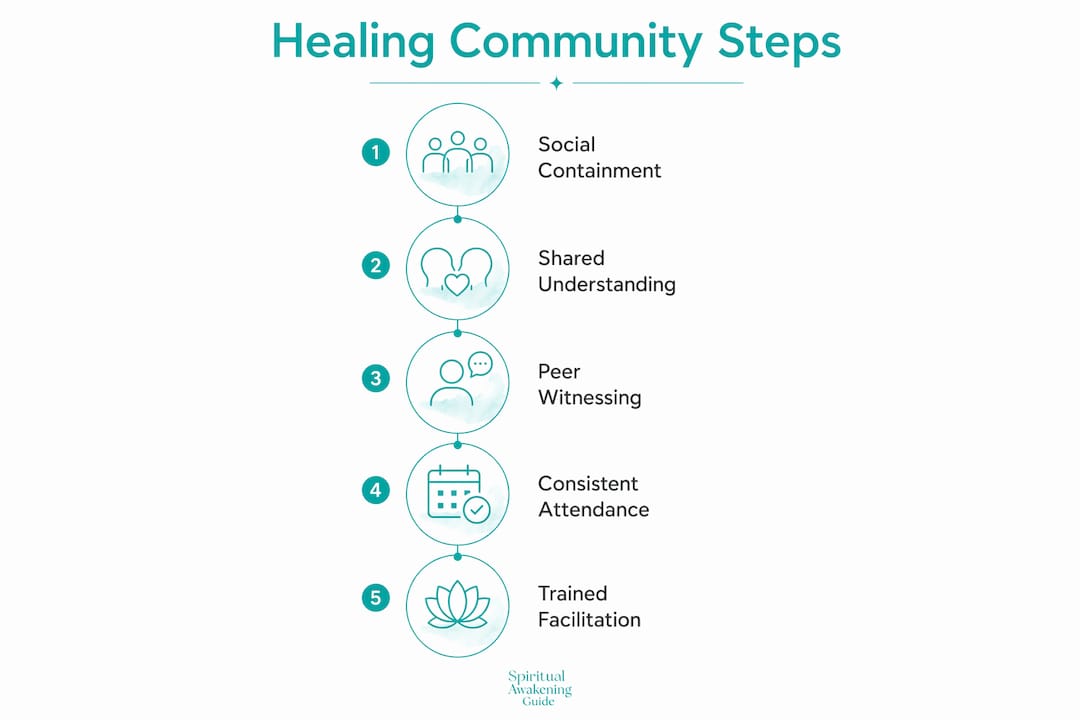
The first mechanism is social containment. A structured group creates a bounded, predictable space where difficult emotions can surface without overwhelming the individual. This containment is what makes trauma processing possible. Without it, many people remain stuck in avoidance or isolation.
The second mechanism is shared understanding. When others in a group have lived through comparable pain, their presence normalizes your experience. Shared understanding and belonging are often more important than clinical content for a healing group’s effectiveness. Knowing you are not alone rewires the shame response that trauma frequently produces.

The third mechanism is peer witnessing. Participants in Rwanda’s Ubuntu circles describe a gesture of presence that translates as “I am here, I hear you.” This witnessing process facilitates forgiveness and self-compassion in ways that self-directed reflection rarely achieves alone.
Social connection also affects biological measures related to stress regulation and immune function. Community healing is not only psychological. It produces measurable physiological change, which is why the impact of community on mental health extends into the body itself.
Key healing mechanisms that community provides:
- Emotional safety: A consistent group structure reduces threat responses and allows vulnerability.
- Normalization: Hearing shared stories reduces shame and self-blame.
- Peer witnessing: Being seen and heard by others accelerates self-compassion.
- Language for emotions: Groups give people words for experiences they could not previously name.
- Collective meaning-making: Shared narrative helps individuals place personal pain in a larger context.
- Accountability and rhythm: Regular meetings build momentum and reduce the risk of relapse into isolation.
Pro Tip: When joining a healing group, prioritize consistency over intensity. Attending regularly, even when sessions feel unremarkable, builds the relational trust that makes deeper healing possible.
What are proven community soul healing models and their outcomes?
Three evidence-based models demonstrate what community support in healing looks like at scale, and what results it produces.
Rwanda’s Ubuntu Community-Based Social Healing circles
Ubuntu’s Community-Based Social Healing (CBSH) model runs 15-week healing circles led by trained community members, reaching more than 30,320 people at approximately $24 per participant. The circles use emotion-naming exercises, the Tree of Life story-mapping method, singing, and peer witnessing as structured tools. Non-professional community members deliver the program after training, demonstrating that scalable soul-level healing does not require clinical infrastructure. The Ubuntu model proves that culturally grounded, community-led methods can reach populations that formal mental health systems never reach.
Utøya survivor peer groups
Survivors of the 2011 Utøya attack in Norway participated in 64 peer-support meetings over three years, meeting every other week for two hours with professional facilitation. Participants consistently identified the sense of community belonging as the central element of their recovery, not the clinical content of sessions. Healing was enhanced when survivors developed their own agency and solidarity within the group over time. This model shows that long-term, consistent community engagement produces sustained recovery in ways that short-term interventions do not.
Digital peer support findings
A University of Manchester systematic review analyzed 29 controlled intervention trials involving 5,825 participants. Digital peer support interventions produced small-to-moderate reductions in depression (SMD −0.28) and anxiety (SMD −0.47), along with modest improvements in social functioning and quality of life. These results confirm that online communities carry real healing potential, though outcomes vary based on structure and facilitation quality.
| Model | Duration | Key Methods | Scale | Primary Outcome |
|---|---|---|---|---|
| Ubuntu CBSH (Rwanda) | 15 weeks | Story-mapping, peer witnessing, singing | 30,320+ people | Emotional processing, community belonging |
| Utøya Peer Groups (Norway) | 3 years (64 sessions) | Professional facilitation, open sharing | Small group | Sustained trauma recovery, agency |
| Digital Peer Support | Variable | Online forums, structured programs | 5,825 participants | Reduced depression and anxiety |
Pro Tip: If you are evaluating a community healing program, ask specifically about its facilitation model and session frequency. Programs with trained facilitators and consistent meeting schedules produce measurably better outcomes than unstructured peer forums.
What nuances affect the effectiveness of community in soul healing?
Not all communities heal equally. The quality of community dynamics in emotional wellness depends heavily on structure, facilitation, and the type of support offered.
Facilitation is the single most important variable. Effective trauma recovery communities use trained facilitators to create safe relational containment with structured exercise protocols and consistent meeting cadence. Without skilled leadership, groups can drift into unproductive venting cycles that retraumatize rather than heal.
The type of support also matters significantly. A network meta-analysis published in the British Journal of Psychiatry found that therapeutic human support produced an effect size of g=0.42 for reducing depression, compared to g=0.15 for technical support alone. That gap is substantial. Communities that rely on automated tools or passive content without human therapeutic engagement produce far weaker results.
Sustaining gains requires ongoing reinforcement. A randomized controlled trial of weekly peer support groups for rheumatoid arthritis patients found that psychological well-being improvements were not sustained without booster sessions after the initial six-week program. The implication for soul healing is direct. Initial community engagement opens the door. Continued participation keeps it open.
Factors that enhance or diminish healing outcomes in community settings:
Factors that enhance outcomes:
- Trained or experienced facilitation
- Structured exercises with clear emotional goals
- Consistent meeting rhythm over months, not weeks
- Shared cultural or experiential context among members
- Booster sessions or ongoing group contact after initial programs
Factors that diminish outcomes:
- Unstructured peer venting without containment
- Reliance on technical or automated support without human presence
- Irregular or infrequent meetings
- Lack of psychological safety or group confidentiality
- Short-term programs without follow-up support
Pro Tip: Digital peer communities work best as complements to in-person or professionally facilitated groups, not as replacements. Use them to maintain connection between sessions, not as your primary healing structure.
How can you find or build a community for soul healing?
Accessing the right community is a practical decision, not just a spiritual one. The structure, values, and facilitation model of a group determine whether it supports genuine recovery or simply provides social contact.
When evaluating an existing group, look for four qualities. First, the group should have a consistent meeting schedule. Second, it should have a facilitator or experienced leader who maintains safety and direction. Third, members should share a common context, whether that is a specific loss, a spiritual tradition, or a shared life experience. Fourth, the group should use structured practices, not just open conversation. Practices like sacred ritual frameworks, journaling exercises, or story-mapping give sessions direction and depth.
If no existing group fits your needs, building one is achievable. Start with two or three people who share a healing intention. Establish a regular meeting time and a simple structure for each session. Introduce a reflective practice, such as journaling for soul healing, as a shared exercise between meetings. Grow the group slowly. Trust is built through consistency, not size.
| Community type | Format | Best for | Key consideration |
|---|---|---|---|
| In-person healing circles | Weekly group, facilitated | Deep trauma processing | Requires trained facilitator |
| Faith-based groups | Weekly, values-aligned | Spiritual grief and loss | Effectiveness varies by leadership |
| Digital peer forums | Asynchronous or live online | Accessibility, ongoing support | Best as adjunct, not primary |
| Therapist-led group therapy | Biweekly, clinical setting | Clinical trauma and depression | Higher cost, structured outcomes |
| Peer-built small groups | Flexible, self-organized | Specific shared experiences | Needs structure to avoid drift |
Common pitfalls to avoid when engaging with community healing:
- Attending only the first few sessions and expecting lasting change
- Choosing a group based on convenience rather than facilitation quality
- Treating digital forums as equivalent to in-person relational contact
- Skipping booster sessions after an initial program ends
- Joining groups without clear confidentiality agreements
Key Takeaways
Community is the primary environment for soul healing because shared presence, skilled facilitation, and consistent group rhythm produce psychological and spiritual recovery that solitary practice cannot replicate.
| Point | Details |
|---|---|
| Community is the core mechanism | Healing is relational; community provides the safety and witnessing that enable deep recovery. |
| Facilitation determines outcomes | Trained facilitators produce measurably stronger results than unstructured peer groups. |
| Consistency sustains gains | Booster sessions and long-term engagement prevent the loss of initial healing benefits. |
| Digital communities complement, not replace | Online peer support reduces depression and anxiety but works best alongside in-person contact. |
| Structure amplifies healing | Practices like story-mapping, emotion-naming, and ritual give community sessions lasting impact. |
What I have learned from watching community heal people
I have spent years studying and practicing inner healing methods, and the pattern I keep returning to is this: the people who make the deepest recoveries are almost never the ones who worked hardest in isolation. They are the ones who found a group where they felt genuinely seen.
What surprises most people is that the content of a healing session matters less than the quality of presence within it. The Utøya survivors did not attribute their recovery to any particular therapeutic technique. They attributed it to the feeling of belonging to a group that understood them without explanation. That is a relational outcome, not a clinical one.
The uncomfortable truth about community healing is that it requires you to show up before you feel ready. Most people wait until they feel stable enough to be vulnerable in a group. That logic is backward. The stability comes from the group, not before it.
I also want to name something that structured programs often overlook. The mind, body, and soul connection means that community healing is not only emotional. When you sit in a circle with others who carry similar wounds, your nervous system responds. Your stress hormones shift. Your immune markers change. The body registers belonging as safety, and safety is where healing begins.
Choose your community with care. Prioritize facilitation, consistency, and shared context over size or convenience. Then stay long enough to let it work.
— Sean
Spiritualmethod resources for your healing path
Spiritualmethod offers a structured library of practical methods designed to complement the community healing work described in this article.
If you are working through grief, trauma, or spiritual disconnection alongside a community, the soul retrieval healing examples on Spiritualmethod provide concrete frameworks for understanding what recovery looks like at the soul level. The site also offers a practical journaling guide designed to deepen the reflective work you do between group sessions. For those exploring the spiritual dimensions of recovery, the guide on holistic grief healing practices offers a structured path through loss that pairs naturally with community-based support.
FAQ
What is the role of community in soul healing?
Community provides the relational safety, shared understanding, and peer witnessing that enable deep emotional and spiritual recovery. Research from Rwanda’s Ubuntu circles and Utøya survivor groups confirms that healing is fundamentally social, not solitary.
Can community aid soul healing without professional therapy?
Yes. Programs like Ubuntu’s Community-Based Social Healing model demonstrate that trained non-professional community members can deliver effective soul healing interventions, reaching more than 30,320 people at approximately $24 per participant.
How does digital peer support compare to in-person community healing?
Digital peer support produces small-to-moderate reductions in depression and anxiety, but therapeutic human support outperforms technical support by a significant margin. Online communities work best as supplements to in-person or professionally facilitated groups.
How long does community healing take to produce results?
Short-term programs of six weeks show initial benefits, but research confirms that gains are not sustained without ongoing booster sessions. The Utøya peer groups met for three years, suggesting that sustained community engagement produces the most durable recovery.
What makes a community healing group effective?
Trained facilitation, a consistent meeting schedule, structured practices, and shared context among members are the defining factors. Groups that rely on unstructured peer conversation without skilled leadership produce weaker and less sustained outcomes.