
Spiritual awakenings typically move through a recognizable sequence: a triggering event, a period of questioning, active seeking, a deconstruction phase (often called the dark night of the soul), ego softening, glimpses of unity or bliss, integration, and finally a stabilized orientation toward service and growth. Psychology Today notes that these experiences involve expanding perception and connection, and even brief awakening moments can produce lasting shifts in outlook and behavior. The most practical next step, regardless of where you are in the process, is to stabilize with grounding exercises, consistent journaling, and professional support if any red flags appear.
The common spiritual awakening stages at a glance:
- Stage 1: Early discontent and loss of meaning
- Stage 2: The catalyst or triggering event
- Stage 3: Curiosity, seeking, and learning
- Stage 4: Purging and shadow work
- Stage 5: The dark night of the soul
- Stage 6: Ego softening and non-attachment
- Stage 7: Glimpses of bliss and unity
- Stage 8: Physical and sensory symptoms
- Stage 9: Relationship shifts and temporary isolation
- Stage 10: Integration, stabilization, and service
Pro Tip: If you are not sure which stage applies to you right now, start with the stage that produces the strongest emotional recognition. You do not need to work through them in perfect order.
Key Takeaways
Spiritual awakening is a structured but non-linear process, and integration, not the peak experience, is the phase that determines whether lasting change takes hold.
| Point | Details |
|---|---|
| Ten recognizable stages | The process moves from early discontent through catalyst, seeking, shadow work, dark night, ego softening, bliss, symptoms, relationship shifts, and integration. |
| Non-linear and spiral | Stages overlap and recur; skipping a stage tends to cause that material to resurface later with greater intensity. |
| Integration is the critical phase | Practical stabilization work (grounding, journaling, somatic practice, community) is the most commonly omitted step and the one most responsible for durable change. |
| Red flags require professional care | Suicidal ideation, severe dissociation, or inability to function for more than two weeks are clinical signals; contact 988 or a licensed therapist immediately. |
| Spiritualmethod’s structured guides | The downloadable bundle provides daily-use grounding, journaling, and ritual practices designed to support stabilization at every stage. |
Table of Contents
- What are the spiritual awakening stages, and what happens at each one?
- How do you know if you are going through a spiritual awakening?
- What triggers a spiritual awakening, and how long does it last?
- How to stabilize and integrate a spiritual awakening
- Why integration is the stage most people skip
- Structured support for every stage of the process
- Sources
What are the spiritual awakening stages, and what happens at each one?
The spiritual awakening process is rarely a straight line. Most people cycle through these stages in a spiral pattern, returning to earlier phases with greater depth each time. Practical stage guides confirm that stages overlap, timelines vary, and any material skipped tends to resurface later. The ten stages below reflect a synthesis of widely used frameworks, including the five-stage model (trigger, deconstruction, void, rebirth, integration) and the six-stage tradition-informed map (stirring, seeking, initiation, dark night, integration, stabilization).
1. Early discontent and loss of meaning
Life begins to feel hollow. Routines that once provided satisfaction no longer do. A career, relationship, or identity that seemed stable starts to feel misaligned with something deeper. This stage often arrives quietly, as a persistent low-grade dissatisfaction rather than a dramatic crisis.
Common signs: Chronic restlessness, questioning long-held beliefs, a sense that “something is missing,” difficulty finding motivation for previously enjoyable activities.
Daily-life impact: Work performance may dip; social interactions can feel performative.
Short action: Write one honest sentence about what no longer feels true in your life. Do not edit it.
2. The catalyst or triggering event
A specific event accelerates the process. Loss of a loved one, a serious illness, a near-death experience, a relationship ending, or even a sudden and unexpected moment of profound love can all serve as catalysts. Some people report no single dramatic event but rather a slow accumulation of dissatisfaction that reaches a tipping point.
Common signs: A felt sense that life has divided into “before” and “after,” heightened emotional sensitivity, urgency to find answers.
Short action: Name the catalyst plainly in writing. Naming it reduces its unconscious grip.
3. Curiosity, seeking, and learning
The questioning that began in Stage 1 now becomes active. People in this phase read widely, explore meditation, attend workshops, seek teachers, and experiment with practices from multiple traditions. This is the seeker phase, and it carries genuine energy and enthusiasm.
Common signs: Appetite for books on consciousness, philosophy, and spirituality; attraction to new communities; a sense of purpose returning through learning.
Caution: Collecting spiritual experiences without integrating them is a known pitfall sometimes called “spiritual materialism.” Depth matters more than breadth here.
Short action: Choose one practice and commit to it for 30 days before adding another.
4. Purging and shadow work
Old patterns, suppressed emotions, and unexamined beliefs begin to surface. This stage often feels uncomfortable because it requires confronting aspects of yourself that have been avoided. Shadow work, a term drawn from Jungian psychology, describes the process of bringing these unconscious elements into conscious awareness.

Common signs: Emotional volatility, vivid or disturbing dreams, sudden awareness of long-standing behavioral patterns, grief for past versions of yourself.
Relationship impact: Friendships and family dynamics may feel strained as you begin to respond differently to familiar situations.
Short action: Use a journaling practice for soul healing to document recurring emotional patterns without judgment.
5. The dark night of the soul
This is the most challenging phase. The structures that once gave life meaning have been dismantled, and new ones have not yet formed. Tradition-informed frameworks describe this as a purification phase that can resemble clinical depression but is distinct from it. The key difference: the dark night is driven by a loss of meaning and identity, not primarily by neurochemical dysregulation, though the two can co-occur.
Common signs: Profound emptiness, withdrawal from social life, questioning whether life has any purpose, a sense of being “between worlds.”
Physical signs: Fatigue, disrupted sleep, appetite changes, a feeling of heaviness in the body.
Safety callout: If you experience suicidal ideation, inability to function in daily life for more than two weeks, or severe dissociation, these are clinical signals that require professional attention. Contact the 988 Suicide and Crisis Lifeline (call or text 988) or speak with a licensed mental-health professional. The dark night and clinical depression can overlap, and there is no virtue in navigating a clinical condition without support.
6. Ego softening and non-attachment
The rigid sense of a fixed, separate self begins to loosen. This does not mean the ego disappears, but its grip on identity weakens. From a psychological perspective, this process involves a progressive rewiring of perception, shifting identity from the content of experience toward the awareness that observes experience. This framing helps set realistic expectations: it is a gradual process, not a single moment of enlightenment.
Common signs: Reduced reactivity to criticism, decreased need for external validation, moments of genuine equanimity, growing capacity to witness thoughts without being controlled by them.
Short action: Practice a five-minute “observer” meditation: sit quietly and notice thoughts as passing events rather than facts about who you are.
7. Glimpses of bliss and unity
Brief but powerful experiences of connection, love, or oneness begin to appear. These can occur during meditation, in nature, during creative work, or spontaneously in ordinary moments. Psychology Today confirms that awakening experiences are not limited to religious contexts and can happen to ordinary people during everyday activities.
Common signs: A felt sense of interconnection with others and the world, spontaneous compassion, moments where time seems to stop, a quiet but unmistakable sense of rightness.
Caution: These experiences can be so compelling that people attempt to chase or recreate them, which often produces frustration. They are signposts, not destinations.
8. Physical and sensory symptoms
The body registers the process. Commonly reported physical experiences include tingling or pressure in the head or chest, heightened sensory sensitivity (sounds, light, and textures feel more vivid), changes in sleep patterns, fluctuating energy levels, and what some traditions call “ascension symptoms.” These are real physical experiences, though their mechanisms are not fully established in clinical literature.
Common signs: Tingling sensations, changes in appetite, unusual fatigue or bursts of energy, heightened empathy, sensitivity to environments and crowds.
Short action: Track symptoms in a daily log. Patterns become visible over time and help distinguish awakening-related experiences from symptoms that warrant medical evaluation.
9. Relationship shifts and temporary isolation
As your values, priorities, and ways of engaging with the world shift, some relationships naturally become strained or fall away. This is one of the most practically disruptive aspects of the process. It is not a sign that something has gone wrong. People who were once close may no longer share the same frame of reference, and that gap can feel isolating.
Common signs: Withdrawal from social activities, difficulty relating to previous social circles, attraction to new communities aligned with your evolving values, occasional loneliness.
Short action: Distinguish between healthy solitude (restorative, chosen) and isolation driven by shame or fear. The former supports integration; the latter can deepen distress.
10. Integration, stabilization, and service
A grounded step-by-step guide describes this final phase with the Zen phrase “chop wood, carry water”: the insights gained through the process are now expressed through ordinary daily life rather than through dramatic experiences. Integration is the phase most commonly omitted in popular accounts, yet it is the one that determines whether the awakening produces durable change. Practical guides consistently identify integration as the most essential phase for lasting transformation.
Common signs: Stable compassion, reduced drama in daily life, a growing orientation toward contributing to others, capacity to hold complexity without anxiety.
Short action: Identify one concrete way to express your values in service to others this week, however small.
How do you know if you are going through a spiritual awakening?
Recognizing the process while you are inside it is genuinely difficult. The signs span cognitive, emotional, sensory, relational, and physical dimensions, and they often arrive in combinations rather than one at a time.
Common signs of an active awakening:
- A persistent sense that your previous identity or worldview no longer fits
- Heightened sensitivity to the emotions of others (empathy that feels almost physical)
- Recurring questions about the nature of consciousness, meaning, or purpose
- Synchronicities that feel too specific to dismiss as coincidence
- A felt shift in how time moves, either slowing or becoming less relevant
- Spontaneous moments of deep peace or clarity with no obvious cause
- Reduced tolerance for superficial conversation or environments that feel energetically dense
- Dreams that feel unusually vivid, symbolic, or instructive
- A growing sense of connection to something larger than personal identity
Pro Tip: Awakening experiences are not exclusive to people with a spiritual practice. Research confirms they can occur to anyone, including during mundane activities. If the signs above resonate, you do not need a tradition or a teacher to validate the experience.
Red flags: when to seek professional help
The dark night of the soul and clinical depression share surface similarities, but they are not the same condition. The distinction matters because the appropriate response differs.
Seek professional mental-health support if you experience:
- Suicidal thoughts or thoughts of self-harm (contact 988 immediately)
- Inability to maintain basic daily functioning (work, hygiene, eating) for more than two weeks
- Severe dissociation or loss of contact with reality
- Psychosis-like symptoms: hearing voices, paranoid ideation, inability to distinguish inner experience from external events
- Substance use escalating as a coping mechanism
A trauma-informed therapist or a counselor familiar with spiritual emergencies can hold both dimensions simultaneously. You do not have to choose between psychological care and spiritual understanding.
Quick next steps for stabilization:
- Five minutes of barefoot grounding outdoors (direct contact with earth or grass)
- A brief grounding exercise practice to reduce sensory overwhelm
- A daily journaling prompt: “What feels true today that did not feel true a year ago?”
- Contact a licensed counselor if functional impairment persists beyond two weeks
What triggers a spiritual awakening, and how long does it last?
Common triggers include:
- Death of a loved one or a personal near-death experience
- Serious illness, chronic pain, or a significant health diagnosis
- The end of a long-term relationship or marriage
- A sudden and overwhelming experience of love or beauty
- Prolonged burnout or career collapse
- Psychedelic experiences (in contexts where these are legally accessible)
- Long-term meditation or contemplative practice that reaches a threshold
- Slow, cumulative dissatisfaction that builds over years without a single identifiable event
The depth of the catalyst, the degree of prior psychological conditioning, and the quality of support available all influence how the process unfolds. Stage models consistently note that timelines vary widely and that stages frequently overlap or recur. A major phase like the dark night might last weeks for one person and years for another. The spiral model is more accurate than a linear timeline: most people revisit earlier stages with greater depth rather than completing them once and moving on.
Pro Tip: Attempting to accelerate the process by accumulating experiences, practices, or teachers without integrating what you already have is a well-documented trap. Sustainable progress tends to look boring from the outside: consistent daily practice, adequate sleep, and regular reflection produce more durable change than intensive retreats followed by no follow-through. Tracking your breakthrough days on a structured calendar can help you pace your practice and recognize natural rhythms in your process.
How to stabilize and integrate a spiritual awakening
From a psychological and neuroscientific perspective, awakening involves a softening of the ego’s rigid boundaries and a progressive rewiring of how perception operates. This framing, supported by Psychology Today’s coverage of the awakening process, is useful because it replaces the expectation of instant transformation with a more realistic model: gradual, practice-supported change over time. The classical Ten Bulls sequence from Zen tradition maps a strikingly similar trajectory, from initial stirrings through seeking, breakdown, realization, and return to ordinary life, suggesting that this pattern appears across cultures and centuries.
Integration is the phase where the insights gained through awakening become embedded in daily behavior. Without it, even profound experiences tend to fade or produce instability rather than growth.
Step-by-step integration practices
- Daily grounding (5–10 minutes): Barefoot contact with natural surfaces, slow diaphragmatic breathing, or a body-scan meditation. Grounding reduces the dissociation that often accompanies intense awakening phases.
- Structured journaling: Use a consistent template: one observation about your inner state, one pattern you noticed in your behavior, one thing you are grateful for. Consistency matters more than length. A structured journaling guide can provide the scaffolding to make this sustainable.
- Somatic exercises: Gentle yoga, slow walking, or progressive muscle relaxation help anchor cognitive and emotional shifts in the body. The body processes experience differently than the mind, and somatic work addresses what purely cognitive practices miss.
- Sacred routines: A consistent morning or evening ritual, however brief, creates a container for the process. This might include intention-setting, a brief meditation, or a grounding breath sequence.
- Shadow-work exercises: Write about a recurring emotional reaction that feels disproportionate to its trigger. Trace it back to its earliest memory. The goal is not to resolve it in one session but to bring it into conscious awareness.
- Community and mentorship: Isolation during integration tends to amplify distress. A community of people engaged in similar work, or a mentor who has moved through comparable stages, provides both perspective and accountability.
- Pacing strategies: Schedule deliberate rest periods. Integration requires metabolic and neurological resources. Overloading the process with too many practices or too many new inputs slows rather than accelerates progress.
What to look for in a therapist or counselor
Not every therapist is equipped to work with spiritual emergencies. Look for practitioners who:
- Are familiar with the concept of spiritual emergency (a term developed by Stanislav and Christina Grof)
- Use trauma-informed approaches (somatic experiencing, EMDR, or IFS are commonly cited)
- Do not pathologize spiritual experience as a default
- Have personal experience with contemplative practice (not required, but often useful)
The Spiritual Emergence Network and trauma-informed directories are reasonable starting points for finding qualified support in the United States.
Stabilization checklist
Use this weekly to track integration progress:
- Sleep: Are you getting 7–9 hours most nights?
- Appetite: Are you eating regular meals without significant disruption?
- Daily function: Can you meet basic work and personal responsibilities?
- Relationships: Are you maintaining at least one supportive connection?
- Compassionate practices: Are you engaging in at least one grounding or reflective practice daily?
| Practice | Primary benefit | Supporting context |
|---|---|---|
| Daily grounding (barefoot, breath, body scan) | Reduces dissociation and sensory overwhelm | Widely recommended in trauma-informed and somatic frameworks |
| Structured journaling | Builds self-awareness and tracks pattern change | Supported by reflective practice research in psychology |
| Somatic movement (yoga, slow walking) | Anchors cognitive shifts in the body | Somatic experiencing and body-based therapies |
| Shadow-work writing | Surfaces unconscious patterns for integration | Jungian and depth-psychology traditions |
| Community or mentorship | Reduces isolation; provides perspective | Cross-traditional contemplative guidance models |
Pro Tip: If you cannot maintain basic daily functioning (sleep, eating, work, one supportive relationship) for more than two weeks, that is the functional marker for seeking clinical support. Integration is not a solo endurance test.
Why integration is the stage most people skip
The popular image of spiritual awakening tends to emphasize the dramatic: the breakdown, the bliss, the sudden clarity. What receives far less attention is the long, unglamorous work of integration, which is precisely where durable change either takes root or fails to.
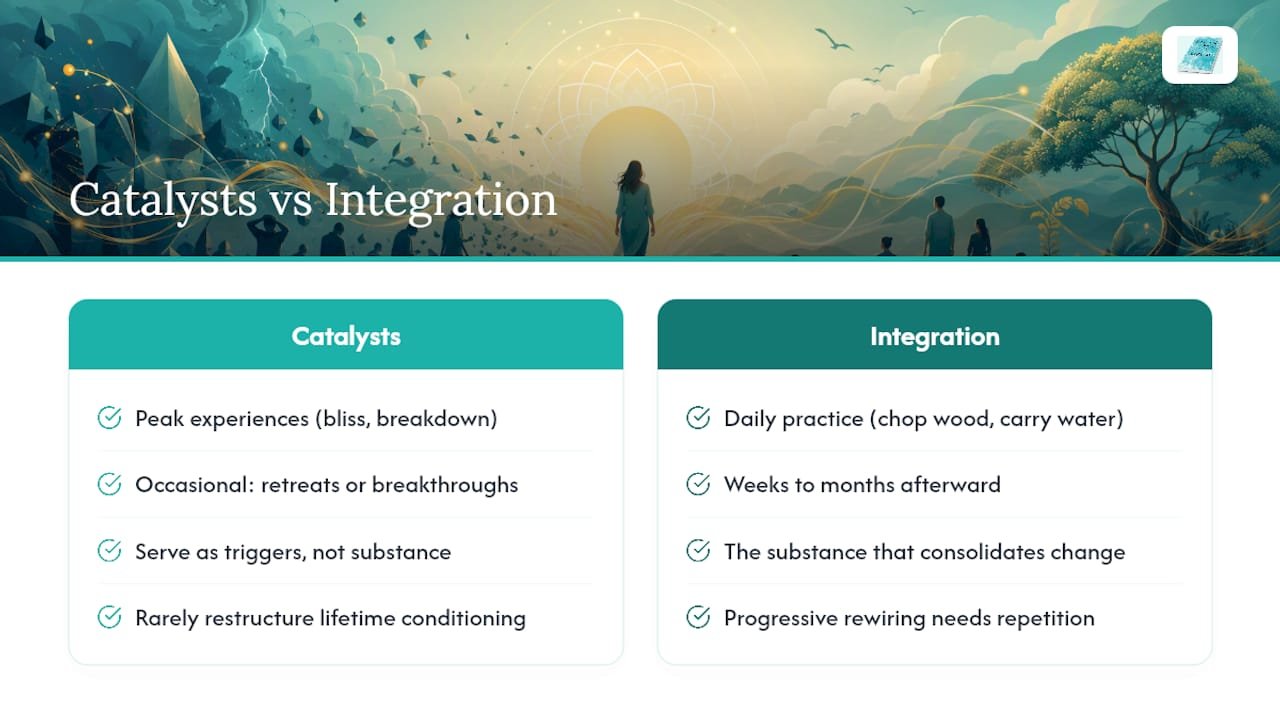
There is a real tension in how awakening gets presented. Many accounts focus on the peak experiences, the dark night, the moments of unity, as though these are the substance of the process. They are not. They are the catalysts. The substance is what you do in the weeks and months afterward, when the intensity has faded and ordinary life reasserts itself. That is when the rewiring either consolidates or dissolves.
The neuroscience framing is useful here not because it reduces awakening to brain chemistry, but because it sets realistic expectations. Progressive rewiring takes time and repetition. A single retreat, a single breakthrough, a single insight does not restructure a lifetime of conditioning. Daily practice does. The Zen instruction “chop wood, carry water” is not a dismissal of transcendence. It is a description of where the real work happens.
There is also a subtler risk worth naming: the tendency to use spiritual frameworks to avoid psychological work. Shadow work is uncomfortable precisely because it requires confronting what has been suppressed, not transcending it. Genuine integration requires both dimensions, the spiritual and the psychological, working together rather than one substituting for the other.
The 7-step practical guide at Spiritualmethod reflects this dual emphasis, pairing structured reflective practices with grounding routines in a format designed for daily use rather than occasional inspiration.
Structured support for every stage of the process
Spiritualmethod’s downloadable guide bundle offers a concrete, structured framework for readers who want more than general advice. The core offering is a 50+ page ebook covering the full awakening and inner healing process, paired with a spirituality planner and journal and a moon manifesting ritual guide.

The bundle includes step-by-step practices in grounding, energy clearing, sacred bathing rituals, intention-setting, and progress tracking, all organized for daily use rather than occasional reference. For readers working through shadow work and integration, the mind-body-soul connection guide provides a structured framework for embedding insights into daily routines. The planner and journal components address the single most common integration gap: the absence of a consistent daily practice structure. Every element is available as an instant digital download, with no subscription or ongoing commitment required. Visit Spiritualmethod to access the full bundle and begin building the daily routines that make integration durable.
Sources
The following sources informed this article and offer additional depth for readers who want to explore specific frameworks or traditions in greater detail.
External sources:
- Exploring the Process of Spiritual Awakening | Psychology Today
- Spiritual Awakening: 6 Real Stages, Signs, And Dark Night
- The Spiritual Awakening Process Step by Step: A Grounded Guide
- Spiritual Awakening Stages: What Happens at Every Stage and What to Expect – PsychicNetwork
Spiritualmethod internal resources:
A consistent daily practice, even five minutes of grounding and ten minutes of journaling, produces more durable integration than any single peak experience. Track your changes, seek support when the process feels clinically overwhelming, and treat the ordinary days as the real work.