
Use the new moon to seed intentions and the full moon to release and integrate what no longer serves you. That distinction drives every ritual choice that follows: the new moon is a blank slate for manifestation, while the full moon is a checkpoint for gratitude, closure, and shadow work. Practitioner sources including North Star Astro, Lunar Guide, and Luminos Path all frame the moon cycle this same way: plant at the new moon, harvest and release at the full moon.
- New moon: write 3 to 5 intentions, speak them aloud, take one grounding action within 48 hours.
- Full moon: review those intentions, note what came true, release what stalled.
Set one clear intention at your next new moon. At the next full moon, review it and let one thing go.
Key Takeaways
Consistent, simple moon rituals produce more lasting change than elaborate ones practiced sporadically, because repetition, not tool complexity, drives the psychological benefit.
| Point | Details |
|---|---|
| New moon = plant | Write 3 to 5 present-tense intentions and take one grounding action within 48 hours. |
| Full moon = release | Review new-moon intentions, release what stalled, and give thanks for what shifted. |
| Track across cycles | Use a two-column journal (intentions vs. outcomes) logged at each full moon for at least three cycles. |
| Skip the expensive setup | A pen, paper, and optional candle or jar of water cover nearly every ritual in this guide. |
| Spiritualmethod’s guides | The Moon Manifesting Ritual Guide and Spirituality Planner & Journal give scripted rituals and printable trackers so you can start tonight instead of drafting prompts from scratch. |
Table of Contents
- New Moon vs Full Moon: Choosing the Right Phase for Your Goal
- Three New Moon Rituals You Can Start Tonight
- Three Full Moon Rituals for Release and Gratitude
- How to Build a Monthly New Moon and Full Moon Practice
- What You Actually Need (and What You Can Skip)
- Ready-Made Guided Rituals from Spiritual Method
- Where to Start With Spiritualmethod
- Frequently Asked Questions
- Sources
New Moon vs Full Moon: Choosing the Right Phase for Your Goal
The new moon works like a blank page. There’s no visible moonlight, which practitioners treat as symbolic darkness before growth, a good moment to plant something specific rather than vague. The full moon works in reverse: it’s the culmination point, when whatever you started two weeks earlier comes into full view, ready to be examined, thanked, or released.
Timing matters more than most beginners assume. The new-moon window for intention work typically runs the day of the exact new moon through the next two or three days, while practitioners treat the full-moon window as the night before peak fullness through roughly one day after, according to Farmer’s Almanac. That gives you a two-week arc: plant at the new moon, act during the waxing weeks, harvest at the full moon, rest during the waning weeks. Repeat.
Here’s the simple decision rule:
- Starting a creative project? New moon. Write the intention, then take one small action before the moon starts waxing.
- Setting a relationship boundary? Full moon. Boundaries are often clarity work, and clarity is what a full moon illuminates.
- Changing a habit? Both. Seed the commitment at the new moon, then use the full moon two weeks later to check whether it stuck.
Pro Tip: Don’t wait for the “perfect” moon phase to start. If you’re mid-cycle and feeling called to release something, do it. The lunar calendar is a rhythm to lean on, not a rule that locks you out of your own intuition.
Three New Moon Rituals You Can Start Tonight
Each of these takes under 20 minutes and needs nothing beyond a candle, paper, and a pen.
- The 15-minute intention seal. Light a candle. Write down what you want to release from the last cycle in one sentence, then set that paper aside. Write 3 to 5 new intentions in present tense (“I am building…” not “I hope to…”). Speak each one aloud once. Blow out the candle and take one concrete action, like scheduling a call or blocking calendar time, within 24 to 48 hours. This mirrors the five-phase structure Lunar Guide recommends: release, clarify, write, speak, act.
- Guided visualization and scripting. Sit somewhere quiet, close your eyes, and picture your intention already realized: what do you see, smell, hear? Write that scene down as if narrating a memory. Anchor it with a scent (a specific candle or oil) you’ll use only for this practice, so your senses learn to associate that smell with focused intention. Within 48 hours, do one grounding task tied to the vision.
- Planner-based intention tracker. Open your planner or journal and log each intention next to a single micro-action and a target date. A sample row: Intention: “I am finishing my manuscript’s first draft.” Micro-action: Write for 20 minutes daily. Check-in: next full moon.
Journal prompts to pair with any of the three: What am I ready to call in? What would this intention look like if I already believed it was possible? What’s the smallest version of action I can take in the next two days? If your new moon falls in a specific zodiac sign, let that flavor the theme (a new moon in Cancer might lean toward home and emotional security) without treating it as a hard rule.
Pro Tip: A grounding action within 24 to 48 hours turns a wish into a habit. Even something as small as sending an email or drinking a glass of water while holding the intention in mind helps anchor the shift into observable behavior.

Three Full Moon Rituals for Release and Gratitude
Full-moon work asks something different of you: less planting, more letting go. These three scripts cover release, gratitude, and integration.
- Write-and-burn release. Write down what you’re ready to release, one sentence per item, then burn each slip in a fireproof bowl. Say “I release this” as it burns. If burning isn’t safe or possible where you live, tear the paper into small pieces and place them in water, or bury them instead. Common full-moon practices like this, along with candle work and moon-charged water, are outlined by Farmer’s Almanac.
- Gratitude and harvest review. Pull out the intentions you wrote at the new moon. For each one, note what shifted, even slightly. Write a one-line thank-you to yourself for the effort, not just the outcome.
- Integration bath or breathwork. Draw a warm bath with a handful of Epsom salt, or if a bath isn’t available, sit with your feet in a basin of warm water while doing slow breathing for five minutes. Women’s Health points to movement, cleansing, and journaling as effective full-moon tools for people without access to visible moonlight or outdoor space.
Safety checklist before you begin: never leave a burning candle or paper unattended, keep a fireproof bowl and water nearby for any burning ritual, and skip essential oils in bathwater if you have sensitive skin. If you’re doing group release work, get clear consent before sharing anyone else’s story aloud.
Journal prompts for this phase: What did I complete this cycle? What am I still holding onto that’s ready to go? What’s one lesson I want to carry into the next new moon?

Pro Tip: Full-moon rituals work best when treated as completion, not perfection. North Star Astro frames the week after the full moon as an integration window, so don’t rush to “fix” everything the same night.
How to Build a Monthly New Moon and Full Moon Practice
A single ritual rarely creates lasting change. What does is repetition across cycles, which is why practitioners recommend tracking outcomes in a simple moon journal rather than starting fresh every month.
Here’s a sample structure:
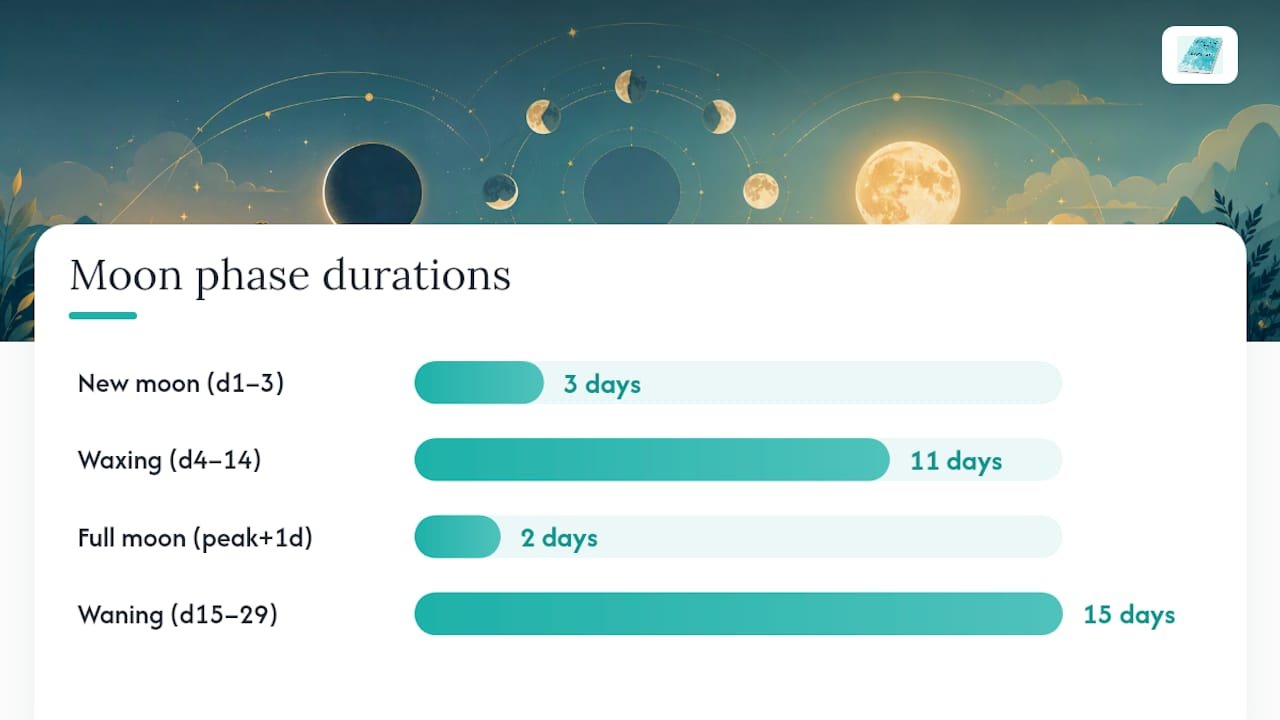
- New moon (day 1 to 3): Set 3 to 5 intentions. Log them in your journal alongside one micro-action each.
- Waxing weeks (day 4 to 14): Take the micro-actions. Check in every few days.
- Full moon (peak night to day 1 after): Review, release, give thanks.
- Waning weeks (day 15 to 29): Rest, integrate, retire or reword any intention that no longer fits.
Your tracking template can be as simple as two columns: Intentions on one side, Outcomes on the other, logged at every full moon so patterns become visible across three or more cycles, a habit Luminos Path ties directly to better follow-through.
Keep the intention count low. Three to five is enough; more than that and none of them get real attention. Between moon phases, small daily anchors, a two-minute grounding routine or a morning intention check-in, keep momentum alive instead of leaving all the work to two nights a month.
What You Actually Need (and What You Can Skip)
You need a pen, paper, and a way to mark time. That’s it. A candle helps set mood but isn’t required; a jar of water left on a windowsill overnight can substitute for moon-charged water if you don’t want to buy anything.
- Burn safety: always use a fireproof bowl, never leave flame unattended, keep water nearby.
- No outdoor access? A windowsill or a photo of the moon works as a visual anchor.
- Mobility or sensory limits? Swap movement rituals for breathwork or a written-only practice.
- Group rituals: get explicit consent before any shared release work.
None of this requires an altar or expensive tools. Rituals work because of consistency and structure, not because of what you’re holding while you do them.
Pro Tip: If you only have five minutes, write one sentence about what you’re releasing or seeding and read it aloud once. Showing up small, every cycle, beats an elaborate ritual you only do twice.
Ready-Made Guided Rituals from Spiritual Method
If you’ve read this far and want the scripts already written for you, that’s exactly what Spiritualmethod’s downloadable guides are for. They’re built for people who want the structure above without having to draft prompts and trackers from scratch every month.
- Moon Manifesting Ritual Guide: scripted new- and full-moon rituals with guided prompts, ready to follow the night of.
- Spirituality Planner & Journal: printable tracking pages built around the intentions-and-outcomes format described above, including micro-action rows you can fill in each cycle.
- 50+ page inner-healing ebook: deeper frameworks for grounding, energy clearing, and sacred bathing rituals that extend the full-moon integration work into a broader practice.
Buyers get instant PDF downloads, formatted for printing or digital journaling, paced for three full moon cycles so you can actually see whether the practice is working before deciding to continue.
Pro Tip: Beginners often over-plan their first ritual and never actually do it. Start with the Moon Manifesting Ritual Guide’s shortest script, repeat it for one full cycle, then expand.
Why Rhythm Beats Complexity
What tends to separate people who stick with moon rituals from people who try one and quit isn’t discipline. It’s whether the ritual is simple enough to repeat without dread. A five-minute journal entry done every new and full moon for three cycles moves the needle more than one elaborate ceremony done once and abandoned. If you take one thing from this article, pick a single ritual, run it for three cycles, and only then decide whether to add complexity.
Where to Start With Spiritualmethod
There are other ways to build this practice: a blank notebook, free ritual scripts scattered across blogs, or a printable template you cobble together yourself. All of that works if you have the time to build it and the discipline to keep at it without structure. Spiritualmethod skips the assembly step. Every ritual, prompt, and tracker in this article already exists in finished, printable form inside the Moon Manifesting Ritual Guide and the Spirituality Planner & Journal, so you open the PDF and start the same night instead of building your own system from scratch.

For readers who want to go deeper than moon work alone, the inner child healing guide pairs well with full-moon shadow work, and the journaling for soul healing guide extends the prompts in this article into a full standalone practice. Both are built for beginners and repeat practitioners alike, with no prior ritual experience required.
Download the Moon Manifesting Ritual Guide before your next new moon and have your first script ready to run within minutes of opening it.
Frequently Asked Questions
Is the new moon or full moon better for manifesting?
The new moon is better for setting intentions and starting something new, since it functions as the blank-slate point in the lunar cycle. The full moon is better for evaluating what’s already in motion and releasing what isn’t working.
How long should a new moon or full moon ritual take?
Most effective rituals take 15 to 20 minutes. Length matters far less than doing a grounding action within 24 to 48 hours afterward, which is what actually moves an intention from wishful thinking into behavior.
Do I need to do a ritual on the exact night of the new or full moon?
No. Practitioners generally treat the new-moon window as the exact day through the next two or three days, and the full-moon window as the night before through about a day after peak fullness, so there’s flexibility built in.
Can I customize new moon intentions based on my zodiac sign?
Yes, and many practitioners recommend it as a way to add theme and specificity. Just don’t treat the sign as a strict rule; use it as a prompt, not a limit, when writing your intentions.
What if I miss a new moon or full moon ritual?
Pick up at the next one. The monthly rhythm is meant to be a repeatable structure, not a strict deadline, and missing a single cycle doesn’t undo the practice.
Sources
- Ritual: your secret source of wellness and resilience | Psychology Today
- New moon intention setting step by step (June) | Lunar Guide
- Full moon ritual self-care | Farmer’s Almanac
- New moon intentions | North Star Astro
- Full moon rituals | Women’s Health
For readers who want to add a celestial layer to ritual customization, the Mayan Sign Calculator offers another lens for personalizing intention themes beyond the standard zodiac.