
Intention setting means choosing, in advance, how you want to show up in a moment, day, or season, rather than reacting on autopilot. It differs from goal setting because it lives in present tense and focuses on mindset, not outcome: a goal is “lose ten pounds,” an intention is “I move my body with gratitude today.” Here are six ready to use right now.
- Emotion: “I meet today with patience.”
- Relationship: “I listen fully before I respond.”
- Work: “I focus on one task at a time.”
- Health: “I nourish my body with care.”
- Creativity: “I let ideas flow without judgment.”
- Spiritual: “I stay open to guidance today.”
Pick one and use it now.
Key Takeaways
Effective intentions are present tense, positively framed, paired with a physical anchor, and measured by how quickly you return after drifting.
| Point | Details |
|---|---|
| Definition matters | An intention is a present-tense mindset choice, distinct from a future-focused goal. |
| Domain grouping helps | Sorting intentions into emotional, relational, work, health, and spiritual categories speeds up phrasing. |
| Phrasing formula | Use present tense, positive framing, and language within your own control. |
| Anchors beat willpower | Journaling, alarms, and physical objects make intentions stick better than memory alone. |
| Structured practice | Spiritual Method’s journaling guide offers guided prompts for readers who want a repeatable routine. |
Table of Contents
- Why Intention Setting Examples Actually Change Your Day
- Intention Statement Examples by Life Domain
- Daily Intention Ideas You Can Copy Right Now
- How to Write an Intention Statement That Actually Works
- Anchoring Rituals That Make Intentions Stick
- How Sean Uses Short Intentions in His Own Practice
- What Actually Makes Intention Setting Work
- A Structured Next Step for Your Intention Practice
- Frequently Asked Questions
- Sources
Why Intention Setting Examples Actually Change Your Day
The value shows up fast because a written or spoken intention gives your attention a target before the day scatters it. According to Cleveland Clinic, practitioners group intentions into emotional, relational, professional, and spiritual categories specifically because that structure increases how effective the practice becomes.
Statistic callout: Success with intention setting isn’t measured by flawless follow-through. Cleveland Clinic frames it as a “practice of return,” meaning the real skill is noticing when you’ve drifted and gently coming back to your intention, not avoiding drift altogether.
That reframing matters for anyone who has quit a habit after “failing” once. Three outcomes tend to follow a consistent intention practice:
- Sharper focus, since you’ve named what deserves your attention before distractions compete for it.
- Calmer reactions, because you’ve pre decided your tone instead of improvising under stress.
- Clearer priorities, which makes small daily decisions faster and less draining.
Intention Statement Examples by Life Domain
Choosing a domain starts with a simple question: what feels shaky right now? If your inbox is chaos, borrow from the productivity list. If a relationship feels strained, start there instead. Each line below works as a daily line or can stretch across a full week by simply repeating it each morning.
Emotional and mindset
- “I release what I cannot control.”
- “I speak kindly to myself today.”
- “I choose calm over urgency.”
- “I notice my thoughts without judging them.”
- “I make space for joy.”
Scale note: for a week, pair this with two minutes of evening reflection on where calm showed up.
Relationships
- “I show up fully for the people I love.”
- “I offer patience instead of criticism.”
- “I ask questions before assuming.”
- “I express appreciation out loud.”
- “I set boundaries with love.”
Scale note: pick one person to focus this on for the week rather than everyone at once.
Work and creativity
- “I focus on progress, not perfection.”
- “I protect my energy for what matters most.”
- “I let my ideas be imperfect at first.”
- “I finish before I start something new.”
- “I create before I consume.”
Scale note: attach this to your first work block of the day so it has a clear trigger.
Health and wellness
- “I move my body because it feels good.”
- “I eat with attention, not distraction.”
- “I rest without guilt.”
- “I drink water before reaching for caffeine.”
- “I listen to what my body needs.”
Spiritual and meaning
- “I trust the timing of my life.”
- “I stay open to signs and guidance.”
- “I honor the sacred in ordinary moments.”
- “I release the need for certainty.”
- “I return to gratitude when I feel lost.”
Daily Intention Ideas You Can Copy Right Now
Short, specific lines work better than vague ones because they’re easier to remember mid-task. My Best Day Blog notes that daily intentions land best when tied to a role, like parent or team lead, and slotted into a short routine you already have.
Thirty quick options, grouped by theme:
- Calm: “I breathe before I react.” 2. Calm: “I slow down on purpose.” 3. Calm: “I let go of what’s already passed.” 4. Focus: “I do one thing at a time.” 5. Focus: “I close distracting tabs before I start.” 6. Focus: “I protect my first hour.” 7. Focus: “I finish what I begin.” 8. Kindness: “I assume good intent from others.” 9. Kindness: “I offer one genuine compliment today.” 10. Kindness: “I forgive small mistakes quickly.” 11. Kindness: “I check in on someone I care about.” 12. Energy: “I move before I sit for hours.” 13. Energy: “I take a real lunch break.” 14. Energy: “I say no to what drains me.” 15. Energy: “I rest when I need to.” 16. Boundaries: “I speak up when something feels wrong.” 17. Boundaries: “I leave work at work today.” 18. Boundaries: “I honor my own schedule.” 19. Boundaries: “I ask for help when I need it.” 20. Gratitude: “I notice three good things today.” 21. Gratitude: “I appreciate this moment as it is.” 22. Growth: “I try one new thing today.” 23. Growth: “I stay curious instead of certain.” 24. Presence: “I put my phone down during meals.” 25. Presence: “I listen more than I speak.” 26. Confidence: “I trust my own judgment.” 27. Confidence: “I take up space I’ve earned.” 28. Simplicity: “I do less, better.” 29. Connection: “I reach out first today.” 30. Renewal: “I end the day with something calming.”
Three fill in the blank templates:
- Morning: “Today I choose to feel ___ so I can ___.”
- Work block: “For the next hour, I focus on ___ and let go of ___.”
- Evening: “Tonight I reflect on ___ and release ___.”
A simple micro routine: pick three lines on Sunday, one per theme, and rotate them through the week instead of choosing fresh each morning.
How to Write an Intention Statement That Actually Works
Strong intentions follow one formula: present tense, positively framed, within your control, and emotionally specific enough that you’d notice if you drifted from it. My Best Day Blog points to present tense and positive framing as the two most common phrasing mistakes people skip.
Compare these:
- Weak: “I hope I don’t get anxious in the meeting.” Strong: “I speak with calm confidence.”
- Weak: “I’ll try to be less distracted.” Strong: “I give my full attention to one task.”
A 60 second morning script: write or say your line once, close your eyes for ten seconds and picture yourself living it, then move on. Check the difference between an intention and a goal if you’re unsure which one you’re actually setting.
Pro Tip: Set a midday alarm labeled with your intention word. Seeing it once at noon does more for follow-through than writing it once and forgetting it.
Anchoring Rituals That Make Intentions Stick
Cleveland Clinic’s research is direct on this point: a physical anchor, such as journaling, an alarm, or a placed object, works better than a mental note alone. A seven-day starter plan:
- Day 1, write your intention on paper.
- Day 2, say it aloud while getting dressed.
- Day 3, set a phone alarm with the line as the label.
- Day 4, place a small object (a stone, a sticky note) where you’ll see it.
- Day 5, pair it with an existing habit, like brushing your teeth.
- Day 6, do a two-minute journal check-in on how it went.
- Day 7, choose whether to repeat it or pick a new one.
If you drift midweek, that’s expected, not failure. Return to the line and keep going.
How Sean Uses Short Intentions in His Own Practice
I keep my morning intention to one short line, said aloud while the coffee brews, because anything longer gets forgotten by 9 a.m. Pairing it with a two-minute evening journal entry, using prompts from our spiritual journaling guide, is what actually makes the practice stick over weeks instead of days.
The intention that survives a busy Tuesday is the one you wrote down and can say in under five seconds.
Our inner peace guide covers how intentions fit into a broader practice, not just a morning habit.
What Actually Makes Intention Setting Work
Most advice on this topic overcomplicates it. People are told to journal for twenty minutes, meditate first, and craft the perfect wording before they’re allowed to start. That’s backward. The evidence points to something simpler: a five-second line, said or written, paired with one physical anchor, beats an elaborate ritual you abandon after four days.

The conventional wisdom also treats drifting from an intention as a sign the practice isn’t working. It’s the opposite. Cleveland Clinic’s framing of a “practice of return” suggests the return itself, not the perfect streak, is the actual skill being built. Readers who grade themselves on consistency quit fast. Readers who grade themselves on how quickly they notice and reset tend to stick with it for months.
If you take one thing from this article, prioritize the anchor over the wording. A mediocre sentence with a strong ritual behind it outperforms a beautifully worded intention with nothing holding it in place.
A Structured Next Step for Your Intention Practice
If the daily lines and templates above felt useful, a structured workbook takes the guesswork out of picking new ones each week. Journaling for Soul Healing is Spiritual Method’s downloadable guide built specifically to extend this kind of daily practice with guided prompts and space to track your own returns over time, instead of you having to build a system from scratch.
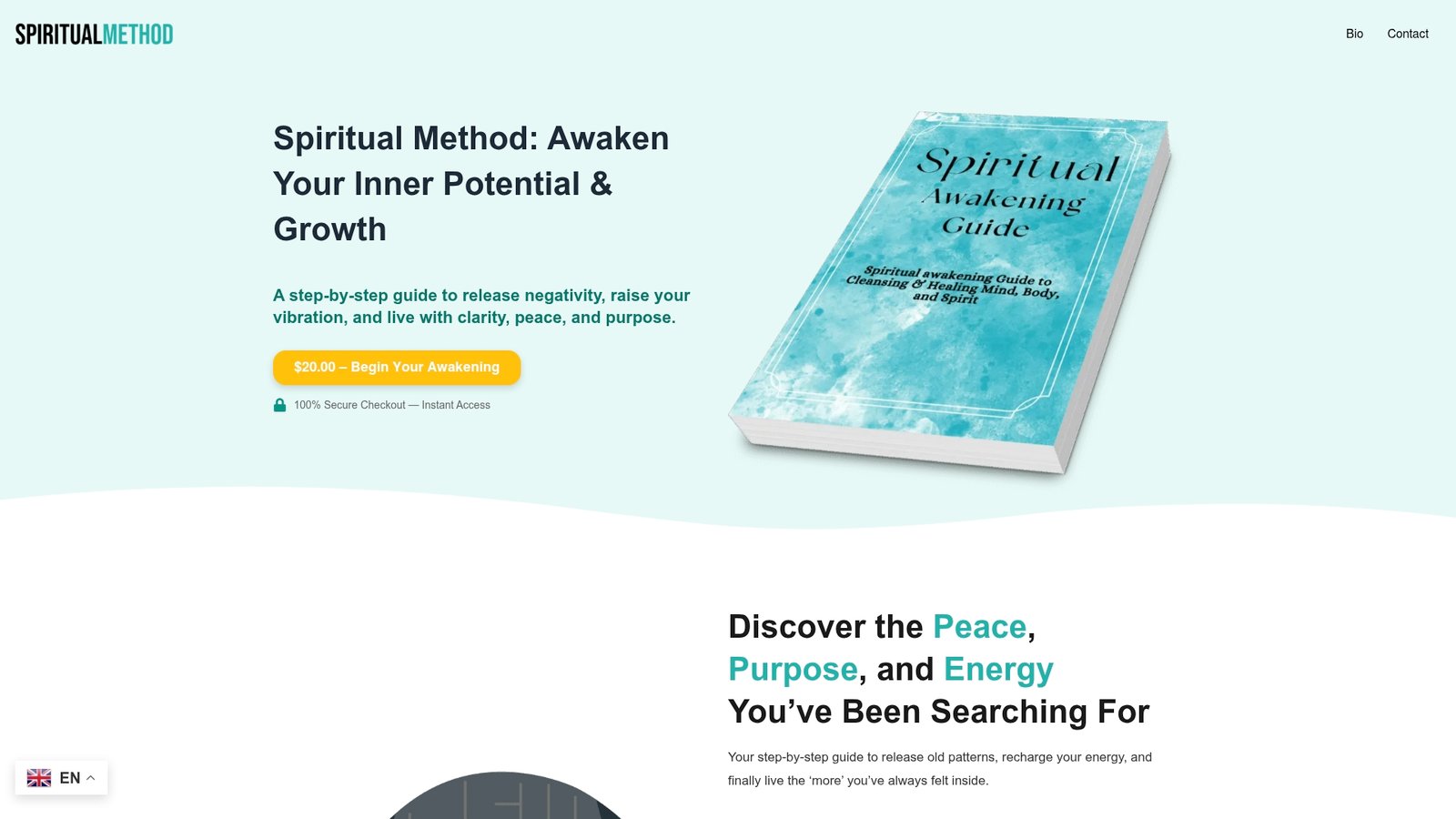
Rather than reinventing your intention list every Sunday night, the workbook gives you pre-built prompts organized by theme so you can open it, write for two minutes, and move on with your day. Download it and use tonight’s reflection prompt as your first entry.
Frequently Asked Questions
What is the difference between an intention and a goal?
A goal targets a future outcome, like finishing a project. An intention is present tense and focuses on how you want to feel or act right now, such as “I work with focus today.”
How many intentions should I set per day?
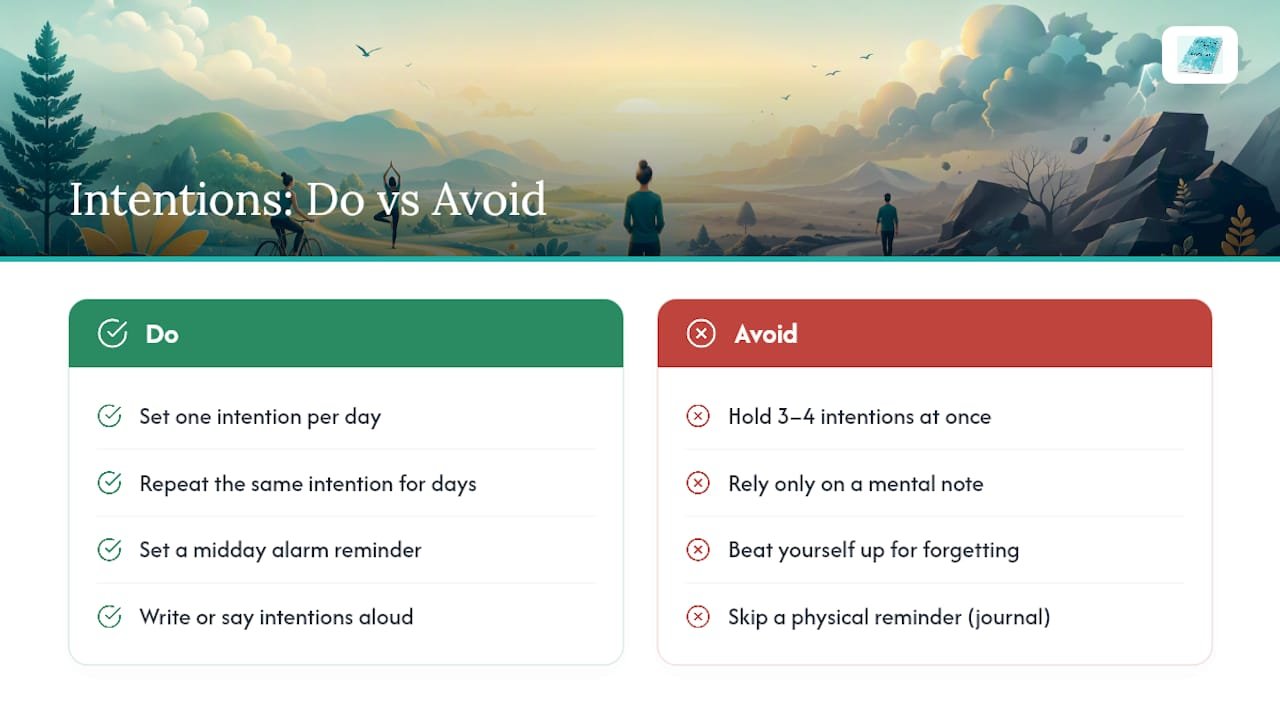
One is usually enough. Trying to hold three or four intentions at once tends to dilute your attention rather than sharpen it.
Can I reuse the same intention for a whole week?
Yes. Repeating one intention across several days often works better than a new one daily, since repetition builds the habit of noticing when you’ve drifted and returning to it.
What if I forget my intention by mid-morning?
That’s normal and expected. Set a midday alarm as a simple reminder, and treat the moment you remember as the win, not a failure.
Do I need to write intentions down, or can I just think them?
Writing or speaking them aloud works better than a mental note alone, since a physical anchor like a journal entry or sticky note makes the intention harder to forget.
Sources
- Setting intentions: Examples and how to do it | Cleveland Clinic
- The Complete Guide to Daily Intention Setting (2025) | My Best Day Blog