
An intention board ritual pairs chosen images and words with a short plan of action, giving a goal both meaning and momentum. The single change that makes this practice work is simple: write one clear if-then plan beneath each main image, naming the obstacle you expect and the response you will take. This article covers the materials, a step-by-step ritual script, the research behind pairing visualization with planning, and a daily practice to keep the board alive.
TL;DR:
- A 30 to 45 minute session can use five to nine visuals, with a short obstacle and response plan beneath each main goal.
- A 2021 review of 21 studies found that mental contrasting with action plans improved goal attainment modestly; guided interactive exercises worked better than worksheets.
- Attach a 30 second morning glance to an existing habit, then use a 60 to 90 second evening check to record one action.
- A physical board offers tactile image making, while a digital collage travels easily and updates quickly but lacks the hands on ritual.
Table of Contents
- What to Gather for a Physical or Digital Board
- A Step-by-Step Ritual to Build and Activate Your Board
- Why Visualization Alone Falls Short, and What Fixes It
- Keeping the Board Active Day to Day
- Personalizing the Ritual to Your Beliefs and Energy
- Clearing Emotional Blocks Before You Begin
- Cleansing and Recharging Your Board Over Time
- How This Ritual Reflects Our Approach
- Where to Go Next if You Want Ready-Made Templates
- FAQ
- Sources
What to Gather for a Physical or Digital Board
Before beginning, we recommend gathering supplies that make the ritual feel intentional without adding pressure. A physical board works well for readers who want a tactile, visible object, while a digital board suits those who travel often or share living space.
- Physical supplies: a corkboard or poster board, scissors, glue stick, magazines or printed photos, colored pens, and pushpins.
- Inexpensive substitutes: a manila folder, printer paper taped together, or a repurposed picture frame work just as well as store-bought boards.
- Digital options: a phone wallpaper collage, a Google Slides deck, or a collage app; these travel with you and update easily, though they lack the tactile act of cutting and placing images by hand.
- Images and words: choose visuals that trigger an emotional response rather than generic stock photos; a photo that makes you feel calm or determined does more work than one that simply looks appealing.
- Symbols: a pressed flower, a ticket stub, or a hand-drawn icon can represent a goal more personally than any magazine clipping.
Placement matters as much as content. Put the board somewhere you pass daily, a closet door, a desk corner, or a nightstand, so the images register without demanding extra effort. If you share a household, choose a spot that respects others’ privacy and avoid placing anything near heat sources or open flames if you plan to incorporate candles later in the ritual.
A Step-by-Step Ritual to Build and Activate Your Board
A full ritual session takes 30 to 45 minutes and moves through four stages: preparation, creation, activation, and a first-week follow-through plan.
- Ground yourself. Sit quietly for three to five minutes, breathing slowly, and ask what you genuinely want to feel more of this season.
- Journal before cutting. Write short answers to two prompts: “What outcome matters most right now?” and “What has gotten in the way before?”
- Select and arrange images. Choose five to nine visuals or words that reflect those outcomes, arranging them by theme (career, relationships, health, inner growth) rather than at random.
- Write an if-then plan under each major image. For example: “If I feel too tired to write after work, then I will write for five minutes before dinner instead.”
- Speak an activation script. Name the outcome aloud, state one thing you are grateful for already, and close with a sealing phrase such as “This board reflects what I am building, one action at a time.”
- Add a symbolic act if it feels right. Lighting a candle safely away from the board, placing a small stone on the frame, or saying a short blessing can mark the moment without becoming the point of the ritual.
- Plan your first week. Choose two micro-tasks per goal area and commit to glancing at the board each morning and evening.
Pro Tip: Keep your if-then statements short enough to say in one breath: specificity matters more than length.
The first week sets the pattern. A short morning glance paired with a single journal line (see our morning ritual for setting daily intentions) keeps the board from becoming wallpaper you stop noticing after day three.
Why Visualization Alone Falls Short, and What Fixes It
Looking at inspiring images feels good, but research on mental contrasting and implementation intentions suggests that outcome-only visualization can actually reduce motivation when it is not paired with planning. Picturing success without naming obstacles can trick the mind into feeling the goal is already handled.
The fix is a method called MCII: mental contrasting with implementation intentions. A 2021 meta-analysis of 21 studies found that MCII produced a small-to-medium improvement in goal attainment, with an overall effect of g ≈ 0.336. The same review found that guided, interactive versions of the exercise outperformed self-guided worksheets, though document-based practice still helped.
To build MCII into your ritual:
- Visualize the outcome in vivid, sensory detail for sixty seconds.
- Name the single most likely obstacle standing between you and that outcome.
- Write one or two if-then plans per obstacle, in the format “If [obstacle], then I will [specific response].”
- Say the plan aloud once, since speaking a commitment tends to reinforce it more than reading it silently.
- Share one if-then plan with a friend or partner for light accountability.
Keeping the Board Active Day to Day
A board only works if it stays part of your routine rather than becoming decoration. Short, consistent check-ins matter more than long sessions.
- Morning glance (30 seconds): look at the board, pick one image, and silently restate its if-then plan.
- Evening check (60 to 90 seconds): note one action taken toward any goal, however small.
- Weekly review: revisit each goal area, mark visible progress, and rewrite any if-then plan that has not held up against real obstacles.
- Habit-stacking: attach the morning glance to an existing habit, such as pouring coffee or brushing your teeth, so it needs no extra willpower.
Pro Tip: Treat a missed day as information, not failure: ask what got in the way, then adjust the plan rather than the goal.
Pair your weekly review with a short written reflection; our intention journal prompts offer quick questions suited to this pace.
Personalizing the Ritual to Your Beliefs and Energy
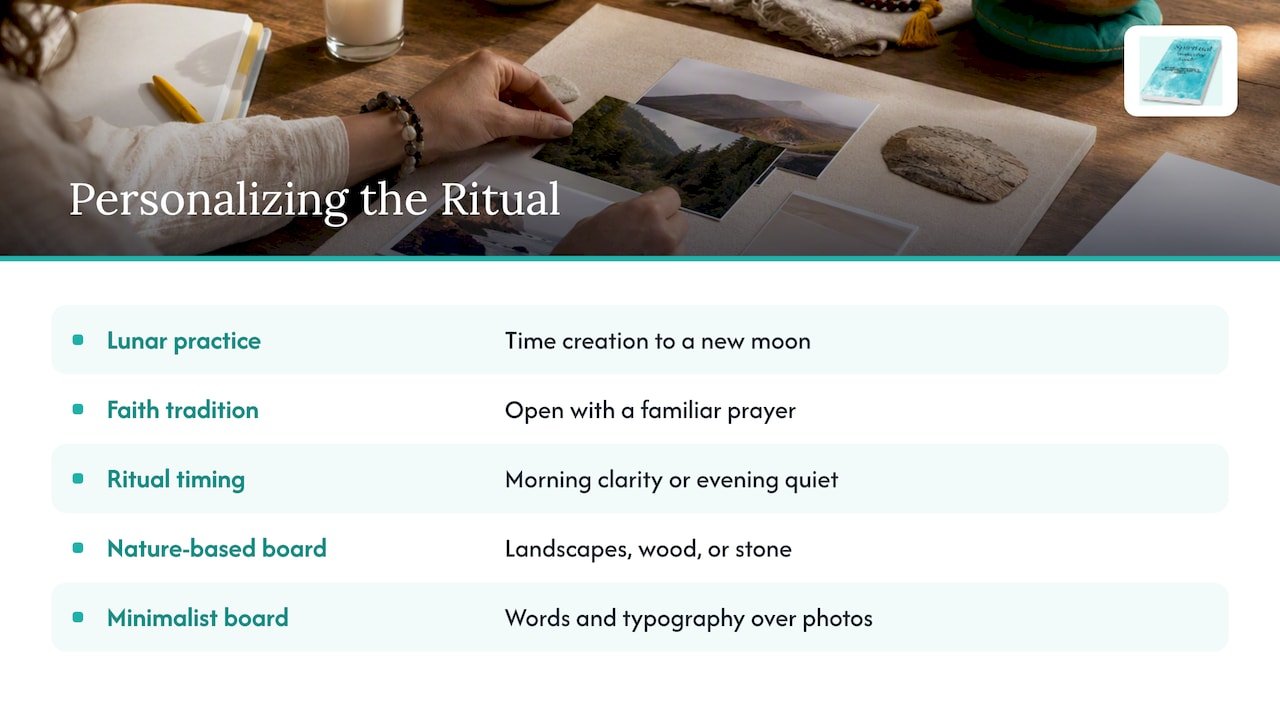
An intention board ritual works best when it reflects your own spiritual framework rather than someone else’s template. Readers drawn to lunar or seasonal practice might time their board creation to a new moon, while those grounded in a specific faith tradition might open the ritual with a familiar prayer instead of a generic script. Neither approach is more correct than the other; the structure matters more than the language around it.
Energy patterns also shape timing. Some people feel clearest and most decisive in the morning, making early hours the right window for creation and activation. Others find that evening quiet, after the day’s demands have settled, produces more honest answers to the journaling prompts. Pay attention to when your own thinking feels least cluttered and schedule the ritual there instead of forcing it into a fixed hour.
The content of the board should follow the same logic. A reader oriented toward nature-based practice might favor images of landscapes and natural materials like wood or stone, while someone drawn to minimalism might prefer words and typography over photographs. Our guide to intention versus goal setting can help clarify which type of language, feeling-based or outcome-based, fits your own style before you start cutting images.
Clearing Emotional Blocks Before You Begin
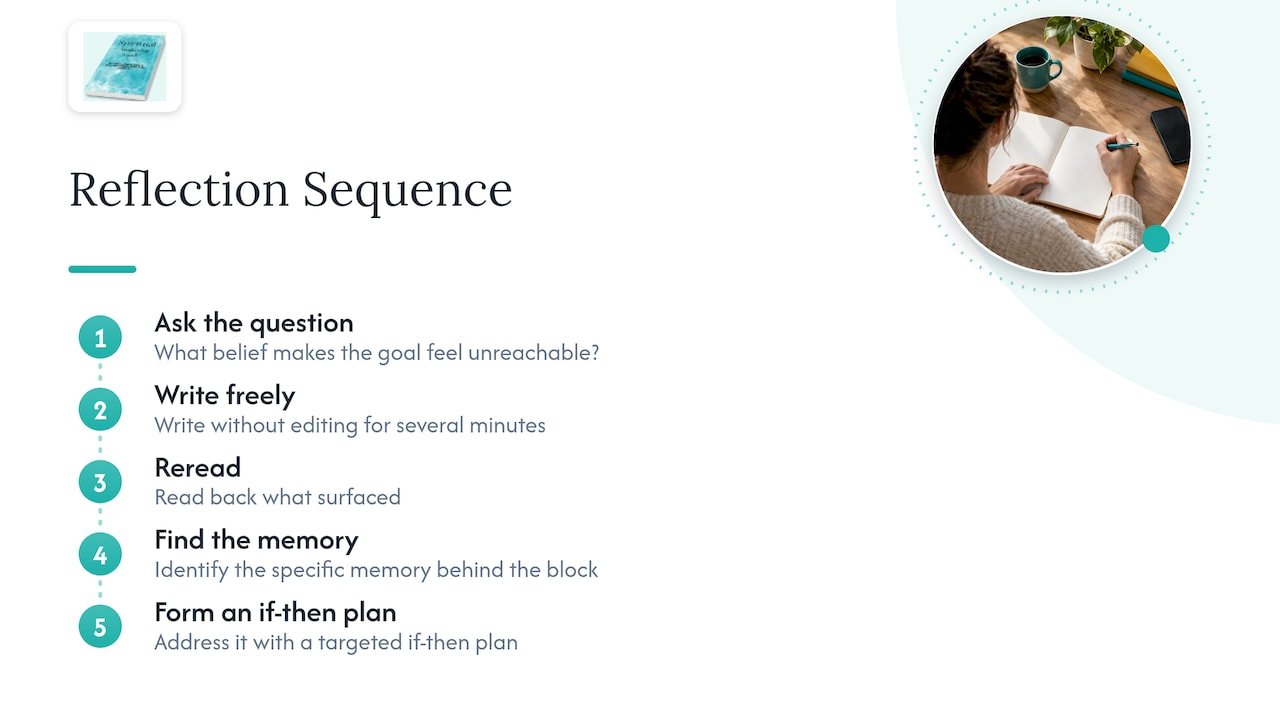
Limiting beliefs often surface the moment you sit down to define what you want, showing up as doubt about whether a goal is realistic or deserved. Addressing these before building the board tends to produce a clearer, more honest result than pushing through distraction.
A short writing exercise helps surface what is actually in the way. Ask yourself plainly: “What do I believe about myself that makes this goal feel out of reach?” Write without editing for several minutes, then read back what surfaced. Often the block is an old, specific memory rather than a general flaw, and naming it concretely makes it easier to address with a targeted if-then plan rather than vague willpower.
Breathwork or brief grounding meditation before journaling can also loosen tension that keeps thoughts circling. Five slow breaths, each with a longer exhale than inhale, signal the nervous system to settle before difficult questions arise. For a more structured approach to this kind of reflection, our journaling for soul healing guide offers prompts built specifically around releasing old narratives before setting new ones.
If digital reminders help you stay honest about recurring patterns between sessions, a tool like Kratic can track mood and journaling entries over time, surfacing patterns that might otherwise stay invisible between one ritual and the next.
Cleansing and Recharging Your Board Over Time
A board that sits untouched for months tends to lose its pull, so periodic renewal keeps it meaningful rather than stale. Many practitioners tie this renewal to the lunar cycle, using the new moon to set fresh intentions and the full moon to review progress and release what no longer fits.
Smudging with sage or palo santo is a common cleansing practice, though it should always be done with attention to ventilation and never near paper or flammable materials; a safer alternative is passing a cleansing scent like essential oil on a cloth near the board instead of an open flame. Some readers prefer to simply dust the board and reread each if-then plan aloud, which serves a similar purpose of renewed attention without any fire risk.
A full recharge, replacing outdated images and retiring goals that have shifted, works well on a seasonal rhythm: four check-ins a year keeps the board current without turning renewal into a constant chore. Our daily spiritual practices guide includes short rituals that pair naturally with this kind of seasonal reset.
How This Ritual Reflects Our Approach
We built this ritual around a simple belief: spiritual practice and practical follow-through are not opposites. Pairing a meaningful image with a concrete if-then plan honors both the feeling behind a goal and the action required to reach it. That is the same philosophy behind every structured practice we design for mind-body-soul integration.
— Sean
Where to Go Next if You Want Ready-Made Templates
If you would rather work from a structured guide than build every template from scratch, our spiritual awakening guide includes ritual templates, habit trackers, and journaling prompts designed to extend exactly the kind of practice described above.

- A fillable MCII template for writing obstacle-and-response plans next to your own goals.
- A 7-day ritual tracker to log daily glances and micro-tasks without extra guesswork.
- Grounding and sacred bathing practices that pair with board creation sessions.
The guide costs $20 as a one-time purchase, with instant download after checkout. If the ritual outlined here resonated, it offers a practical next step toward building that practice into a fuller routine.
FAQ
Does a vision board really work?
A vision board works best as an attention-management tool that keeps a goal visible daily rather than as something that produces results on its own. Research on mental contrasting shows that visualization paired with obstacle-identification and if-then planning supports follow-through more reliably than images alone.
What to put on a manifestation board?
Include images and words that trigger a genuine emotional response, paired with a short if-then plan beneath each main goal area. Concrete symbols, a ticket stub, a hand-drawn icon, or a specific phrase tend to work better than generic stock photos.
Can ChatGPT make a vision board?
An AI tool can help generate a list of relevant images, phrases, or if-then plan wording to use as a starting point, though the final selection should still reflect your own emotional response to each image. The ritual itself, grounding, arranging, and activating the board, remains a personal practice no tool can complete for you.
What does God say about vision boards?
Vision boards are not addressed in religious texts directly, so readers from faith traditions often adapt the practice by opening with prayer or scripture reflection instead of a secular activation script. The structure of naming a goal and planning concrete action is compatible with most spiritual frameworks when the language is adjusted to fit personal belief.
How often should I update my intention board?
A seasonal rhythm, roughly four times a year, keeps a board current without turning renewal into a frequent task. Many readers tie smaller check-ins to the new and full moon for shorter review cycles between full resets.
Sources
- Frontiers | A meta-analysis of the effects of mental contrasting with implementation intentions on goal attainment
- PMC review and related literature on mental contrasting and implementation intentions