
You finish a normal day and still feel agitated. Your inbox is closed, the meeting is over, and no one is actively asking anything from you, but your body hasn’t caught up. Your jaw is tight, your thoughts are noisy, and even simple things feel heavier than they should.
That’s often how negative energy shows up in real life. Not as something theatrical or mysterious, but as emotional residue, environmental stress, and unprocessed tension that stays in the body after the moment has passed. For some people, that heaviness lifts quickly. For others, especially empaths, highly sensitive people, and stressed professionals, it lingers.
If you’ve been trying to learn how to release negative energy, generic advice usually falls short. “Just smudge.” “Just meditate.” “Just think positive.” None of that helps if you’re absorbing tension all day, carrying other people’s moods home, or feeling disconnected from your own center. Some empath-focused guidance notes that empaths and highly sensitive persons absorb external negativity more intensely due to heightened mirror neuron activity, and recent wellness trends show a 35% rise in empath self-identification among a group estimated at 15-20% of the population. The same source also notes that a compassionate release approach can reduce negativity recurrence by 40% for this group, according to empath-centered guidance on clearing negative energy.
The good news is that release can be learned. It works best when you combine fast resets, deeper rituals, and a way to track what helps your system.
Table of Contents
- Recognizing the Weight of Negative Energy
- Immediate Relief Daily Grounding and Breathing
- Quick Energy Resets for a Demanding Life
- Deeper Cleansing Protective Rituals for Your Space and Self
- Using Nature's Tools Crystals Herbs and Moon-Aligned Baths
- Building a Sustainable Practice and Tracking Your Progress
Recognizing the Weight of Negative Energy
Some days you can tell exactly why you feel off. A conflict. Bad sleep. Too much screen time. Too many people wanting something from you. Other days, the feeling is less obvious. You’re not in crisis, but you feel emotionally muddy, overstimulated, or strangely flat.

That’s the form negative energy often takes. It can be the buildup of stress from work, tension from unresolved conversations, the aftereffect of constant alerts, or the atmosphere of a space that never feels settled. In practice, I don’t treat it as “bad” in a moral sense. I treat it as stagnant emotional charge that needs movement, containment, or release.
What negative energy usually feels like in the body
It rarely arrives as one neat symptom. It tends to cluster.
- Mental signs include fog, irritability, looping thoughts, and difficulty deciding simple things.
- Physical signs often show up as shallow breathing, heaviness in the chest, neck tension, tired eyes, or a wired-but-drained feeling.
- Relational signs include absorbing someone else’s mood, losing your own emotional baseline, or feeling depleted after ordinary interactions.
Negative energy becomes a problem when you stop noticing what is yours and what isn’t.
For empaths and highly sensitive people, this distinction matters even more. If you naturally read rooms quickly, sense unspoken tension, or feel “full” after being around distressed people, your issue may not be weakness. It may be a lack of energetic boundaries.
A quick body-first check
Before you try to fix anything, check three things:
| Check | Ask yourself | What it reveals |
|---|---|---|
| Body | Where am I tight right now? | Where energy is being held |
| Breath | Am I breathing deeply or barely at all? | Whether your system feels safe |
| Boundary | Did this feeling begin with me? | Whether you’re carrying your own stress or someone else’s |
The wrong method wastes energy. If you’re mentally overwhelmed, more analysis usually doesn’t help. If you’re physically charged, sitting still may feel impossible. If you’ve absorbed other people’s stress, positivity talk won’t clear it. You need a method that matches the form the heaviness has taken.
That’s where this work becomes practical. Instead of asking whether energy is “real enough,” ask a better question. What helps you feel clearer, steadier, and more like yourself again?
Immediate Relief Daily Grounding and Breathing
The fastest internal reset I know is simple. Slow the breath, bring awareness back into the body, and give stored emotion a path to leave. That’s why grounding and breathwork are where I start with almost everyone.

The most useful version for stress, anxiety, and emotional buildup is the Heart Shutter technique. According to this guided explanation of the Heart Shutter method, the practice can reduce cortisol by up to 23% in 10-minute sessions by activating the vagus nerve. Practitioner logs also report 85% immediate mood elevation, with regular practice associated with a 20-30% expansion of the protective aura.
How to do the Heart Shutter technique
Sit or lie down somewhere you can stay undisturbed for a few minutes. You don’t need a perfect spiritual setup. A chair in your office, your bed, or even your parked car can work.
- Settle your posture. Let your shoulders soften and unclench your jaw.
- Take a few deep breaths. Aim for three to five slower breaths to signal that you’re shifting out of reaction mode.
- Scan your body. Notice where you feel pressure, numbness, tightness, or emotional static.
- Visualize shutters over your heart. Imagine them opening gently, not forcefully.
- Inhale acceptance. Let the feeling exist without arguing with it.
- Exhale release. Picture the heaviness floating out through the open heart space.
- Repeat for several cycles. Continue until your chest, throat, or belly feels less compressed.
The most important part is the middle. Don’t skip the body scan, and don’t try to “perform” calmness. This technique works better when you allow what’s present to move instead of trying to replace it instantly.
What helps and what gets in the way
People often struggle with this practice for very ordinary reasons.
- Rushing the process keeps the body in command mode. If you treat this like a productivity hack, your nervous system often stays guarded.
- Overthinking the visualization blocks the release. The image doesn’t need to be vivid. It only needs to feel usable.
- Forcing emotion creates more tension. Let the breath do the work.
Practical rule: If your mind is loud, simplify the image. If your body is tense, lengthen the exhale.
A companion practice makes the Heart Shutter even stronger. Keep both feet flat on the floor and imagine roots extending down into the earth. Feel the weight of your legs, the pressure of your feet, and the support under you. This grounds mental energy downward instead of letting it keep circulating in the head.
If you want a guided moment to settle into this kind of release, this short practice can help:
Use this combination when you feel emotionally flooded, socially overstimulated, or unable to separate stress from identity. Done consistently, it teaches your body that it doesn’t have to hold everything.
Quick Energy Resets for a Demanding Life
A lot of people don’t need a long ritual in the middle of the day. They need something that works between meetings, after a difficult call, or before they walk through the front door and bring work stress into the house.
That’s where somatic release is more effective than mental effort. If tension is sitting in the body, the body needs a chance to discharge it.
The fastest reset is movement
Intentional shaking is one of the most underrated ways to release negative energy quickly. According to this overview of movement-based energy release, exercise-based discharge methods such as shaking or dancing can reduce anxiety symptoms by 40%. The same source notes that this mirrors shake-off behavior observed in 90% of mammals after trauma, and a 2024 survey found 61% of professionals using quick movement rituals reported significant energy renewal after stressful events.
You don’t need music, privacy, or a full workout. You need motion with intention.
Try this:
- Start at the hands: Shake out your fingers and wrists first. This helps if you’ve been typing, gripping, or bracing.
- Move to the shoulders: Roll them up, back, and down. Then loosen the elbows.
- Let the knees bend: Keep the jaw loose and bounce lightly.
- Shake for a short burst: Stay with it until you feel warmth, breath, or a shift in your mood.
- Pause and notice: Stand still for a moment and compare your state before and after.
This works because it interrupts stress retention. The body often holds what the mind keeps postponing.
When you need a quiet reset at work
Shaking isn’t always practical in a shared office or public setting. When you need something discreet, use sound and micro-movement.
A quiet clearing break might look like this:
| Situation | Fast reset | Why it helps |
|---|---|---|
| After a tense meeting | Step into a hallway and exhale slowly while rolling your shoulders | Releases held bracing |
| Before entering home | Shake your hands outside your door, then brush down your arms | Signals an energetic boundary |
| In an open office | Listen to a soft clearing tone through headphones for a minute while relaxing your jaw | Redirects attention and softens mental charge |
| After contact with a draining person | Wash your hands intentionally and imagine the interaction leaving with the water | Gives the mind and body a closing cue |
If you only have a minute, don’t use it to think harder. Use it to move, breathe, or reset your senses.
What doesn’t work well in these moments is pretending you’re unaffected. Many professionals try to power through energetic overload with more caffeine, more scrolling, or more self-control. That usually delays the release and makes the next interaction harder.
Treat these as energetic hygiene breaks. Short, regular resets often work better than waiting until you’re completely depleted.
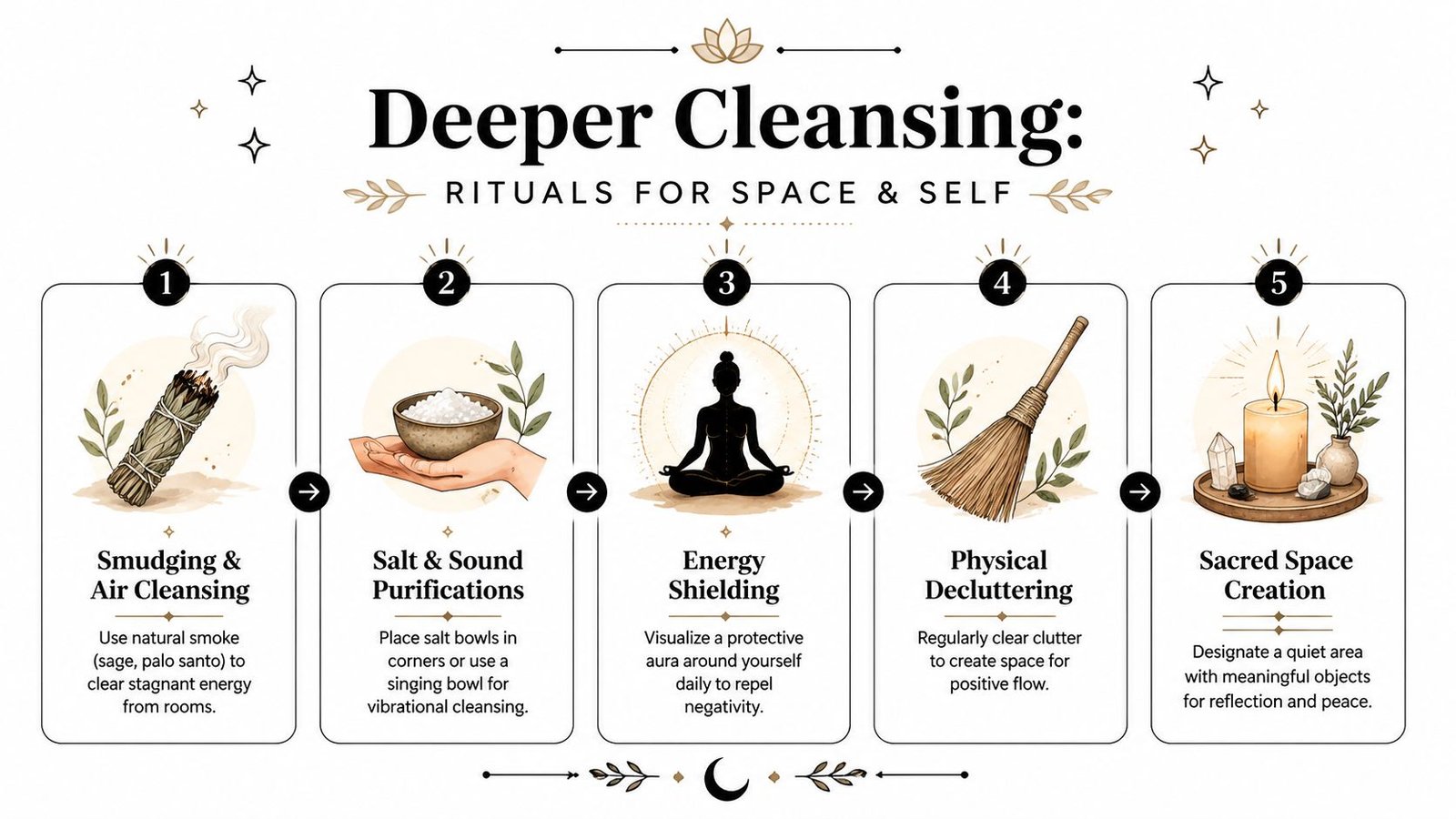
Deeper Cleansing Protective Rituals for Your Space and Self
Quick resets keep you functional. Deeper rituals help you stop living in buildup mode.
When your home feels heavy, your sleep feels crowded, or you’re absorbing too much from other people, you need something more intentional than a few breaths. Protective practices are essential. They don’t isolate you from life. They help you stay in contact with life without carrying all of it.
The aura sweep and bubble shield protocol
The Aura Sweep and Bubble Shield protocol is one of the clearest ways to cleanse and protect your field. According to this overview of aura clearing practices, the method has an 82% success rate in balanced emotional reactivity after 21 days of practice. The shielding element is benchmarked to prevent up to 75% of empathic absorption, and daily use is correlated with a 40% increase in personal vibration through HRV metrics.
Use it this way:
- Stand with both feet planted. Begin grounded, not rushed.
- Set an intention. Keep it simple, such as releasing what isn’t yours to carry.
- Sweep the arms overhead and down. Inhale up, exhale down, and continue for several minutes.
- Build the shield. Visualize golden light in the chest expanding around your whole body.
- Refine the field. Use your fingertips to sweep around the head, shoulders, and torso.
- Close by grounding. Rest your hands on your body or place them on your thighs and breathe.
The sweeping motion matters. It gives the body a physical language for release. The bubble matters because it changes your orientation from porous to discerning.
Protection isn’t about becoming closed. It’s about becoming selective.
If you already work with lunar timing, pairing this ritual with a beginner-friendly full moon ritual practice can help you create a more consistent clearing rhythm.
Smudging smoke-free options and consent
Smudging can be effective for shifting the feeling of a room, especially after conflict, illness, visitors, or long periods of stagnation. But it isn’t the only option, and it isn’t always the best one.
Use smoke when it’s appropriate. Skip it when someone in the home is sensitive, the space is poorly ventilated, or the ritual becomes more about performance than presence.
A grounded approach looks like this:
- For smoke cleansing: Open a window first, move slowly, and use a clear intention rather than dramatic gestures.
- For smoke-free clearing: Try herbal sprays, a bell, a singing bowl, or even firm clapping in corners where a room feels stagnant.
- For physical support: Declutter surfaces, wash fabrics, and let fresh air move through the space. Physical and energetic clearing work well together.
- For ethics: Don’t cleanse someone else’s room, office, or home without their permission.
That last point matters. Consent belongs in spiritual practice. If a space isn’t yours, ask. If a family member doesn’t want smoke, respect that. If your own nervous system feels activated by a ritual, choose a gentler method. Effective cleansing should leave you clearer, not overstimulated.
Using Nature's Tools Crystals Herbs and Moon-Aligned Baths
Natural tools can support release beautifully when you use them with intention. They become less helpful when they turn into a collection of objects you hope will do the work for you.
I encourage beginners to keep this part simple. Pick one or two tools that fit your life, not ten that create pressure.

A practical bath ritual for release
Bathing is one of the oldest cleansing practices across spiritual traditions. Ayurvedic texts from 1500 BCE prescribed herbal baths for purification, and modern reporting summarized in mindbodygreen’s guide to clearing negative energy notes that salt water baths reduced reported stress by 35% among participants, measured through pre- and post-intervention cortisol levels.
A release bath doesn’t need to be elaborate. It needs to create a container.
Try this basic ritual:
- Start with salt: Add Epsom salt, sea salt, or both to warm water.
- Add herbs thoughtfully: Rosemary is useful when you want freshness and mental clearing. Lavender is better when your system feels frayed and overextended.
- Set a clear intention: Name what you’re releasing. Stress from work. Lingering resentment. Social heaviness. Mental noise.
- Soak without multitasking: Don’t bring your phone in if you can avoid it.
- Close the ritual: When the bath is over, imagine the residue leaving with the water.
The moon can deepen this practice. If your focus is release, the waning moon is a supportive time because the symbolism matches the action. You’re letting something diminish, soften, and leave.
How to work with crystals and herbs without overcomplicating it
Crystals are useful as anchors for attention and intention. Herbs can shape the atmosphere of a ritual. Neither should become a substitute for self-awareness.
A practical setup is enough:
| Tool | Best use | Practical placement |
|---|---|---|
| Black tourmaline | Grounding and boundary support | Near the front door or in a work bag |
| Hematite | Stabilizing scattered energy | On a desk or carried in a pocket |
| Selenite | Clearing and resetting | Near the bed or on an altar |
| Smoky quartz | Heavy-feeling environments | In a room that often feels dense |
If you want a more detailed starting point, this guide to crystals for healing and protection gives useful context for choosing tools without guesswork.
A few trade-offs are worth saying clearly:
- More tools don’t guarantee better results. Too many objects can distract you from your actual state.
- Timing helps, but consistency matters more. Moon alignment can deepen a ritual, but a simple weekly bath still works.
- Scent should support, not overwhelm. If herbs or oils irritate you, leave them out.
Use natural tools as allies. Don’t turn them into requirements.
When people ask how to release negative energy in a way that feels calming instead of forced, this is often the answer. Keep the ritual tactile, simple, and repeatable.
Building a Sustainable Practice and Tracking Your Progress
The struggle isn’t due to a lack of options. It stems from not knowing which practices are helping, how often to do them, or when a ritual is becoming avoidance instead of healing.
That’s why a sustainable practice needs two things. Rhythm and feedback.
According to this discussion of measurable outcomes in energy clearing, wellness practices show 40% higher adherence when people use gamified apps or mood charts tied to personal cycles. The same source also notes that inner shadow work yields 50% greater long-term negativity reduction than surface-level clearing rituals alone.
A simple weekly rhythm
You don’t need to do everything every day. A better approach is to assign each method a role.
A practical weekly rhythm could look like this:
- Daily: Use a short grounding or Heart Shutter practice in the morning or after work.
- Several times a week: Use movement-based discharge when stress spikes and your body feels activated.
- Once a week: Clean your space, refresh your protective practice, or take a release bath.
- Regularly: Journal on recurring triggers, emotional patterns, and situations where you absorb too much.
Many individuals experience rapid improvement, not because they’ve found a magical technique, but because they stop being random. Their body starts to trust the pattern.
How to know if your practice is working
Track simple markers, not perfection.
Use a mood chart, planner, notes app, or journal and record:
- Energy level: heavy, neutral, light
- Emotional tone: anxious, flat, steady, calm
- Body signal: chest tightness, jaw tension, shallow breath, grounded
- Trigger exposure: social overload, conflict, digital fatigue, poor sleep
- Practice used: breathwork, shaking, bath, shielding, journaling
After a few weeks, patterns become easier to see. You may notice that movement works better than meditation after conflict. Or that baths help your sleep, but shielding helps your workday. Or that the same draining dynamic keeps returning until you address the wound underneath it.
That last part matters. Surface clearing has value, but if the same negativity keeps rebuilding, some of it may be linked to an old belief, grief, or boundary issue asking for deeper attention. If that’s where you are, practices that support reflection and emotional honesty tend to create more lasting relief than repetitive cleansing alone. For related support, this resource on how to raise your vibration can help you connect daily rituals with inner work.
The strongest practice is the one you’ll keep. Not the most elaborate one. Not the one that looks spiritual online. The one that helps you come back to yourself with more honesty, steadiness, and care.
If you're ready for a more structured path, Spiritual Method offers a step-by-step awakening guide for releasing negativity, building grounding rituals, working with crystals and herbs, using moon-aligned baths, and tracking your progress with reflection templates, gratitude prompts, self-care tools, and mood charts. It’s a practical companion for anyone who feels drained, stuck, or ready to reconnect with clarity, peace, and purpose.