
A single pass through your home with open windows, a lit bundle of white sage or a ringing bell, and a clear spoken intention is enough to shift the atmosphere in 10–15 minutes. That is the core of an effective home energy cleansing ritual, and you can do it today with items already in most households.
Open every window and interior door in your home before you begin. Gather your tool: a sage bundle, a stick of incense, a small bowl of salt, or a hand bell. Stand at your front entrance, take three slow breaths, and state your intention aloud. Move counterclockwise through each room, directing smoke, sound, or salt toward corners and thresholds. Close the ritual at your front door by stating that the space is clear and protected.
Safety note: Keep a fireproof dish under any burning material, disable smoke alarms temporarily in the room you are working in, and keep pets and young children out of smoke-filled spaces until the air clears.
Ethics note: White sage (Salvia apiana) is a plant sacred to several Indigenous nations. Purchase only from suppliers who source it sustainably and, where possible, from Indigenous-owned businesses.
Key Takeaways
A consistent, intention-led home energy cleansing practice, combining physical cleaning with one or two energetic methods and performed on a weekly and monthly schedule, produces more reliable results than any single elaborate ritual.
| Point | Details |
|---|---|
| Start with physical cleaning | Dust, declutter, and scrub before any energetic method; physical grime traps stagnant energy. |
| Intention drives results | State clearly what you are releasing and inviting before and after every cleanse. |
| Layer two or three methods | Combining salt, sound, or smoke produces a more thorough reset than any single method alone. |
| Maintain a weekly habit | A five-minute sound or salt pass each week prevents energy from accumulating between full cleanses. |
| Spiritualmethod supports consistency | The downloadable self-help guide includes printable checklists, intention scripts, and a maintenance calendar for ongoing practice. |
Table of Contents
- What tools do you need for a home cleansing ritual?
- How to cleanse your home energy room by room
- How do you use smoke safely and respectfully?
- Smoke-free cleansing methods that work in any home
- When should you cleanse your home, and how often?
- Safety, household considerations, and disposal of used materials
- Why does intention matter in a home cleansing ritual?
- How can you tell if the cleanse worked?
- The case for keeping energy hygiene simple
- A structured guide to support your cleansing practice
- Sources
What tools do you need for a home cleansing ritual?
The materials for a home cleansing ritual fall into two categories: smoke-based and smoke-free. Neither category is inherently more effective. Experienced practitioners emphasize that intention is the primary active element; tools are conduits, not the source of the work.
Smoke-based options
- White sage: The most widely recognized smudging herb in the U.S. Use sparingly and source from certified sustainable suppliers or Indigenous-owned vendors.
- Palo santo: A resinous wood from South America. Purchase only from suppliers who harvest from naturally fallen trees and carry sustainability documentation.
- Incense: Cedar, frankincense, copal, and sandalwood are common choices. Widely available and lower-cost than sage or palo santo.
Smoke-free alternatives
- Salt: Sea salt or Himalayan pink salt placed in small piles in room corners or dissolved into a spray bottle with water.
- Sound tools: A hand bell, a singing bowl, or even a pair of metal spoons struck together. Sound is the most apartment-friendly option.
- Essential oil diffuser: Lavender, eucalyptus, or frankincense oil diffused for 30–60 minutes per room.
- Ventilation and physical cleaning: Opening windows and scrubbing surfaces is foundational, not optional. Physical cleaning, ventilation, and symbolic acts like salt placement are the steps that make energetic methods more effective.
Ethical sourcing for palo santo and white sage
Both plants carry cultural weight and face supply pressure. Palo santo should come from naturally deceased trees, not harvested live wood. For white sage, look for vendors who work directly with Indigenous growers or who carry third-party sustainability certification. When ethical supply is uncertain, locally grown herbs such as rosemary, lavender, or garden sage are practical substitutes with a long history of use in European purification traditions.
Pro Tip: If you are starting from scratch, a single item, such as a box of sea salt and a hand bell, is enough for a complete cleanse. Complexity does not improve results; consistency and clear intention do. Read more about setting daily intentions to strengthen your practice.
How to cleanse your home energy room by room
Starting with a thorough physical cleaning before any energetic work is not a preliminary step. It is the first energetic step. Dust, clutter, and grime trap stagnant energy, and removing them resolves a significant portion of what most people describe as a heavy atmosphere.
Preparation checklist
- Dust, vacuum, and scrub every room, paying attention to baseboards, under beds, and behind appliances.
- Open all windows and interior doors, including closets and cabinets.
- Gather your tools and place them near the front entrance.
- Stand quietly for two minutes. Set your intention: “I release all stagnant, heavy, or unwanted energy from this home. Only what is clear and supportive remains.”
Room order and why it matters
Begin at the front entrance and move counterclockwise through the home. Counterclockwise movement (called widdershins in several Western traditions) is used to break up and drive out stagnant energy. After the cleanse is complete, a final clockwise pass seals the space and sets a protective intention.
Work in this sequence: front entrance → living room → kitchen → dining area → hallways → bedrooms → bathrooms → any basement or attic space. End back at the front entrance.
Room-by-room action checklist
| Room | Key actions | Specific focus areas |
|---|---|---|
| Front entrance | Direct smoke or sound toward the door frame and threshold | Door hinges, welcome mat, coat closet |
| Living room | Work corners first, then center; open any storage cabinets | Behind furniture, under cushions, bookshelves |
| Kitchen | Pay attention to appliances and under the sink | Refrigerator sides, stove hood, pantry corners |
| Bedrooms | Open closets fully; address under-bed space | Nightstands, headboard corners, window sills |
| Bathrooms | Short pass; salt near drain is optional | Mirror edges, cabinet interiors, floor corners |
| Hallways | Move slowly; sound tools work well in narrow spaces | Light fixtures, closet doors, stairwells |
What to say in each room
You do not need a memorized script. A short, direct statement works well. Examples:
- At the entrance: “What no longer serves this home, leave now.”
- In bedrooms: “This space supports rest, clarity, and peace.”
- At the close: “This home is clear, protected, and filled with light.”
Speak calmly and with conviction. The words matter less than the focused attention behind them.
How do you use smoke safely and respectfully?
Smudging with sage, palo santo, or incense follows a consistent technique regardless of which material you choose. Light the tip of the bundle or wood, allow it to catch flame for 10–15 seconds, then gently blow out the flame so the material smolders. Hold a fireproof dish underneath to catch ash.
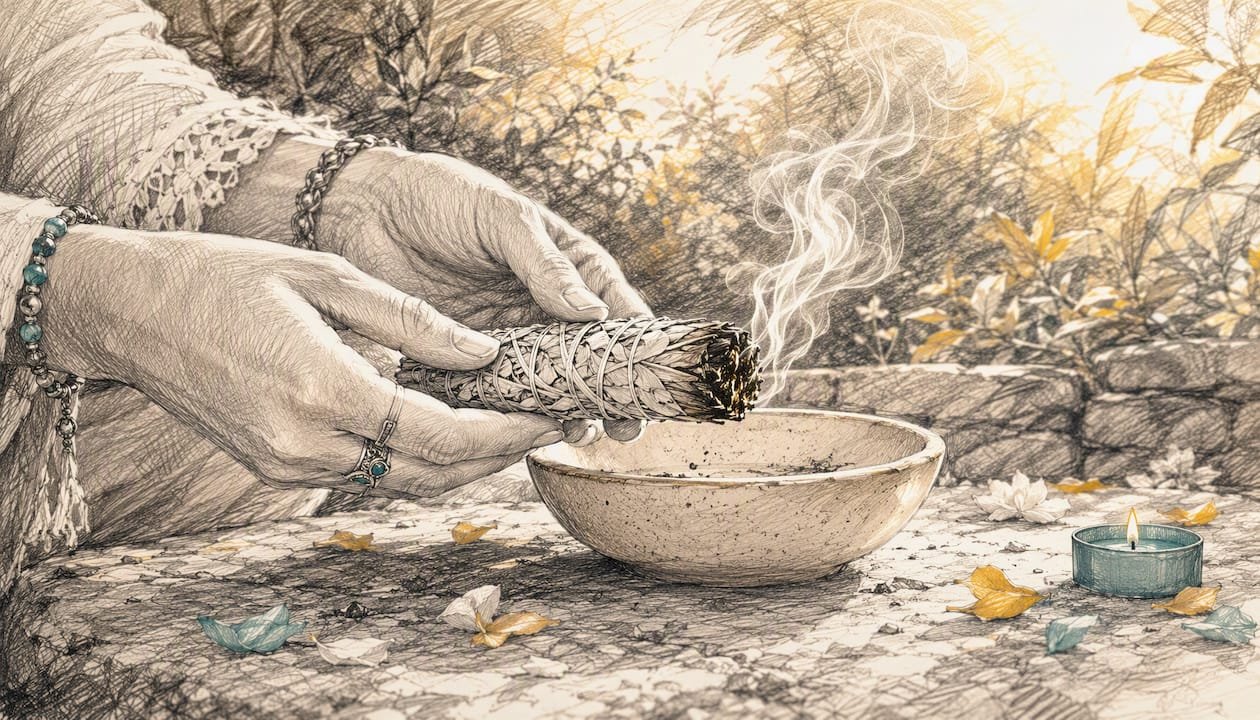
Direct the smoke toward corners, along door frames, and into open closets. Move the bundle or wood in slow, deliberate arcs. Do not rush. A typical room takes two to four minutes.
Differences between smoke materials
White sage produces dense, pungent smoke and clears a room quickly. It is the most potent option and the one most likely to trigger sensitivities. Palo santo burns with a lighter, sweeter smoke and is gentler for households with mild sensitivities. Incense sticks offer the most control over smoke volume and are the easiest to extinguish.
Fire and smoke safety checklist
- Always use a fireproof dish, abalone shell, or ceramic bowl under burning material.
- Never leave burning material unattended, even for a moment.
- Temporarily disable the smoke alarm in the room you are working in, but re-enable it immediately when you move to the next room.
- Keep children and pets out of rooms with active smoke until the air clears, typically 10–20 minutes after you finish.
- Extinguish material completely in sand or a small amount of water before disposal.
Cultural respect
Smudging with white sage is a ceremonial practice originating with specific Indigenous nations of North America. Using it as a household cleaning tool is acceptable to many practitioners, but doing so with awareness of its origins is a basic form of respect. Acknowledge the cultural source, source the material responsibly, and consider whether a non-Indigenous alternative serves your needs equally well.
Smoke vs. smoke-free: a practical comparison
| Method | Best for | Limitations |
|---|---|---|
| White sage | Full-home reset, strong clearing | Strong scent, allergy risk, cultural sensitivity |
| Palo santo | Lighter clearing, pleasant scent | Sustainability concerns, requires careful sourcing |
| Incense | Apartments, mild clearing, low cost | Lighter effect, synthetic varieties less effective |
| Salt | Absorption, threshold protection | No immediate sensory signal, slower effect |
| Sound (bell/bowl) | Apartments, allergy households, quick passes | Requires technique; less familiar to beginners |
| Essential oils | Diffused maintenance, gentle daily use | Not a substitute for a full cleanse |
Smoke-free cleansing methods that work in any home
Layering two or three cleansing methods produces a more thorough result than relying on a single approach, and smoke-free combinations are often the most practical for apartments, rental units, and households with allergies or young children.
Salt
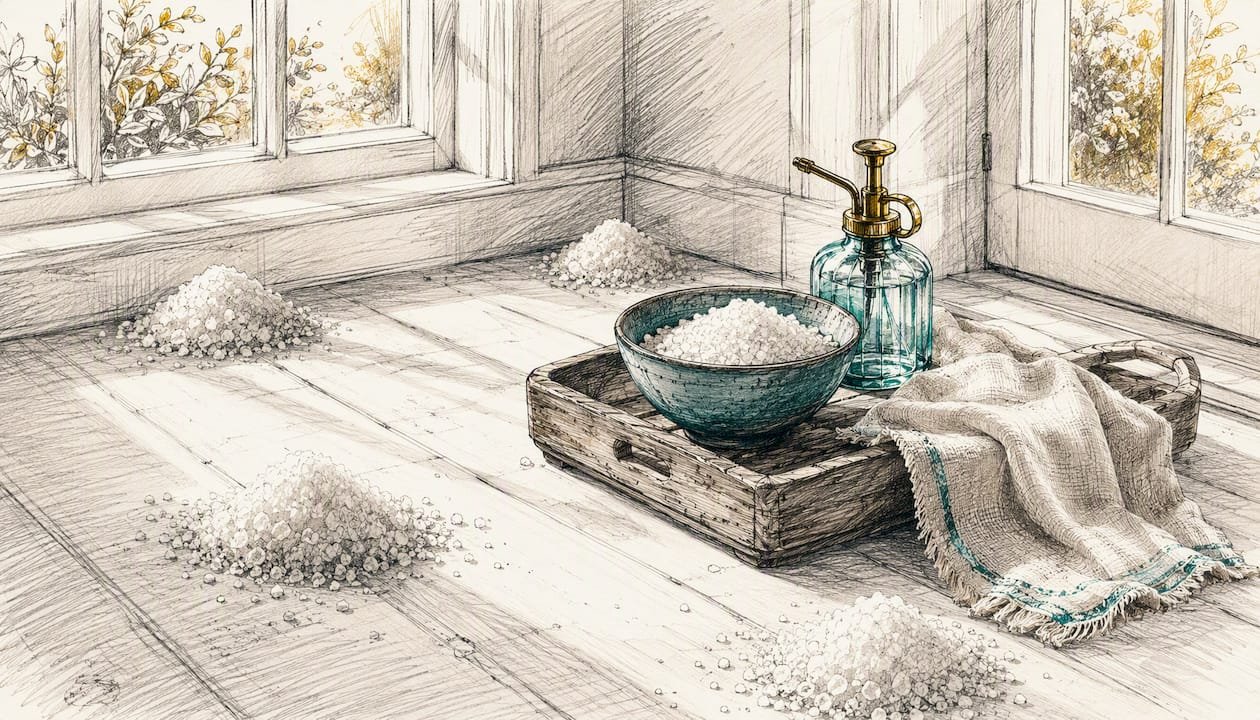
Place small piles of sea salt or Himalayan salt in the corners of each room. Leave them for 24–48 hours, then collect and discard them outside the home, not down a drain. For a faster option, dissolve two tablespoons of salt in a spray bottle of water and mist corners, thresholds, and window sills. Salt is one of the most cross-culturally documented purification materials in ethnobotanical literature.
Sound
Strike a hand bell or singing bowl once in each corner of a room. Listen to the tone. A dull, flat sound in a particular corner often indicates where energy feels densest; ring the bell there repeatedly until the tone rings clear. Work from the floor level upward. Sound is the most rental-friendly method because it leaves no residue and requires no open flame.

Essential oils
Run a diffuser with lavender, frankincense, or eucalyptus for 30–60 minutes per room. Do not use eucalyptus or tea tree oil in homes with cats, as these are toxic to felines. Keep diffusers out of reach of small children.
Ventilation and deep cleaning
Opening windows on opposite sides of the home creates cross-ventilation that physically moves stagnant air out within minutes. Pair this with scrubbing floors, wiping down walls, and decluttering any space that has accumulated objects over months. This combination alone resolves much of what people describe as a heavy or tense atmosphere.
Small-space and apartment tips
- Use a salt spray instead of piles to avoid landlord concerns.
- A singing bowl or hand bell produces no smoke and no residue.
- A diffuser with a short run time (30 minutes) is undetectable to neighbors.
- Open one window per room for at least 20 minutes before and after any method.
Pro Tip: For a personal reset before starting a home cleanse, a 20-minute soak with two cups of sea salt in warm bathwater helps clear your own energy field so you are not carrying tension into the ritual. A foot soak works equally well if a full bath is not practical. Explore additional aura cleansing techniques to complement your home practice.
When should you cleanse your home, and how often?
Certain life events call for a full cleanse. Others call for a quick maintenance pass. Knowing the difference saves time and keeps the practice sustainable.
Triggers for a full home energy cleanse
- Moving into a new home or apartment, regardless of how recently it was renovated
- Completing a major renovation or construction project
- After extended houseguests, particularly after conflict or illness
- Following a significant argument or period of prolonged stress in the household
- After a serious illness or the death of a person or pet in the home
- At each seasonal change, particularly fall and spring
Recommended cadence
- Weekly quick ritual: A five-minute sound pass or a brief salt spray at thresholds keeps energy from accumulating between full cleanses.
- Monthly full cleanse: A complete room-by-room pass using your preferred method, combined with physical cleaning.
- Seasonal deep cleanse: A layered approach using two or three methods, ideally timed with a seasonal shift.
Practical guides recommend combining methods and suggest weekly quick cleans with monthly full cleanses and seasonal refreshes to prevent energy buildup.
Moon timing
Many practitioners prefer the waning moon phase for cleansing and releasing, and the new moon for setting fresh intentions in a cleared space. This is a focusing tool, not a requirement. A cleanse performed with clear intention on any day of the month is effective.
Safety, household considerations, and disposal of used materials
Responsible practice means attending to physical safety as carefully as energetic intention.
Fire safety
- Never leave burning sage, palo santo, or incense unattended.
- Use a ceramic, stone, or metal dish; never a paper plate or wooden surface.
- Extinguish material fully in a small amount of sand before setting it down.
- Keep burning materials away from curtains, paper, and fabric.
Allergy and ventilation
- Anyone with asthma, COPD, or smoke sensitivity should use smoke-free methods exclusively.
- Run an air purifier with a HEPA filter during and after smoke-based sessions.
- Open windows in adjacent rooms to create airflow even if you are only working in one room.
Disposal of used materials
Used salt, ash, and herb remnants carry the energy they absorbed during the ritual. Discard them outside the home. Bury used salt or ash in soil away from water sources, or release them in a moving body of water if local regulations permit. Do not flush used salt down household drains in large quantities, as it can affect plumbing over time. Wrap used herb bundles in paper and place them in an outdoor trash receptacle.
Pro Tip: If you rent, check your lease for restrictions on open flames or incense before your first smoke-based cleanse. Most leases in the U.S. prohibit open flames beyond standard candle use. Sound and salt methods are universally rental-safe.
- Keep a small fire extinguisher or a bowl of sand within arm’s reach during any burning session.
- Inform neighbors in shared-wall buildings if you plan a smoke-based cleanse; common courtesy prevents complaints.
Why does intention matter in a home cleansing ritual?
Intention is not a soft concept in this context. Experienced practitioners consistently identify intention as the primary activating force in a house-cleansing ritual. Movement direction, smoke, sound, and sweeping are the practical methods used to break up and remove residue. Intention is what directs those methods toward a specific outcome.
This position is supported by a broader pattern in cultural practice. Ethnobotanical and anthropological research documents that salt, smoke, plant materials, and water appear in purification rituals across dozens of unrelated cultures. The consistency of these materials across cultures suggests they function as reliable anchors for focused human attention, not as chemically active agents of spiritual change.
A practical intention formula
Before beginning any cleanse, state your intention in two parts: what you are releasing and what you are inviting. Example:
“I release all stagnant, heavy, and unwanted energy from this home. I invite clarity, peace, and ease into every room.”
Repeat this at the start of the ritual and once more at the close. The repetition reinforces focus, not superstition. For deeper guidance on grounding rituals and intention-setting, Spiritualmethod’s resource library offers structured frameworks for building this practice into a daily routine.
How can you tell if the cleanse worked?
The signs of a successful cleanse are mostly subjective, but they are consistent enough across practitioners to be useful as a practical checklist.
Observable signs the space has shifted
- The air in the home feels noticeably lighter or easier to breathe within 24–48 hours.
- Sleep quality improves, particularly in bedrooms that received focused attention.
- Household members report fewer arguments or a general reduction in irritability.
- Decision-making feels clearer; the mental noise that often accompanies a heavy home atmosphere decreases.
- Guests comment that the home feels calm or welcoming without being prompted.
Immediate follow-up habits
- Open at least one window per room for 20 minutes each morning to maintain airflow.
- Place a small dish of salt near the front threshold and replace it weekly.
- Perform a brief sound pass (one minute per room with a bell) once a week.
- Keep clutter from accumulating; physical disorder is the fastest way to reintroduce stagnant energy.
When to repeat a deeper cleanse
If the heavy atmosphere returns within a week, a single-method cleanse was likely insufficient. Move to a layered approach: physical cleaning plus sound plus salt, or smoke plus salt plus ventilation. Log your observations in a journal for two to four weeks. Note sleep quality, mood, and household interactions. Patterns in the log will show you which methods and combinations work best for your specific space. Spiritualmethod’s journaling guide for soul healing includes structured prompts that adapt well to tracking cleanse results over time.
The case for keeping energy hygiene simple
There is a tendency in spiritual practice communities to equate complexity with effectiveness. Longer rituals, rarer materials, and elaborate sequences feel more serious, and that feeling can be reassuring when you are dealing with a space that genuinely feels heavy. But the evidence from experienced practitioners points in the opposite direction.
A five-minute weekly sound pass with a hand bell, performed with clear and specific intention, does more sustained work than an elaborate monthly ceremony performed while distracted or uncertain. Consistency is the variable that most practitioners underestimate. A home that receives brief, regular attention stays clear far more reliably than one that receives an intensive cleanse every few months.
The other underestimated factor is physical cleanliness. Most of what people describe as stagnant or negative energy in a home resolves with a thorough scrub of baseboards, a cleared-out closet, and two hours of open windows. The energetic work amplifies and formalizes what the physical cleaning begins. Skipping the physical step and going straight to smoke or sound is the single most common reason a cleanse produces no noticeable result.
Start simple. One method, one clear intention, one room at a time. Build from there.
A structured guide to support your cleansing practice
Knowing the steps is one thing. Having a printable framework you can follow room by room, week by week, is what makes the practice stick.

Spiritualmethod’s downloadable self-help healing guide gives you a structured, 50-page framework built around exactly this kind of routine-based practice. It includes printable room-by-room cleansing checklists, intention scripts you can use verbatim or adapt, a moon-phase maintenance calendar, and ethical sourcing guidance for every material mentioned in this article. The guide also covers grounding exercises, sacred bathing rituals, and journaling prompts designed to help you track changes in your home’s atmosphere over time.
For readers who want to extend the work inward after clearing their space, the companion grounding exercises guide provides daily practices that reinforce the clarity a home cleanse creates. Both guides are available as instant digital downloads, no subscription required.
Sources
- A House Cleansing Ritual: Spiritually Protecting Your Space | John Beckett
- Cleansing Methods: Complete Guide to Spiritual Energy Clearing
- KonMari: Home purification
- Doi
- How to Cleanse a House