
A complete gratitude ritual takes as little as 5 minutes and no more than 15. The full sequence runs seven steps: set your intention (30 seconds), take three slow breaths (1 minute), name 3–5 specific gratitudes with “because” clauses (3–5 minutes), savor one item for 60 seconds, write a single sentence of appreciation (1–2 minutes), send or plan one external thanks (1 minute), and close with a grounding breath (30 seconds). That is the whole practice. You can start tonight.
Here is the quick-scan version:
- Step 1 — Set your intention (30 sec): State why you are pausing.
- Step 2 — Breathe in (1 min): Three slow, deliberate breaths to shift your nervous system.
- Step 3 — Name 3–5 gratitudes (3–5 min): Specific items with “because” clauses.
- Step 4 — Savor one item (60 sec): Feel it physically, not just mentally.
- Step 5 — Write it down (1–2 min): One sentence minimum in a journal or phone note.
- Step 6 — Plan one external thanks (1 min): A text, note, or verbal acknowledgment.
- Step 7 — Close with breath (30 sec): Signal the ritual is complete.
The practice is repeatable, scalable, and requires nothing but a few minutes and a willingness to be specific. As the ritual becomes familiar, you can expand each step or compress the whole sequence to a shorter duration on busy days.
Key Takeaways
A consistent gratitude ritual requires specificity, a fixed trigger, and at least three sessions per week to produce measurable benefits within two to four weeks.
| Point | Details |
|---|---|
| Start with 5 minutes tonight | Run steps 1–4 of the seven-step sequence before bed to begin the habit immediately. |
| Specificity drives results | Always add a “because” clause; named memories produce deeper benefits than vague lists. |
| Habit-stack your trigger | Attach the ritual to an existing cue — coffee, dinner, brushing teeth — to remove the decision to start. |
| Use subtraction on flat days | Imagining life without something ordinary generates accessible gratitude when nothing feels significant. |
| Spiritualmethod’s guide | The downloadable bundle provides printable templates, habit trackers, and structured rituals for a complete daily practice. |
Table of Contents
- What are the gratitude ritual steps, and how do you do each one?
- Short ritual variations for every time slot
- What to do when gratitude feels forced
- What does the science say about gratitude rituals?
- Ready-to-use prompts and journal templates
- How to run a group or family gratitude ritual
- Why short rituals are worth teaching
- Spiritualmethod’s downloadable ritual guide
- Sources
What are the gratitude ritual steps, and how do you do each one?
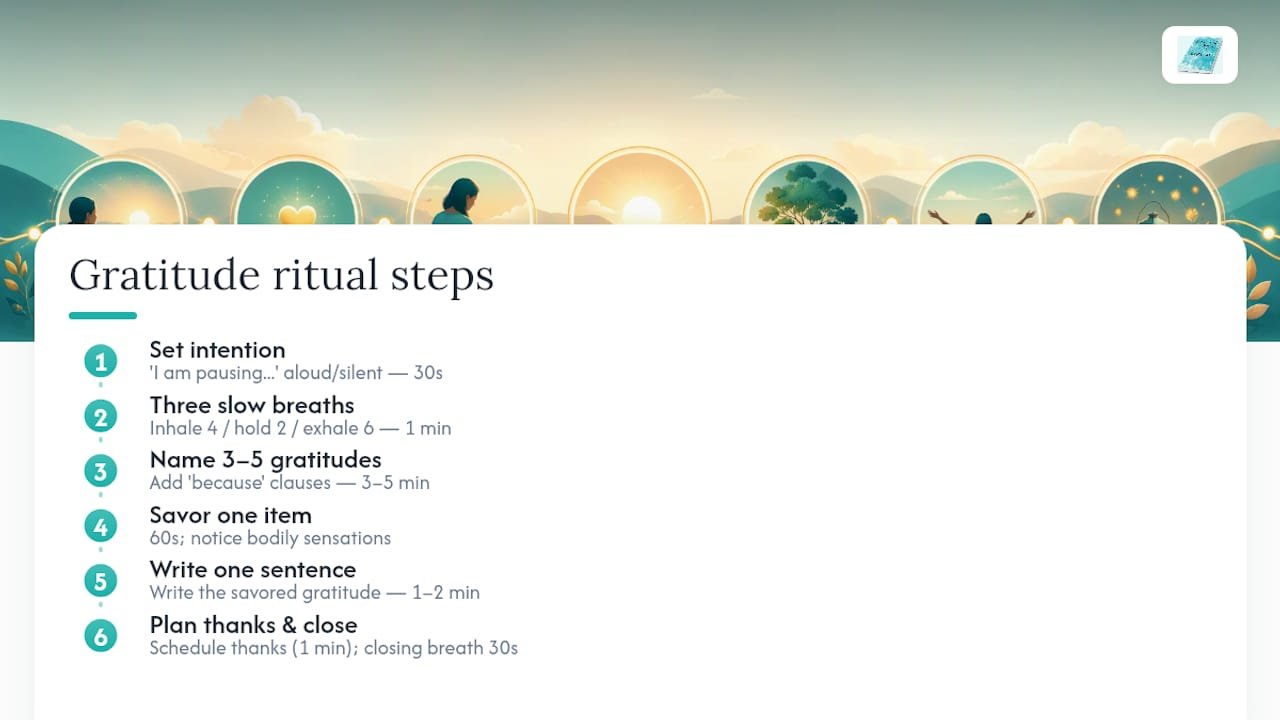
The seven gratitude ritual steps work best when they follow a fixed order. Sequence matters because each step primes the next: the breath calms the mind, the naming focuses attention, and the savoring converts a cognitive list into a felt experience.
Step 1: Set your intention (30 seconds)
Before anything else, say aloud or silently: “I am pausing to notice what is already good.” This single sentence redirects attention from task mode to receptive mode. It sounds minor, but without it, the rest of the ritual can feel like a chore.
Step 2: Three slow breaths (1 minute)
Inhale for four counts, hold for two, exhale for six. Repeat three times. This is not decoration. A slower exhale activates the parasympathetic nervous system, which makes genuine appreciation physiologically easier to access.
Step 3: Name 3–5 specific gratitudes with “because” clauses (3–5 minutes)
Vague entries (“I’m grateful for my family”) produce shallow results. Specificity is what generates depth. The Greater Good in Action gratitude journal guidelines recommend writing up to five items and always including a “because” clause. Example: “I am grateful for my colleague Maya because she stayed late to help me finish the report without being asked.” That level of detail makes the memory retrievable and emotionally resonant.
Step 4: Savor one item for 60 seconds
Pick one item from Step 3. Close your eyes. Notice where you feel the appreciation in your body — warmth in the chest, a relaxed jaw, a slight smile. Dr. Tyler VanderWeele at Harvard highlights savoring as the bridge between noticing and genuinely experiencing gratitude. Sixty seconds of physical attention is enough to shift the ritual from a checklist into an embodied practice.

Step 5: Write one sentence (1–2 minutes)
Open a journal, a notes app, or a dedicated planner. Write the one gratitude you savored in Step 4 as a complete sentence. You do not need a paragraph. One specific, written sentence anchors the experience in memory and creates a record you can return to on difficult days.
Step 6: Plan one external thanks (1 minute)
Gratitude directed outward multiplies its effect. Decide right now: who will you thank today, and how? A two-line text, a handwritten note left on a desk, or a verbal acknowledgment at dinner all count. You do not need to send it during the ritual — scheduling it is enough.
Step 7: Close with a grounding breath (30 seconds)
One final slow exhale signals that the ritual is complete. This closing cue trains the brain to recognize the practice as a bounded, finished event rather than an open-ended task, which makes it easier to repeat tomorrow.
Total time: 7–15 minutes. The Columbia College student wellbeing guidance recommends Multiple sessions per week, each lasting several minutes, are a practical starting target.
Pro Tip: The most common mistake is rushing through the list without pausing. After you name each gratitude, place one hand on your chest and breathe once before moving to the next item. That single physical cue turns a cognitive exercise into a somatic one.
Short ritual variations for every time slot
Not every day allows 15 minutes. These timed variations preserve the core structure while fitting real schedules. Habit-stacking each one onto an existing trigger — your morning coffee, a commute, dinner — removes the decision overhead that causes people to skip.
2-Minute Reset (anytime)
Trigger: after brushing your teeth.
Name one specific thing you are grateful for and say “because” out loud. Breathe once. Done. This is the minimum viable ritual for high-stress days.
5-Minute Morning Practice
Trigger: while your coffee brews.
Three breaths. Name three gratitudes with “because” clauses in a phone note. Savor the strongest one for 30 seconds. No writing required beyond the note.
10-Minute Evening Journal
Trigger: before lights out.
Run the full seven steps in compressed form. Write three entries using the “Three Good Things + because” template. Plan tomorrow’s external thanks. This version pairs naturally with a structured journaling practice for soul healing if you want to go deeper.
Mealtime Gratitude (family or solo)
Trigger: before the first bite.
State one specific thing that went well today and why. Keep it to 30 seconds. No journal needed. This works at any meal and requires zero preparation.
Gratitude Walk (10–15 minutes)
Trigger: a regular walk route.
As you walk, name one thing you notice with each sense — something you see, hear, feel underfoot, smell. Then name one person you are grateful for and why. A nature-based walk ritual naturally supports this sensory-savoring approach. No phone, no journal required.
What to do when gratitude feels forced
Every consistent practitioner hits flat days. The ritual feels hollow, the list feels fabricated, and the whole exercise can start to feel performative. That is normal, and there are specific techniques that work precisely because they do not demand positivity.
Use the subtraction method. Instead of asking “what am I grateful for?”, ask “what would today look like if this person or thing were not in my life?” The mental subtraction practice from Greater Good in Action reliably generates concrete grateful feelings because it makes the ordinary visible by imagining its absence. Try: “What would this morning have looked like without running water?”
Run a 3-Line Mental Reset. Write three lines: one small win from today (even “I made it through”), one person or thing that supported you, and one thing you are ready to release. This bounded structure prevents the blank-page paralysis that makes flat days worse. It also works as a tool for breaking negative thought patterns when rumination is blocking access to appreciation.
Try sensory savoring. Mindful gratitude practices that use sensory anchors — pausing to notice what you see, hear, smell, and feel right now — help people with low energy access appreciation without forced positivity. Name five things you can physically sense in this moment. Gratitude for the present is often more accessible than gratitude for events.
Claim one small win. Ask: “What is one thing I did today that I can acknowledge, however small?” Finishing a task, making a phone call, getting outside — any completed action qualifies. Acknowledging effort is a legitimate form of gratitude directed at yourself.
Pro Tip: The subtraction method works fastest when you pick something so ordinary you never think about it — your eyesight, a working phone, a door that locks. Ordinary things produce the strongest contrast effect because they have never been on your gratitude list before.
What does the science say about gratitude rituals?
The evidence for consistent gratitude practice is specific and worth knowing before you commit. Harvard Health research links regular gratitude practices to improved sleep, reduced depression risk, better cardiovascular markers, and a cumulative “multiplier effect” that many practitioners report after 1–2 months of regular practice.
Dose recommendation: Columbia College’s student wellbeing guidance suggests 15 minutes per day, at least three times per week, as a practical minimum for a two-week test window. That is a low bar — three 15-minute sessions per week totals under an hour.
Johns Hopkins guidance on cultivating a gratitude practice emphasizes choosing a simple medium, observing existing “thank you” moments in daily life, and using sensory-based savoring to deepen the practice. The consistency of the recommendation across institutions is notable: specificity, regularity, and savoring appear in every evidence-based framework.
Key benefits supported by research:
- Sleep quality: Gratitude journaling before bed is associated with longer sleep duration and fewer intrusive thoughts at night.
- Depression risk: Regular practice correlates with lower depressive symptom scores across multiple study populations.
- Cardiovascular markers: Gratitude is linked to lower inflammatory markers and better heart-rate variability in several studies.
- Emotional resilience: The multiplier effect means the practice compounds — what feels effortful in week one tends to feel natural by week six.
Realistic timeline: most people notice a mood shift within two weeks. Structural changes in how you perceive daily events typically take four to eight weeks of consistent practice.
Ready-to-use prompts and journal templates
These prompts are grouped for immediate use. Copy any of them into a phone note, a planner, or a printed template.
Morning prompts
- I am grateful for ___ because ___.
- One thing I am looking forward to today is ___ because ___.
- A person who made yesterday easier was ___ because ___.
- Something I often overlook that I appreciate right now is ___.
- One strength I am glad I have today is ___.
Evening prompts
- Three things that went well today: ___, ___, ___ — because ___.
- One moment I want to remember from today is ___.
- Someone I want to thank tomorrow is ___ for ___.
- A challenge today that I can find something useful in: ___.
- One small win I can acknowledge: ___.
Relationship prompts
- I appreciate ___ because they ___ without being asked.
- A quality in ___ that I do not say out loud enough is ___.
- One memory with ___ that I am glad exists: ___.
Work prompts
- A colleague who made my work easier today: ___ because ___.
- One skill I used today that I am glad I have: ___.
- A problem I solved (or made progress on) today: ___.
Low-energy day prompts
- If I did not have ___, today would have been harder because ___.
- One ordinary thing I am glad exists right now: ___.
- The smallest good thing that happened today: ___.
Simple template formats:
Three Good Things + because (per Greater Good guidelines):
- Today I noticed ___ because ___.
- I am grateful for ___ because ___.
- Something that supported me was ___ because ___.
Gratitude jar slip: Write one sentence on a slip of paper: “On [date], I am grateful for [specific thing] because [reason].” Fold and drop in a jar. Read them at the end of each month.
Gratitude letter template: “Dear [name], I have been thinking about how you [specific action]. I want you to know it mattered because [impact on you]. Thank you.”
How to run a group or family gratitude ritual
Group rituals work best when they are short, structured, and completely voluntary. Pressure to share kills the practice faster than anything else.
Dinner-table sharing (2–3 minutes)
Go around the table. Each person names one specific thing that went well today and says why. One sentence each. No commentary from others — just listening. If someone passes, that is fine.
Classroom gratitude chain (5 minutes)
The teacher names one specific appreciation and passes to a student. Each student names one thing and passes to the next. Stop after 8–10 students. The rule: no repeats and no vague answers (“I’m grateful for my friends” becomes “I’m grateful for Jaylen because he shared his notes”).
Team standup gratitude (1–2 minutes)
At the start of a weekly meeting, each team member names one thing from the past week they appreciated — a colleague’s action, a completed task, a piece of feedback. Keep it to one sentence per person. This works in remote and in-person settings.
Group gratitude jar
Place a jar and slips of paper in a shared space (kitchen, classroom, office). Anyone can add a slip at any time. Read them aloud at a weekly meal or meeting. The jar becomes a visible record of what the group values.
Rules that protect the practice:
- Time limit per person (30–60 seconds maximum)
- No one is required to share
- No debate, advice, or commentary on what someone shares
- Adapt language for age: younger children respond better to “What made you smile today?” than “What are you grateful for?”
For culturally mixed groups, frame the practice around appreciation and noticing rather than gratitude as a religious or spiritual concept, which makes it accessible across backgrounds.
Why short rituals are worth teaching
There is a tendency in personal development spaces to assume that longer, more elaborate practices produce better results. The research does not support that assumption. A two-minute practice done daily outperforms a 30-minute practice done occasionally — not because depth is unimportant, but because consistency is what produces the cumulative effect that makes gratitude transformative.
Short rituals also solve a specific problem: they remove the performance pressure that makes people abandon the practice. When a ritual takes 15 minutes, a busy morning becomes a reason to skip it. When it takes two minutes, there is no legitimate excuse. The daily spiritual practice framework that Spiritualmethod teaches is built on exactly this principle: small, repeatable actions compound into structural change over weeks and months.
The other thing worth saying plainly: gratitude is not a mood. It is a redirected attention practice. You are not trying to feel happy — you are training your attention to notice what is already present. That reframe matters because it makes the ritual accessible on difficult days, not just easy ones.
Spiritualmethod’s downloadable ritual guide
The seven steps in this article are a strong starting point. Spiritualmethod’s downloadable healing guide bundle takes the practice further with a structured 50+ page ebook, a spirituality planner and journal with printable templates, and a moon manifesting ritual guide — all designed for people who want a complete, self-guided system rather than scattered notes.

The bundle includes habit trackers, intention-setting pages, grounding and energy-clearing practices, and journaling templates that align directly with the gratitude steps covered here. For readers ready to move from a single ritual to a full mind-body-soul practice, the guide provides the structure to do that without needing a coach or a course. Download it once, use it for as long as the practice serves you.
Sources
- Gratitude enhances health, brings happiness – and may even lengthen lives – Harvard Health
- Gratitude journal | Greater Good in Action
- Gratitude journaling (Student Wellbeing PDF)
- Use This Simple Daily Gratitude Habit to Be Grateful Every Day – James Clear