
Yes, a salt bath can support spiritual cleansing when practiced with clear intention. It works as a ritual and grounding tool, not a medical treatment. To try a simple version now, dissolve 1 to 2 cups of unrefined sea salt or Epsom salt in warm bathwater, soak for 15 to 30 minutes while visualizing tension leaving your body, and drain the water while sitting still. If you manage high blood pressure, kidney disease, or are pregnant, check with a clinician before adding salt baths to your routine.
That’s the short version. Spiritualmethod built this guide because the searches keep coming from the same place: people feel drained, foggy, or weighed down after a hard week and want a physical action that matches the emotional reset they’re after. A salt bath spiritual ritual gives you exactly that, a concrete, repeatable act tied to an intention you set yourself.
Key Takeaways
A salt bath spiritual ritual works as a repeatable act of intention paired with warm water and 1 to 2 cups of salt, not as a medical treatment.
| Point | Details |
|---|---|
| Start small | Try a quick soak with 1 cup of Epsom salt and one clear intention this week. |
| Journal right after | Write one sentence about what you released and one about what you want more of. |
| Set a weekly rhythm | Schedule one maintenance soak each week and a deeper monthly ritual around the waning moon. |
| Watch for contraindications | Skip or shorten baths if you’re pregnant or manage high blood pressure, kidney issues, or thyroid sensitivity. |
| Use Spiritualmethod for structure | The guided workbook offers ritual templates and timing plans if you want the routine mapped out for you. |
Table of Contents
- What Does a Salt Bath Spiritual Ritual Actually Do?
- What Spiritual Benefits Do People Report From Salt Baths?
- Which Salt Should You Use for a Spiritual Bath?
- How Do You Prepare and Perform a Salt Bath Ritual?
- What Are Some Variations on the Basic Ritual?
- Who Should Be Cautious About Salt Baths?
- How Do You Build Salt Baths Into a Regular Practice?
- A Guided Way to Structure Your Ritual Practice
- Sources
What Does a Salt Bath Spiritual Ritual Actually Do?
Salt and water have shown up together in cleansing practices across cultures for centuries, and the logic behind pairing them is consistent even where the traditions differ. Shinto purification rites use salt at entryways and after funerals. Folk magic traditions treat salt as a barrier against unwanted energy. Christian holy water blends salt with water in specific rites tied to blessing and protection. None of these traditions coordinated with each other, yet they landed on the same combination.
The reasoning holds up when you look at what water and salt each represent in ritual work. Water is the dissolver. It moves, releases, and carries things away, which is why so many cleansing rituals happen in showers, rivers, or baths rather than standing still. Salt is treated as absorbent and protective, drawing out what needs to leave and creating a boundary around what you want to keep. Water dissolves and releases while salt absorbs and protects, and that pairing is the entire mechanism behind why the ritual feels complete rather than half finished.
There’s a practical layer underneath the symbolism, too. Warm water triggers a real nervous-system response, slowing your heart rate and easing muscle tension, which is part of why a bath feels like a reset even before you add any spiritual framing. The ritual gives that physical relaxation a direction and a purpose.
Salt going into the water isn’t just seasoning the bath. It’s the moment you name what you’re releasing, out loud or silently, and the moment the water starts doing the work you asked it to do.
Translating that symbolism into action is simple. You set an intention before you get in, you speak or think a phrase as you add the salt, and you drain the water at the end as a physical signal that the release is complete. Each step maps to something the salt and water are supposed to represent, which is what separates a ritual bath from just taking a bath.
What Spiritual Benefits Do People Report From Salt Baths?
Ask anyone who does this regularly what they get out of it, and you’ll hear a fairly consistent list. Practitioners commonly report aura cleansing, protection, grounding, emotional release, clearer sleep, and sharper focus after a ritual salt bath, and each benefit tends to match a different starting point.
- Aura cleansing: Use this when you feel like you’re carrying someone else’s mood or stress, especially after a long shift working with the public or caring for others.
- Protection: Reach for this before a stressful event, like a difficult family gathering or a high stakes meeting, when you want an energetic buffer going in.
- Emotional release: This fits after a breakup, an argument, or grief, when you need a physical act to mark an emotional turning point.
- Grounding: Good for the fog after too much screen time or a day that felt scattered and unfocused.
- Improved sleep: Works well as an evening ritual when your mind won’t slow down enough to rest.
- Clearer intuition: Some people use a bath before making a decision, treating the quiet soak time as space to hear their own thinking.
None of these outcomes are measurable the way a blood test is. They’re subjective, tied to how consistently you show up and how clearly you name what you want. A single bath with a vague intention rarely does much. A bath with one specific ask, repeated over weeks, tends to build a felt sense of change that people describe as real even if it resists a lab measurement.
Which Salt Should You Use for a Spiritual Bath?
Not all salt behaves the same way in a tub, and the differences matter more than most guides let on. Some are gentler on skin, some carry stronger traditional associations, and one common kitchen staple should stay out of the water entirely.
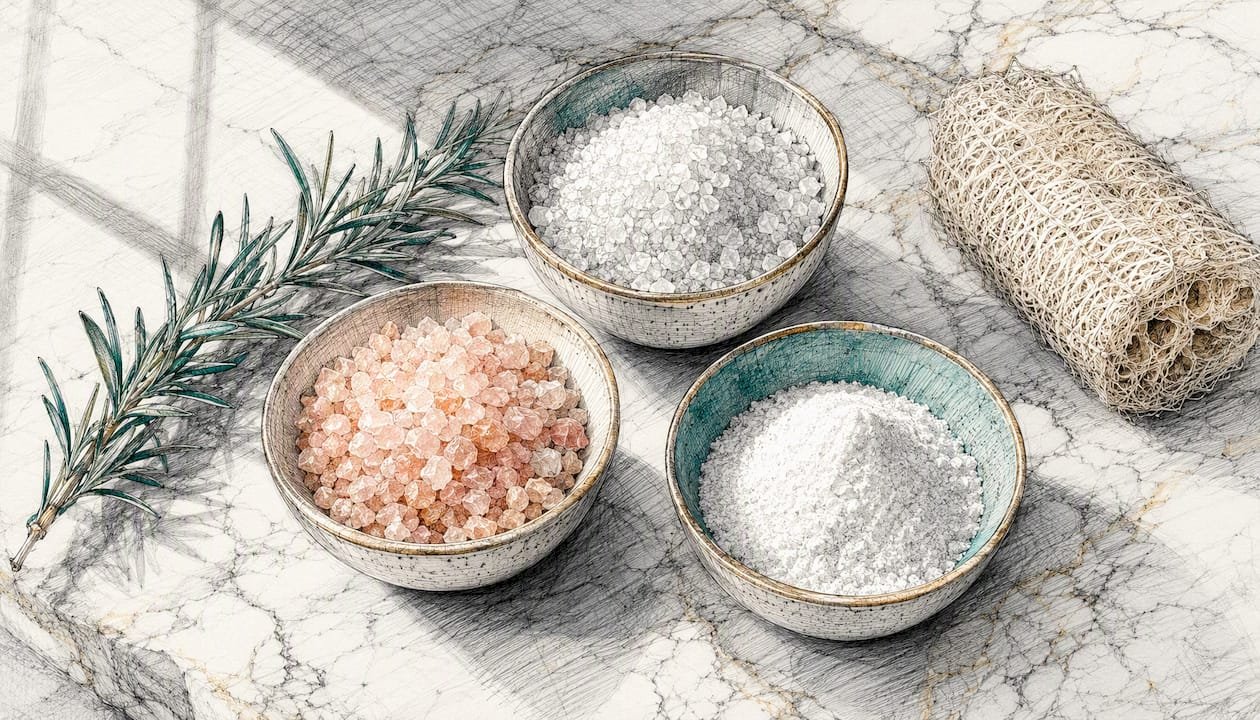
| Salt Type | Energetic Association | Skin Effect | Best Use |
|---|---|---|---|
| Epsom salt (magnesium sulfate) | Release, relaxation, tension clearing | Gentle, well suited to sensitive skin | Weekly maintenance, post-stress soaks |
| Unrefined sea salt | Purification, connection to natural cycles | Coarser, can feel drying with frequent use | Deep cleansing rituals, protection work |
| Himalayan pink salt | Grounding, mineral richness, ancient association | Mild, mineral content varies by batch | Grounding rituals, slower monthly resets |
| Kosher/rock salt | Boundary setting, traditional folk protection | Coarse texture, dissolve fully before soaking | Protection intentions, budget-friendly swaps |
Epsom salt is often the better choice when skin sensitivity or muscle tension is a concern, since it’s gentler than coarser sea salts while Himalayan and rock salts add mineral variety and different traditional weight to the ritual.
If you’re pregnant, have sensitive or eczema-prone skin, or you’re bathing more than twice a week, Epsom salt is the safer default and the most budget-friendly option at most grocery stores. Save unrefined sea salt or Himalayan salt for deeper, less frequent rituals where the texture and mineral content matter more.
One caveat worth repeating: skip iodized table salt. It’s processed with additives that can irritate skin with regular use, and it carries none of the traditional associations that make unrefined salt meaningful for this kind of work. If iodized salt is genuinely all you have, a plain warm shower with a spoken intention is a better substitute than forcing it into a bath.
How Do You Prepare and Perform a Salt Bath Ritual?
A good ritual bath has three phases: preparation, the soak itself, and closing. Skipping the closing phase is the most common mistake, since it’s the step that actually signals the release is finished.
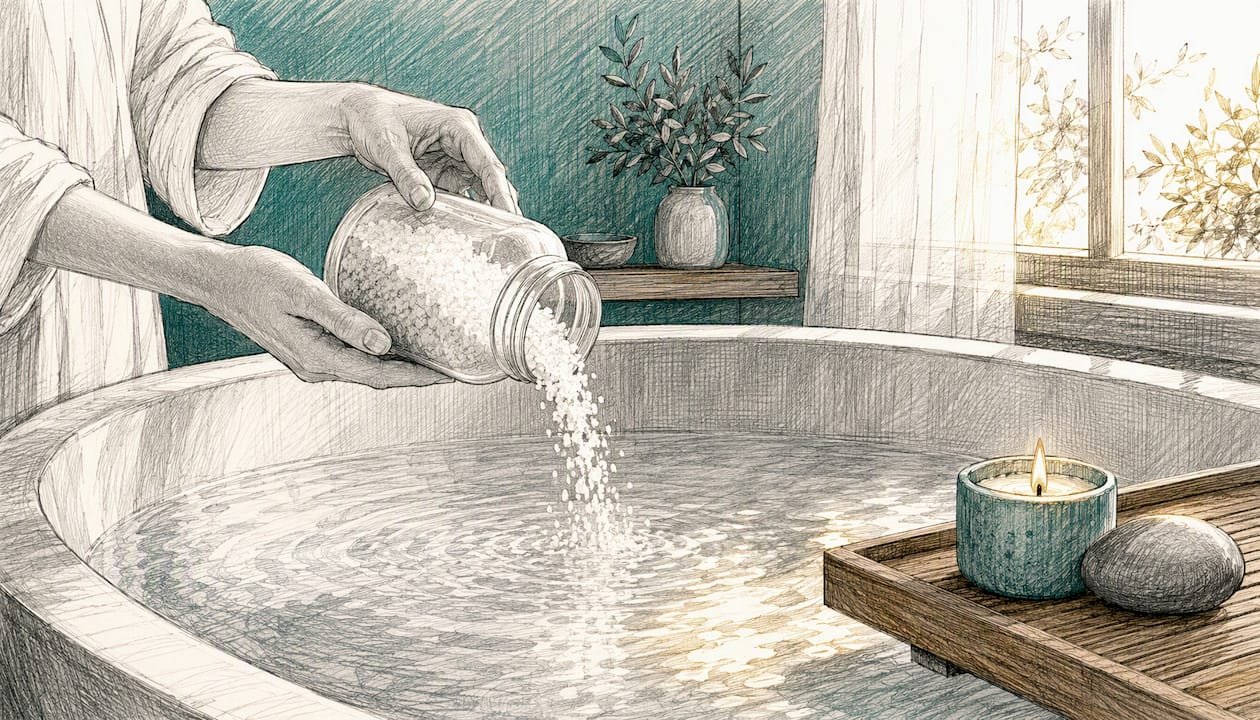
Supplies you’ll need:
| Item | Amount | Notes |
|---|---|---|
| Unrefined sea salt or Epsom salt | 1 to 2 cups | Baseline measurement for a home ritual, adjust down for sensitive skin |
| Warm water | Full tub | Comfortably warm, not scalding |
| Candle (optional) | 1 | White or unscented for neutral intention |
| Essential oil or dried herb (optional) | A few drops or a small sachet | Lavender for calm, rosemary for protection |
Before you run the water, tidy the bathroom and take a quick rinse shower to remove surface dirt so the ritual bath isn’t doing double duty as a hygiene bath. Light a candle if you’re using one, and take thirty seconds to name your intention in a single sentence. “I am releasing this week’s tension” works better than something vague like “good vibes.”
- Add the salt as the tub fills, stating your intention out loud or silently the moment it hits the water.
- Step in and settle once the water is a comfortable temperature, taking three slow breaths before doing anything else.
- Soak for 15 to 30 minutes, a range most ritual bath guides converge on, with some practitioners extending to 40 minutes for deeper work.
- Visualize the water pulling tension or heaviness away from your body, silently repeating a short phrase like “this is leaving me now.”
- Submerge briefly if comfortable, letting the water pass over your shoulders or the crown of your head for a few seconds.
- Pull the plug while still seated, watching the water drain and picturing whatever you released going with it.
Staying seated as the water drains and picturing the unwanted energy leaving with it is a common closing practice, and it’s worth pairing with a quiet transition afterward, no phone, no news, just a few minutes of stillness before you re-enter your regular evening.
Pro Tip: If you notice dry or itchy skin after a few sessions, cut your salt down to half a cup, shorten the soak to 15 minutes, and drink an extra glass of water before bed. Frequent salt bathing can pull moisture and electrolytes along with it, so hydration is part of the aftercare, not an afterthought.
Once you’re out, towel off gently rather than scrubbing, drink a full glass of water, and eat something grounding like a piece of fruit or a small snack. A short journaling prompt helps lock in the shift: write one sentence about what you released and one sentence about what you want more of this week.
What Are Some Variations on the Basic Ritual?
The core steps stay the same across variations. What changes is timing, add-ins, and how deep you want to go.
- Waning-moon release soak: Use 2 cups of sea salt with a few drops of rosemary oil, soaking for 30 minutes during the week the moon is shrinking, a timing many practitioners favor specifically for letting-go work.
- Full-moon renewal soak: Use 1 cup of Himalayan salt with a lavender sachet, a gentler 20 minute soak meant for restoration rather than release.
- Protection soak: Use 1 to 2 cups of kosher or rock salt, spoken intention focused on boundaries, best before a stressful event or difficult meeting.
- Quick foot soak: Use half a cup of Epsom salt in a basin of warm water for 10 to 15 minutes, ideal for apartments without a tub or for a fast reset between longer rituals.
For households without a bathtub, a salt-water shower rinse works as a real substitute rather than a compromise. Mixing salt into a cup of water and pouring it over your body during a shower, or using a foot soak instead, are both valid adaptations that keep the intention and closing steps intact even without full submersion. Foot soaks are also the easiest entry point for children or for anyone easing into ritual practice for the first time.
Who Should Be Cautious About Salt Baths?
Salt baths are generally low-risk, but a handful of conditions call for real caution rather than a quick disclaimer you skim past.
- Pregnancy: Extended hot water immersion can raise core body temperature, so check with your doctor before regular salt baths.
- High blood pressure or kidney issues: Salt absorption through skin is minimal, but soaking in hot water affects circulation, so clear it with a clinician first.
- Open wounds or broken skin: Salt water stings and can slow healing on cuts, scrapes, or fresh tattoos.
- Thyroid sensitivity: Skip iodized salt specifically, and stick to unrefined sea salt or Epsom salt instead.
- Medication interactions: Certain blood pressure or heart medications affect how your body handles heat and hydration shifts, so ask your pharmacist if you’re unsure.
- Sensitive or eczema-prone skin: Start with a smaller amount, half a cup, and shorten the soak before working up to a full dose.
Guides consistently recommend avoiding very hot water, going light on essential oils for sensitive skin, and staying hydrated afterward, and that advice holds regardless of which salt you choose. If you feel dizzy, lightheaded, or faint at any point, get out immediately and sit with your head between your knees until it passes. A practical safety habit worth building in: always have a plan to exit the tub while seated rather than standing up quickly, since the combination of heat and a long soak can make you lightheaded on standing.
If any of these apply to you, cutting the salt quantity in half, shortening the soak, and using cooler water are simple adjustments that keep the ritual accessible without the risk.
How Do You Build Salt Baths Into a Regular Practice?
A single bath rarely creates lasting change. The people who report the clearest results tend to treat salt bathing as one piece of a repeated rhythm rather than a one-time fix, similar to how aura cleansing works best as a layered practice rather than a single technique used in isolation.
- Weekly maintenance: One Epsom salt soak, 15 to 20 minutes, on the same night each week to build consistency.
- Monthly deep cleanse: A longer sea salt or Himalayan salt ritual timed to the waning moon, paired with journaling afterward.
- Event-driven soaks: An as-needed bath after anything emotionally heavy, a conflict, a loss, a draining shift at work.
- Integration sequence: A short breathwork session before the bath, the soak itself, journaling right after, then a grounding exercise before bed.
Intention remains the primary ingredient across ritual bath traditions; the herbs, salts, and timing amplify the work, but the sentence you speak while the salt hits the water is what actually does the shifting. Over a month, that sequence, breathwork, bath, journaling, rest, becomes less of a checklist and more of a rhythm your body starts to recognize on its own. If you want that rhythm mapped out with specific timing and prompts rather than building it from scratch, a structured workbook can save you the trial and error of figuring out what schedule actually works for your life.
Why Ritualized Salt Bathing Works as Ongoing Spiritual Hygiene
The mistake most people make with salt baths is treating them like a reset button instead of a maintenance habit. A single bath after a terrible week can feel good, but it doesn’t build the kind of steady boundary that keeps you from absorbing other people’s stress in the first place. The real value shows up after the fourth or fifth bath, when you start noticing you recover faster from draining situations because you’ve built a physical routine that reinforces an emotional one.
If you’re new to this, don’t overthink the first attempt. Pick one clear intention, something small and specific like “I’m letting go of today’s tension,” use whatever salt you have on hand, and give it fifteen minutes. The ritual doesn’t need candles or perfect timing to work. It needs repetition and honesty about what you’re trying to release. Small, consistent routines like this compound in a way that grand gestures rarely do, and that’s really the whole case for keeping it simple and doing it again next week.
A Guided Way to Structure Your Ritual Practice
Figuring out your own rhythm for weekly soaks, monthly deep cleanses, and event-driven rituals takes trial and error most people don’t have time for. Spiritualmethod built its guided resources specifically to remove that guesswork, giving you ritual templates, journaling prompts, and timing plans instead of leaving you to reinvent the schedule every month.
The Mind Body Soul Connection Explained guide walks through exactly how practices like salt bathing, breathwork, and grounding work together as a single system rather than isolated techniques, so you’re not stitching together advice from a dozen different sources. It pairs practical exercises with the reasoning behind them, which makes it easier to stay consistent instead of falling off after a strong first week.
If you’ve read this far and you’re ready to stop rebuilding your own ritual from scratch every time, check out the guide and start applying a structured plan to your next salt bath this week.
Sources
- Salt Water Purification Bath — Materials, Timing, Steps & Aftercare | Insights by Omkar
- How to Do a Ritual Bath: Herbs, Salts, and Spiritual Cleansing
- How to Take a Spiritual Salt Bath for Energy Cleansing and Protection – Nichole’s Secret Garden
- 11 Spiritual Meanings Of Salt Bathing: The Healing Waters