
Energy boundaries are the internal filters that decide what emotional and mental input you let in, and what you let leave your body and mind. Setting them starts with one 30 second habit: a quick baseline scan, where you notice your mood before an interaction, then a grounding visualization picturing a permeable but selective barrier around you right after. That single pause protects your focus and emotional reserves before anyone else’s stress becomes yours.
TL;DR:
- Setting energetic boundaries involves a quick baseline scan to identify your mood before and after interactions, helping you recognize external emotional influences.
- Drained feelings after specific people or situations indicate your boundaries are weak, especially when burnout or resentment develops without clear personal cause.
- Reinforcing boundaries requires short routines before, during, and after interactions, including intention-setting, grounding techniques, and deliberate clearing rituals.
- Communicating boundaries with clear, specific language and stated consequences increases their enforceability, reducing misinterpretation and negotiation.
- Maintaining boundary practices daily with structured habits, like morning scans and evening reviews, helps prevent energy leakage and supports long-term resilience.
Table of Contents
- What Are Energetic Boundaries, Exactly?
- How Do You Know Your Energetic Boundaries Are Weak?
- What Practices Actually Strengthen Energy Boundaries?
- How Do You Communicate a Boundary So It Actually Holds?
- What Daily Habits Keep Boundaries From Slipping?
- How Do Pre-Commitment Policies Remove the Guesswork?
- When Should You Bring in Professional Support?
- Why Ritual and Habit Design Beat Willpower Alone
- Build Your Boundary Practice With a Structured Guide
- Sources
- FAQ
What Are Energetic Boundaries, Exactly?
Energetic boundaries govern the invisible exchange, your mood shifting because someone else walked into the room, your focus draining after a phone call that had nothing to do with you. Physical boundaries protect your body and space. Emotional boundaries protect your feelings and reactions. Energetic boundaries sit underneath both, governing the subtler transfer of mood, tension, and attention that happens even when nobody touches you or says anything hurtful.
Forbes frames this well: energetic boundaries function as internal filters and habits, not walls. They determine what you absorb and what you release, and they let you stay connected to people without inheriting their stress. That distinction matters for anyone who has been told that setting boundaries means becoming cold or distant. It does not. It means being selective about what you carry.
Some of the confusion around energy boundaries comes from mixing them up with plain avoidance. Research on interpersonal emotion regulation shows that people use overlapping strategies to manage their own feelings and to influence the feelings of others, which means boundary work is an ongoing, active skill rather than a switch you flip once. You are not blocking emotion. You are actively deciding, moment to moment, whose emotional weather you are willing to stand in.
The Me/Not-Me distinction is the practical tool for this. Cleveland Clinic recommends body scanning and noticing physical tension as a way to separate your own feelings from ones you’ve absorbed. If you walked into a meeting calm and left irritable with no clear reason, that irritability likely belongs to someone else in the room, not you.
A baseline scan turns this into a repeatable habit:
- Before: Name your mood in one or two words. Write it down or just note it mentally. “Calm.” “Tired.” “Fine.”
- During: If you notice a sudden shift, tightness in your chest, a mood swing, a wave of fatigue, flag it without reacting yet.
- After: Compare your post-interaction state to your baseline. A mismatch is your cue that something outside you crossed the line.
Two weeks of this simple before-and-after tracking trains your awareness faster than any single technique, because it builds the pattern recognition that makes every other boundary practice work.
How Do You Know Your Energetic Boundaries Are Weak?
Feeling drained after specific people, not everyone, is the clearest signal. If you leave lunch with one friend energized and leave lunch with another feeling hollowed out, your boundaries are letting one of those interactions through unfiltered.
Other common signs show up in predictable clusters:
- Persistent mood shifts that track to specific people or environments rather than events in your own life.
- Resentment that builds quietly because you keep saying yes when you mean no.
- A sense of over-responsibility for other people’s emotions, feeling obligated to fix a friend’s bad mood or a coworker’s stress.
- Physical fatigue with no clear cause, especially after phone calls, group chats, or crowded environments.
- Difficulty concentrating immediately after emotionally intense conversations, even ones that went fine on the surface.
The clinical term closest to this pattern is compassion fatigue, and it is not just a spiritual concept. A systematic review of mental health professionals found that high job demands combined with low support predict compassion fatigue and emotional exhaustion, while peer and organizational support buffer against it. That finding applies well beyond clinical settings. Caregivers, customer-facing workers, and anyone who absorbs other people’s emotional load as part of daily life face the same mechanism.
Quick self-check. Ask yourself these five questions right now:
- Do I feel noticeably different after specific people versus others?
- Do I agree to things I don’t want to do, then feel resentful afterward?
- Do I replay other people’s problems in my head hours after a conversation ends?
- Do I struggle to enjoy time alone without decompressing from something?
- Have I skipped meals, sleep, or exercise because I was emotionally caught up in someone else’s situation?
Three or more “yes” answers means your energetic boundaries need active reinforcement, not just awareness.
What Practices Actually Strengthen Energy Boundaries?
Strengthening energy boundaries works best as a three-phase routine: before an interaction, during it, and immediately after. Each phase takes seconds, not hours, and the short duration is exactly what makes the habit stick.
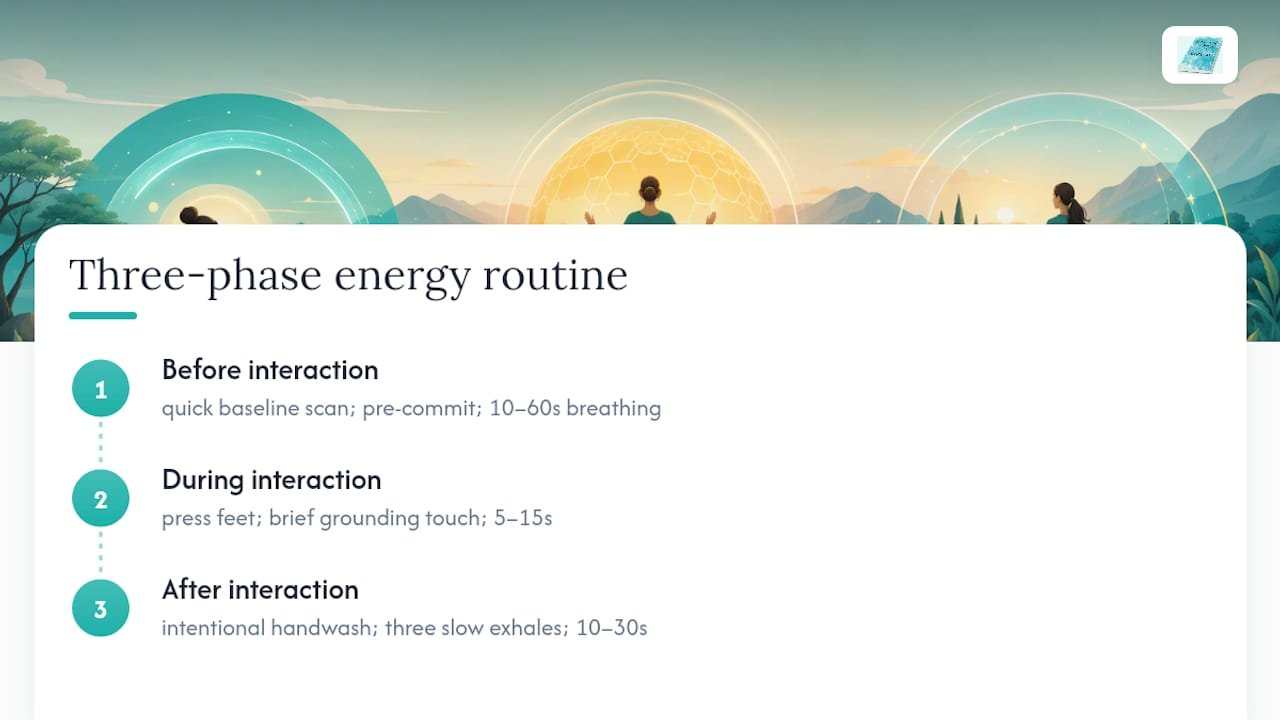
Before the interaction
Run your baseline scan first. Then set one pre-commitment rule for the conversation, a decision made in advance about what you will and won’t agree to, so you’re not negotiating your limits in real time under pressure. A short intention-setting ritual works well here: thirty seconds of quiet breathing while stating a simple phrase to yourself, something like “I stay open, not absorbed.”
During the interaction
This is where most people feel the pull of someone else’s emotional state and don’t know what to do about it in the moment. A few grounding micro-practices help:
Feet press. Press your feet flat into the floor and notice the contact. This anchors you in your own body within seconds.
Breath anchor. Take one slow breath in through the nose, a longer exhale through the mouth. Repeat if the conversation runs long.
Permeable boundary visualization. Picture a barrier around you that lets warmth and connection through but filters out tension, like a screen door rather than a solid wall.
Gaze softening. Instead of intense, sustained eye contact, which tends to intensify emotional absorption, let your gaze soften slightly. You stay present without pulling in every micro-expression.
After the interaction
Clearing rituals matter as much as the in-the-moment work, because residue from a hard conversation lingers if you don’t actively release it. Washing your hands with intention, imagining tension rinsing away, takes thirty seconds and works as a physical cue that the interaction is over. A longer breath release, three slow exhales with a mental note of “letting go,” takes about a minute. Journaling one line about what you absorbed versus what was genuinely yours reinforces the Me/Not-Me distinction from earlier. Some readers also use sound, a single bell tone, a hum, or a short piece of music, as an audible marker that resets their state.
For empaths specifically, this three-phase structure matters more than any single technique. One reader working a caregiving job might run the full sequence, baseline scan, feet press during difficult moments, handwashing ritual after, five or six times a day. That repetition is what builds the skill, not any one perfect method. Empath protection rituals built specifically for high-sensitivity readers extend this into a fuller daily practice, and a step-by-step guide to releasing negative energy covers the clearing phase in more depth.
Pro Tip: Keep your clearing ritual identical every time, same words, same motion, same length. Repetition is what trains your nervous system to recognize “this interaction is over” faster than novelty ever will.
How Do You Communicate a Boundary So It Actually Holds?
Vague requests get ignored, not because people are inconsiderate, but because vague language leaves room for reinterpretation. “I need some space” invites negotiation. “I’m not available for calls after 8 PM” does not. Cleveland Clinic’s guidance on boundaries emphasizes that specificity, paired with a clear consequence, is what makes a boundary enforceable rather than aspirational.
Compare these directly:
| Weak phrasing | Strong phrasing |
|---|---|
| “I’m kind of busy lately.” | “I can’t take calls on weeknights. Text me and I’ll respond by Saturday.” |
| “You’re a lot sometimes.” | “I need us to talk about one topic at a time. I’ll circle back to the rest tomorrow.” |
| “I guess I can help.” | “I can help for thirty minutes. After that I need to leave.” |
A handful of ready scripts cover most situations:
- For family: “I love you, and I’m not able to discuss this at family dinners. Let’s set a separate time to talk it through.”
- For friends who vent constantly: “I want to support you, but I can only listen for a few minutes right now. Can we pick this up later?”
- For coworkers who overload you: “I can take this on next week, not today. Send me the details and I’ll confirm a timeline.”
- For chronic emotional dumpers: “I care about what you’re going through, but I’m not the right person for this conversation. Have you thought about talking to someone trained for it?”
Consequences make the boundary real. If a coworker keeps calling after hours despite your stated rule, the consequence might be letting the call go to voicemail and responding the next morning. If a family member keeps steering dinner into conflict, the consequence might be leaving the table for a few minutes. State the consequence once, calmly, and then actually follow through the first time it’s tested. People adjust their behavior based on what happens, not what you say might happen.
Rehearsing a script out loud, even alone in your car or in front of a mirror, makes a measurable difference. The words feel foreign the first few times you say them. By the fifth repetition, they start to sound like you.

What Daily Habits Keep Boundaries From Slipping?
Boundaries decay without maintenance the same way any habit does. A short daily and weekly structure keeps the practice automatic instead of something you only remember after a bad week.
Morning: Run your baseline scan and a thirty to ninety second grounding practice, feet on the floor, one intention stated silently, before you check your phone. Starting the day reactive to notifications undoes the benefit before you’ve had a chance to set your own tone.
Midday: Set specific windows for messages and mute group chats outside those windows. A midday reset, even just three slow breaths at your desk, interrupts accumulated tension before it compounds into the afternoon.
Evening: Close the day with a clearing ritual, the same handwashing or breath release from your post-interaction practice, and one journaling line noting what you absorbed that wasn’t yours.
Weekly: Review which interactions consistently drained you and schedule deliberate recovery time, an evening alone, a walk, anything that isn’t performance for someone else.
| Time | Practice | Duration |
|---|---|---|
| Morning | Baseline scan + grounding intention | 30 to 90 seconds |
| Midday | Digital hygiene reset + breath check | 1 to 2 minutes |
| Evening | Clearing ritual + one-line journal note | 2 to 3 minutes |
| Weekly | Review draining interactions, schedule recovery | 10 to 15 minutes |
Screenshot that table or copy it into a notes app. The value isn’t in doing every item perfectly. It’s in having a checklist to glance at on days when willpower runs low and you need the routine to run on autopilot instead.
How Do Pre-Commitment Policies Remove the Guesswork?
Pre-commitment means deciding your rule in advance, before you’re in the emotionally charged moment where willpower tends to fail. Forbes describes this as a proactive strategy for protecting your energy, and it works because it removes the need to negotiate your limits while someone is actively pushing against them.
Think of it as writing your own energy policy the way a business writes an operating policy: fixed, known in advance, and applied consistently.
A few templates worth adopting directly:
- Meeting defaults. No calls scheduled before 9 AM or after 6 PM, stated in your calendar settings rather than negotiated case by case.
- Phone-free hours. A specific window, dinner through bedtime, where your phone stays in another room.
- Visitor limits. A cap on how many social obligations you accept in a single week, decided at the start of the week, not in the moment someone asks.
- Response windows. A stated rule that messages get replies within 24 hours, not immediately, removing the pressure to respond the second a notification appears.
Trial one rule for two weeks. Track how you feel using the same baseline scan from earlier, noting your energy at the start and end of each day. If the rule genuinely reduces the drained, resentful feeling that weak boundaries produce, keep it. If it doesn’t change much, adjust the specifics rather than abandoning the whole idea.
When Should You Bring in Professional Support?
Self-practice handles most day-to-day energy leaks, but certain signals mean it’s time to bring in outside help. Chronic exhaustion that doesn’t improve with rest, intrusive thoughts about other people’s problems that won’t quiet down, or old trauma surfacing during boundary work are all reasons to prioritize professional support over self-guided practice alone.
The systematic review on compassion fatigue interventions found that structured interventions can meaningfully reduce secondary traumatic stress and improve compassion satisfaction, particularly for people carrying emotional burden over long periods. That’s a strong argument for treating chronic symptoms as a signal to escalate, not just push through.
Different professionals serve different needs:
- Therapists help address people-pleasing patterns and build assertiveness skills when self-practice alone hasn’t shifted the underlying habit.
- Trauma-informed therapists specialize in cases where boundary violations connect to past trauma, not just present-day overwhelm.
- Coaches focus on practical accountability, useful once you know what you need but struggle with follow-through.
- Energy workers complement psychological approaches with body-based and ritual practices, useful alongside, not instead of, clinical support when trauma is involved.
For readers who want structure without a therapy commitment, Sean’s guidance through Spiritual Method’s grounding exercises offers a practical starting point that pairs well with professional care rather than replacing it.
Why Ritual and Habit Design Beat Willpower Alone
Most boundary advice stops at telling you to “say no more.” That’s incomplete. Willpower fails predictably under pressure, which is exactly when boundaries matter most. What actually holds up is pairing short, reproducible rituals, the kind that take thirty to ninety seconds, with pre-commitment policies that remove the decision entirely.
I built Spiritual Method’s approach around that pairing because ritual alone tends to fade without structure, and structure alone tends to feel cold without ritual. The grounding and spiritual awakening resources on the site reflect that balance: practical enough to use during a stressful phone call, grounded enough to feel like more than a productivity hack. Readers who stick with a simple baseline scan and one clearing ritual for two weeks tend to notice the shift faster than they expect. The skill isn’t complicated. It’s just rarely practiced consistently, which is the actual gap between people who protect their energy and people who talk about wanting to.
— Sean
Build Your Boundary Practice With a Structured Guide
Reading about grounding rituals and pre-commitment policies is one thing. Having them written out as a step-by-step plan you can follow on a hard day is another. Spiritual Method’s downloadable guide takes the practices covered here, ritual templates, habit trackers, and guided exercises for grounding and clearing, and organizes them into a structured format you don’t have to reconstruct from memory every time you need it.

The guide works best for readers who already recognize the patterns in this article, the drained feeling after specific people, the resentment that builds from vague boundaries, and want a guided plan instead of piecing one together themselves. It includes the same kind of before, during, and after structure covered above, translated into templates you fill in rather than concepts you have to remember under pressure.
If digital tools for emotional regulation also interest you, BreatheFree’s emotional support resources offer another angle worth exploring alongside ritual work.
Get the Spiritual awakening guide as a one-off purchase and start applying a structured version of these practices today.
Sources
- How To Set Boundaries In Healthy Ways — Cleveland Clinic
- Why Protecting Your Energy Should Be A Top Goal In 2026 — Forbes
- A systematic review of job demands and resources associated with compassion fatigue — PMC
FAQ
What Are the 7 Types of Boundaries?
Common frameworks describe physical, emotional, sexual, material, time, intellectual, and energetic boundaries as the main categories, though definitions vary slightly across sources. Energetic boundaries specifically govern mood, focus, and emotional absorption, which is why they’re often discussed separately from the more commonly known physical or emotional types.
What Are the Four C’s of Boundaries?
Definitions of the “four C’s” vary depending on the source, and no single version is universally standardized. A widely used practical version emphasizes being clear, consistent, calm, and following through with consequences, all of which align with the specificity-and-consequences approach covered in this guide.
How Do You Block Your Energy From Others Spiritually?
The goal isn’t blocking, it’s filtering. A permeable boundary visualization, imagining a barrier that lets connection through while screening out tension, paired with a grounding practice like a feet press or breath anchor, gives you an active tool rather than a wall. Spiritual Method’s empath protection rituals walk through several versions of this practice in more depth.
What Are Five Healthy Boundaries?
Five practical examples include stating specific response windows for messages, limiting how many social obligations you accept weekly, ending conversations that consistently drain you, declining to absorb responsibility for other people’s emotions, and setting phone-free hours in the evening. Each works best when paired with a stated consequence, so the boundary holds under pressure rather than dissolving the first time it’s tested.
What’s the Fastest Way to Start Setting Energy Boundaries Today?
Start with the baseline scan: note your mood in one or two words before and after your next few interactions. That single habit builds the awareness every other boundary practice depends on, and it takes under a minute to run each time.