
A throat chakra blockage is a suppressed capacity for honest self-expression, tied to what yogic tradition calls Vishuddha, the fifth energy center governing voice and truth. It shows up as tightness in speaking up, chronic throat tension, or a habit of swallowing what you actually mean. Try this now: hum steadily for 60 seconds, then notice whether your throat feels open or strained afterward.
TL;DR:
- Practicing vocal humming, chanting “HAM,” or reading aloud can reveal tension patterns and track progress in opening the throat chakra.
- Lengthy history of childhood silencing, verbal abuse, or environments that punish honesty often underpin blockages and require gentle, consistent work.
- Combining breath, vocal, and body-awareness exercises with slow practice and therapist support yields the most sustainable results.
- Evidence supports the benefits of group singing and breath-body work for emotional regulation and expressive confidence, though energy field claims lack scientific backing.
- A gradual two-week practice routine, including daily vocal exercises and honest communication, fosters long-term improvement over quick fixes.
Table of Contents
- What Are the Signs of a Blocked Throat Chakra?
- What Causes a Blocked Throat Chakra?
- How Do You Know if Your Throat Chakra Needs Work?
- What Are the Best Throat Chakra Healing Techniques?
- What Does Research Say About Throat Chakra Healing and Safety?
- A Two-Week Plan to Open Your Throat Chakra
- Why Slow, Steady Practice Beats a Quick Fix
- A Structured Way to Keep Building From Here
- Sources
- FAQ
What Are the Signs of a Blocked Throat Chakra?
Throat chakra symptoms rarely stay in one lane. They surface in the body, the emotions, and the way you act around other people, often all three at once.
Physically, a blocked throat chakra tends to show up as recurring throat tightness, hoarseness that comes and goes, jaw clenching or TMJ discomfort, and neck and shoulder stiffness that massage never quite resolves. Some people describe globus sensation, that persistent feeling of a lump in the throat with no medical cause behind it, according to Healthline’s overview of throat chakra healing.
Emotionally and behaviorally, the picture splits into two opposite patterns:
- Underactive presentation: fear of speaking up, chronic people-pleasing, feeling unheard even in close relationships, and creative blocks that make writing or singing feel impossible.
- Overactive presentation: compulsive talking, interrupting, oversharing, or dominating conversations as a way to avoid silence.
Both patterns point to the same root: an unreliable relationship between what you feel and what you say. Someone who never speaks up and someone who never stops talking can be working through the identical throat energy blockage, just expressed in opposite directions.
What Causes a Blocked Throat Chakra?
Most throat chakra blockages trace back to a history where speaking honestly felt unsafe. That history can be interpersonal, psychological, physical, or environmental, and usually it’s a mix.
- Interpersonal histories: childhood silencing (“children should be seen and not heard”), verbal abuse, or repeated invalidation when you did speak up.
- Psychological patterns: shame around your own voice, fear of judgment, or trauma that narrows what feels sayable at all.
- Physical and habitual contributors: chronic stress held in the jaw and neck, teeth grinding, shallow breathing, and vocal strain from overuse or underuse.
- Contextual drivers: workplaces or family systems that reward silence and punish disagreement, which trains the throat to stay shut long after the original threat is gone.
None of these causes are permanent sentences. They’re patterns, and patterns respond to repetition in the opposite direction, which is exactly what the practices below are built to do.
How Do You Know if Your Throat Chakra Needs Work?
A few low-risk checks can tell you more in ten minutes than a week of wondering.
- Vocal activation test: hum for 30 seconds, sustain a single vowel sound for another 30, then read a paragraph aloud. Note where tension shows up, whether your voice cracks, or whether it actually feels easier by the third step.
- Journaling prompts: write two lists, “what I never say out loud” and “who I go quiet around.” Patterns in these lists usually point straight to the source of the blockage.
- Low-risk communication experiment: pick one small, honest, bounded statement, something like naming a preference you’d normally suppress, and say it in a safe setting. Watch your own reaction as closely as the other people.
Pro Tip: Do the vocal activation test in the morning and again at night for a week. Most people find their baseline tension is highest right after waking, which often traces back to overnight jaw clenching.
If throat symptoms include real physical pain, swallowing difficulty, or a voice change that won’t resolve, that’s a medical question first. More on those red flags below.
What Are the Best Throat Chakra Healing Techniques?
Vishuddha healing works best as a stack: breath and voice first, then body, then expression, then optional support.
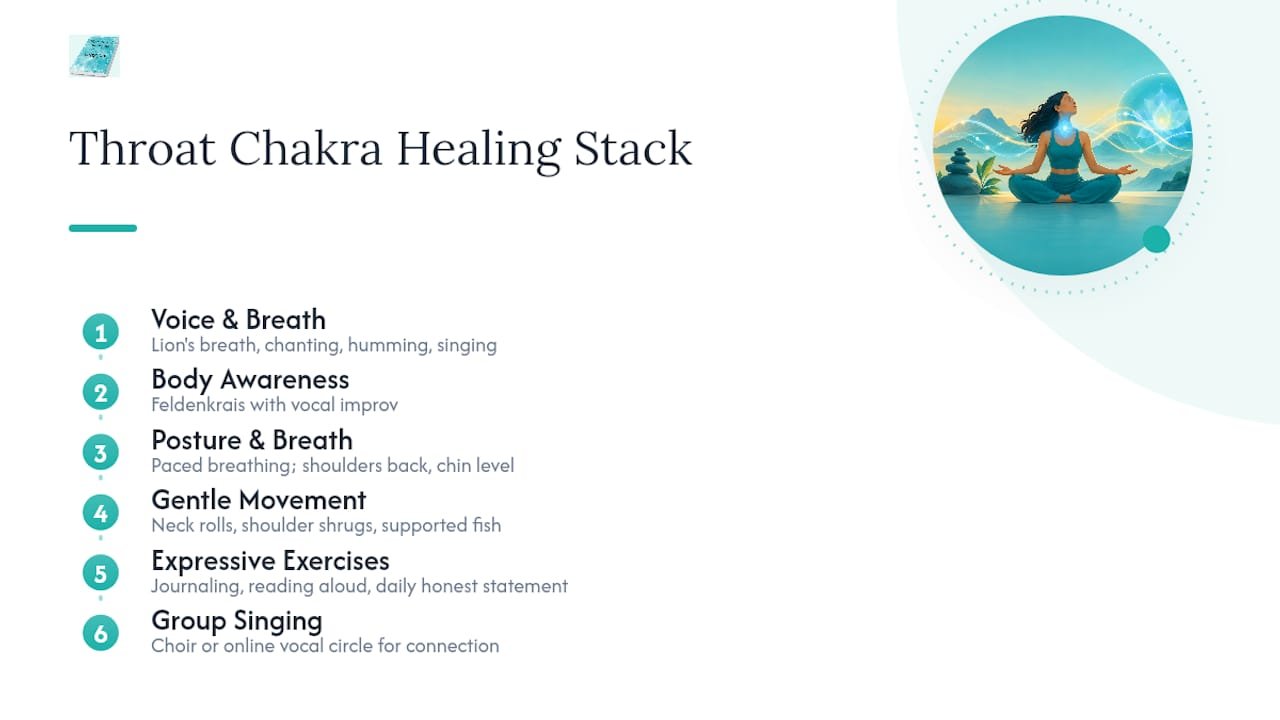
Vocal and breath practices form the foundation. Lion’s breath, an audible exhale with the tongue extended and eyes wide, releases jaw and throat tension fast. Chanting the seed mantra “HAM” on a single sustained tone, humming for a few minutes, or holding sustained vowel sounds all activate the same vibration patterns in the throat and chest. Daily singing for a few minutes, even alone in the car, counts as real practice, not just a warm-up.
Breath-body integration matters more than most guides admit. A mixed methods evaluation of a combined Feldenkrais and vocal improvisation program found that pairing body-awareness work with vocal improvisation improved participants’ breathing capacity and their sense of connection to their own bodies, alongside a greater capacity for self-expression. Paced breathing and simple posture correction, shoulders back, chin level, do the same groundwork before you ever open your mouth to speak.
Gentle yoga and stretching support the mechanical side: neck rolls, shoulder shrugs, and a supported fish pose all loosen the muscles that clench when speech feels risky. Move slowly and stop short of strain. A soft, breathable yoga set built for full range of motion makes it easier to actually stretch the neck and shoulders instead of fighting restrictive clothing.

Expressive exercises close the loop between insight and action: journaling prompts, reading aloud, practicing one honest statement per day, or free-form voice work with no audience at all.
Group options raise the stakes productively. Choir and group singing have been studied as a mechanism for what researchers call collective narrative repair, helping people regulate emotion, build social connection, and express material that feels too exposed to say alone, according to research on group singing and post-traumatic growth. A local choir or an online vocal circle is a reasonable next step once solo practice feels steady.

Some people add color visualization (imagining blue light at the throat) or carry stones like blue lace agate as symbolic reminders. These are supportive rituals, not treatments, and they work best alongside the practices above, not instead of them.
What Does Research Say About Throat Chakra Healing and Safety?
The clinical evidence lines up more with the practices than with the theory behind them. Group singing programs show measurable benefits for emotional regulation and social connection, and breath-body work shows real gains in breathing capacity and expressive confidence. Where the science stops is at the idea of an energy field itself.
“There is no scientific evidence that energy fields exist or can be manipulated,” notes the National Center for Complementary and Integrative Health, while affirming that mind-body practices like yoga and breathwork are generally safe and can meaningfully support stress reduction and wellbeing.
That distinction is worth sitting with: the metaphor of a “blocked chakra” may not be literally measurable, but the breathing, singing, and stretching it inspires produce real, documented effects.
Safety still comes first. Harvard Health flags hoarseness or sore throat lasting more than two weeks as a reason to see a doctor, and anything involving trouble breathing or swallowing, blood in your sputum, or a high fever needs immediate medical attention, not a breathing exercise. If trauma is part of your throat chakra symptoms, pair voicework with a therapist rather than working through it alone.
A Two-Week Plan to Open Your Throat Chakra
Consistency beats intensity here. Consistent daily practice builds more real change than occasional intensive sessions.
- Days 1 through 7: five minutes of humming or HAM chanting each morning, two minutes of neck and jaw stretches, and a short journal entry answering one prompt from the self-check section.
- Days 8 through 14: add five minutes of singing or reading aloud, practice one honest, bounded statement in a real conversation, and consider joining an online vocal circle or a single choir rehearsal.
- Throughout: track how your voice feels, not just what you did. A one-line daily note (“tight,” “easier,” “avoided one thing”) shows patterns a checklist won’t.
Pro Tip: If a day feels emotionally heavy after a practice, that’s a sign to slow down, not push through. Chakra work should loosen tension gradually, not force it open all at once.
Why Slow, Steady Practice Beats a Quick Fix
Most guides treat throat chakra healing like a checklist you finish in a weekend. It isn’t. The nervous system that learned to stay quiet took years to build that habit, and it won’t unlearn it in three days of chanting. What actually works is closer to strength training: small, repeatable reps that compound.
The overlooked piece is pacing. People with a real trauma history behind their silence often push into voicework too fast, get flooded with emotion, and quit. Combining breath and vocal practice with a therapist, especially when childhood silencing or verbal abuse is part of the story, isn’t a failure of the spiritual approach. It’s what makes the spiritual approach sustainable. The same logic applies to heart chakra work and aura cleansing practices: gradual habit-building outperforms intensity every time.
— Sean
A Structured Way to Keep Building From Here
A guide picks up exactly where daily voice and breath practice leaves off, with structured rituals, journaling templates, habit trackers, and a paced vocal practice schedule instead of a loose list of tips to remember on your own.

The 50-plus page Spiritual awakening guide is a one-time $20 download with instant access, built around the same principle behind the two-week plan above: forgiving, sustainable habits beat one intense weekend every time. It bundles grounding, energy clearing, and intention-setting practices alongside the throat and voice work covered here, so you’re not piecing together separate resources. For a deeper dive into the awakening framework itself, the 7 Steps to a Transformative Spiritual Awakening guide walks through the full sequence. Download it, open it tonight, and start with page one instead of a blank journal.
Sources
- Throat Chakra Healing: How to Unblock for Better Health — Healthline
- Chronic laryngitis — Harvard Health
- Mind and body practices — NCCIH
- Everyone Breathes: a mixed methods evaluation of a combined Feldenkrais and vocal improvisation group — PMC
FAQ
How Can I Clear a Blocked Throat Chakra?
Start with daily breath and vocal practice, humming, lion’s breath, or the HAM chant, paired with honest journaling about what you avoid saying. Add gentle neck and jaw stretches and one small, honest conversation per day, building toward group singing once solo practice feels steady, per Healthline’s recommended techniques.
What Trauma Blocks the Throat Chakra?
Childhood silencing, verbal abuse, and repeated invalidation are common histories behind a blocked throat chakra, since they teach the nervous system that honest speech isn’t safe. Trauma-informed voicework paired with a therapist tends to work better than solo practice when this history is significant.
What Are the Signs My Throat Chakra Is Opening?
Look for less tension in the jaw and neck, an easier time sustaining your voice while singing or reading aloud, and a growing willingness to say what you actually mean without over-explaining. Some people also notice fewer instances of chronic sore throat or hoarseness as vocal tension eases.
What Emotions Are Associated With a Blocked Throat Chakra?
Fear of judgment, shame around one’s own voice, and a chronic feeling of being unheard are the most common emotional signatures. On the opposite end, some people experience anxious over-talking or oversharing as the same underlying blockage expressed outward instead of inward.
How Much Does the Spiritualmethod Guide Cost?
The Spiritual awakening guide is a one-time $20 download available on the Spiritualmethod downloads page, with instant access after purchase. It includes journaling templates, habit trackers, and structured rituals that extend the practices covered in this article.