
Emotional release journaling is a structured writing practice that helps you name, process, and move through difficult feelings rather than suppress them. The most practical way to begin is a timed session: write continuously for 15 to 20 minutes on one emotional topic, stop when the timer ends, and follow with a grounding exercise. If a session brings up overwhelming symptoms, pause and consult a mental health professional.
TL;DR:
- Longer, exploratory writing sessions tend to yield better emotional benefits than brief or superficial journaling, especially when deep engagement is encouraged.
- Structured sessions should focus on one manageable topic, with grounding rituals afterward, to prevent overwhelming distress and support safe emotional release.
- Avoid editing or rereading entries during a session, and stop immediately when the timer ends to maintain focus and emotional containment.
- Seek professional help immediately if journaling triggers suicidal thoughts, dissociation, or panic that do not subside with grounding techniques.
- Gradual release over multiple sessions indicates increased capacity to sit with feelings, not necessarily the disappearance of the emotions.
Table of Contents
- What research shows about expressive writing and emotional release
- Safety, containment, and when to seek professional help
- A step-by-step session plan for emotional release journaling
- Grounding and containment techniques for after your session
- Prompts for emotional release, from gentle to deeper work
- Building journaling into a wider healing practice
- What release actually means over time
- Continue your practice with guided tools from Spiritualmethod
- Sources
- FAQ
What research shows about expressive writing and emotional release
Expressive writing has been studied for decades, and the picture that emerges is encouraging but measured. A systematic review and meta-analysis of journaling interventions found small-to-moderate pooled effects across mental health outcomes, alongside considerable variation between studies and notable methodological limits.
Journaling interventions show small-to-moderate benefits across mental health outcomes, according to pooled data from systematic reviews, though results vary widely between studies and populations.
What separates a session that helps from one that does not seem to come down to a few factors:
- How much the writer engages with the material, since longer and more exploratory essays tend to correlate with better outcomes.
- Whether the instructions encourage acceptance and normalize distress, which appears to deepen engagement, according to research on expressive writing instructions.
- Whether the format matches the person’s situation, since a schedule that works for one population may not suit another.
Manualized clinical protocols such as Written Exposure Therapy show documented benefit for trauma symptoms when delivered by a clinician, a different context from a self-guided journal entry. The practical takeaway: journaling can support emotional processing, but it works best as one tool among several rather than a stand-alone fix.
Safety, containment, and when to seek professional help
Writing about painful material can raise distress before it eases it. That short-term spike is a known pattern, not a sign that something has gone wrong, but it does mean sessions need structure. A randomized trial of online expressive writing during a period of widespread social stress found no long-term benefit and some evidence of short-term harm in certain subgroups, a reminder that context and pacing matter.
Containment keeps a session safe:
- Pick one manageable topic instead of trying to process everything at once.
- Set a timer and stop writing the moment it ends.
- Skip rereading or editing what you wrote; the goal is release, not polish.
- Close every session with a grounding practice and a plan for support if needed.
Pro Tip: If a topic feels too large to hold in 20 minutes, write about a smaller piece of it instead of forcing the whole story onto the page.
Seek a clinician or crisis service if a session triggers suicidal thoughts, dissociation, or panic that does not settle with grounding. A Danish therapy practice’s guidance on recognizing severe grief offers a useful outside perspective on knowing when professional support, not solo journaling, is the right next step.
A step-by-step session plan for emotional release journaling
A workable format borrows from the same structure used in clinical research, adapted for self-guided use.
- Choose a private, uninterrupted space and set a timer for 15 to 20 minutes.
- Pick one emotional topic, something specific rather than a vague sense of “everything.”
- Write continuously without editing, stopping only when the timer ends.
- Use acceptance-based framing in your own instructions to yourself, such as “whatever comes up is allowed to be here” rather than “I need to fix this.”
- Close with a short grounding ritual before returning to your day.
Space sessions out rather than writing every day on the same wound. A commonly used research schedule runs three to five sessions spaced two to three days apart, giving the mind time to process between entries.
A few rules make the difference between a session that helps and one that just stirs things up:
- Never edit or reread mid-session; correcting grammar pulls you out of the emotional material.
- Stop the moment the timer sounds, even mid-sentence.
- If you are working through trauma with a clinician, follow their specific protocol, such as Written Exposure Therapy, which uses five sessions of 30 to 50 minutes with therapist oversight rather than a self-guided format.
Grounding and containment techniques for after your session
A writing session that stirs up strong feelings needs a deliberate close. Grounding brings your nervous system back to the present before you step away from the page.
- Try the 5-4-3-2-1 sensory check: name five things you see, four you can touch, three you hear, two you smell, one you taste.
- Practice paced breathing, slow inhale through the nose, longer exhale through the mouth, for one to two minutes.
- Release tension through progressive muscle relaxation, tightening and releasing each muscle group.
- Take a short walk or stretch to shift out of a seated, activated state.
- Reach out to a supportive person if the material felt heavier than expected.
Pro Tip: Pick the same grounding ritual every time so your mind starts to associate it with “the session is over now.”
If grounding does not settle the activation within a reasonable window, pause journaling for that day and focus on stabilization instead. Our guide to grounding exercises for healing walks through these techniques in more depth.

Prompts for emotional release, from gentle to deeper work
Start light and let the prompts deepen only as you feel ready. Use a timer for each, and stop early if a prompt feels like more than you can hold today.
- What am I feeling in my body right now? Where do I notice it?
- What word best names this emotion, without judging it?
- What happened recently that triggered this feeling?
- What do I wish someone had said to me in that moment?
- What story am I telling myself about this situation?
- What would I say to a friend going through the same thing?
- What part of this is within my control, and what is not?
- What have I been avoiding saying, even to myself?
- What did this experience teach me about what I need?
- What is one small, safe step I can take next?
- What am I ready to release, even partially, today?
Gentle sessions work well with prompts 1 through 4 and a 10-minute timer. Save prompts 8 through 11 for days when you feel stable and supported, and give those a full 20 minutes. Whatever prompt you choose, close with a grounding practice, not with more writing.
Building journaling into a wider healing practice
Engagement is one of the clearest predictors of benefit in the expressive writing research: writers who explore more deeply and stick with a structured format tend to see more from the practice. Templates and habit scaffolds help here, since a blank page can be harder to return to than one with a clear starting point.
A few ways to extend the session format described above:
- Structured templates that guide naming, bodily noticing, and a next safe step, similar to our journaling for soul healing guide.
- Short daily prompts for lower-intensity days, covered in 5 to 10 minute spirituality journal ideas.
- Lower-intensity prompt sets, such as gratitude journal prompts, for days when deeper release work is not the goal.
Combining a consistent format with occasional professional support tends to serve people better than either alone.
What release actually means over time
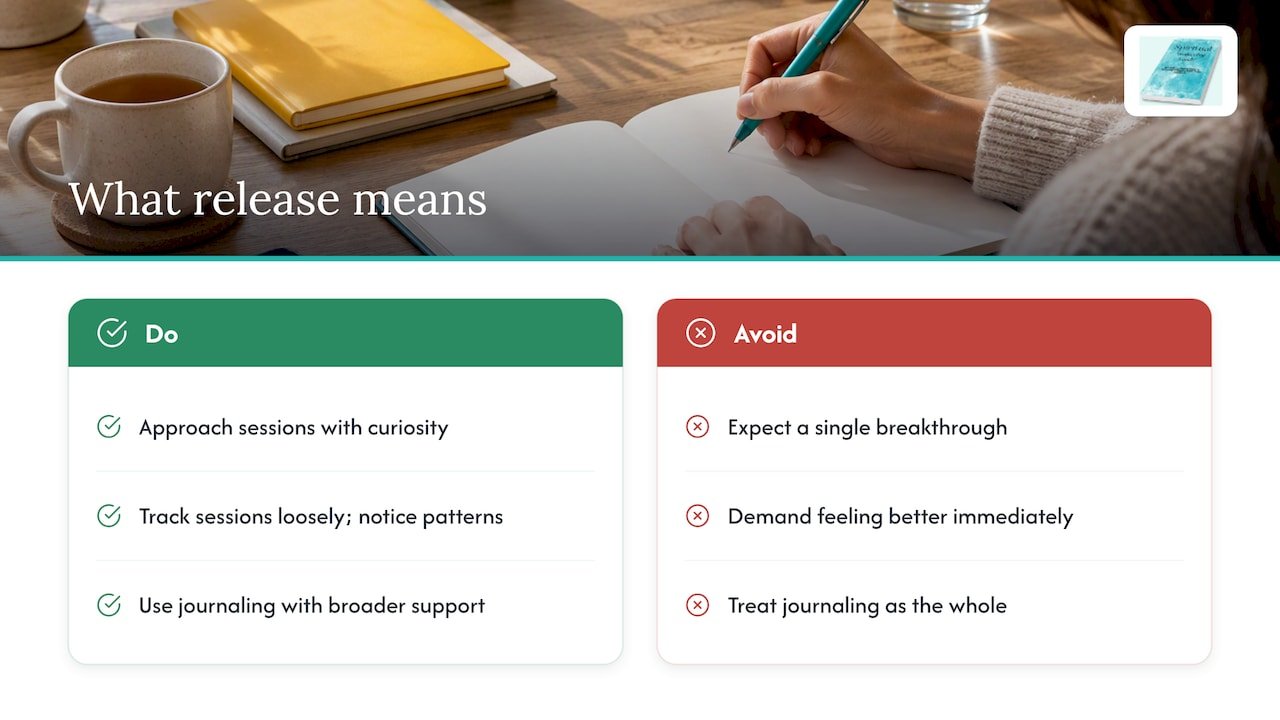
Release rarely arrives as a single breakthrough. It tends to look more like a gradual loosening, some days the same feeling surfaces again, and that does not mean the work failed. Progress in this kind of practice shows up as increased capacity to sit with a feeling, not as its permanent disappearance.
Approach each session with curiosity rather than a demand to feel better by the end of it. Track your sessions loosely, notice patterns, and treat journaling as one part of a broader support system rather than the whole of it.
— Sean
Continue your practice with guided tools from Spiritualmethod
A session format is only as sustainable as the structure behind it, and that is where a guided resource can carry some of the weight. A spiritual awakening guide includes templates, a habit tracker, and grounding rituals designed to support the kind of practice described above, giving you a starting page instead of a blank one each time you sit down to write.

Those templates map directly onto the session plan in this article: a structured prompt to open with, a place to note bodily sensations, and a grounding ritual to close. Because the format is already built, there is less friction between deciding to journal and actually doing it, and engagement is one of the strongest predictors of benefit from this kind of writing. The guide is a one-time purchase of $20 and available now on the downloads page.
This article is general information, not a substitute for advice from a qualified doctor. Consult a qualified healthcare professional about your own circumstances before acting on anything here.
Sources
- Chasing elusive expressive writing effects: emotion-acceptance instructions and writer engagement improve outcomes (PMC)
- Written Exposure Therapy for PTSD (National Center for PTSD)
- Journaling interventions systematic review and meta-analysis (PMC)
FAQ
What is the 3/2/1 method of journaling?
The 3/2/1 method typically involves writing three observations about a situation, two feelings connected to it, and one action or insight to move forward. It is a lighter structure than a full timed expressive-writing session and works well as a quick daily check-in rather than deep release work.
What is an example of emotion-focused coping?
Emotion-focused coping means managing your response to a stressor rather than trying to change the stressor itself, and journaling is one common example. Naming a feeling on the page, sitting with it, and grounding afterward are all forms of emotion-focused coping.
How do you let go of things out of your control?
A practical starting point is writing down what specifically falls inside and outside your control, since separating the two often reduces the mental load of trying to manage everything at once. Prompts that ask “what is within my control here” tend to support this process more directly than general venting.
How do you deal with intense mental pain?
Numbing pain is not the goal of emotional release journaling, and pushing feelings away tends to delay processing rather than resolve it. If pain feels unmanageable, grounding techniques and contact with a mental health professional are more appropriate than trying to write through it alone.