
Crystal healing for anxiety is the practice of using specific stones as tactile anchors to support mindfulness rituals and stress relief. The stones themselves carry no proven medical properties. A 2025 Cambridge University study published in CNS Spectrums confirmed crystals show no effect beyond placebo. That finding does not make the practice useless. The placebo effect is a genuine neurobiological response, and the ritual of holding a stone during slow, focused breathing produces real physiological changes, including cortisol reduction and a calmer nervous system. Crystals like amethyst, rose quartz, and lepidolite are the most commonly cited stones for anxiety support, and each works best as a mindfulness prop, not a cure.
What crystals are best for anxiety relief?
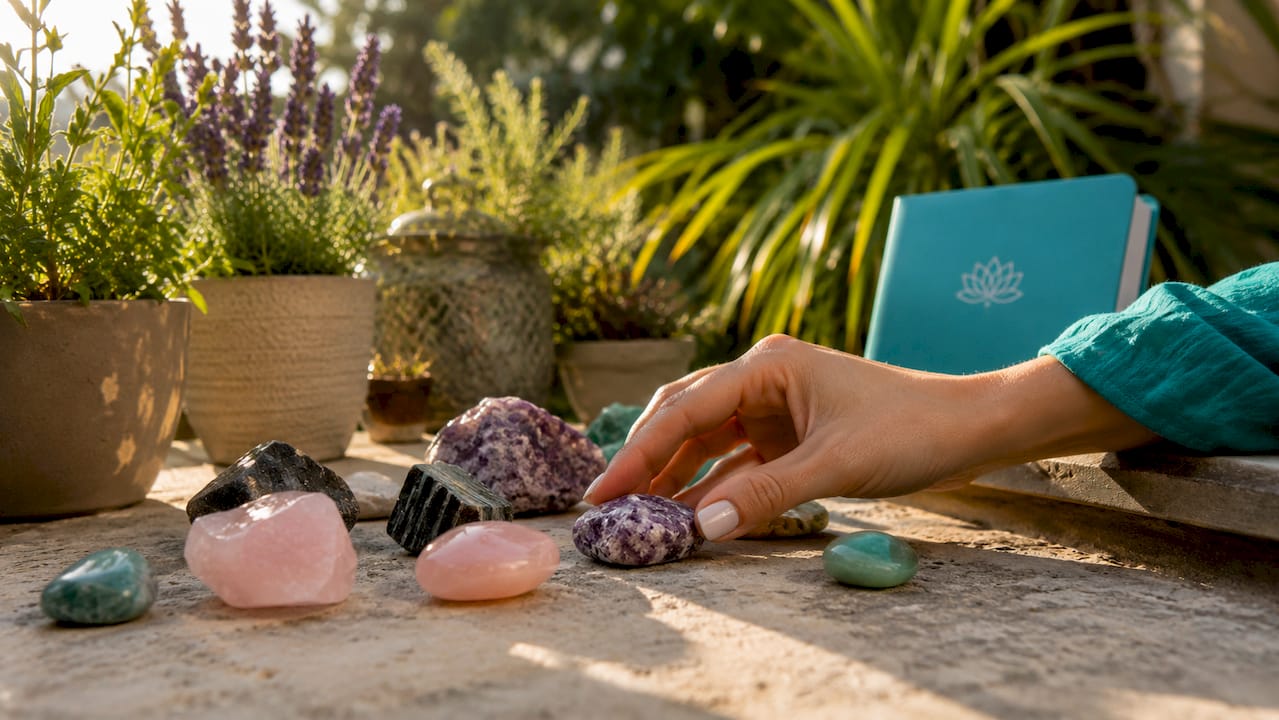
Seven stones appear consistently in crystal therapy for anxiety: amethyst, rose quartz, black tourmaline, lepidolite, blue lace agate, smoky quartz, and clear quartz. Each carries a distinct cultural association and a practical role in a calming ritual.
- Amethyst is linked to mental clarity and calm. Its purple color has been associated with tranquility across Greek, Roman, and Buddhist traditions. Holding amethyst during meditation gives the mind a concrete focal point.
- Rose quartz is associated with self-compassion and emotional warmth. People who struggle with anxiety rooted in self-criticism often find this stone a useful reminder to soften their inner voice.
- Black tourmaline is considered a grounding stone. Its weight and dark, opaque surface make it a strong sensory anchor for people who feel mentally scattered or overwhelmed.
- Lepidolite contains trace amounts of lithium in its mineral composition. Lithium is used clinically in mood stabilization, though the concentration in lepidolite is far too low to produce any pharmacological effect. The stone’s cultural reputation for calm likely stems from this association.
- Blue lace agate is linked to social ease and communication. People with social anxiety often carry it as a tactile cue before difficult conversations.
- Smoky quartz is associated with stress dissipation and grounding. Its translucent brown tones and cool surface temperature make it a satisfying stone to hold during tense moments.
- Clear quartz is used for intention setting. Starting a breathing session by holding clear quartz and stating a calm, specific intention focuses the mind before the practice begins.
These seven anxiety crystals are not interchangeable. Choose one based on the type of anxiety you experience most often, whether that is racing thoughts, social fear, physical tension, or emotional overwhelm.
| Crystal | Primary association | Best used for |
|---|---|---|
| Amethyst | Mental clarity, calm | Racing thoughts, meditation focus |
| Rose quartz | Self-compassion | Emotional anxiety, self-criticism |
| Black tourmaline | Grounding | Scattered thinking, overwhelm |
| Lepidolite | Mood stability | General anxiety, restlessness |
| Blue lace agate | Communication ease | Social anxiety |
| Smoky quartz | Stress dissipation | Physical tension, stress buildup |
| Clear quartz | Intention setting | Starting a new calming routine |
How to use crystals for anxiety: a step-by-step approach
The most effective method for using crystals for stress relief is a short, consistent daily ritual. Practitioners recommend 5–10 minutes each day, not hour-long sessions. Consistency matters more than duration.
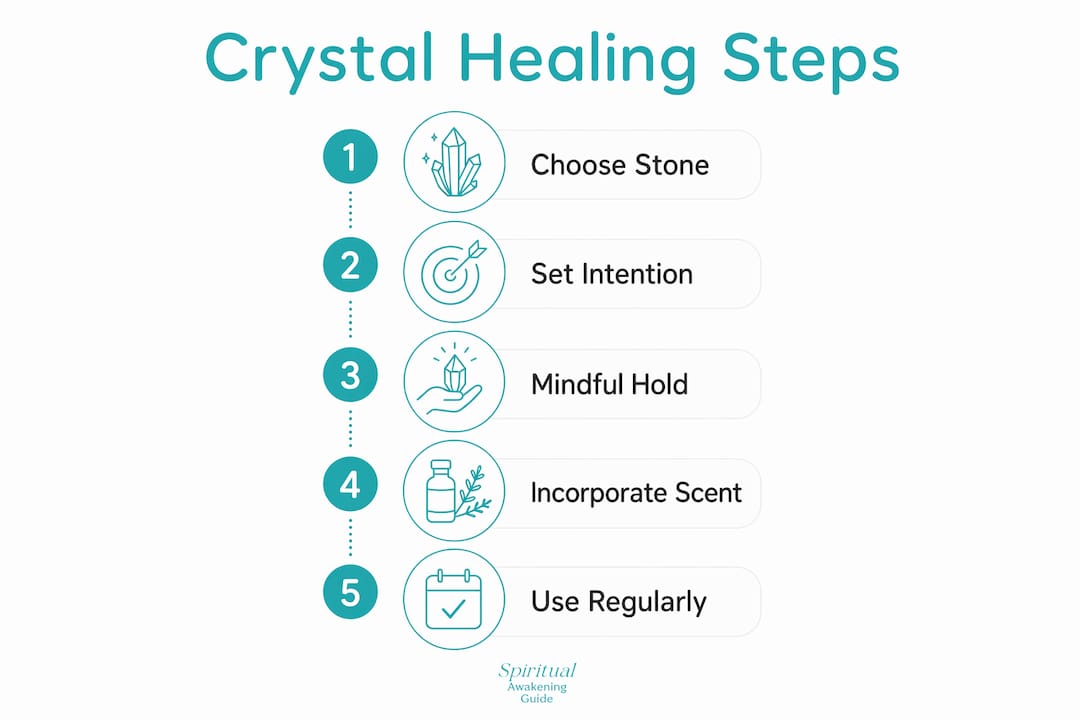
- Choose one stone. Start with a single crystal that matches your primary anxiety pattern. Using multiple stones at once adds complexity without adding benefit.
- Set a fixed time. Morning, before bed, or during a known stress window works well. A fixed time builds a conditioned response: your nervous system begins to associate that moment with calm.
- Hold the stone and breathe. Place the crystal in your non-dominant hand. Use the 4-7-8 breathing technique: inhale for 4 counts, hold for 7, exhale for 8. Repeat four cycles. The 4-7-8 breathing method activates the parasympathetic nervous system, and the stone gives your attention a physical anchor.
- State a simple intention. Before you begin, say one short sentence aloud or silently. “I am calm” or “I release tension” works. This is not magic. It is a cognitive priming technique that directs attention toward a desired state.
- Place the stone as a visual cue. After your session, set the crystal on your desk or bedside table. Seeing it throughout the day reinforces the association with calm.
Pro Tip: Pair your crystal with a specific scent, such as lavender essential oil applied to your wrist before each session. Scent is processed by the limbic system, the brain’s emotional center, and pairing it with your stone creates a stronger conditioned calming response over time.
Beyond the daily ritual, carrying a stone in your pocket gives you a tactile grounding tool during stressful moments. When anxiety spikes, pressing the stone firmly into your palm redirects attention from anxious thoughts to physical sensation. This interruption is brief but effective.
Simple, repeatable rituals consistently outperform elaborate energetic systems. Avoid building complex crystal grids or following multi-stone protocols until a single-stone practice is well established.
What does science say about crystal healing for anxiety?
The psychological mechanism behind crystal therapy for anxiety is well understood. Holding a smooth, weighted stone provides sensory input that redirects focus away from spiraling anxious thoughts. This is a sensory-tracking task, the same principle used in grounding techniques like the 5-4-3-2-1 method.
“The calming effects people report from crystals arise from the ritual pause and physical sensation, not from vibrational energy within the stone itself. Mindfulness and tactile engagement are the active ingredients.”
— SageStone wellness experts
Physical safety cues from holding heavy, smooth stones activate parasympathetic responses that counteract the fight-or-flight state. The weight and texture of the stone signal physical safety to the nervous system. This is the same reason weighted blankets reduce anxiety in clinical settings.
Cultural traditions around stones like amethyst create a psychological expectation that interrupts anxious thought cycles. Expectation is a powerful cognitive tool. When you believe a ritual will calm you, your brain begins preparing for calm before the ritual even starts.
| Mechanism | What it does | Evidence base |
|---|---|---|
| Tactile sensory input | Redirects attention from anxious thoughts | Sensory grounding research |
| Parasympathetic activation | Reduces heart rate and cortisol | Weighted object studies |
| Conditioned ritual response | Primes the nervous system for calm | Behavioral conditioning |
| Placebo neurobiological effect | Triggers endorphin release | Cambridge University, 2025 |
| Mindful breathing pairing | Slows respiration, reduces anxiety | Evidence-based clinical practice |
Crystals serve as accessible mindfulness tools that facilitate sensory grounding and emotional regulation. The stone is the prop. The mindfulness practice is the treatment.
Common mistakes and when to seek professional help
Crystal healing for anxiety works best as a supplementary practice. When people treat it as a primary treatment for clinical anxiety, they delay getting care that actually works.
Crystals should never replace evidence-based treatments like cognitive behavioral therapy, medication, or professional counseling for diagnosed anxiety disorders. This is the most important safety boundary in the practice.
Several specific behaviors carry real risk:
- Ingesting crystals or crystal elixirs. Some stones contain toxic minerals. Ingesting them causes physical harm, not healing.
- Giving small stones to children. Small crystals are a choking hazard. Children under six should not have unsupervised access to them.
- Stopping medication or therapy based on crystal use. Crystals do not treat the neurological or psychological roots of clinical anxiety. Discontinuing professional treatment is dangerous.
- Expecting rapid results. Crystal rituals build conditioned responses over weeks, not days. Expecting immediate relief leads to abandoning the practice before it has time to work.
“If anxiety disrupts your sleep, relationships, or ability to work, that is a clinical signal. A stone in your pocket is not the right first response. A licensed therapist or psychiatrist is.”
Pro Tip: Use crystals as a bridge between therapy sessions, not as a replacement for them. Bring your stone to your next appointment and describe your ritual to your therapist. Many practitioners welcome supplementary self-care tools that support between-session regulation.
Recognizing when anxiety has crossed from manageable stress into a clinical condition is a skill worth developing. Persistent physical symptoms like chest tightness, chronic insomnia, or panic attacks require professional evaluation. Spiritualmethod consistently emphasizes that everyday habits for reducing anxiety work best when layered alongside professional support, not in place of it.
Key Takeaways
Crystal healing for anxiety works through mindfulness, tactile grounding, and conditioned ritual response, not through any inherent property of the stones themselves.
| Point | Details |
|---|---|
| Crystals are mindfulness props | Benefits come from ritual and sensory focus, not from the stone’s energy. |
| Seven stones lead the practice | Amethyst, rose quartz, black tourmaline, lepidolite, blue lace agate, smoky quartz, and clear quartz are the most cited. |
| Daily 5–10 minute rituals work best | Pair one stone with 4-7-8 breathing at a fixed time each day for consistent results. |
| Science supports the mechanism | Placebo, parasympathetic activation, and sensory grounding explain the reported benefits. |
| Professional care comes first | Crystals supplement but never replace therapy or medication for clinical anxiety. |
What I’ve learned from years of working with crystal rituals
People come to crystal healing for anxiety because they want something they can hold. That is not naive. That is a very human need for a physical anchor when the mind is spinning. What I have seen consistently is that the ritual matters far more than the stone. Someone who picks up a piece of clear quartz and breathes slowly for eight minutes every morning will feel calmer after three weeks. Not because of the quartz. Because they built a daily pause into a life that had none.
Where I see people go wrong is in the magical thinking. They buy seven crystals, read about chakra grids, and spend more time arranging stones than actually sitting still. Complexity is the enemy of consistency. One stone, one breath practice, one fixed time. That is the whole method.
I also want to be direct about the limits. If you are waking up at 3 AM with your heart pounding, or if anxiety is affecting your relationships or your work, a crystal is not the right first tool. A therapist is. Crystals work beautifully as a daily emotional regulation practice for mild to moderate stress. They are not a substitute for clinical care, and pretending otherwise does real harm.
The most grounded approach I know is this: get professional help if you need it, then build a simple crystal ritual as one layer of your self-care. Keep it consistent. Keep it simple. Let the stone remind you to breathe.
— Sean
Spiritualmethod’s resources for deeper healing
Crystals are one entry point into a broader practice of inner healing. Spiritualmethod offers structured guides that go well beyond stone selection, covering the mind, body, and soul dimensions of anxiety and emotional regulation.
For those ready to go deeper, Spiritualmethod’s guide to soul retrieval healing explores eight practical examples of how people reconnect with fragmented parts of themselves after prolonged stress or trauma. The site also offers a focused resource on sacred rituals in healing, which places crystal practice inside a broader framework of intentional self-care. Both resources are built for people who want practical methods, not abstract theory.
FAQ
What is crystal healing for anxiety?
Crystal healing for anxiety is the practice of using specific stones as tactile anchors during mindfulness and breathing rituals to support stress relief. Benefits are attributed to the placebo effect, sensory grounding, and conditioned ritual response, not to any inherent property of the crystals.
Which crystals are most recommended for anxiety?
The seven most commonly recommended healing stones for anxiety are amethyst, rose quartz, black tourmaline, lepidolite, blue lace agate, smoky quartz, and clear quartz. Each is associated with a different anxiety pattern, from racing thoughts to social fear.
How long does a crystal meditation for anxiety take?
A crystal meditation for anxiety requires only 5–10 minutes daily. Practitioners recommend pairing one stone with a structured breathing technique like 4-7-8 and repeating the practice at the same time each day for consistent results.
Can crystals replace therapy or medication for anxiety?
Crystals cannot replace evidence-based treatments like cognitive behavioral therapy or medication for clinical anxiety. Experts are clear that crystals are supplementary self-care tools, not substitutes for professional mental health care.
Is there scientific evidence that crystal therapy for anxiety works?
A 2025 Cambridge University study confirmed that crystals produce no effect beyond placebo. The reported benefits are real but stem from mindfulness, tactile grounding, and ritual conditioning, not from any energy or property within the stone itself.