
Crown chakra meditation connects you to higher awareness, supports spiritual clarity, and cultivates a steady sense of unity that extends beyond the individual self. The crown chakra or Sahasrara, sits at the top of the head and is associated with higher states of consciousness and spiritual connection. You can begin right now with this one-minute practice:
After even a single session, most practitioners notice:
- A subtle tingling or warmth at the top of the head
- A brief quieting of mental chatter
- A mild sense of spaciousness or calm that lingers for several minutes
Key Takeaways
Crown chakra meditation is thought to build spiritual clarity and a sense of connection most reliably through short, consistent daily sessions that begin around 5 minutes and gradually increase to 20 minutes over several weeks, as visualization focus and attention develop.
| Point | Details |
|---|---|
| Start short and build gradually | Begin at 5 minutes daily and add two minutes per week, working toward 20-minute sessions. |
| Ground before every session | A 60-second feet-on-floor grounding sequence before crown visualization reduces disorientation. |
| Use sound as a support, not a shortcut | Om mantra and low-volume ambient frequencies complement the practice; keep volume moderate and limit binaural exposure. |
| Know when to pause | Stop and ground if dizziness, panic, or dissociation arises; seek professional support for persistent distress. |
| Spiritualmethod’s downloadable bundle | Offers structured guides, journaling templates, and a practice planner for readers who want a complete written framework. |
Table of Contents
- What Does a Crown Chakra Meditation Practice Look Like?
- How to Build a Reliable Crown Chakra Practice
- What You Can Expect to Feel During and After Practice
- How to Prepare for Crown Work and Clear Energetic Blocks
- Using Sound, Mantras, and Frequencies Safely
- When to Pause Practice and Seek Professional Support
- A 7-Day and 21-Day Practice Plan with Journaling Prompts
- Structured Guides to Support Your Crown Chakra Practice
- Sources
What Does a Crown Chakra Meditation Practice Look Like?
A full crown chakra meditation session runs 5–10 minutes for most beginners and covers posture, breath, visualization, optional mantra, and a grounded close. The following script is designed to be read aloud, recorded, or followed silently. Timing cues are included so you can pace the session without a clock.
Full guided script (5–10 minutes)
Preparation (0:00–1:00)
Find a comfortable seat on the floor or in a chair. Let your spine lengthen naturally. Rest your hands on your thighs, palms facing upward. Set a quiet intention: I am here to open, listen, and connect. Close your eyes and take three full breaths, releasing any tension in your shoulders on each exhale.
Grounding (1:00–2:00)
Feel the weight of your body against the floor or seat. Breathe slowly into your belly. With each exhale, imagine roots extending from the base of your spine down into the earth, anchoring you. This grounding step, recommended by preparatory crown-chakra guides, stabilizes the practice before you move attention upward.
Main visualization sequence (2:00–7:00)
Bring your awareness to the very top of your head. Imagine a thousand-petalled lotus flower resting there, its petals closed. With each inhale, the petals begin to open slowly, one layer at a time. A soft violet or white light gathers at the center of the lotus. As you breathe, that light grows brighter and begins to flow downward through your head, neck, chest, and spine, filling your entire body with clarity.
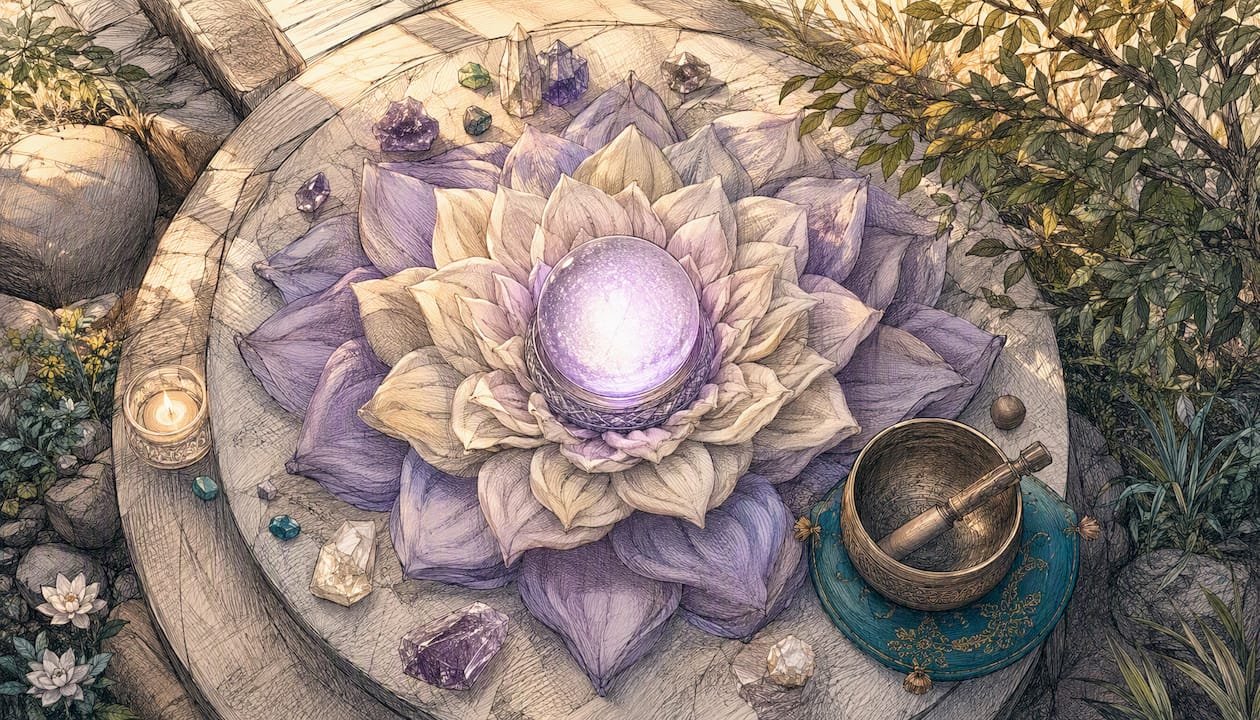
Yoga Journal’s step-by-step practice describes this visualization as guiding the practitioner to imagine light expanding from the crown down the spine, which creates a felt sense of integration between the upper and lower body. Stay with this image for three to five minutes. If your mind wanders, gently return attention to the lotus and the light.
Optional mantra and mudra (7:00–8:30)
If you choose to add sound, begin chanting Om (pronounced “A-U-M”) slowly on each exhale. Let the vibration resonate in your chest and skull. For a hand position, form the Padma (lotus) mudra: touch the base of your palms together, spread your fingers wide like petals, and rest your hands at heart level. Siddhi Yoga’s crown practice guidance notes that combining mantra, mudra, and visualization reinforces the meditative focus and supports longer, more stable sessions.
Closing (8:30–10:00)
Let the lotus petals gently close. Take three grounding breaths, feeling your body’s weight again. Wiggle your fingers and toes. Open your eyes slowly. Sit quietly for one minute before standing.
Audio recording tips:
- Speak at a slow, measured pace, roughly 80–90 words per minute
- Use a warm, even tone with slight pauses at each timing cue
- Soft ambient sound (gentle rain, low-frequency hum) works well underneath a recorded voice; keep it at least 10 decibels below the speaking voice
- Silence is equally effective; do not feel obligated to add music
Pro Tip: Record yourself reading this script on your phone and play it back during practice. Hearing your own calm voice often deepens focus more quickly than following text.
How to Build a Reliable Crown Chakra Practice
Consistency matters more than session length, especially in the early weeks. Yoga Journal recommends starting at approximately 5 minutes and building toward 20 minutes over several weeks, allowing visualization focus and stable attention to develop safely.
Posture options
- Floor seat: Cross-legged or kneeling on a cushion, spine upright, hands on thighs
- Chair: Feet flat on the floor, back away from the chair back, hands resting on thighs
- Supported recline: Lying flat with a folded blanket under the head, suitable for those with back limitations; note that this position increases the risk of falling asleep
Breath instructions
A simple 4-count inhale and 6-count exhale activates the parasympathetic nervous system and supports sustained focus. Box breathing (4 counts in, 4 hold, 4 out, 4 hold) is an alternative for those who prefer a more structured rhythm. Either approach works; the goal is a slow, steady breath that keeps attention anchored.
Visualization specifics
The thousand-petalled lotus at the crown is the most widely used image in this practice. Violet and white are the colors most commonly associated with Sahasrara. Some practitioners prefer to visualize a column of white light entering from above the head and traveling down through the spine. Both approaches are valid; choose the one that feels most natural and vivid.
Mantra and mudra options
Om is the primary mantra for crown work. Chant it aloud, whisper it, or repeat it silently. The Padma mudra described in the guided script above can be held throughout the mantra phase or simply during the opening and closing breaths. Yoga Mission’s practice framework also suggests simple affirmations such as “I am connected to the divine” as an accessible alternative for those who find chanting uncomfortable.
Suggested session durations
| Practice type | Duration | Frequency |
|---|---|---|
| Mini practice | 1–3 minutes | Daily, any time |
| Short daily session | 5–10 minutes initially, building up to 20 minutes | 5–7 days per week |
| Extended session | 10–20 minutes for experienced practitioners | 2–3 days per week |
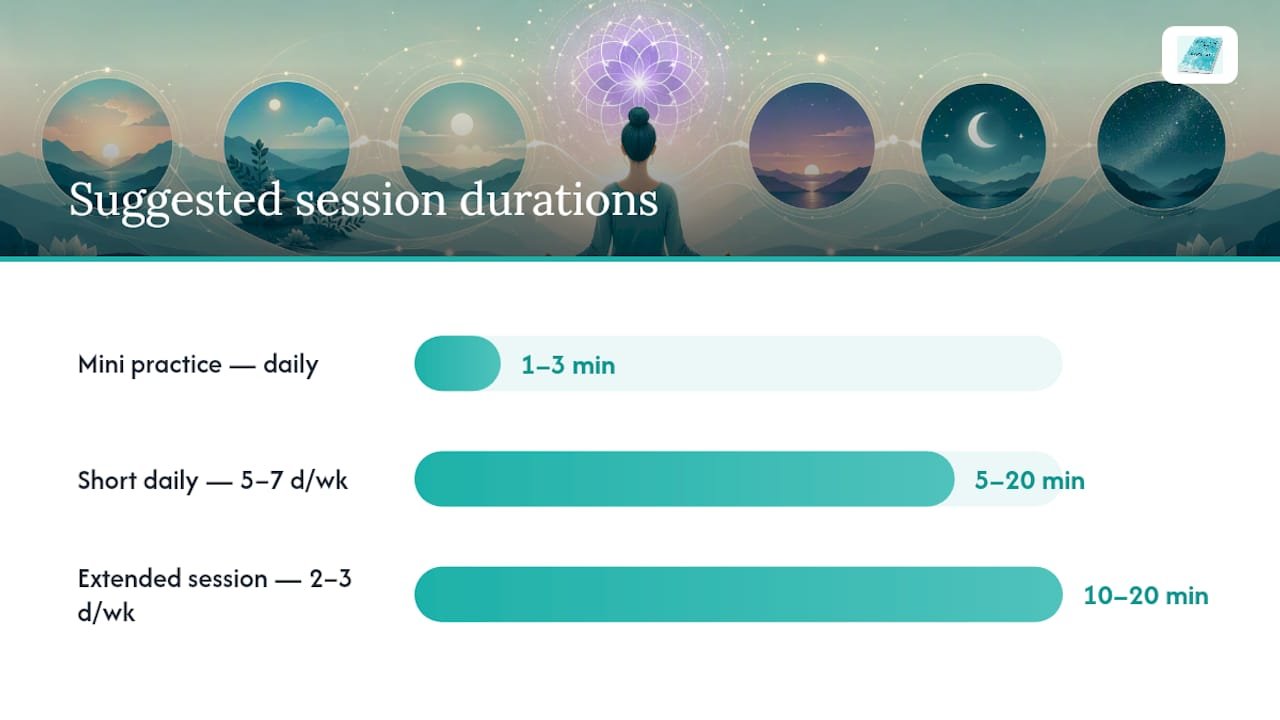
Pro Tip: Begin with short daily sessions of about five minutes and gradually increase the duration over several weeks to build attention and avoid mental fatigue.
What You Can Expect to Feel During and After Practice
Physical sensations during crown-focused meditation are common and generally harmless. Yoga International’s teacher-led approach notes that beginning with wide, open awareness before narrowing focus to the crown supports smoother transitions into subtle sensations, which is why the guided script above opens with environmental awareness before moving inward.
Common physical sensations:
- Tingling or light pressure at the top of the scalp
- Warmth spreading across the crown or forehead
- A sense of the head feeling “lighter” or slightly expanded
- Occasional mild dizziness, which typically resolves within seconds of returning attention downward
Emotional and spiritual experiences:
- Greater mental calm that persists for 30–60 minutes after a session
- Brief moments of clarity or insight, often arriving unprompted during the day
- A feeling of connectedness to others or to a larger sense of purpose
- Reduced reactivity to minor stressors
YogaBasics frames these outcomes as expressions of devotion, inspiration, selflessness, and spiritual understanding, which tend to deepen with regular practice rather than appearing fully formed after a single session.
Timeline:
Most practitioners notice physical sensations (tingling, warmth) within the first one to three sessions. Emotional shifts, such as increased calm and reduced reactivity, typically become consistent after two to four weeks of daily practice. Deeper spiritual experiences, including sustained feelings of unity or clarity, generally require several months of regular engagement.
How to Prepare for Crown Work and Clear Energetic Blocks
Crown-focused meditation is most stable when the lower energy centers are attended to first. Many practitioners and guides recommend grounding and lower-chakra balancing before moving attention to the crown, specifically to avoid disorientation or a scattered feeling after practice. This is especially relevant for anyone working through sacral chakra healing or heart chakra healing alongside crown work.
Grounding sequence (use before every session)
- Sit or stand with both feet flat on the floor.
- Take five slow breaths, directing attention to the soles of your feet on each exhale.
- Visualize roots extending from your feet and the base of your spine into the earth.
- Spend 60 seconds simply noticing the physical weight and warmth of your body.
- Only then shift attention upward toward the crown.
Lower-chakra check
Before crown work, spend 30 seconds each on the root (base of spine), sacral (lower abdomen), and heart (center of chest) areas. A simple breath directed to each location, with the intention of stability and openness, is sufficient. This brief sequence is not a full chakra healing practice; it is a preparatory calibration.
If you feel spacey, dizzy, or emotionally flooded during or after a session:
- Stop the crown visualization immediately
- Return attention to your feet and the floor
- Take five slow, deep belly breaths
- Place both hands flat on your thighs and press gently downward
- Drink a glass of water and rest for five minutes before resuming any activity
Red flags that call for grounding instead of continuing:
- Persistent dizziness lasting more than two minutes
- Sudden emotional flooding or intrusive imagery
- A feeling of being “outside” your body that does not resolve quickly
- Nausea or a racing heart
Pro Tip: Keep a grounding object nearby during practice, such as a smooth stone or a small bowl of soil. Holding it after a session provides an immediate tactile anchor if you feel ungrounded.
Using Sound, Mantras, and Frequencies Safely
Sound is a well-established complement to crown-focused practice. The mantra Om (also written Aum) is the most widely used vocal tool, and its three-part pronunciation (A, U, M) is said to resonate through the chest, throat, and skull in sequence.
Practical sound options:
- Chanting Om aloud on each exhale for 5–10 repetitions
- Whispering or silently repeating Om for those in shared spaces
- Soft ambient recordings of Tibetan singing bowls or gentle nature sounds at low volume
Some crown-chakra guides reference frequencies such as 963 Hz (associated with Sahasrara in Solfeggio traditions) and 432 Hz (a tuning reference some practitioners prefer for its perceived warmth). The evidence base for specific frequency effects on chakra states is limited, and these tones are best understood as supportive ambient tools rather than clinically validated interventions.
Safe listening guidelines:
- Keep ambient audio at a comfortable conversational volume or lower
- Avoid extended exposure (beyond 30 minutes) to intense binaural beats, particularly if you have a history of seizures, epilepsy, or photosensitive conditions
- Always test any new audio at low volume before using it in a full session
- Do not use binaural beat recordings while driving or operating machinery
Layering sound under a guided voice recording works best when the ambient track sits noticeably below the speaking voice. A simple approach: record your guided script first, then add a low-volume ambient layer in any basic audio editing app.
When to Pause Practice and Seek Professional Support
Deep spiritual practice can occasionally surface material that requires professional attention. This is not a reason to avoid the practice, but it is a reason to approach it with awareness.
Pause the session and ground yourself if you notice:
- Disorientation that does not resolve within two to three minutes
- Intrusive imagery or memories that feel destabilizing
- A panic response (racing heart, shortness of breath, strong fear)
- A persistent sense of unreality or disconnection from your body
Seek professional support if you experience:
- Persistent distress, anxiety, or low mood that began or worsened after starting the practice
- Thoughts of self-harm or suicide (contact the 988 Suicide and Crisis Lifeline by calling or texting 988 in the United States)
- Symptoms that resemble psychosis, such as hearing voices, paranoid thinking, or severe confusion
- Trauma memories that feel unmanageable without support
A licensed therapist, particularly one familiar with somatic or mindfulness-based approaches, can help you continue a spiritual practice safely while addressing any underlying psychological material. Communicating clearly with a clinician about what you are experiencing, including the specific sensations and timing, will help them provide accurate support.
A 7-Day and 21-Day Practice Plan with Journaling Prompts
A structured plan removes the daily decision of what to do and for how long, which is one of the most common barriers to consistent practice.
7-day introductory plan
- Day 1: 5-minute session using the grounding sequence and the mini practice from the opening of this article. Journal prompt: What did I notice in my body during the practice?
- Day 2: 5-minute session with the full guided script (posture, breath, lotus visualization). Journal prompt: Where did my attention wander, and how did I return it?
- Day 3: 7-minute session adding the Om mantra for the final two minutes. Journal prompt: Did sound change the quality of my focus?
- Day 4: Rest day. Journal prompt: What moments of calm or clarity appeared in my day without formal practice?
- Day 5: 7-minute session with Padma mudra. Journal prompt: How did the hand position affect my sense of presence?
- Day 6: 10-minute session, full script with mantra and mudra. Journal prompt: What emotional shifts, if any, did I notice after the session?
- Day 7: 10-minute session followed by five minutes of free journaling with no prompt. Note any recurring themes.
21-day deepening plan
The 21-day plan repeats the 7-day cycle three times, adding two minutes to each session in the second week and two more in the third. By day 21, the target session length is 14–16 minutes.
Daily journaling prompts for weeks 2 and 3:
- What insight, image, or feeling stayed with me from today’s session?
- How did my sense of connection to others feel today?
- What resistance or distraction showed up, and what does it point to?
- Where in my body do I feel the most settled after practice?
Modification tips:
- Beginners: Stay at 5 minutes through day 7 before increasing. Skip the mantra until week 2.
- Limited mobility: Use the supported recline posture; set a gentle alarm to avoid sleep.
- Sound sensitivity: Replace Om chanting with silent repetition; avoid binaural tracks entirely.
For readers who want a more structured written framework, Spiritualmethod’s spiritual healing practices guide covers grounding, energy clearing, and intention-setting in a format that complements this plan directly. The 7-step spiritual awakening guide also offers a longer-form progression for those ready to extend their practice beyond the 21-day window.
A note on intention and lineage
Crown-chakra practices draw from the Tantric and yogic traditions of South Asia, where Sahasrara has been described for centuries as the seat of pure consciousness and the point of union between individual awareness and the universal. Approaching this practice with respect for that lineage, and with a clear personal intention, tends to produce more stable and meaningful results than treating it as a purely mechanical exercise.
Students who commit to even a short daily practice commonly report three outcomes: a quieter mind, a greater sense of purpose, and a more consistent feeling of connection to something larger than their immediate circumstances. The practice does not require belief in any particular cosmology. It requires only attention, consistency, and a willingness to observe what arises without judgment. For more on the author’s background and approach, visit the Spiritualmethod bio page.
Structured Guides to Support Your Crown Chakra Practice
The practices in this article are complete as written, and many readers will find them sufficient for building a daily routine. For those who want a structured, all-in-one resource, Spiritualmethod offers a downloadable bundle that pairs guided practice frameworks with a spirituality planner, journaling templates, and a moon manifesting ritual guide.
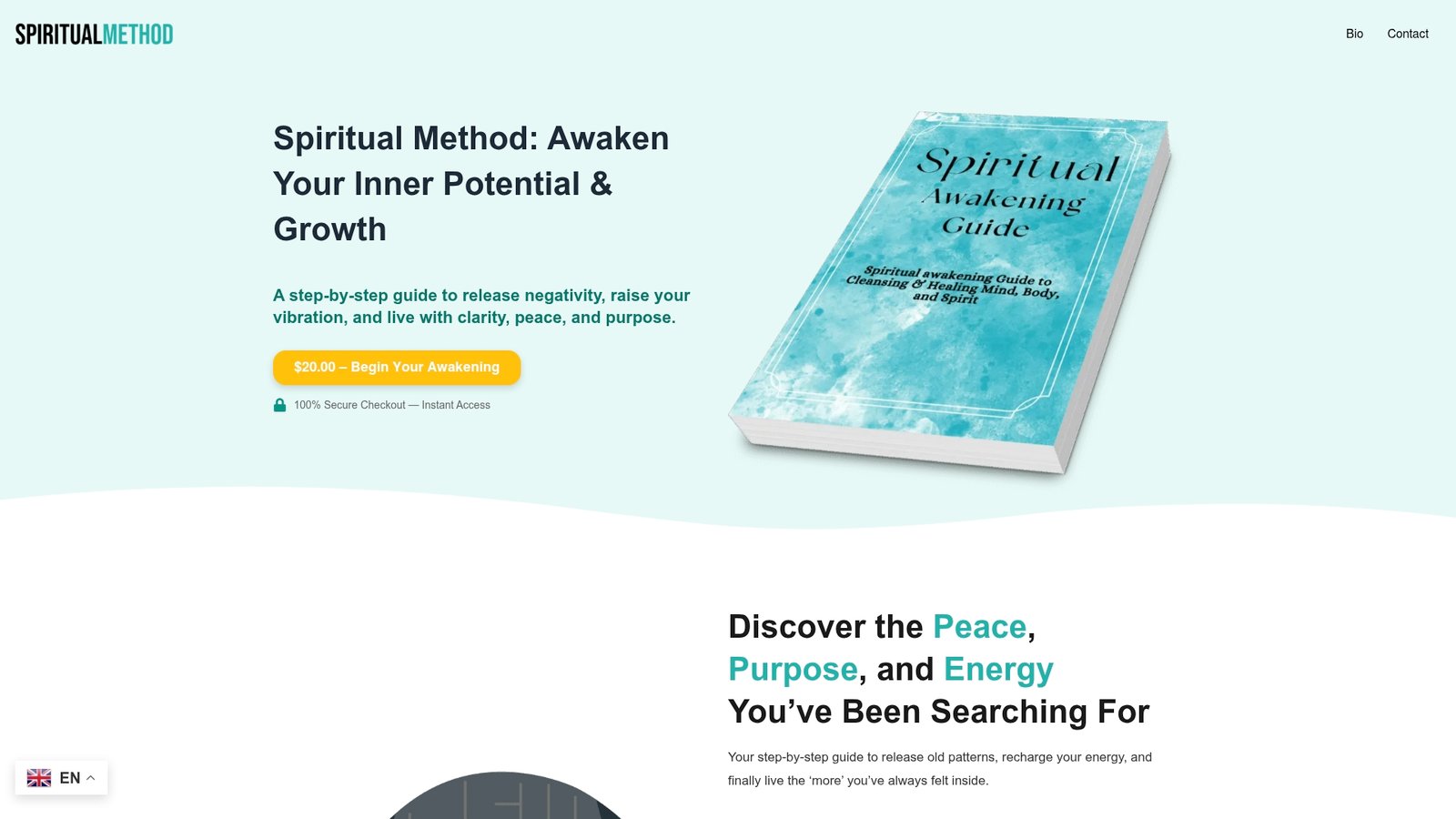
The bundle is designed for spiritual seekers who benefit from a written framework rather than relying on memory or scattered notes. It includes a 50+ page ebook covering grounding, energy clearing, sacred bathing rituals, and intention-setting, alongside a structured planner for tracking daily practice and progress. The journaling templates align directly with the prompts in the 7-day and 21-day plans above, making it straightforward to move from reading this article to a consistent, documented practice.
For readers specifically interested in connecting crown work to broader mind-body-soul integration, the bundle’s structured framework provides the scaffolding that makes daily practice sustainable over weeks and months. Visit Spiritualmethod’s self-help guide for spiritual seekers to review what is included and access the download.
Sources
The following sources informed this article and offer additional depth for readers who want to extend their study:
- Crown Chakra Tune-Up Practice
- Meditating With the Crown Chakra
- Crown Chakra Meditation • Yoga Basics
- Crown Chakra Meditation: Connect with Divine Consciousness
- yoga mission – Crown Chakra Meditation
- Crown Chakra Meditation
- Throat Chakra Healing: How to Unblock for Better Health