
Crystals for emotional healing are physical objects used as mindfulness tools and intention anchors to support emotional balance and well-being. Stones like amethyst, rose quartz, and lepidolite have been used across cultures for centuries as focal points for reflection, calm, and self-compassion. Research confirms that their benefits operate primarily through psychological mechanisms, specifically belief, ritual, and tactile grounding, rather than through any inherent mineral properties. Understanding this distinction does not diminish their value. It clarifies exactly how to use them most effectively.
What makes a crystal effective for emotional healing?
The effectiveness of emotional healing stones is grounded in psychology, not geology. A 2020 Baylor University study with 80 participants found that belief predicted emotional support experience equally whether participants held real or fake crystals. This means the crystal itself is a prop for a mental process you are already capable of initiating.
Several mechanisms explain why this works in practice:
- Placebo and belief: When you expect a crystal to calm you, your nervous system responds to that expectation. The belief system is the active ingredient.
- Ritual and mindfulness: Holding a stone during a breathing exercise creates a structured moment of attention. That structure is what reduces anxiety, not the mineral composition.
- Tactile grounding: Psychotherapy literature supports handheld stones as grounding tools for emotional self-regulation. The physical sensation interrupts negative rumination by redirecting sensory focus.
- Implementation intentions: Pairing a crystal with a stated intention, such as “when I hold this stone, I will breathe slowly,” creates a cognitive cue that reinforces the desired emotional response.
- Social and aesthetic value: The beauty of crystals and the community around them enhance well-being independently of any metaphysical claims.
Crystals work best as adjuncts to your existing coping toolkit, not as replacements for therapy or medical care. Think of them as structured prompts for practices you already know are helpful.
Pro Tip: Start with one crystal and one specific intention. Pairing amethyst with a two-minute breathing practice each morning is more effective than owning ten stones with no consistent ritual.
1. Amethyst for calm and stress relief
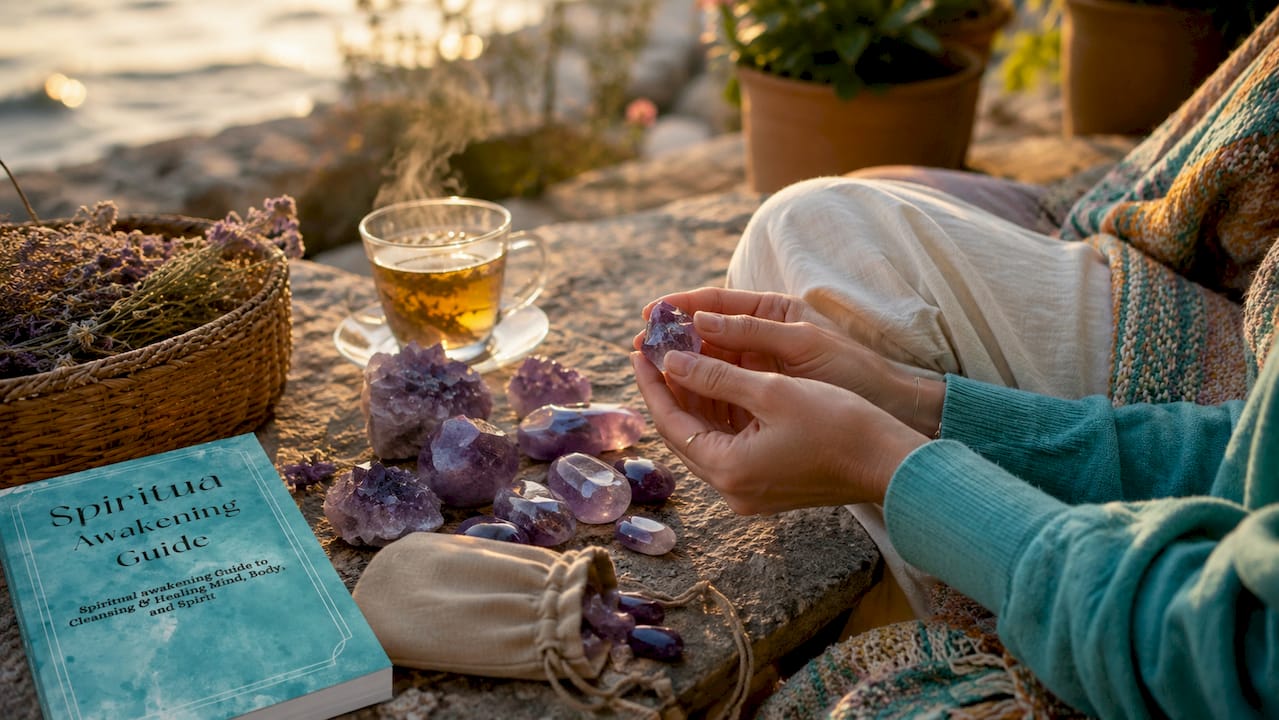
Amethyst is the most widely recognized crystal for stress relief and emotional calm. Its purple hue has long been associated with serenity, and it is frequently used as a focal point during meditation or before sleep. A 2025 randomized study from the University of Southern Denmark found no measurable physiological changes from amethyst exposure, confirming that its calming effects are psychological. That finding does not reduce its utility. It confirms that amethyst works through the ritual and intention you bring to it.
2. Rose quartz for self-love and compassion
Rose quartz is traditionally called the “heart healer” and is one of the best crystals for emotional balance related to self-compassion and relationships. It is commonly used during journaling, self-care routines, or after emotional loss. Holding rose quartz while writing about your feelings creates a tactile anchor that reinforces the intention of self-kindness. For anyone working through grief or a difficult relationship transition, rose quartz serves as a consistent physical reminder of the practice.
3. Lepidolite for anxiety relief
Lepidolite is one of the top crystals for emotional balance specifically tied to anxiety. It contains lithium mica in its mineral structure, which is why some practitioners associate it with calming properties, though no clinical evidence supports a direct biochemical effect from handling it. Its value lies in its use as a grounding object during anxious moments. Carrying lepidolite in your pocket and reaching for it when anxiety spikes functions exactly as a worry stone, a practice supported by grounding techniques for anxiety that redirect attention through sensory engagement.
4. Rhodonite for healing emotional wounds
Rhodonite is traditionally associated with forgiveness and the healing of emotional wounds. Crystal Almanac describes it as a stone for processing grief and resentment, making it a common pairing with rose quartz for post-breakup or post-loss recovery. Its deep pink and black coloring makes it visually distinct, which supports its use as a specific ritual object. When you assign a stone a clear purpose, such as “this is my forgiveness practice stone,” the specificity strengthens the implementation intention and makes the ritual more consistent.
5. Clear quartz for clarity and focus
Clear quartz is often called the “master healer” in crystal traditions and is associated with mental clarity and emotional focus. Its transparency makes it a popular choice for intention-setting practices, where the visual quality of the stone reinforces the idea of clear thinking. Clear quartz pairs well with journaling or decision-making rituals. Holding it while reviewing a difficult situation creates a structured pause that supports reflective practice, one of the core mechanisms behind its reported benefits.
6. Moonstone for emotional balance during change
Moonstone is associated with transitions, intuition, and emotional balance during periods of change. Its iridescent quality, known as adularescence, gives it a visual distinctiveness that makes it effective as a ritual anchor. People navigating major life changes, such as career shifts, relationship endings, or personal reinvention, often find moonstone useful as a daily reminder of their intention to remain emotionally steady. Pairing moonstone with a moon ritual for inner healing amplifies the structured practice around it.
7. Smoky quartz for grounding
Smoky quartz is one of the most recommended emotional healing stones for grounding during periods of overwhelm or dissociation. Its dark, translucent appearance is associated with absorbing and neutralizing heavy emotional energy. In practice, smoky quartz functions as a tactile anchor during grounding exercises, where you focus on the weight and texture of the stone to return attention to the present moment. Consistent use of crystals for healing and protection like smoky quartz builds attentional control over time.
8. Citrine for positivity and confidence
Citrine is associated with optimism, motivation, and emotional confidence. Its warm yellow color is linked in color psychology to energy and positivity, which reinforces the intention you bring to using it. Citrine is commonly used during morning routines as a cue for setting a positive emotional tone for the day. Placing it on a desk or holding it during a brief morning intention practice creates a consistent behavioral anchor for a constructive mindset.
9. Carnelian for motivation and emotional courage
Carnelian is a deep orange stone traditionally associated with motivation, courage, and overcoming fear. It is frequently used by people working through depression-related low motivation or emotional stagnation. As one of the best crystals for depression-adjacent states, carnelian works best when paired with a specific behavioral goal, such as completing one task or making one difficult phone call. The stone becomes a physical cue for the action, reinforcing the connection between intention and behavior.
10. Amazonite for communication and emotional balance
Amazonite is associated with calm communication, emotional balance, and the release of worry. Its blue-green color is visually soothing, and it is often used before difficult conversations or stressful social situations. Holding amazonite before a challenging interaction creates a brief mindfulness pause that reduces reactive emotional responses. For anyone who struggles with anxiety in interpersonal settings, amazonite serves as a practical pre-event grounding tool.
How to incorporate crystals into your daily routine
Building a consistent crystal practice is straightforward. The research is clear that short, consistent coping routines outperform sporadic healing sessions. Here is a structured approach:
- Choose one or two crystals. Focusing on a small number of stones for several weeks reduces anxiety compared to rotating through many. Depth of practice matters more than variety.
- Assign a specific intention. Write down what emotional state you want to cultivate and connect it explicitly to the stone. “When I hold this amethyst, I am practicing calm” is a complete intention.
- Create a brief daily ritual. Hold your crystal during two to five minutes of focused breathing each morning. This is enough to establish the behavioral anchor without overcomplicating the practice.
- Use it as a tactile cue throughout the day. Carry your stone in your pocket. When stress spikes, hold it and take three slow breaths. This is the worry stone mechanism in direct application.
- Combine with other practices. Crystals work best alongside journaling, therapy, physical movement, or other evidence-based coping strategies. They are one tool in a broader self-care framework.
Pro Tip: Pair your crystal practice with an existing habit, such as your morning coffee or evening wind-down. Habit stacking makes the ritual easier to maintain without relying on motivation alone.
Common misconceptions about crystal healing
Several persistent misconceptions limit how effectively people use crystals for emotional support. Addressing them directly supports more realistic and productive use.
- Crystals do not directly treat emotional disorders. No high-quality clinical evidence shows crystals treat conditions like depression, anxiety disorders, or grief. Their benefits align with placebo effects and ritual, not mineral properties.
- The specific crystal matters less than the practice. The quality and consistency of your ritual produce the benefit. The prop supports the coping behavior. Spending significant money on rare stones does not increase effectiveness.
- Crystals should not replace professional care. For serious emotional distress, grief, or diagnosed mental health conditions, professional therapy is the appropriate primary intervention. Crystals are adjuncts, not alternatives.
- Overcomplicating the practice creates anxiety. Chasing multiple crystals, elaborate cleansing rituals, and complex systems can increase rather than reduce stress. Simplicity and consistency are the actual active ingredients.
- The social and aesthetic dimensions are real benefits. Engaging with a crystal community, appreciating the visual beauty of stones, and building a personal ritual all contribute to well-being through mechanisms that have nothing to do with metaphysics.
Key takeaways
Crystals for emotional healing work through belief, ritual, and tactile grounding, making consistent and intentional practice the primary driver of their benefit.
| Point | Details |
|---|---|
| Psychological mechanism | Benefits come from belief, ritual, and tactile grounding, not mineral properties. |
| Best crystals to start with | Amethyst, rose quartz, and lepidolite are the most widely supported for calm, self-love, and anxiety relief. |
| Consistency over variety | Using one or two crystals consistently for weeks outperforms rotating through many stones. |
| Crystals as adjuncts | Crystals support but do not replace therapy or evidence-based mental health care. |
| Ritual simplicity | Short daily practices of two to five minutes produce stronger grounding effects than occasional long sessions. |
Why I think crystals deserve more credit than skeptics give them
I have spent years studying the intersection of mindfulness practice and physical ritual objects, and the honest conclusion is this: the skeptics are technically right and practically wrong. Yes, a 2025 University of Southern Denmark study confirmed amethyst produces no measurable physiological changes. And yet, dismissing crystals on that basis misses what they actually do.
Ritual objects have structured human emotional life for as long as humans have existed. A rosary, a worry bead, a smooth stone carried in a pocket during a hard year. These are not superstitions. They are somatic anchors. They give the nervous system something concrete to return to when abstract thought spirals. The Tufts University research on placebo and ritual confirms that belief and ritual context produce real symptom improvements. That is not a trick. That is a mechanism.
What I find most valuable about crystals is their accessibility. You do not need a therapist’s appointment or a prescription to hold a piece of rose quartz during a difficult morning. You need intention and consistency. The people who dismiss crystals entirely often have robust alternative coping structures. The people who benefit most from them are frequently those building their first structured self-care practice. For that population, a beautiful stone with a clear intention attached to it is a genuinely useful starting point. Pair it with resources like releasing negative energy practices and you have a real framework, not a fantasy.
— Sean
Deepen your practice with Spiritualmethod
Spiritualmethod provides structured frameworks for inner healing across mind, body, and soul. If crystals have sparked your interest in building a more intentional emotional wellness practice, the resources at Spiritualmethod extend that work considerably. The moon ritual for inner healing guide integrates crystal use into a full lunar cycle practice, giving your stones a consistent ritual context that deepens their psychological impact. For a broader foundation, the spiritual healing practices resource covers complementary methods that support emotional balance through reflective and routine-based activities. These are practical, accessible tools designed for people who are serious about building lasting emotional well-being.
FAQ
What are the best crystals for anxiety relief?
Lepidolite, amethyst, and smoky quartz are the most commonly recommended healing crystals for anxiety. They function as tactile grounding objects that redirect attention during anxious moments through sensory engagement.
Do crystals actually work for emotional healing?
Crystals produce real emotional benefits through psychological mechanisms, specifically belief, ritual, and tactile grounding, rather than through any inherent mineral properties. A Baylor University study found that real and fake crystals produced similar self-reported effects when participants believed in their purpose.
How do I use crystals for emotional healing as a beginner?
Start with one crystal, assign it a specific intention, and hold it during a two-to-five-minute breathing practice each day. The crystal healing for beginners guide at Spiritualmethod provides a structured starting framework.
Can crystals replace therapy for depression or anxiety?
Crystals are adjuncts, not replacements, for professional mental health care. For diagnosed conditions like depression or anxiety disorders, professional therapy remains the appropriate primary intervention, with crystals serving as a supplementary coping tool.
Which crystal is best for emotional balance during difficult transitions?
Moonstone is traditionally associated with emotional balance during periods of change, while rhodonite supports the processing of grief and emotional wounds. Using either consistently within a structured daily ritual produces the strongest grounding effect.