
An altar cleansing ritual combines two tasks: a physical cleaning of the surface and objects, and a short reflective practice that marks the space as renewed. The sequence that works best is simple. Set an intention, clear everything off, dust and wash, purify with a method that suits your home, reset the objects deliberately, and close with a moment of stillness. This guide walks through each step, offers smoke-free options, and explains how to handle candles and incense safely.
TL;DR
- Clean first, then cleanse: dust and wipe the altar before any ritual work begins.
- Remove every object, purify the surface, and decide consciously what returns to it.
- Smoke is optional. Sound, salt, water, and spoken intention are established alternatives, especially in shared homes.
- Treat flames and incense with care: ventilation, distance from combustibles, and full extinguishing before you leave the room.
- Repeat the ritual at natural turning points, such as a new season, after illness, or before a new practice.
Table of Contents
- What an Altar Cleansing Ritual Is and Why People Do It
- Before You Begin: Preparation and Timing
- Step-by-Step: How to Cleanse an Altar
- Choosing a Purification Method
- Candle and Incense Safety at the Altar
- A Seven-Day Approach for a Deeper Reset
- How Often Should You Cleanse Your Altar?
- Our Perspective: Cleansing as Reflective Practice
- Extending the Practice Beyond the Altar
- Support for a Structured Practice
- Frequently Asked Questions
- Sources
What an Altar Cleansing Ritual Is and Why People Do It
An altar is a dedicated surface for reflection, prayer, meditation, or intention-setting. It may be religious, secular, or a mixture of both. Over time it collects dust, spilled wax, dried flowers, and, for many practitioners, a sense of accumulated mood: old intentions, stalled projects, or the residue of a difficult season.
Traditions describe cleansing as a way to remove unwanted energy and make room for what is beneficial. One beginner’s guide to cleansing and charging an altar calls regular cleansing a crucial part of spiritual practice of all kinds. Whether you understand that literally, symbolically, or psychologically, the practical benefit is the same. A deliberate reset gives you a clear starting point and a reason to return to your practice with attention.
There is no single correct method. Practices differ by tradition, and the steps below are a flexible framework rather than a prescription. Adapt them to your beliefs, your living situation, and your health.
Before You Begin: Preparation and Timing
Preparation takes about ten minutes and prevents most of the frustrations that interrupt a ritual.
Choose a time
Many people cleanse at the start of a new month, at the turn of a season, after moving a home altar to a new room, or before beginning a new practice. Others simply do it when the space feels cluttered or flat. A quiet window of 20 to 30 minutes is enough for a small altar.
Gather your materials
You will need:
- A soft cloth and a small dish for loose items
- A mild cleaner suited to the altar’s material (water with a little lemon juice is a common household choice for sealed wood, but test a small corner first)
- A purification tool of your choice: a bowl of salted water, a bell or singing bowl, a small spray bottle of water, or a smoke tool
- Any objects you plan to return to the altar
- A pen and notebook for the closing reflection
Prepare the room
Open a window if you plan to use smoke, candles, or incense. Silence your phone. If you share the home, tell others what you are doing so you are not interrupted midway.
Step-by-Step: How to Cleanse an Altar
1. Set your intention
Before touching anything, take a slow breath and ask why you are cleansing today. You may be removing stagnant energy, preparing for a new season, or realigning with a practice you had neglected. A full altar cleansing walkthrough begins the same way, with an intention held silently or spoken aloud. A single plain sentence is sufficient, for example: “I clear this space of what no longer serves me and prepare it for steady practice.”
2. Clear everything off
Remove each item one at a time. As you hold it, ask whether it still reflects your practice, whether it has changed in meaning, and whether it needs cleansing itself. Place the objects on a clean cloth nearby. Guides on preparing a Wicca altar for cleansing also start by physically clearing the surface, and the principle applies across traditions: you cannot refresh what remains buried under objects.
This is the moment to be honest about clutter. Retire dried flowers, burned-out candle stubs, and offerings that have spoiled. If you are unsure what belongs on an altar in the first place, our list of altar offerings ideas can help you decide what returns.
3. Dust and wash the surface
This step is practical, and it should come before any symbolic work. Dust first, remove spilled wax, and wipe the surface with your cleaner. Treat it as part of the ritual rather than a chore that precedes it: slow, attentive movements, a clear surface, and no rush.
If you use a cleansing spray, keep it mild. Strong fragrances can overwhelm a small room and may bother people with sensitivities.
4. Purify the space
Choose the method that fits your home, your tradition, and your lungs. The section below compares the most common options.
5. Cleanse the objects
Purify each item with the same method or a gentler one suited to its material. Some stones and papers should not be soaked, for example, so a bell, a breath, or a passing of the hands may be more appropriate. Objects with religious significance often have their own customs. For context on how formal traditions treat sacred objects, this overview of consecration rituals for Buddhist statues shows how much meaning can attach to the preparation of a single piece.
6. Reset the altar deliberately
Return items one by one. Place the central object first, then supporting pieces. Fewer items usually make a clearer altar. If you are building or rearranging a whole setup, our guide to a beginner’s home altar setup covers layout for both religious and secular use, and for those curious about faith-based approaches, this walkthrough on building a home altar shows a low-cost example.
7. Close the ritual
Stand or sit quietly for a minute. Thank the space in whatever language suits you, or simply note that you are finished. Write two or three lines in a journal about what you released and what you intend to bring in. That record becomes useful later, because it shows you how your practice has changed.
Choosing a Purification Method
The fourth step is where traditions diverge. No method is universally superior, and the table below compares them on practical criteria rather than claims of effect.
| Method | Best for | Considerations |
|---|---|---|
| Smoke (herbs, resin, incense) | Those who find ritual smoke meaningful | Needs ventilation and a fire-safe dish; unsuitable for respiratory sensitivities |
| Sound (bell, singing bowl, clapping) | Apartments, shared homes, quiet households | Very clean; may carry through walls |
| Salt | Surfaces and sturdy objects | Can damage some woods, metals, and porous stones; use sparingly |
| Water or mist | Everyday resets | Keep it light on paper, unfinished wood, and electronics |
| Intention and breath | Anyone, anywhere | Needs focus rather than materials |
| Light (a candle or flameless candle) | Closing or opening a ritual | Flames need supervision |
Some practitioners prefer non-smoke approaches. One source notes that sound, salt, or simply projecting intention are common alternatives for people who share a space or have respiratory sensitivities, which keeps the practice accessible. If sage is meaningful to you, read our guide to practicing sage cleansing responsibly for beginner steps and ethical sourcing.
A simple salt-and-water option
Dissolve a small pinch of salt in a bowl of water, dampen a cloth, and wipe the sealed surface of the altar. Dry it afterward. Do not use salt water on unsealed wood, metal, or electronics. For a fuller bathing practice that pairs well with an altar reset, see our guide to a salt bath for spiritual cleansing.
A sound-based option
Stand at one corner of the altar and ring a bell or strike a singing bowl. Move clockwise or in the direction that feels natural to you, ringing once at each corner and once at the center. Let the final tone fade completely before you continue. This takes about two minutes and leaves no residue.
Candle and Incense Safety at the Altar
Flames and smoke are central to many altars, so safety belongs inside the ritual rather than after it.
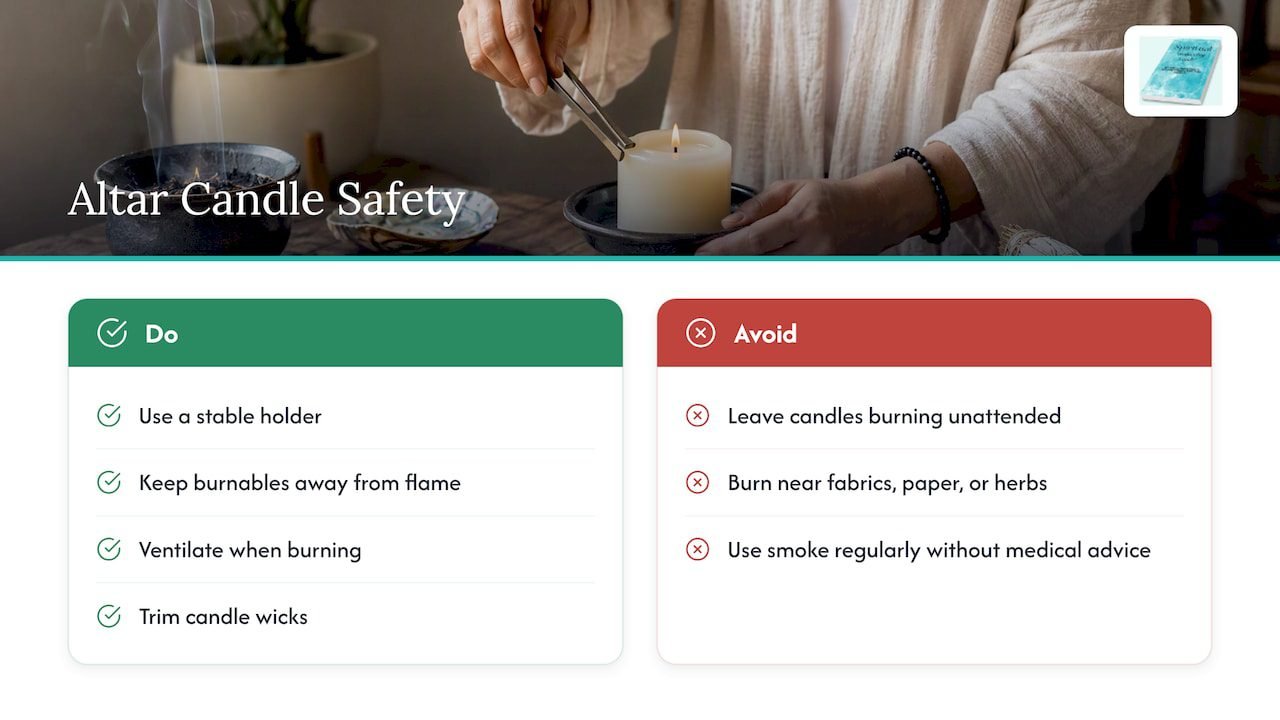
Fire risk. The U.S. Fire Administration notes that the open flame of a candle poses a risk of fire under the right conditions. Local fire departments advise keeping anything that can burn well away from the flame, and a municipal fire department’s safety tips list unattended candles among recurring causes of residential fires. Practical rules follow from that: use a stable holder, keep fabrics, paper, and dried herbs clear of the flame, and never leave a candle burning when you leave the room or go to sleep.
Consider flameless candles. Seattle’s fire department says flameless candles are the safest option while acknowledging that burning candles and incense matter in many religious and spiritual celebrations. A flameless candle can hold the symbolic place of a flame during the cleansing itself, especially on a crowded altar.
Air quality. An EPA literature review explains that burning candles and incense can be sources of particulate matter, and it links incense smoke exposure with several health concerns. If you have asthma, a heart or lung condition, are pregnant, or share your home with infants or pets, speak with your doctor before using smoke regularly, and favor sound or water instead. Ventilate the room whenever you do burn something.
Soot. Candle soot can darken altar cloths and nearby walls. This guide to reducing candle soot lists steps for keeping home surfaces cleaner, which is helpful if your altar sits near paint or fabric. Trimming wicks and keeping candles out of drafts are the usual first measures.
If you want a candle practice with built-in precautions, our intention candle ritual is designed to be safe and simple.
A Seven-Day Approach for a Deeper Reset
Some traditions use structured cycles rather than a single session. A common uncrossing practice, described by one botanica, involves daily bathing over seven days with ingredients such as sea salt and hyssop, combined with prayer or visualization. It often ends with the practitioner dressing in white. That tradition is rooted in specific folk and spiritual customs, and you should approach it with respect for its origins rather than as a generic technique.
A secular adaptation might look like this:
- Day 1: Clear and clean the altar surface.
- Day 2: Cleanse your objects and decide which stay.
- Day 3: Purify yourself with a bath or shower and a few quiet minutes.
- Day 4: Rearrange the altar with a simplified layout.
- Day 5: Write your intention for the coming month.
- Day 6: Sit at the altar for ten minutes without a goal.
- Day 7: Close with a short ritual and note what changed.
If you share a small space, our seven-day sacred space setup shows how to adapt a similar rhythm for minimal or portable arrangements.
How Often Should You Cleanse Your Altar?
There is no fixed schedule. A light dusting and a moment of attention weekly is common among people who use their altar daily. A fuller cleansing monthly or seasonally suits many others. Some trigger events also call for a reset:
- You have moved or rearranged the altar.
- A guest has handled your objects.
- You are starting a new practice or ending an old one.
- You have been ill, grieving, or stressed, and the space feels heavy.
- The altar has been neglected for weeks.
A useful test is whether approaching the altar feels welcoming. If it feels like an obligation, a short reset often restores the sense of invitation.
Our Perspective: Cleansing as Reflective Practice
At Spiritualmethod, we approach altar cleansing as a reflective practice supported by structure. The physical work of dusting, sorting, and rearranging gives the mind something concrete to do while the intention settles. We find that people who treat the ritual as a routine-based activity, rather than a one-time event, tend to build more sustainable habits.
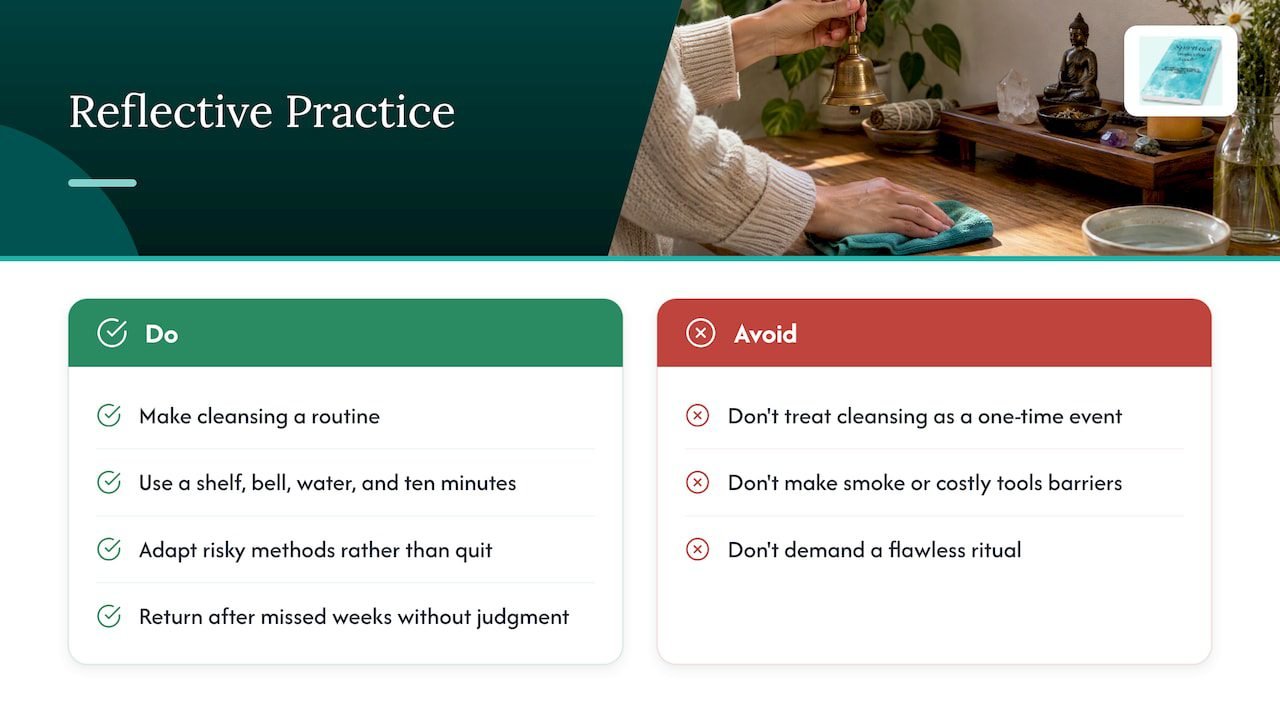
We also believe a practice should be accessible. A small shelf, a bell, a bowl of water, and ten minutes are enough. Smoke, expensive tools, and elaborate preparation are optional, and they should never become a barrier to starting. Where a method carries a risk, such as an open flame, we would rather you adapt it than abandon the practice altogether.
Finally, we encourage forgiving habits. If you miss a week, return without judgment. Our guides emphasize compassionate, sustainable routines because consistency over time matters more than any single flawless ritual. Our article on releasing negative energy and our guide to home energy cleansing extend these ideas from the altar to the rest of the home.
— Sean
Extending the Practice Beyond the Altar
An altar rarely exists in isolation. Many people find the altar reset works best alongside a cleansing of themselves and their room. A few pairings are worth trying:
- Personal cleansing. Follow the altar ritual with a bath or a few minutes of breathwork. Our list of aura cleansing methods offers ten techniques to choose from.
- Room cleansing. Open windows, tidy surfaces, and move the air before and after the ritual.
- Journaling. Record what you removed, what you kept, and why. Over several months this builds a useful picture of your practice.
Support for a Structured Practice
If you prefer a guided framework to assembling a routine yourself, our spiritual awakening guide is available as a downloadable PDF for a one-time price of $20. It includes structured practices in grounding, energy clearing, sacred bathing rituals, intention-setting, journaling, and progress tracking, together with a spirituality planner and journal and a moon manifesting ritual guide. It is designed for readers who want step-by-step methods and forgiving habit trackers they can use at their own pace.
Frequently Asked Questions
How do you cleanse an altar without sage?
Sound, salt, water, and intention are the most common alternatives. Ring a bell or singing bowl over the surface, wipe it with lightly salted water if the material allows, or hold your hand above the altar and state your intention aloud. These options also work well in apartments and shared homes.
Should I clean the altar physically before cleansing it spiritually?
Yes. Dust, spilled wax, and old offerings should be removed first, because symbolic work is more effective on a clear, tidy surface. The physical cleaning can be treated as the first stage of the ritual itself.
Is it safe to burn candles and incense while cleansing?
It can be, with precautions. Use stable holders, keep flammable items away, ventilate the room, and extinguish everything before leaving or sleeping. People with respiratory conditions should consult their doctor and consider flameless candles and smoke-free methods.
How do you purify an altar that holds religious items?
Follow the customs of your own tradition first, as many have specific prayers or methods. If you are unsure, a gentle approach such as dusting, a quiet prayer or blessing, and a bell is generally respectful. Consult a clergy member or teacher in your tradition for guidance on particular objects.
How often should I cleanse my altar?
Most practitioners dust weekly and perform a fuller cleansing monthly or seasonally. You can also cleanse after any significant change, such as moving the altar or beginning a new practice.
Sources
- Altar Cleansing Ritual: A Sacred Reset
- How to Cleanse and Charge Your Altar: A Beginner’s Guide
- Otherworldly Oracle
- How to Cleanse Your Wicca Altar for Fresh Energy
- Topical Fire Research Series: Candle Fires in Residential Structures (USFA)
- Safety Tips, Moncks Corner Fire Department
- Holiday Fire Safety Tips: Candles and Incense (Seattle Fire Department)
- Candles and Incense as Potential Sources of Indoor Air Pollution (EPA)
- Remove a Crossed Condition With These Uncrossing Spells