
Career intention setting, in this framing, means using guided journaling and short rituals, not secular career coaching, to clarify and spiritually align your relationship to work. The immediate step we recommend: take three minutes to ground yourself, write one sacred sentence naming your intention, then choose one small action to take within the next day. We outline exact journal templates later in this piece so the practice becomes repeatable.
TL;DR:
- A two week daily Examen reflection trial improved hope, life meaning, and satisfaction compared with a wait list, with hope showing the strongest shift.
- Use a three minute daily entry, a 20 minute weekly review, or a monthly session; name one action to take within 24 to 72 hours.
- Moon timing, candles, and consecration language are optional; the practice needs no symbolic tools and shapes attention rather than guaranteeing career outcomes.
- Spiritual diary writing five to seven times weekly correlated with higher life satisfaction and self transcendence than less frequent writing.
- If journaling brings up difficult emotions, slow the pace, shorten sessions, and consider professional support.
Table of Contents
- Why ritualized career intention setting helps
- A compact 10 to 20 minute career-intention ritual you can use today
- Journal templates and 3-minute prompts
- How to schedule and integrate the practice into daily life
- Common pitfalls, ethics, and adapting the practice
- A note from Sean
- Where to go next with structured templates
- FAQ
- Sources
Why ritualized career intention setting helps
Ritual and reflective writing give the mind a structured container for attention, and the evidence on short daily practices is encouraging. A 2025 randomized controlled trial on a daily Examen-based practice found that two weeks of brief daily reflection improved life meaning, life satisfaction, and hope compared with a wait-list control group, with hope showing the strongest shift. That matters for career intentions specifically, because hope and a sense of meaning are often what stall out when someone feels stuck in their work.
A separate mixed-method study of spiritual diaries found that participants who wrote in a spiritual diary five to seven times a week reported higher spiritual perspective, self-transcendence, and life satisfaction than those who wrote less often, with qualitative interviews linking frequent writing to habit formation and a closer felt sense of spiritual experience.
Scholars at Harvard Divinity School describe intention-setting as a rite of sacralization: a way of marking an experience as meaningful, which sharpens attention and moral clarity rather than guaranteeing a specific job offer or promotion.
- Daily reflection practices are tied to gains in hope and life meaning.
- Frequent spiritual journaling correlates with stronger self-transcendence and life satisfaction.
- Sacralizing an intention shapes how you pay attention, not what external events occur.
One finding worth sitting with: the Examen trial showed the largest effect on hope, a quality many career seekers lose first when they feel directionless.
A compact 10 to 20 minute career-intention ritual you can use today
This ritual works whether you are choosing a new path, realigning with a current role, or simply feeling unmoored at work. Set aside 10 to 20 minutes and a notebook.
- Ground for two to four minutes. Sit comfortably, take five slow breaths, and name one thing you notice in each of your senses. If you hold a devotional practice, speak a short consecration line (“I set this time apart”). If you prefer a secular approach, simply say, “I am giving this time my full attention.”
- Choose one writing format. A single sacred sentence (“I intend to bring steadiness and honesty to my work this season”), a short narrative paragraph describing the career shift you are moving toward, or a question-to-answer format (“What does align work feel like in my body? It feels unhurried and clear.”).
- Write without editing for three to five minutes. Let the sentence or paragraph come out rough.
- Close with an embodied gesture. Place a hand on your chest, close the notebook, or light a candle if that fits your practice.
- Name one concrete next step to take within 24 to 72 hours, something small enough to actually do, like sending one email or updating one line of a resume.
Pro Tip: If you only have five minutes, skip to step two and write a single sentence intention. The ritual works in miniature as well as in full.
If moon-based timing or altar objects do not fit your framework, every step above works with no symbolic tools at all. The structure, not the décor, is what carries the benefit.
Journal templates and 3-minute prompts
A repeatable template turns a one-time ritual into a habit. Below are three templates sized for daily, weekly, and monthly use.
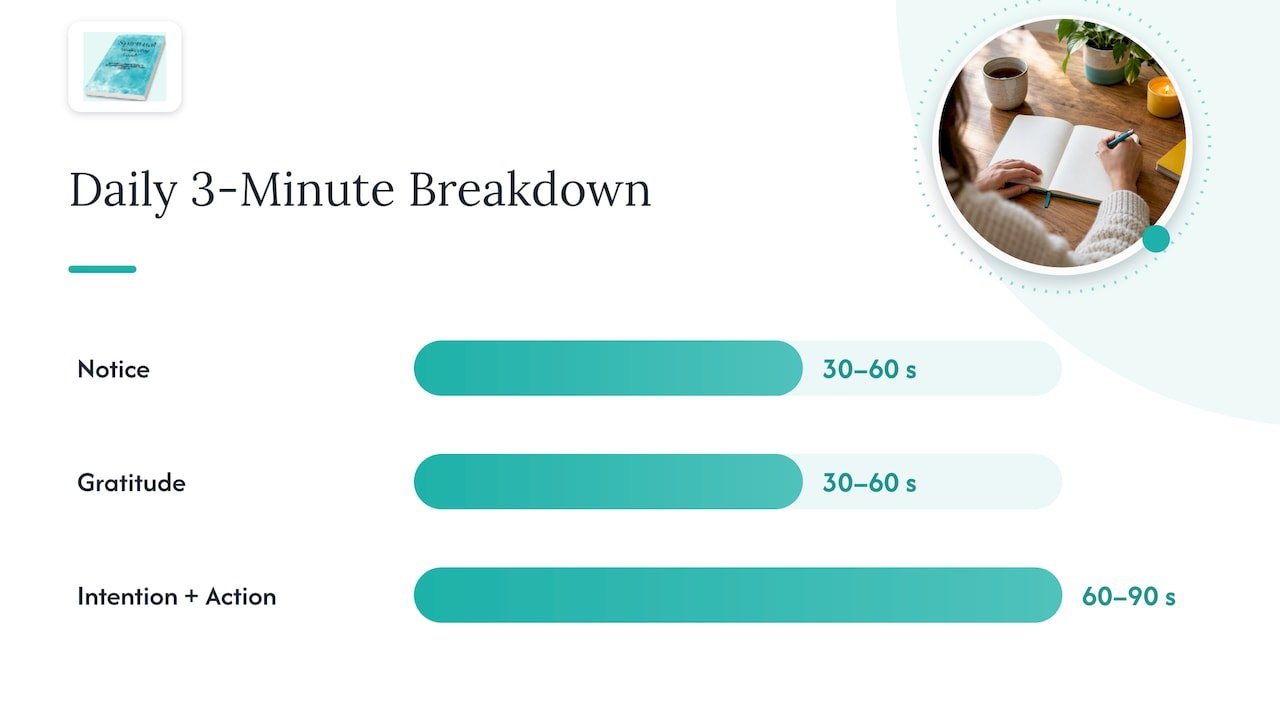
The 3-minute daily template has three short parts: notice (30 to 60 seconds: “What did I feel in my body during work today?”), gratitude (30 to 60 seconds: “What part of today’s work am I grateful for?”), and intention plus one tangible step (60 to 90 seconds: “Tomorrow I intend to… and the one action I will take is…”).
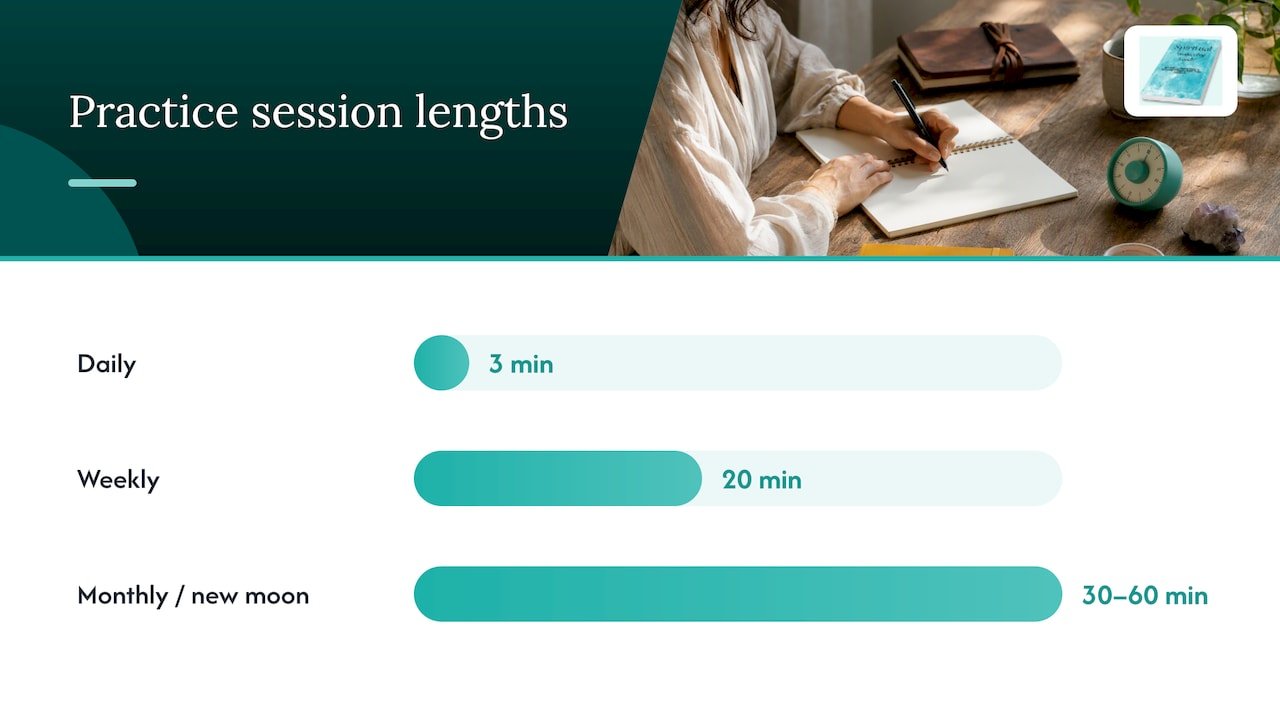
The weekly reflection template takes about 20 minutes: review one win, one lesson, one obstacle, and set three priorities for the coming week, closing with a short ritualized commitment line such as “I recommit to steady, honest work.” Our weekly reflection ritual offers a ready-made version of this exact structure.
The new-moon or monthly template is for broader career intentions. Qualitative research on new-moon intention rituals describes participants using sacred space, simple ritual tools, and embodied attunement, and reporting a stronger sense of meaning and well-being after repeated practice. You can adapt this with a candle, a dedicated journal page, and a single paragraph naming the career direction you are tending over the coming month. Our guide on writing one new moon intention and one concrete next step walks through a single-session version of this.
| Template | Time | Core prompt |
|---|---|---|
| Daily | 3 minutes | Notice, give thanks, name one next step |
| Weekly | 20 minutes | One win, one lesson, three priorities |
| Monthly or new moon | 30 to 60 minutes | Broader intention plus symbolic closing gesture |
For more prompt variety, our guide to spiritual journaling prompt types offers additional entry points for readers who want to rotate styles.
How to schedule and integrate the practice into daily life
The templates above only work if they attach to a rhythm you will actually keep. We suggest three timing tiers rather than one.
- Daily (3 minutes): attach the practice to an existing habit, such as right after your morning coffee or just before you close your laptop for the day.
- Weekly (20 minutes): choose a fixed slot, Sunday evening or Friday afternoon work well, since both sit at natural transition points in the work week.
- Monthly or new moon (30 to 60 minutes): mark it on a calendar in advance so it does not get crowded out by routine tasks.
Habit-stacking makes the daily layer nearly automatic: pair it with brushing your teeth, your commute, or an end-of-day closing ritual similar to the Examen structure. Our piece on setting intentions for the day has more on building that morning anchor.
Track three things each time: the intention itself, the action you actually took, and the emotional tone of the entry. Process measures like these tell you more about whether the practice is working than any single outcome does, since career shifts often take months to show results.
Common pitfalls, ethics, and adapting the practice
A few missteps are common enough to flag directly.
- Treating the written intention as a guarantee of a specific outcome misreads what the research supports: ritual shapes attention and meaning, not external events.
- Borrowing ritual tools from traditions you do not belong to without context can tip into appropriation. Treat moon work, candles, and consecration language as optional symbolic choices, and feel free to swap in a secular version of each step.
- Journaling can surface difficult material, old griefs about career setbacks or identity. If that happens, slow the pace and consider professional support alongside the practice; our shadow work prompts guide includes pacing notes for exactly this situation.
A note from Sean
We built this approach around a simple belief: sustainable inner work comes from small, repeated containers rather than one dramatic breakthrough. Our step-by-step templates and trackers at Spiritualmethod exist because the habit, not the intensity of any single session, is what carries people through a career transition. Try the 3-minute daily template for seven days and watch how your sense of clarity and hopeful anticipation shifts.
— Sean
Where to go next with structured templates
If this ritual-and-journaling approach resonates, our downloadable guide gives you the full structured version rather than the compact one described above. We built it for readers who want printable pages and trackers rather than reconstructing a practice from scratch each week.

Inside, you will find:
- Step-by-step ritual scripts for daily, weekly, and monthly practice
- Full journal templates with space for notes, not just prompts
- Habit trackers designed to be forgiving on the weeks you miss a day
This guide fits best for readers who are already committed to a spiritual practice and want the structure done for them rather than assembled piecemeal. You can preview more of our journaling approach in our guide to journaling for soul healing, or go straight to the spiritual awakening guide to start with the full templates. If you would rather explore guided coaching alongside your own ritual practice, this 90-day purpose alignment program for women is a resource we point readers toward for that kind of ongoing support.
FAQ
What is career intention setting in a spiritual practice?
It is the use of short rituals and guided journaling to clarify and spiritually align your relationship to work, distinct from secular goal-setting frameworks. The focus sits on attention, meaning, and hope rather than fixed outcomes.
How is a career intention different from a career goal?
A goal usually names a concrete external result, like a title or salary, while an intention names a quality of attention or being you want to bring to your work. Research on intention-setting as a rite of sacralization frames intentions as shaping how you show up, not guaranteeing a specific result.
How often should I practice career intention journaling?
A mixed-method study on spiritual diaries found that writing five to seven times a week was linked to higher life satisfaction and self-transcendence than less frequent journaling. Starting with a 3-minute daily template and a longer weekly review is a sustainable way to approach that frequency.
Do I need moon rituals or special tools to set career intentions?
No. Moon-based and embodied practices are optional and highly personal, and the same grounding, writing, and closing structure works with no symbolic tools at all.
What if journaling brings up difficult emotions about my career?
That is common enough to plan for, and it does not mean the practice is going wrong. Slow your pace, shorten your sessions, and consider pairing the ritual with professional support if the material feels heavy.
Sources
- A Randomized Controlled Trial Assessing the Psychological Benefits of a Daily Examen-Based Practice | Journal of Religion and Health
- The Benefits of Spiritual Diaries: A Mixed-Method Study
- With Best Intention: Psychedelic Intention-Setting Rituals as Rites of Sacralization | Harvard Divinity School
- The Psychospiritual Effects on Women Who Practice New Moon Intention-Setting Rituals – ProQuest