
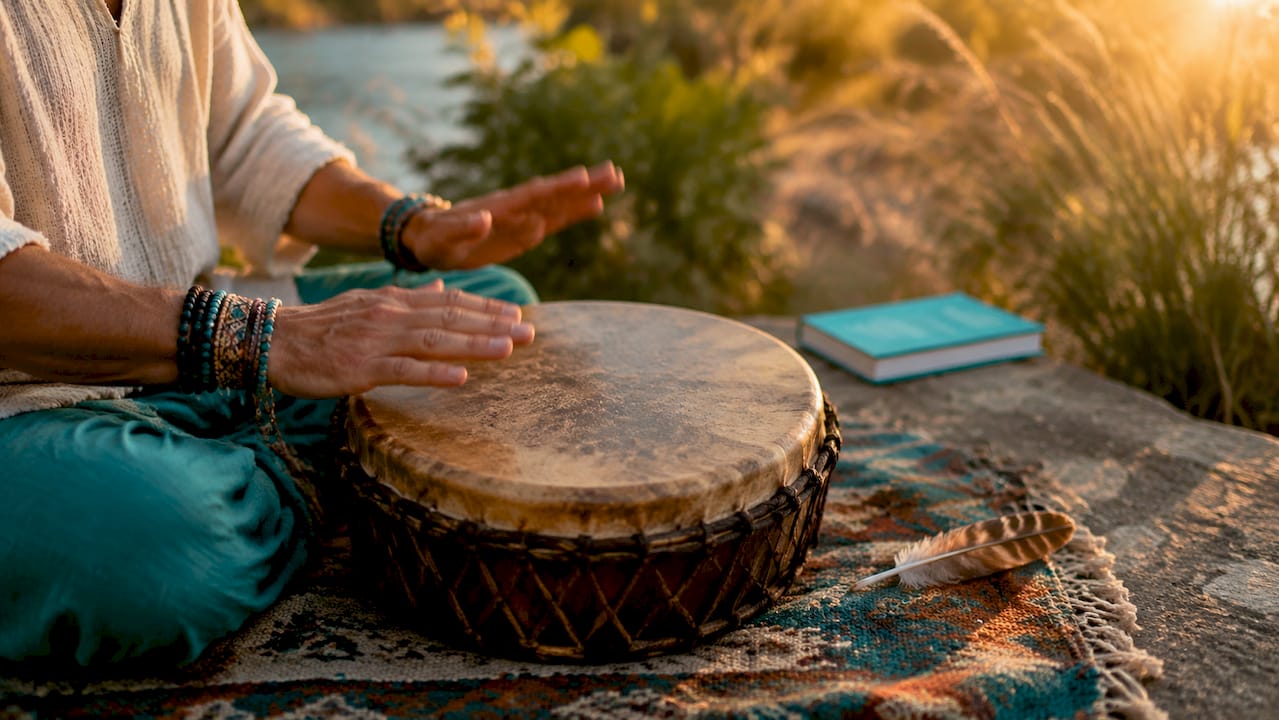
Shamanic journeying is defined as the intentional practice of entering an altered state of consciousness to access spiritual realms for healing, guidance, and self-knowledge. The practice relies on rhythmic drumming, typically at 4 beats per second, to shift brainwave activity into a theta state where vivid, interactive experiences become possible. Experts describe it as “dreaming while awake”, with the drum acting as an external auditory driver that keeps the mind tethered and engaged. Unlike passive relaxation, shamanic journeying is active and intentional. Spiritualmethod recognizes it as one of the most direct methods for inner healing across mind, body, and soul.
What is shamanic journeying and how does it work?
Shamanic journeying is the core technique of shamanism, one of humanity’s oldest spiritual healing traditions, practiced across Indigenous cultures on every continent. A shaman is a practitioner who enters non-ordinary reality on behalf of themselves or others to retrieve information, restore energy, or facilitate healing. The practice is not a religious belief system. It is a structured method for accessing inner wisdom through a specific state of consciousness.
The altered state itself is neurologically measurable. EEG studies confirm that shamanic drumming increases gamma activity and alters neural connectivity, producing vivid visionary experiences. That shift in brain activity is what separates journeying from ordinary imagination or daydreaming. The experience feels autonomous and interactive, not self-generated.
During a journey, practitioners navigate three distinct cosmological territories. The Lower World is accessed by moving downward through the earth and is associated with power animals and ancestral wisdom. The Upper World is reached by moving upward through clouds or light and is associated with spirit guides and higher knowledge. The Middle World mirrors ordinary reality but exists in its energetic or spiritual form. Each world serves a different healing purpose, and experienced practitioners learn to move between them with intention.
Shamanic journeying vs. meditation: key differences
Many people ask whether shamanic journeying is simply a form of meditation. The distinction is significant. Shamanic journeying differs from meditation by being active and intentional, using external auditory driving, whereas meditation seeks mental quietude or present-moment awareness.
| Feature | Shamanic journeying | Meditation |
|---|---|---|
| State of mind | Active, interactive trance | Quiet, receptive presence |
| Primary tool | Rhythmic drumming | Breath, mantra, or silence |
| Goal | Retrieve guidance or healing | Calm the mind, build awareness |
| Engagement | Dialogue with spiritual entities | Observation of thoughts |
| Brainwave target | Theta state via auditory driving | Alpha or theta via internal focus |
The table above shows that journeying requires active participation. You ask questions, follow guides, and bring back specific information. Meditation, by contrast, invites you to observe without directing.
How to shamanic journey: preparation and first steps
Safe and effective shamanic journeying begins with the physical environment. Choose a quiet, darkened space where you will not be interrupted for 20–30 minutes. Lie down or sit comfortably with your eyes covered using a cloth or eye mask. The body needs to feel fully supported so that physical awareness can recede naturally.
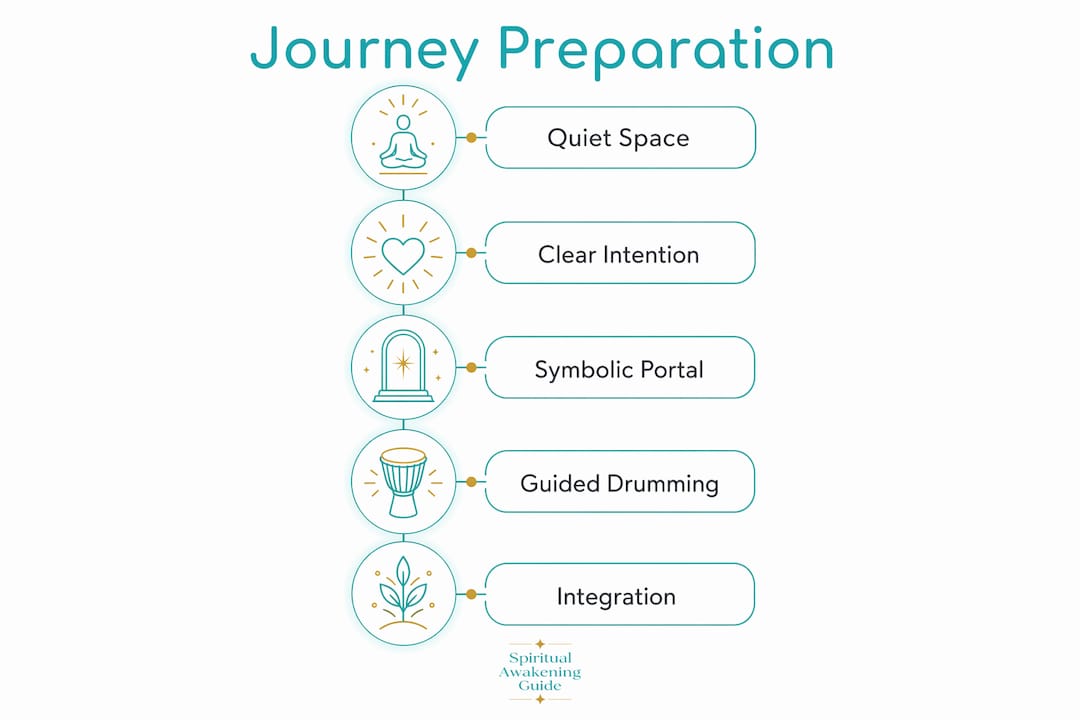
Setting a clear intention before you begin is not optional. It is the steering mechanism of the entire experience. Your intention might be a direct question, such as “What is blocking my healing?” or a request to meet a power animal. Without intention, the journey lacks direction and produces little of practical value.
Entering through a symbolic portal is a widely used technique for transitioning safely into non-ordinary reality. Practitioners visualize a real or imagined location in nature, such as the base of a tree, the mouth of a cave, or the edge of a body of water. This portal becomes the consistent entry and exit point for every journey. Returning through the same portal at the end grounds the experience and restores ordinary awareness.
Pro Tip: Begin your first journeys by visiting a familiar natural place in your imagination before the drumming starts. Familiarity with the entry point reduces disorientation and builds confidence for deeper work.
Safety is non-negotiable. Practicing shamanic journeying under the influence of substances is unsafe because the theta trance state lowers physical reflexes and awareness. Journeys require a sober, secure, and relaxed environment every time.
Step-by-step guide for beginners
- Choose a quiet, darkened room and remove all distractions, including your phone.
- Set a clear, specific intention for what you want to learn or heal.
- Lie down or sit comfortably with eyes covered and body fully supported.
- Begin playing a shamanic drumming track at approximately 4 beats per second.
- Visualize your chosen portal in nature and move through it with your intention in mind.
- Engage actively with whatever you encounter: ask questions, observe, and listen.
- When the drumming signals the end, return through the same portal and gently reorient to the room.
- Write down everything you experienced immediately after the journey ends.
What are the benefits of shamanic journeying for healing?
The benefits of shamanic journeying extend across emotional, psychological, and physical dimensions. Shamanic journeying assists healing by illuminating the root causes of emotional blocks, allowing practitioners to perform soul retrieval or energy cord removal for deep transformation. Soul retrieval is the practice of recovering fragmented parts of the self lost through trauma, grief, or prolonged stress. You can explore soul retrieval healing examples to understand how this process works in practice.
Physiological research supports these claims. A 2025 single-case study measuring ECG signals across 14 journey sessions found that shamanic journeying increases heart rate variability metrics including SDRR and RMSSD, reflecting dynamic cardiac changes distinct from those observed during Qigong meditation. That finding matters because heart rate variability is a recognized marker of autonomic nervous system health and stress resilience.
Spirit guides, power animals, and ancestors encountered during journeys offer personalized support, wisdom, and empowerment. Practitioners report that these encounters provide clarity on decisions, relationships, and life direction that ordinary reflection does not reach. Learning to connect with spirit guides is a skill that deepens with each session.
Key benefits practitioners and researchers have documented include:
- Emotional release: Processing grief, fear, and trauma through symbolic interaction rather than verbal analysis alone.
- Soul retrieval: Recovering lost energy and wholeness from past experiences, including prenatal or ancestral events.
- Stress reduction: Measurable improvements in heart rate variability and autonomic nervous system regulation.
- Clarity and guidance: Receiving specific, actionable insight from spirit guides and power animals.
- Empowerment: Building a felt sense of inner strength and spiritual support that carries into daily life.
- Connection: Deepening the relationship between the conscious self and the soul level of experience.
How do you interpret what happens during a shamanic journey?
The primary benefit of shamanic journeying is illumination and gaining insight, not escapism. That distinction shapes how you approach everything you encounter. The images, beings, and messages that arise are not random. They carry meaning specific to your question and your inner life.
Animals are among the most common symbols encountered. A wolf may represent loyalty or the need for boundaries. An eagle may point toward perspective or spiritual vision. The meaning is rarely universal. Context and personal resonance matter more than any fixed symbol dictionary. Ask the animal or guide directly what it represents. The answer that comes back will feel distinct from what you would consciously invent.
Discernment is a skill that develops over time. Helpful spirits in the Lower and Upper Worlds communicate with warmth, clarity, and respect. Entities that feel threatening or demanding are generally not reliable guides. Experienced practitioners advise returning through your portal immediately if an encounter feels unsafe, without negotiating or engaging further.
Journaling after every session is the most effective integration tool available. Journaling for soul healing creates a written record of symbols, messages, and feelings that can be reviewed over weeks and months. Patterns emerge across sessions that a single reading cannot reveal.
Pro Tip: Record your journey experience within five minutes of finishing, before ordinary thinking reasserts itself. Voice memos work well if writing feels too slow. The details that seem obvious in the moment fade quickly.
The active imagination involved in shamanic journeying differs from daydreaming because it is intentional, interactive, and produces vivid autonomous feedback. You are not constructing the experience. You are receiving it.
Key Takeaways
Shamanic journeying is a structured, neurologically measurable practice that uses rhythmic drumming to access spiritual realms for healing, guidance, and personal growth.
| Point | Details |
|---|---|
| Core definition | Shamanic journeying is an intentional altered state of consciousness induced by rhythmic drumming at 4 beats per second. |
| Three worlds | Practitioners navigate the Lower, Middle, and Upper Worlds, each serving a distinct healing and guidance purpose. |
| Scientific support | A 2025 study confirmed measurable heart rate variability changes during journeying, distinct from meditation effects. |
| Safety requirements | Journeys require a sober, quiet, and physically supported environment to protect the practitioner during the theta trance state. |
| Integration practice | Journaling immediately after each session is the most effective method for capturing and applying journey insights. |
Why shamanic journeying deserves more serious attention
Most people who ask about shamanic journeying expect a mystical curiosity, something interesting but ultimately peripheral to real healing work. I have found the opposite to be true. The practice is one of the most direct methods I know for reaching the parts of the self that talk therapy and mindfulness practices rarely touch.
What surprises people most is the specificity of what comes back. The messages and images are not vague or poetic. They are often uncomfortably precise. A practitioner working through grief does not receive a general sense of comfort. They receive a specific image, a specific instruction, or a specific encounter that addresses the exact question they brought in. That precision is what separates this from guided visualization or relaxation.
The cultural dimension deserves respect. Shamanism is not a modern wellness trend. It is a living tradition carried by Indigenous communities worldwide, and approaching it with genuine respect matters. That means learning the principles, practicing with integrity, and understanding that the role of sacred rituals in healing is not decorative. Ritual creates the container that makes the work safe and effective.
My honest observation after years of engagement with these practices is this: the people who benefit most are those who approach journeying as a discipline, not a one-time experiment. Consistency, clear intention, and honest integration are what produce lasting change.
— Sean
Deepen your healing with soul retrieval at Spiritualmethod
Shamanic journeying often reveals what needs to be healed. Soul retrieval is the practice that does the healing itself, recovering fragmented energy lost through trauma, loss, or prolonged stress.
Spiritualmethod has compiled practical guidance on soul retrieval healing with eight documented examples showing how this process works across different life experiences. Whether you are new to shamanic practice or looking to deepen an existing one, these resources provide a clear, grounded framework for the next step. Spiritualmethod is built around one purpose: providing practical methods toward inner healing of mind, body, and soul. The soul retrieval resources are a direct extension of that mission.
FAQ
What is a shaman?
A shaman is a practitioner who enters non-ordinary reality through an altered state of consciousness to retrieve healing, guidance, or information on behalf of themselves or others. The role exists across Indigenous cultures worldwide and predates organized religion.
How long does a shamanic journey last?
Most shamanic journeys last between 15 and 30 minutes, guided by a drumming track that signals the beginning and end of the session. Beginners typically start with shorter sessions of 15 minutes.
Can beginners practice shamanic journeying safely?
Yes, beginners can practice shamanic journeying safely by following core preparation steps: a quiet environment, a clear intention, a sober state, and a consistent entry and exit portal. Starting with guided drumming tracks designed for beginners reduces risk significantly.
What is soul retrieval in shamanic healing?
Soul retrieval is a shamanic healing practice that recovers fragmented parts of the self lost through trauma, grief, or stress. Practitioners access the Lower or Upper World during a journey to locate and reintegrate these lost aspects of the soul.
How does shamanic journeying differ from lucid dreaming?
Shamanic journeying is practiced while awake, using rhythmic drumming to induce a theta brainwave state, whereas lucid dreaming occurs during sleep. Journeying is intentional and directed by a specific healing question from the start.