
A moon ritual for inner healing is a structured, phase-based ceremony that uses the lunar cycle to guide intentional emotional release, reflection, and renewal. These practices draw on the symbolic power of the full moon and new moon to create a repeatable framework for processing grief, anxiety, unresolved trauma, and emotional stagnation. Spiritualmethod has observed that individuals who engage consistently with lunar meditation practices report a stronger sense of inner clarity and emotional resilience over time. This guide covers the tools, step-by-step rituals, inner child work, new moon intentions, and the psychological reasoning behind why these practices genuinely support healing.
What tools and materials do you need for a moon ritual for inner healing?
The most effective moon rituals use a small, purposeful set of tools rather than an elaborate altar. Common ritual tools include a journal, pen, white or intention candle, fireproof container, sage or incense, crystals, and a bowl of water for making moon water. Each item serves a specific function in the ritual rather than acting as decoration.
A white candle anchors your focus and signals the beginning of sacred time. Crystals such as moonstone and clear quartz are widely used in moon energy for wellness practices because they support energetic clarity and emotional grounding. Sage or incense clears the physical space and signals to the nervous system that this time is set apart from daily routine.

Safe burning practices are a critical and often overlooked consideration for newcomers. If burning a release letter is not possible indoors, tearing the paper into small pieces and discarding it outside works equally well. The symbolic act of physical release matters more than the specific method.
| Tool | Purpose | Beginner tip |
|---|---|---|
| Journal and pen | Record emotions, write release letters | Use a dedicated ritual journal |
| White candle | Focus intention, mark sacred space | Place on a stable, fireproof surface |
| Fireproof container | Safe burning of release papers | A cast iron bowl or ceramic dish works well |
| Crystals | Energetic support and grounding | Moonstone or clear quartz are good starting points |
| Sage or incense | Space cleansing before ritual | Open a window for ventilation |
| Water bowl | Moon water preparation and reflection | Leave outside overnight under the full moon |
Pro Tip: Before beginning any ritual, spend two minutes sitting quietly in your chosen space. This brief pause signals to your body that the environment is safe, which makes emotional processing significantly more accessible.
How to perform a step-by-step full moon ritual for emotional release
A full moon healing ritual follows a clear arc: preparation, emotional identification, physical release, and integration. The full moon amplifies emotional awareness, which makes it the most potent phase for releasing what no longer serves your growth. Performing your ritual within 24 hours of the exact full moon captures this heightened energy most effectively.
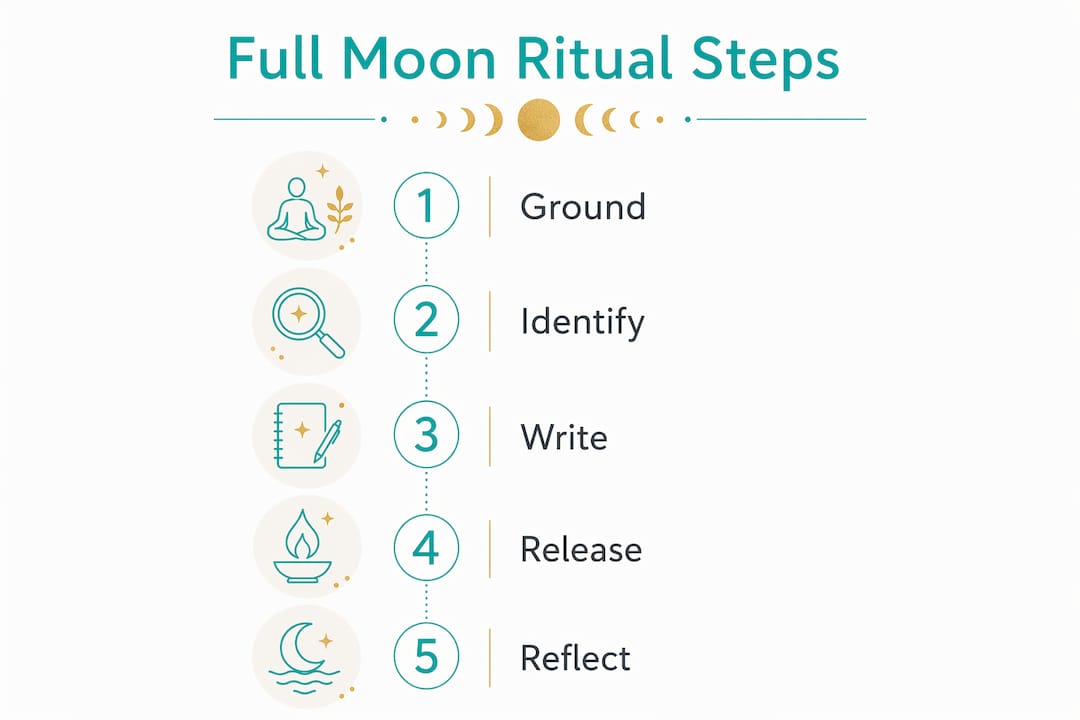
The following six steps form the core structure of a complete full moon release ritual.
Ground yourself. Sit comfortably, close your eyes, and take five slow breaths. Feel the weight of your body against the floor or chair. This step activates the parasympathetic nervous system, which is the physiological state required for genuine emotional processing.
Check in honestly. Ask yourself: what am I carrying right now? Name the emotion without judgment. Grief, resentment, fear, and shame are all valid starting points. Honest identification is the foundation of the entire ritual.
Write your release list or letter. Write down every burden, belief, or emotional pattern you are ready to let go of. Some practitioners address this letter directly to their inner child or to a past version of themselves. Specificity matters more than length.
Perform the physical release. Burn the paper safely in your fireproof container, tear it into pieces, or bury it outside. As you do this, state aloud or silently: “I release this. I am ready to heal.” The physical act creates a somatic signal that reinforces the emotional intention.
Sit with your body. After the release act, pause for at least three to five minutes. Emotional intensity at full moon rituals is managed best by allowing the body time to process rather than moving on immediately. Notice any sensations without trying to fix them.
Close with gratitude. Extinguish your candle, write three things you are grateful for, and formally end the ritual. Gratitude shifts the nervous system from release mode into receptive mode, which supports integration.
| Step | Action | Purpose |
|---|---|---|
| 1 | Ground with breath | Activate calm nervous system state |
| 2 | Identify emotions | Create honest starting point |
| 3 | Write release letter | Externalize internal burdens |
| 4 | Physical release act | Reinforce intention somatically |
| 5 | Sit with body response | Allow emotional integration |
| 6 | Close with gratitude | Shift into receptive healing state |
Pro Tip: Set a phone reminder for the exact time of the full moon each month. Performing your ritual within that 24-hour window, rather than days later, keeps the practice anchored to a real, recurring rhythm.
What is an inner child healing moon ritual and how does it work?
Inner child healing refers to the psychological process of addressing unmet emotional needs and unresolved wounds from early life. Lunar energy supports this work because the cyclical, rhythmic nature of moon cycle rituals creates a reliable container for revisiting tender emotional territory without feeling overwhelmed. An inner child moon ritual blends journaling with somatic movement to help process early emotional wounds at both the cognitive and body level.
Somatic release is the element that distinguishes inner child moon rituals from standard journaling. Somatic movement within moon rituals provides a body-based mechanism to release stored trauma that cognitive reflection alone cannot reach. Practices like conscious shaking, slow swaying, or rhythmic breathing allow the nervous system to discharge tension that has been held in the body for years.
A complete inner child healing ritual includes the following elements:
- Grounding: Begin with five minutes of slow, intentional breathing or gentle movement to signal safety to the nervous system.
- Reflection: Journal on a specific early memory or emotional pattern. Ask: “What did younger me need that I did not receive?”
- Letter writing: Write a compassionate letter from your present self to your inner child. Acknowledge the pain without minimizing it.
- Somatic release: After writing, stand up and shake your hands, arms, and body gently for two to three minutes. This physical discharge completes the emotional processing cycle.
- Setting healing intentions: Write two or three present-tense statements welcoming self-compassion, healthy boundaries, and emotional presence. Examples include “I am safe to feel my emotions” and “I welcome compassion toward myself.”
- Closing with gratitude: Acknowledge the courage it took to show up for this work. Light a candle, hold a crystal, or simply place a hand on your heart.
Consistency across multiple moon cycles produces the deepest results. A single ritual opens the door; repeated practice builds the capacity to stay present with difficult emotions over time.
How do new moon rituals complement full moon healing?
The new moon is the natural counterpart to the full moon in any moon cycle ritual practice. Where the full moon is the time to release and reset, the new moon is the time to plant seeds for what you want to grow. New moon intention-setting rituals typically last 30 to 60 minutes and involve cleansing your space, reflective writing, and sealing the ritual with gratitude.
Focused and vivid wording in your intentions significantly enhances their emotional and subconscious impact. Writing “I am building a daily practice of self-compassion” is far more effective than writing “I want to feel better.” Focused, realistic new moon intentions of three to five specific statements maximize nervous system alignment and avoid the diffuse energy of vague goal-setting.
The table below clarifies the distinct purpose of each phase within a complete lunar healing practice.
| Phase | Energy | Primary practice | Healing focus |
|---|---|---|---|
| Full moon | Release and amplification | Burning or tearing release letters | Letting go of emotional burdens |
| New moon | Renewal and planting | Writing present-tense intentions | Setting direction for growth |
To set effective new moon intentions, follow these steps:
- Cleanse your space with sage or incense before beginning.
- Sit quietly and reflect on what you genuinely want to cultivate in the coming cycle.
- Write three to five specific, present-tense intentions in your journal.
- Read them aloud once to engage both the auditory and cognitive channels.
- Seal the ritual by extinguishing a candle or placing your journal under moonlight overnight.
Returning to your written intentions at the following full moon creates a direct feedback loop between release and renewal, which is the core engine of manifestation with moon practices.
What does science say about why moon rituals feel healing?
Moon rituals are culturally framed psychological tools that produce genuine healing effects through well-understood mechanisms, even without strong direct lunar causation. Scientific studies find small lunar effects on sleep around full moons, which validates the experience of heightened emotional sensitivity during this phase. This mild sleep disruption increases emotional reactivity, making the full moon a naturally receptive window for reflective practice.
The more powerful mechanism is expectation and cultural framing. When you approach a ritual with clear intention and a structured framework, the brain engages the prefrontal cortex in a way that supports emotional regulation and meaning-making. Rituals work as psychologically meaningful reflection frameworks rather than as direct conduits of lunar energy. This distinction matters because it places the healing capacity firmly within the practitioner.
Journaling, somatic movement, and symbolic release each engage specific psychological healing mechanisms. Journaling externalizes internal experience, which reduces cognitive load and emotional overwhelm. Somatic movement completes the physiological stress response cycle. Symbolic release, such as burning a letter, creates a concrete sensory marker that the brain uses to signal closure.
“Moon rituals are not magic performed on you by the moon. They are structured invitations you create for yourself to process, reflect, and renew. The moon provides the timing and the symbolic container. You provide the intention and the honesty.”
Pro Tip: Approach moon rituals as tools for intentional mindfulness and emotional integration. Expecting immediate transformation from a single ritual leads to disappointment. Expecting gradual, cumulative clarity over several cycles is both realistic and deeply rewarding.
A guided dark moon ritual for trauma survivors, as developed by Dr. Kelsey Harper, Psy.D., typically lasts about 60 minutes and uses journaling prompts alongside spiritual healing practices. This clinical framing confirms that structured lunar rituals have genuine therapeutic applications beyond casual spiritual practice.
Key takeaways
A moon ritual for inner healing works because it combines structured reflection, somatic release, and symbolic action within a repeatable lunar framework that supports consistent emotional processing.
| Point | Details |
|---|---|
| Use the full moon for release | Write and physically release a list of emotional burdens within 24 hours of the full moon. |
| Use the new moon for intentions | Write three to five specific, present-tense intentions to direct your healing focus for the coming cycle. |
| Include somatic movement | Add body-based practices like shaking or conscious breathing to process stored trauma beyond journaling alone. |
| Keep tools simple | A journal, candle, and fireproof container are sufficient for an effective ritual. |
| Consistency builds depth | Repeated practice across multiple moon cycles produces more sustainable healing than a single elaborate ritual. |
Why simple rituals outperform elaborate ones
After working with moon-based healing practices for years, the pattern I see most consistently is this: the people who benefit most are not the ones with the most elaborate setups. They are the ones who show up honestly, month after month, with a journal and a candle.
The temptation to build a perfect altar, source rare crystals, or wait for ideal conditions is real. It is also a form of avoidance. The emotional work of a moon ritual happens in the writing, the sitting, and the releasing. None of that requires anything expensive or complicated.
The hardest part of this practice is not the ritual itself. It is tolerating the emotions that surface during it. Grief, anger, and shame do not disappear the moment you burn a piece of paper. They soften over time, with repeated honest engagement. Impatience with this process is the most common reason people abandon the practice before it has a chance to work.
My practical advice: start with the six-step full moon release ritual described in this article. Do it for three consecutive months before adding any complexity. Notice what shifts in your emotional patterns, your sleep, and your relationship with yourself. The results of that simple, consistent practice will tell you everything you need to know about whether to deepen the work.
— Sean
Deepen your healing practice with Spiritualmethod
Spiritualmethod offers structured resources for individuals ready to move beyond a single ritual and build a sustained inner healing practice. The spiritual healing practices section of the site includes guided frameworks for moon cycle rituals, inner child work, and emotional resilience practices designed for consistent, self-guided use. For those working through deeper emotional patterns, the releasing negative energy guide provides practical journaling and release techniques that complement every phase of the lunar cycle. Each resource is built around the same principle that guides this article: practical methods toward healing the mind, body, and soul.
FAQ
What is a moon ritual for inner healing?
A moon ritual for inner healing is a structured ceremony aligned with lunar phases, typically the full moon or new moon, that uses journaling, symbolic release, and reflective practice to process emotions and support psychological renewal.
How long does a full moon healing ritual take?
A basic full moon release ritual takes 30 to 60 minutes. Guided trauma-focused rituals, such as those developed by Dr. Kelsey Harper, Psy.D., are typically structured for 60 minutes with preparatory instructions provided in advance.
Do new moon intentions actually work?
New moon intentions work as a focused psychological tool. Specific, present-tense intentions of three to five statements engage the subconscious and nervous system more effectively than vague goals, creating a clear direction for behavior and emotional focus in the weeks ahead.
Is there science behind moon rituals and emotional healing?
Yes, with important context. Small lunar effects on sleep around the full moon increase emotional sensitivity, and the structured reflection built into rituals engages well-documented psychological healing mechanisms including journaling, somatic release, and symbolic closure.
Can moon rituals help with anxiety?
Moon rituals for anxiety work by providing a consistent, structured outlet for emotional processing. The grounding, breathing, and journaling components of lunar meditation practices directly engage the parasympathetic nervous system, which reduces the physiological markers of anxiety over time with regular practice.
Pingback: What Is Transpersonal Healing: A Practical Guide
Pingback: The Role of Sacred Rituals in Healing Mind and Soul