
You’ve done the yoga classes, saved moon ritual posts, maybe started a crystal shelf or a morning journaling habit. But something still feels unfinished. You want more than scattered practices. You want a spiritual foundation that explains why energy work, inner healing, intention, and ethical living fit together.
That’s often the moment people get curious about books on theosophy.
Then they open one and hit a wall. The language is old. The sentences are dense. The ideas seem huge. You’re suddenly staring at words like karma, skandhas, devachan, and sevenfold constitution, wondering whether you’ve found deep wisdom or just a library of mystery.
That confusion is normal.
Theosophy can feel intimidating because most guides point straight to the oldest and heaviest texts without helping you read them in a grounded, usable way. Existing content on books on theosophy tends to center classic authors like H.P. Blavatsky, Annie Besant, and William Q. Judge, but gives very little help to modern beginners who want to connect these teachings with everyday spiritual practice such as energy cleansing, intention-setting, or ritual self-care, as noted by this review of existing theosophy book coverage.
This guide takes a different path. It treats Theosophy as a living system of spiritual understanding, not just a shelf of historical books. You’ll learn what Theosophy is, which books to start with, how to read them without overwhelm, and how to translate their ideas into simple modern practices that support clarity, grounding, and inner growth.
Table of Contents
- Your Starting Point on the Path to Divine Wisdom
- What Is Theosophy and Where Did It Come From
- Understanding Theosophy's Core Ideas
- Your Theosophy Reading Path From Beginner to Advanced
- How to Study Theosophical Literature Effectively
- Integrating Theosophical Wisdom into Your Daily Life
- Your Journey with Divine Wisdom Begins Now
Your Starting Point on the Path to Divine Wisdom
Many people arrive at Theosophy after trying spiritual practices that help, but don’t fully explain themselves. A bath ritual calms you. Breathwork clears your head. Journaling reveals patterns. Energy cleansing shifts your mood. Yet a deeper question remains. What is a human being, really? Why do certain emotional patterns repeat? What are you healing?
Theosophy speaks to that hunger for a more complete map.
At its heart, it tries to gather the wisdom behind many traditions into one broad spiritual framework. That’s why it attracts readers who are already spiritually open but now want roots, language, and philosophical depth. It doesn’t ask you to abandon your current practices. It asks you to understand them at a deeper level.
Why people get stuck with Theosophical books
The problem isn’t lack of insight. The problem is access.
Classic books on theosophy were written in a style that assumes patience, concentration, and familiarity with religious and philosophical language from many traditions. A beginner opens a famous title and quickly feels lost, not because the ideas are empty, but because the presentation is demanding.
The best way to approach Theosophy is to stop treating it like a textbook you must conquer and start treating it like a contemplative conversation.
That shift matters. If you expect fast self-help language, you’ll feel frustrated. If you expect symbolic, layered writing that unfolds over time, the books become far more approachable.
A gentler way in
A modern wellness seeker doesn’t need to begin with the most difficult material.
You can begin by asking simpler questions:
What kind of book do I need first
A primer, not a masterpiece. You need orientation before scale.What am I trying to understand
Reincarnation, subtle energy, spiritual ethics, or cosmology. Naming your question helps you choose the right book.How will I use what I read
Through meditation, journaling, intention-setting, or reflection on relationships and habits.
That last point is where many lists of books on theosophy fall short. They tell you what existed. They don’t help you digest it. A wise reading path should leave you more grounded, not more foggy.
What Is Theosophy and Where Did It Come From
You open a century-old Theosophy book, read a paragraph about soul evolution, hidden laws, and ancient wisdom, and then wonder whether you picked up a spiritual text or a coded manuscript. That reaction is common. Theosophy uses big language for questions many modern seekers already ask in simpler terms. What is the deeper pattern behind my life? How do energy, ethics, and consciousness connect? Why do teachings from different traditions sometimes sound strangely similar?
At its root, Theosophy means divine wisdom. In practice, it refers to a spiritual philosophy that looks for the deeper principles running through religion, mysticism, nature, and human development. It is less a fixed belief system and more a study of underlying patterns.

A historical movement with a practical purpose
The modern Theosophical movement took organized form in 1875, when Helena Petrovna Blavatsky, Henry Steel Olcott, and William Quan Judge founded the Theosophical Society in New York City. Their work helped turn scattered esoteric interests into a real study culture with lectures, journals, and books that reached a wide audience, as noted by Harvard Library’s Theosophy Collections.
That history matters for a beginner because it explains why Theosophical books feel so layered. They were written during a period of intense exchange between Eastern and Western religious thought. Authors were trying to compare systems, recover forgotten teachings, and build a shared spiritual vocabulary. The result can feel dense, but the intention was broad. These books were meant to connect traditions, not isolate one school from another.
A helpful way to approach Theosophy is to see it as a cross-traditional map. It gathers ideas from Hinduism, Buddhism, Western esotericism, Neoplatonism, symbolism, and comparative religion, then asks what patterns repeat.
Those repeating questions include:
- What laws shape consciousness and spiritual growth?
- How are spirit and matter related?
- Why does the soul pass through cycles of learning?
- Why do sacred symbols echo across cultures?
If you already study texts from India, some of this language will feel more familiar with a little background in Vedic scriptures in English. That context can make older Theosophical writing easier to follow, especially when it borrows Sanskrit terms without much explanation.
For a modern wellness reader, this is the part that matters most. Theosophy is not only a historical curiosity or a shelf of difficult occult books. It offers a framework for practice. If you are drawn to meditation, energy work, moon rituals, intention-setting, or shadow work, Theosophy gives you a wider philosophy for why inner practice matters and how personal growth fits into a longer arc of soul development.
So where did Theosophy come from? Historically, from a 19th-century movement. Spiritually, from a much older human urge to gather fragments of wisdom and ask what whole they belong to. That is the lens that makes these books more readable. You are not reading them just to collect doctrines. You are reading them to build a usable map of consciousness.
Understanding Theosophy's Core Ideas
The easiest way to make books on theosophy feel usable is to stop trying to swallow every doctrine at once. Start with a few core ideas. Once these become familiar, the denser books begin to open.
Karma and reincarnation as learning, not punishment
Many people hear karma and immediately think reward and punishment. Theosophy presents something more subtle.
Karma is closer to a law of moral and spiritual cause and effect. Your thoughts, motives, and actions shape future conditions. Reincarnation is the long arc through which the soul learns from those conditions over many lives.
In The Key to Theosophy, Helena P. Blavatsky explains reincarnation through karma and says that skandhas, or personality aggregates, carry impressions across lives. She also describes a devachanic state that can last 1,000 to 5,000 years, according to The Key to Theosophy.
For a beginner, here’s the plain-language version. You are not a blank slate in each life. You carry tendencies. Some feel like gifts. Some feel like recurring emotional knots. Theosophy says those patterns are part of a much larger continuity of learning.
If you already resonate with sacred texts from India, this can pair well with broader study of Vedic scriptures in English, especially when you want context for terms that appear in older Theosophical writing.
The sevenfold human being
One of the most practical Theosophical ideas for modern spiritual readers is the sevenfold constitution of the human being.
C.W. Leadbeater describes the human constitution as sevenfold in A Textbook of Theosophy. The model includes the physical body, etheric double, prana, kama, manas, buddhi, and atma, as outlined in A Textbook of Theosophy.
You don’t need to memorize the Sanskrit names right away. Just understand the pattern.
| Layer | Plain meaning |
|---|---|
| Physical | Your visible body |
| Energetic | Life force and subtle vitality |
| Emotional | Desire, attraction, aversion |
| Mental | Thinking, reasoning, identity |
| Spiritual | Intuition, soul wisdom, divine essence |
This is one reason modern readers often find Theosophy unexpectedly relevant. If you’ve worked with chakras, aura cleansing, meditation, or energy sensitivity, this model gives you a larger architecture for those experiences.
Universal brotherhood and inner development
Another core principle is universal brotherhood. That phrase can sound old-fashioned, but the living meaning is simple. Every being is linked. Spiritual growth isn’t separate from how you treat others.
This changes how you read the harder books. They aren’t only trying to explain hidden worlds. They’re trying to form character.
A modern reader can test this directly. If a spiritual study path makes you more inflated, more detached from compassion, or more obsessed with being special, it’s probably missing the center of the teaching.
Theosophy asks for expansion of consciousness, but it also asks for ethical refinement.
That combination is why these books still matter. They aren’t only speculative. They’re meant to support transformation.
Your Theosophy Reading Path From Beginner to Advanced
Most lists of books on theosophy make one mistake. They treat all classic books as equal entry points. They aren’t.
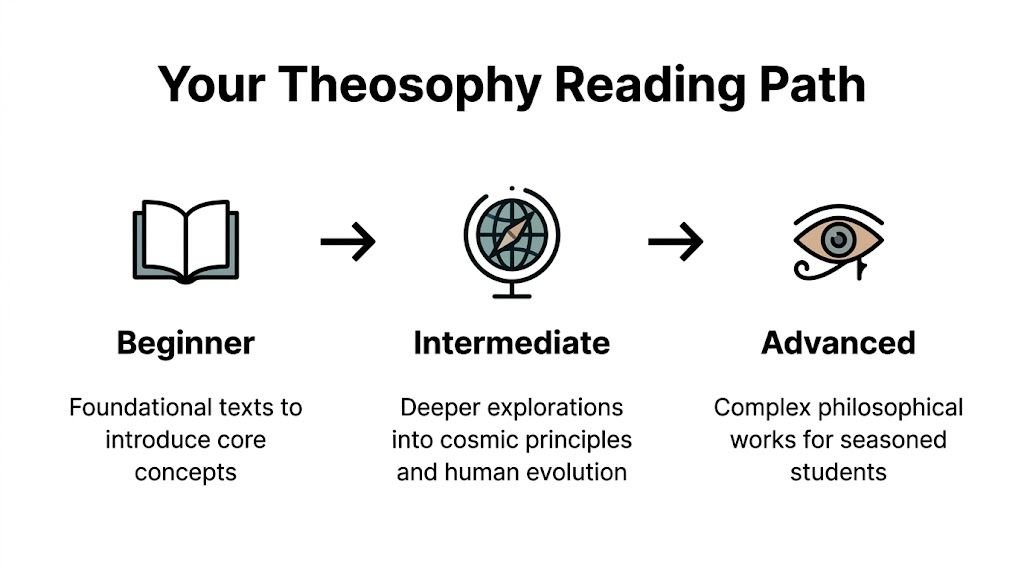
Some books orient you. Some deepen your framework. Some are mountain climbs. If you read them in the wrong order, you’ll assume Theosophy is impossible to approach. If you read them in the right order, it becomes a steady unfolding.
Start with books that orient you
For most beginners, the best first book is The Key to Theosophy by H.P. Blavatsky.
Why? Because it was written as an explanatory text. It helps you understand terms, worldview, and core principles without immediately dropping you into the most enormous cosmological arguments. If you’re serious but still new, this is usually the right door.
Another beginner-friendly option is A Textbook of Theosophy by C.W. Leadbeater. It gives a more systematized overview, especially for readers who like structure and categories. Some readers will find it easier than Blavatsky because it feels more instructional.
If you’ve also explored other Hermetic or esoteric material, you may notice useful points of comparison with this introduction to the Kybalion. That kind of side-by-side reading can help you see where traditions overlap and where they differ.
Move into structure and worldview
After you’ve grasped the basics, books like The Voice of the Silence and The Key to Theosophy become richer on a second pass, and then you can move toward works that ask more of you.
At this stage, Isis Unveiled becomes more meaningful. It’s large, argumentative, and wide-ranging. You read it less for neat conclusions and more for immersion in Theosophy’s comparative method. It shows how the movement tried to weave together religion, philosophy, science, and occult thought.
This is also the stage where the cultural reach of Theosophy becomes more visible. Its influence extended into literature. W.B. Yeats integrated Theosophical concepts into over 20 major works, and 15% of his published poetry by 1900 is estimated to have contained Theosophical themes, according to the record on Theosophy and literature. That matters because it shows these books didn’t stay inside occult study groups. They shaped artistic imagination.
A short visual overview can help before you go further:
Approach the monumental texts slowly
Then there is The Secret Doctrine.
This is not your starting book unless you already love dense symbolic literature and don’t mind moving at a very slow pace. It is massive, layered, and often difficult. But it’s also central. Many readers eventually want to reach it because it contains the broad cosmological vision that defines much of later Theosophical thought.
The key is not to “finish” it quickly. The key is to build enough conceptual stamina that it stops feeling like static.
Here’s a good mindset shift:
- Beginner books teach vocabulary and orientation.
- Intermediate books teach pattern recognition.
- Advanced books ask for symbolic and contemplative reading.
Theosophy Reading Path
| Level | Key Book(s) | Why Start Here | Best For |
|---|---|---|---|
| Beginner | The Key to Theosophy, A Textbook of Theosophy | They clarify major ideas in a more direct way | Readers who want a grounded introduction |
| Intermediate | Isis Unveiled, The Voice of the Silence | They deepen worldview and spiritual tone | Readers ready for wider symbolic and comparative study |
| Advanced | The Secret Doctrine | It holds the large cosmological framework of modern Theosophy | Dedicated students with patience for difficult texts |
A simple rule helps here. Don’t choose the most famous book first. Choose the book that helps you keep going.
How to Study Theosophical Literature Effectively
Reading Theosophy well is less about speed and more about method. If you try to read these books like modern productivity nonfiction, you’ll tire quickly. They ask for a slower, more reflective kind of attention.
Read for patterns, not for perfect mastery
You do not need to understand every term on the first pass.
In fact, trying to decode every unfamiliar word can break your rhythm. A better approach is to look for recurring themes. Notice which ideas keep returning. Watch how the text speaks about consciousness, ethics, cycles, evolution, and the layered nature of the human being.
Try reading in very small portions.
Read one short section at a time
A page or two may be enough for one sitting.Underline repeated ideas
Words like karma, mind, soul, desire, form, spirit, and consciousness often reveal the structure.Pause before researching everything
Let some meaning gather through context before jumping to definitions.
If a paragraph feels dense, ask one question only. “What is this trying to say about human nature or spiritual growth?”
That question keeps the reading alive.
Build a living study practice
Theosophy becomes clearer when study is active, not passive.
Keep a notebook with three columns. In the first, write the concept. In the second, translate it into plain language. In the third, write how it appears in your own life. For example, “kama” might become “reactive desire” and then “the part of me that reaches for comfort when I feel overwhelmed.”
That kind of translation turns old philosophy into self-knowledge.
You may also want to create a simple rhythm:
- Read slowly
- Journal one insight
- Sit in silence for a few minutes
- Notice where the teaching meets your day
This makes even difficult books on theosophy feel less like intellectual labor and more like spiritual training.
Integrating Theosophical Wisdom into Your Daily Life
You finish a meditation, light a candle, set an intention for the day, and still wonder whether your spiritual practice is transforming you. This is the point where Theosophy can help. It gives language and structure to experiences that many modern seekers already have, but do not yet know how to interpret.

Use thought and emotion more consciously
A central Theosophical teaching is that thought is active. It does something. In practical terms, your repeated mental patterns help shape your inner atmosphere, your reactions, and the tone you bring into a room.
This idea appears in Leadbeater’s writing on thought-forms, as noted earlier in the article. For a modern reader, the point is simple. Intention-setting works best when it is supported by feeling, attention, and repetition. A passing worry is not the same as a well-established mental habit.
That distinction matters.
If you already use energy practices, Theosophy can give them more depth. A ritual for clarity, protection, or healing becomes stronger when you understand that attention and emotion train your subtle life over time. If that language is new to you, this guide on how to raise your vibration with steady daily practices pairs well with a more philosophical study of consciousness.
Translate philosophy into ritual
Theosophy can feel abstract until you give it a home in ordinary life. The easiest way to do that is to match a core teaching with a small repeated practice.
Here are a few examples:
Karma as morning intention
Before checking your phone, ask, “What am I setting in motion today?” This turns intention-setting into a practice of cause and effect, not wishful thinking.The sevenfold human being as a self-check
If you feel off, pause and scan in layers. Is the strain in the body, the emotions, the thought stream, or the deeper sense of meaning? This helps you respond with more precision.Inner development as meditation
During silence, notice what changes and what observes the change. Desire rises and falls. Thoughts come and go. Something quieter remains aware. Theosophical books describe these layers in formal terms, but meditation lets you experience them directly.Universal brotherhood as relationship practice
Choose one difficult person and refuse to reduce them to your latest irritation. This is not passivity. It is disciplined spiritual perception.
A helpful comparison is learning anatomy in a yoga class. The poses matter, but understanding the structure underneath changes how you practice. Theosophy does that for ritual work. It explains why cleansing, prayer, visualization, journaling, or intention-setting can profoundly affect you when done with sincerity and self-observation.
A ritual has more depth when you know the principle beneath it.
That is why these old books still matter. They can turn a loose collection of wellness habits into a coherent spiritual path.
Your Journey with Divine Wisdom Begins Now
The best books on theosophy aren’t just old spiritual classics. They are doorways into a larger way of seeing yourself and the world.
If you begin gently, Theosophy doesn’t have to feel remote or overwhelming. It can become a companion for the questions that surface when quick spiritual content no longer satisfies. It gives language to inner development, structure to subtle experience, and meaning to the long arc of growth.
Start with one accessible book. Read a little at a time. Translate what you learn into plain language. Then let it shape your practice.
You don’t need to master everything at once. You only need to begin sincerely.
The path of divine wisdom often starts in a simple way. You open a book, read a paragraph that speaks to something ancient in you, and realize you’re not just collecting ideas. You’re remembering a deeper way of living.
If you want a practical companion for daily spiritual growth, Spiritual Method offers a step-by-step awakening guide that blends ancient wisdom with grounded tools for energy cleansing, intention-setting, sacred routines, and emotional clarity. It’s a supportive next step for anyone who wants to turn spiritual insight into steady daily practice.
Pingback: The Lost Keys of Freemasonry: A Guide to Spiritual Awakening – Spiritual awakening guide