
You’re probably here because you’ve felt that familiar pull. You see a beautiful deck on a shelf, or in an online shop, and something in you says yes. Then the practical questions arrive just as fast. Is this an angel deck, a tarot deck, or both? Will it comfort me, challenge me, or confuse me? Which one should I use when I need help making sense of my life?
That uncertainty is normal. Many people begin with sincere curiosity and then stall because the card world can seem full of mixed language. Some decks promise loving guidance. Others promise deep insight. Some call themselves angel tarot, which can sound like two systems blended into one.
The simplest way to begin is this. Angel cards often feel like a soft hand on your shoulder. Tarot often feels like a map spread across the table. One offers reassurance and encouragement. The other helps you see patterns, choices, and lessons with more detail. Neither is better. They just serve different needs.
If you’ve been wanting a grounded, welcoming guide to angel card tarot, this is for you. You’ll learn what each tool does well, when to reach for one instead of the other, and how to use them together without feeling overwhelmed.
Table of Contents
- Introduction Are You Seeking Comfort or a Roadmap
- What Are Angel Cards Your Connection to Gentle Guidance
- What is Traditional Tarot Mapping the Soul's Journey
- Angel Cards vs Tarot A Direct Comparison
- Simple Spreads for Angel Cards and Tarot
- Integrating Divination into Your Daily Spiritual Practice
- Conclusion Choosing the Right Tool for Your Path
Introduction Are You Seeking Comfort or a Roadmap
A woman walks into a spiritual shop after a draining week. She isn’t looking for anything dramatic. She just wants a little clarity. One deck shows glowing angels and words like healing, peace, and support. Another shows symbolic scenes, cups, towers, moons, and figures on winding roads. She picks up both, reads the backs, and thinks, “I don’t know which one I need.”
That moment says a lot. Sometimes you don’t need a deep symbolic mirror. You need relief. You need a message that helps your nervous system soften. At other times, a soothing message isn’t enough. You need to understand why a pattern keeps repeating, where you’re stuck, or what a decision might be asking of you.
That’s the central question behind angel card tarot. Are you seeking comfort right now, or a roadmap?
If your heart feels tender, angel cards can be a kind place to begin. If you’re ready to look at the full scope of your inner life, tarot can offer more depth. And if you’re drawn to both, that doesn’t mean you’re doing it wrong. It usually means your intuition already understands something important. Healing and insight belong together.
Practical rule: Use angel cards when you need reassurance and emotional steadiness. Use tarot when you need detail, pattern recognition, and a fuller picture.
People often get tangled because the names overlap. Some decks use tarot structure with angel-themed art and language. Others are oracle decks with angel imagery but no fixed system. The answer isn’t to memorize labels first. The answer is to ask what kind of guidance you want from the reading.
When you know that, the cards become far less mysterious.
What Are Angel Cards Your Connection to Gentle Guidance
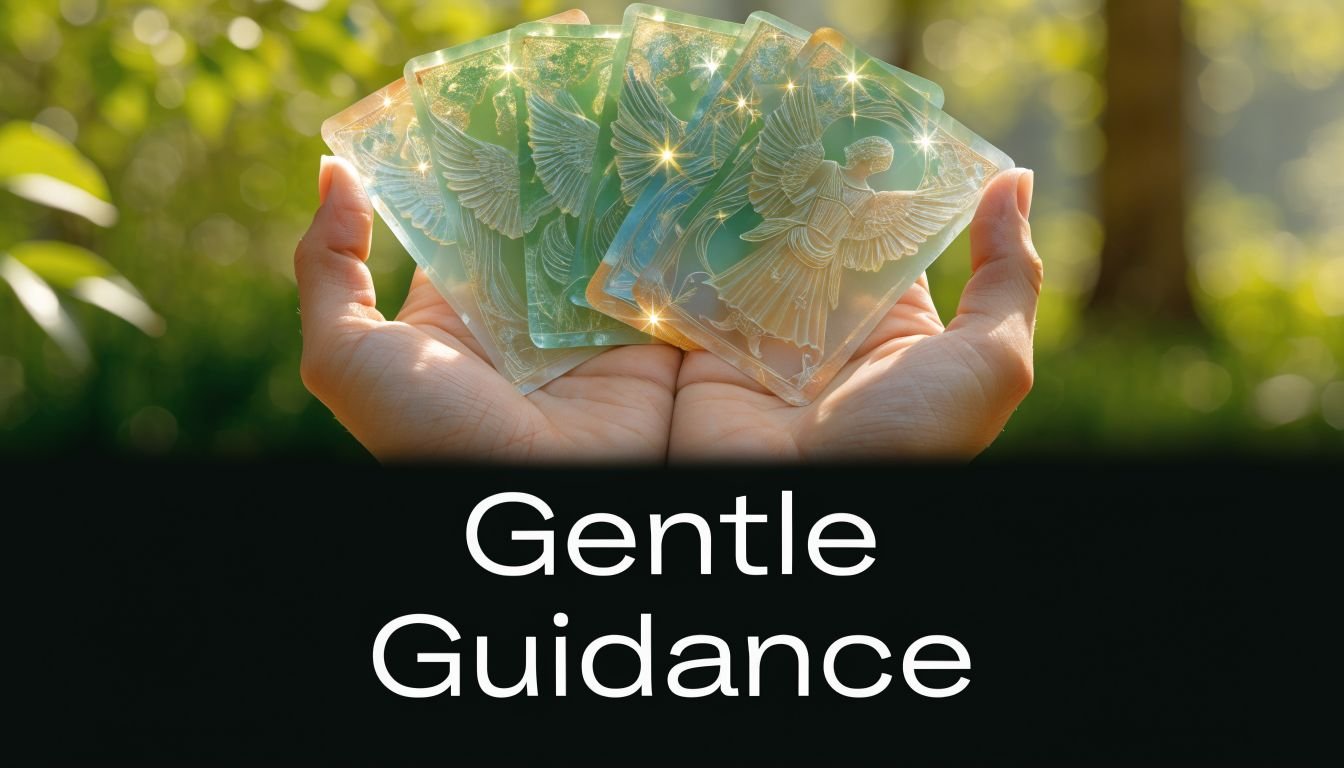
Angel cards are usually best understood as oracle-style cards centered on comfort, encouragement, and simple spiritual reflection. Their job is different from a system that asks you to decode layers of symbols. An angel deck usually offers a clear message you can receive quickly, especially on days when your energy feels low or your emotions are close to the surface.
Why angel cards feel easier to approach
Angel cards often use calming artwork and direct language such as “trust,” “healing,” “protection,” or “peace.” That makes them easier to read in the moment. You are usually receiving guidance in plain words, not trying to sort through a dense symbolic scene before you can understand the message.
This matters during stressful seasons. If you are grieving, overstimulated, heart-tired, or trying to reconnect with your intuition, an angel deck can feel like a softer doorway back into practice. Some readers also pair their pull with grounding rituals, such as breathwork, tea, or crystals for healing and protection, so the reading becomes a full moment of care rather than a quick answer hunt.
A helpful example is Angel Tarot Cards by Doreen Virtue and Radleigh Valentine. As noted in Aeclectic’s review of Angel Tarot Cards, the deck presents traditional card ideas in a strongly positive, reassuring format, with encouraging text printed directly on the cards. For a beginner, that can make the first few readings feel less intimidating.
What angel cards are designed to help with
Angel cards work well for questions that need emotional steadiness more than detailed analysis. You might pull one when asking:
- What energy would support me today?
- What reminder do I need before I react?
- How can I meet this moment with more trust or calm?
- What would comfort look like right now?
That difference is easy to miss at first.
A tarot reading often asks you to examine a pattern. An angel card reading often asks you to receive support, then carry that support into the day.
A gentle message can still be useful, specific, and honest.
That is why angel cards fit so naturally into daily ritual. A one-card pull in the morning can set the tone for the next few hours. If the card speaks about patience, you might use that message before a difficult conversation. If it points to rest, the guidance may be asking you to protect your energy instead of pushing through.
People sometimes worry that a kind deck will only tell them what they want to hear. In practice, angel cards are often most helpful when you know their purpose. They are not usually the best tool for mapping every layer of a complicated decision. They are very good at helping you settle, listen inward, and choose your next step from a calmer place.
Used that way, angel cards become more than “nice messages.” They become a reliable part of spiritual self-care, especially when you need comfort first and clarity second.
What is Traditional Tarot Mapping the Soul's Journey
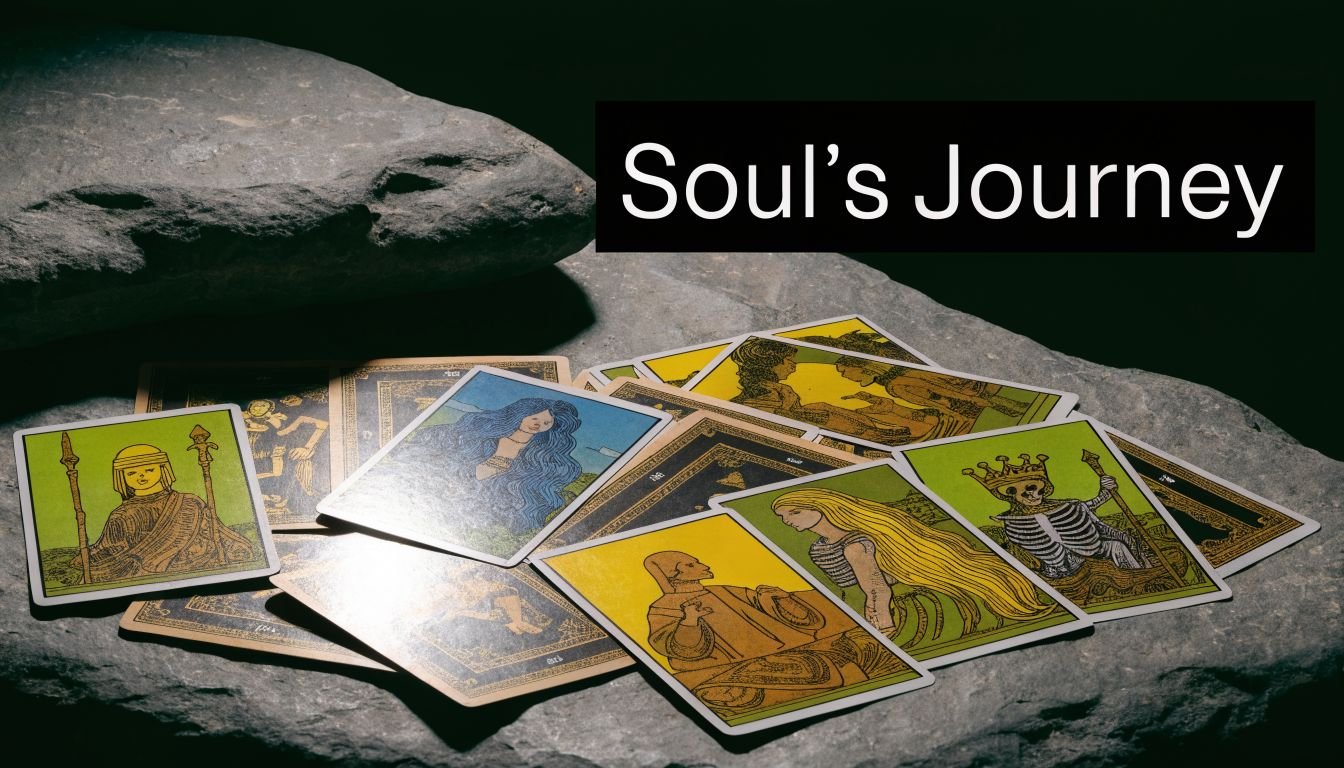
Tarot is a structured symbolic system. Where angel cards often offer a comforting message, tarot tends to show a broader scope. It reflects your patterns, tensions, choices, hopes, fears, and lessons. If angel cards feel like a caring voice, tarot feels more like a detailed map.
The structure that makes tarot different
Traditional tarot has a fixed architecture. The 78-card tarot structure has been rigidly fixed since its origin in 15th-century northern Italy. It includes 56 minor arcana and 22 major arcana trumps, and angel imagery appeared on high-ranking trump cards to symbolize divine judgment, as noted in this historical overview of tarot structure.
That fixed structure is one reason tarot feels deeper and more layered over time. You aren’t just drawing random inspiration cards. You’re working within a long-standing symbolic language.
Here’s the basic shape of that language:
- Major Arcana: These cards point to larger life themes, soul lessons, turning points, and archetypal experiences.
- Minor Arcana: These cards reflect everyday life, including emotions, thoughts, practical matters, relationships, and conflict.
- Court Cards: These often describe people, personality styles, or ways of responding.
Why tarot can feel intense but useful
Tarot doesn’t only show what feels soothing. It also shows friction. That’s part of its value. If a reading reveals avoidance, fear, grief, or a repeating cycle, tarot isn’t punishing you. It’s naming what’s present so you can work with it consciously.
Many readers feel intimidated. They assume tarot is predicting doom because some cards look dramatic. Usually, tarot is doing something simpler and more useful. It’s showing energy in motion. A difficult card can point to stress, resistance, or a needed change. A joyful card can point to alignment, connection, or momentum.
Tarot works best when you treat it as a mirror, not a threat.
A simple way to understand it is this. The Major Arcana is the big weather system. The Minor Arcana is today’s forecast. If you pull a Major card, the message may involve a longer chapter of growth. If you pull a Minor card, the reading may be speaking to the immediate situation in front of you.
That’s why tarot supports questions such as:
| Reading need | Tarot helps you explore |
|---|---|
| Decision making | What influences are shaping this choice |
| Pattern awareness | What keeps repeating and why |
| Relationships | What each person may be bringing into the dynamic |
| Shadow work | What you’re avoiding, denying, or ready to heal |
If you want your angel card tarot practice to include both kindness and depth, tarot is often the piece that provides the map.
Angel Cards vs Tarot A Direct Comparison
The easiest way to compare these tools is to stop asking which one is “better” and start asking what each one is designed to do. They overlap, but they don’t lead with the same voice.
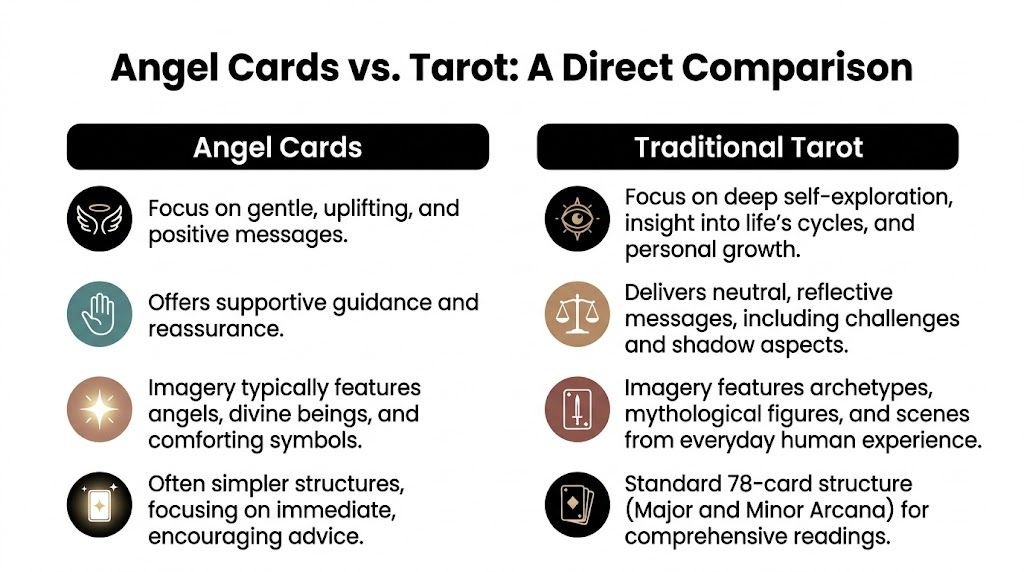
Angel cards usually center comfort, affirmation, and spiritual support. Tarot centers symbolism, complexity, and the full spectrum of human experience. One isn’t more spiritual than the other. They are suited to different moments.
Angel Cards vs Tarot at a Glance
| Feature | Angel Cards | Tarot |
|---|---|---|
| Structure | Often flexible and deck-specific | Fixed 78-card system |
| Tone | Gentle, uplifting, reassuring | Reflective, layered, sometimes confronting |
| Purpose | Comfort, encouragement, spiritual support | Insight, pattern recognition, deeper exploration |
| Learning curve | Usually easier to start with | Steeper because of symbolism and card relationships |
| Best for | Emotional steadiness, daily encouragement | Decisions, shadow work, life mapping |
One reason people still search for “angel card tarot” is that many readers want both. They don’t want an either-or answer. They want a reading that comforts without becoming vague, and one that reveals truth without becoming harsh.
That’s a real need. A discussion of common tarot frustrations notes a recurring gap in online guidance. Many people ask how to layer angel cards and tarot together, which shows a genuine desire for hybrid practice rather than a strict divide.
Later in this guide, you’ll see exactly how to do that.
A short video can also help if you learn best by hearing someone talk through the difference.
When to choose one over the other
Try this simple matching process.
- Choose angel cards when your energy feels tender, your thoughts are racing, or you want a loving message to center the day.
- Choose tarot when you need clarity around a situation, a relationship, or an internal pattern that keeps returning.
- Choose both when you want emotional support and practical insight in the same session.
Use angel cards to ask, “What will help me meet this moment well?” Use tarot to ask, “What is this moment showing me?”
This distinction removes a lot of confusion. If you keep drawing from the wrong tool for the wrong reason, the reading may feel off. Not because the deck failed, but because your intention and your method weren’t aligned.
Simple Spreads for Angel Cards and Tarot
You don’t need a complicated layout to start reading well. A small spread, used consistently, will teach you more than a large spread that overwhelms you. The key is to interpret the cards according to the tool in your hands.
A one card daily draw
This is the simplest daily practice, and it works beautifully with either deck.
With angel cards, ask: “What energy will support me today?”
Then read the message as guidance to embody. If the card points to trust, your practice may be to stop forcing every answer. If it points to compassion, you might soften your inner dialogue.
With tarot, ask: “What should I be aware of today?”
Now the card becomes a lens. A tarot card might point to a mood, a challenge, a dynamic, or a strength that will shape your day. Instead of just receiving comfort, you’re receiving context.
Reading tip: With angel cards, focus on the medicine in the message. With tarot, focus on the pattern the card is naming.
A three card spread for clarity
A strong beginner spread is:
- Where I am now
- What is influencing me
- What will help most
This works for both systems, but the tone changes.
With angel cards, the three cards can feel like a gentle conversation. The first card validates your current state. The second names what energy surrounds the issue. The third offers a supportive response.
With tarot, the same positions usually become more analytical. The first card may describe your emotional or practical reality. The second can show hidden pressure, a habit, or a relationship dynamic. The third often points to a wiser approach.
If you’re using affirmations in your ritual, you can pair the final card with spoken intention. Some readers like to anchor that practice with language-based manifestation work such as Your Word Is Your Wand.
A gentle hybrid reading
In these situations, angel card tarot becomes especially useful.
Pull one angel card first and ask, “What loving energy should hold this reading?” Then pull three tarot cards for the actual situation. The angel card sets the emotional container. The tarot cards provide the map.
For example:
- Angel card: Peace
- Tarot card 1: Your current state
- Tarot card 2: The obstacle
- Tarot card 3: The next wise step
This helps sensitive readers stay grounded while still receiving detail.
Advanced angel tarot systems take personalization even further. In Travis McHenry’s Angel Tarot and Occult Tarot decks, each of the 78 cards is assigned to one of the 72 Shem HaMephorash angels, and readers can identify personal guardian angels based on birth data before reading, as described in Benebell Wen’s review of Angel Tarot and Occult Tarot. If that sounds too technical, don’t worry. You don’t need a specialized system to begin. But it shows how rich this path can become if you want to go deeper later.
Integrating Divination into Your Daily Spiritual Practice
A reading becomes far more helpful when it belongs to a rhythm. If you only pull cards in moments of panic, the practice can start to feel like emergency decoding. When you read regularly, even briefly, the cards become part of your self-awareness.
Build a ritual that feels sustainable
Your routine doesn’t need to be elaborate. It just needs a clear shape.
You might try something like this:
- Morning grounding: Sit, breathe, and pull one card before checking your phone.
- Midday reset: Revisit the card and ask whether you’ve been living its guidance.
- Evening reflection: Write a few lines about how the message showed up in real life.
That rhythm works with angel cards, tarot, or a hybrid approach. The point is repetition. A simple ritual gives the reading somewhere to land.
You can also make the space feel intentional. Light a candle. Tidy the table. Say a short prayer or intention. If you use angel cards, ask for loving guidance. If you use tarot, ask for truth delivered with clarity and steadiness.
Keep your ritual small enough that you’ll actually return to it tomorrow.
Track what shifts after a reading
Many spiritual readers want their practice to feel not only meaningful, but observable. That instinct makes sense. A discussion of angel card basics and evidence-based tracking notes a 40% rise in wellness apps integrating divination, references a 2025 study showing an 18% vibration increase post-oracle use via HRV monitoring, and says 62% of spiritual seekers want evidence-based validation.
You don’t need lab equipment to honor that desire. You can create your own simple record.
Try tracking these after each reading:
| What to log | Example |
|---|---|
| Mood before | Scattered, tired, hopeful, tense |
| Card pulled | Name of angel card or tarot card |
| Message received | One sentence in plain language |
| Action taken | Rested, had a conversation, journaled, set a boundary |
| Mood after | Calmer, clearer, more focused |
A gratitude prompt can help too. So can a short note like, “What felt true?” or “What changed after I acted on this message?” This turns your reading practice into a living dialogue rather than a one-time mystical event.
If you like working with energy themes, pair your card practice with habits that support your overall state, such as journaling, grounding breathwork, or methods for raise your vibration. The card then becomes part of a wider self-care system.
The most helpful daily practice usually isn’t dramatic. It’s consistent, honest, and gentle enough to keep.
Conclusion Choosing the Right Tool for Your Path
The best choice isn’t angel cards or tarot in some absolute sense. The best choice is the one that meets your inner state authentically.
If you need warmth, reassurance, and a soft place to begin, angel cards are a beautiful companion. If you need depth, symbolism, and a clearer look at your patterns, tarot offers that map. If you want both, angel card tarot can become a balanced practice that supports your heart while sharpening your insight.
Trust your reason for reaching for the deck. That matters more than trying to choose the “perfect” system from the start. Some seasons call for comfort. Others call for courage and deeper examination. Many call for both.
The cards are tools, not tests. You don’t have to perform spirituality correctly to benefit from them. You just have to show up with sincerity, ask a clear question, and listen.
Start easily. Pull one card. Write one note. Let your practice grow from real experience, not pressure. The right path often becomes clear after you begin walking it.
If you’re ready to turn occasional card pulls into a grounded daily ritual, Spiritual Method offers a compassionate step-by-step guide for releasing negativity, raising your vibration, and building practices that support clarity, peace, and purpose. It’s especially helpful if you want structure around sacred space, cleansing, reflection, and steady spiritual growth.
Pingback: Am I in Love with My Friend? A Guide to Your Feelings