
Some days you wake up already tired. Your body is technically rested, but your mind feels crowded, your chest feels heavy, and even simple choices seem louder than they should. That’s often the moment people start searching for ways to raise your vibration.
What they usually find is a fog of spiritual language with very little guidance on what to do.
A higher vibration isn’t about acting cheerful when you’re hurting. It isn’t about pretending you’ve transcended stress. It’s about becoming more aligned, more honest, and more available to peace. When your inner state shifts, your choices shift with it. You notice what drains you faster. You return to what nourishes you sooner.
This guide takes a practical path. Start with quick resets you can use today. Build daily rituals that hold your energy steady. Go deeper when you’re ready. Track what changes so you’re not guessing. And when you hit a slump, respond with skill instead of self-judgment.
Table of Contents
- What It Really Means to Raise Your Vibration
- Immediate Vibrational Lifts You Can Do Today
- Building a High-Vibration Daily Routine
- Deeper Energy Work for Lasting Transformation
- Tracking Your Progress and Navigating Challenges
- Living a High-Vibration Life with Authenticity and Purpose
What It Really Means to Raise Your Vibration
If you feel stuck, flat, emotionally reactive, or strangely disconnected from your own life, that’s often what people mean when they say their vibration feels low. The word can sound mystical, but the lived experience is familiar. You don’t feel like yourself.
In practical terms, vibration points to the quality of your inner state. It includes your emotions, your thought patterns, your nervous system, and whether your choices match what you know is true for you. When your state is contracted, fearful, numb, or performative, life often feels harder than it needs to. When your state is clear and grounded, your next step becomes easier to see.

Authenticity sits higher than performance
One of the most useful corrections in spiritual work is this. You do not raise your vibration by faking a good mood. You raise it by becoming more authentic.
Research discussed in relation to the Scale of Positive and Negative Experience says authenticity vibrates at a level 400 times higher than love, linking alignment with your true self to a powerful emotional frequency (research on authenticity and SPANE). Whether you take that language as literal or symbolic, the lesson is valuable. Congruence matters.
Practical rule: If a practice makes you more honest, more present, and less split within yourself, it’s probably helping.
What raising your vibration actually changes
A higher inner state doesn’t make life perfect. It changes how you meet life.
You may notice:
- Cleaner decisions because you stop negotiating with what you already know.
- More emotional steadiness because you process feelings instead of storing them.
- Better discernment because your body spots draining people and environments faster.
- A sense of peace that comes from alignment, not from control.
That’s why this work matters. Not because you need to become “high vibe” all the time, but because you deserve to feel at home in your own energy.
Immediate Vibrational Lifts You Can Do Today
When your energy drops, you don’t need an elaborate ritual. You need something simple enough to do before your mind talks you out of it.
These quick lifts work best when you treat them like resets, not magic tricks. They won’t solve your whole life in ten minutes. They will help you interrupt a spiral.
Start with the body, not the mind
Trying to think your way into a better state often backfires when you’re overwhelmed. Begin with a physical signal of safety or presence.
Try one of these:
- Stand barefoot or sit with both feet flat. Press your soles into the ground and take slow breaths. On each exhale, soften your jaw and shoulders.
- Wash your hands slowly. Feel the temperature of the water. Let the act mark a transition out of stress and into awareness.
- Step outside for natural light. Don’t scroll. Look at the sky, a tree, or the line of a building. Give your eyes one thing to rest on.
That kind of grounding sounds small because it is small. Small is useful when you’re flooded.
Use a gratitude blitz when your mind is narrowing
Gratitude helps when your attention has locked onto lack, resentment, or pressure. Keep it fast so it doesn’t become forced.
Write down or say aloud:
- Three things your body did for you today
- Two people or moments that made life easier
- One thing you’re ready to stop carrying for the rest of the day
The shift comes less from being “positive” and more from widening your perception.
A low state narrows your field. A simple gratitude practice opens it again.
Change the room on purpose
Your environment affects your energy. If a room feels stagnant, don’t sit there waiting for inspiration.
Do one of these immediately:
- Open a window. Fresh air changes the feel of a space fast.
- Play music that softens your chest or lifts your posture. Don’t overthink the genre. Use what helps your body respond.
- Light a candle before you work, pray, journal, or rest. Ritual focus matters more than aesthetics.
- Clear one visible surface. A bedside table, desk corner, or kitchen counter can shift your mental load more than a long to-do list.
Speak one honest sentence
If you want to raise your vibration quickly, say something true. Saying it to yourself is fine.
Examples:
- I’m more tired than I realized.
- I need ten minutes before I answer that.
- I’m carrying tension that isn’t mine.
- I want peace more than performance today.
That sentence can break the trance of pretending.
Make your quick wins repeatable
Pick three fast practices and use them repeatedly for a week. Repetition teaches your system that relief is available.
A strong starter set is:
- Grounding through the feet
- A short gratitude list
- A room reset with light, air, or sound
You don’t need dozens of tools. You need a few that you’ll use.
Building a High-Vibration Daily Routine
Quick resets help, but your baseline changes through rhythm. Daily structure gives your energy somewhere to land.
A high-vibration routine shouldn’t feel like punishment dressed up as discipline. It should feel supportive enough that you can return to it on hard days, not just inspired ones.

Create a sacred start
The first part of your morning shapes more than mood. It shapes attention.
A simple morning rhythm might include:
- Hydrate before inputs. Drink water before email, texts, or news.
- Move gently at first. Stretch, walk, or do a few minutes of yoga before sitting still.
- Set one intention. Keep it grounded. “I stay present in hard conversations” works better than a vague wish to “have good energy.”
- Protect the first pocket of silence. Even a few quiet minutes changes the texture of the day.
If you like structure, keep your routine in one visible place. A notebook, printed checklist, or a guided resource from Spiritual Method tools and products can make consistency easier.
Use movement and meditation together
One of the strongest daily combinations is exercise followed by meditation. According to a wellness guide on integrated practice, a proven method for raising vibration involves combining daily aerobic exercise with meditation, and 70-80% of practitioners who stay consistent for 4-6 weeks report sustained mood elevation and energetic shifts (exercise plus meditation method).
That matters because the pairing does two different jobs.
Movement helps discharge static energy. Meditation helps you stop recreating it.
Here’s a workable version:
| Part | What to do | Why it helps |
|---|---|---|
| Movement | Walk, yoga, cycling, tai chi, or another form of aerobic or mindful movement | It wakes up the body and changes your state |
| Transition | Sit for a minute before meditation | It tells your system the pace is changing |
| Meditation | Sit quietly and follow your breath | It settles mental chatter |
| Reflection | Note how you feel afterward | It builds self-awareness |
This short practice is worth watching in action:
Close the day gently
Evening routines matter because unprocessed energy follows you into sleep. If your nights are full of stimulation, your mornings will have to work harder.
A simple closing ritual can include:
- A low-light transition in the last part of your evening
- A short journal release for worries, resentment, or unfinished thoughts
- Light stretching or slow breathing
- A closing question such as “What am I done carrying today?”
Your evening practice doesn’t need to be deep. It needs to tell your body the day is over.
If your current routine feels impossible, reduce it. A sustainable ritual beats an ideal one you abandon after three days.
Deeper Energy Work for Lasting Transformation
Daily habits stabilize you. Deeper energy work helps you remove what keeps pulling you back down.
Ritual becomes useful here. Not because candles, herbs, or moon phases are automatically powerful on their own, but because intention plus repetition creates a container where release becomes easier.
Cleanse energy with intention
Energy clearing works best when you’re specific. Don’t just wave smoke or ring a bell and hope for the best. Name what you are releasing and what you are inviting in.
A simple home or personal cleanse can look like this:
- Open the space first. Crack a window or door.
- Choose one clearing tool. Sound, breathwork, prayer, smoke cleansing, or visualization all work when used with focus.
- Move slowly through the space. Pay attention to corners, entrances, and the places where you work or sleep.
- Close with a statement. Say what remains. Peace, clarity, steadiness, rest.
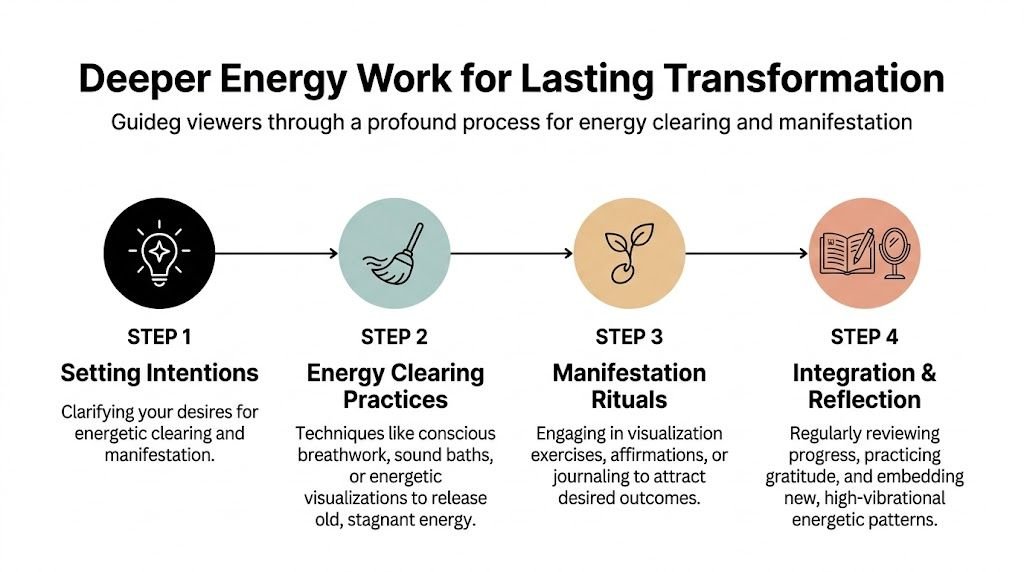
Not every cleanse has to be ceremonial. Some days, clearing a room, opening fresh air, and speaking an intention is enough.
Work with moon rhythms
Moon rituals can give your inner work a useful cadence.
Try this pattern:
| Moon phase | Best focus | Practice |
|---|---|---|
| New Moon | Begin | Set intentions, write desires, choose one aligned action |
| Full Moon | Release | Journal what feels complete, grieve, forgive, simplify |
Use these rituals to sharpen awareness, not to bypass responsibility. Intention without action becomes fantasy. Action without reflection becomes strain.
For a guided framework that includes grounding, moon-aligned ritual support, and reflection tools, the Spiritual Awakening Guide offers a structured path.
Shadow work changes the root
If you only use uplifting practices, you may feel better for a while without changing the pattern underneath. That’s where shadow work matters.
Shadow work means meeting the parts of yourself you’ve rejected, suppressed, or hidden. Anger. Neediness. Fear. Jealousy. Grief. The wish to be seen. The wish to be left alone. These parts don’t disappear because you cover them with affirmations.
A shadow process shared by Christina Lopes emphasizes acceptance, identification, conscious release, daily reprogramming, and integration monitoring, and notes that this kind of work can improve long-term results by 60% compared to positivity-only methods (shadow work process and long-term results).
That sequence matters.
Acceptance
Stop fighting the feeling long enough to admit it’s there.Identification
Journal the trigger, story, and body sensation. Ask what this reaction is protecting.Conscious release
Use breath, tears, prayer, movement, or visualization to let energy move.Reprogramming
Replace the old inner script with something more accurate and less punishing.Integration
Review patterns over time so the insight becomes lived change.
Some of the discomfort people feel at the start of spiritual work isn’t failure. It’s buried material becoming visible.
That’s why deeper practices create lasting transformation. They don’t just brighten the surface. They clear the drag underneath it.
Tracking Your Progress and Navigating Challenges
A lot of people quit this work because they can’t tell whether anything is changing. They’re meditating, journaling, cleansing, or moving their body, but the results feel inconsistent.
Progress in spiritual practice is rarely linear. It helps to track patterns instead of asking, “Do I feel amazing today?”
What to track each week
Use a simple tracker for one week before you change anything major. Then keep using it as your practices settle.
Sample Weekly Vibration Tracker
| Day | Morning Practice (e.g., Meditation, Gratitude) | Evening Practice (e.g., Journaling, Stretching) | Energy Level (1-5) | Mood Level (1-5) | Clarity Level (1-5) | Notes/Insights |
|---|---|---|---|---|---|---|
| Monday | ||||||
| Tuesday | ||||||
| Wednesday | ||||||
| Thursday | ||||||
| Friday | ||||||
| Saturday | ||||||
| Sunday |
Keep the notes practical.
Record things like:
- What helped quickly
- What drained you
- Who or what consistently changed your state
- Whether your body felt open, shut down, restless, or calm
After a week, patterns start to show themselves.
Use measurable signals without losing intuition
Some people want more than a mood score. That’s reasonable. Not everything in spiritual practice can be measured, but some things can be tracked indirectly.
One example is Heart Rate Variability, often shortened to HRV. In the context of vibration work, HRV has been discussed as a measurable proxy. A 2025 study found that daily gratitude journaling increased HRV by 18% over 8 weeks in stressed professionals, and that increase correlated with reduced anxiety (HRV and gratitude journaling findings).
That doesn’t mean HRV is your soul on a graph. It means your body can sometimes reflect changes that your spirit already feels.
If you use a wearable or tracking app, treat it as one lens among several. Pair it with journaling and self-observation.
Helpful lens: The most important measure is not whether every day feels light. It’s whether you recover faster, react less blindly, and return to yourself more easily.
When practices don’t seem to work
Disappointment can turn into cynicism quickly.
A 2021 MSU Denver study found no statistically significant mood effects from exposure to different vibrational frequencies alone (MSU Denver vibration study). That’s a useful corrective. Sound or frequency by itself may not create the shift people hope for.
What tends to matter more is the psychological and intentional part of the practice. Your attention. Your belief. Your emotional honesty. Your consistency.
If something isn’t helping, ask:
- Am I doing this mechanically?
- Am I avoiding the underlying feeling?
- Is this practice calming me, or just distracting me?
- Would a simpler method work better right now?
Why you might feel worse at first
Sometimes people begin journaling, meditating, or doing shadow work and feel more emotional for a while. That can happen when numbness starts to lift.
Common signs include:
- More tears
- Vivid dreams
- Irritability
- Temporary fatigue
- A stronger awareness of what no longer fits
That doesn’t always mean the practice is right, but it also doesn’t automatically mean it’s wrong. Go slower. Shorten the sessions. Add grounding. Drink water. Rest more. Keep your life simple while things surface.
Protecting your energy around negative people
Protection starts before the interaction, not after the damage.
Use a short sequence:
- Name your intention before entering the space
- Relax your body so you don’t absorb by bracing
- Limit overexplaining
- Leave when your body says enough
- Clear yourself afterward with breath, movement, water, or silence
You don’t need to win every energetic battle. Often the high-vibration move is to disengage sooner.
Living a High-Vibration Life with Authenticity and Purpose
A high-vibration life isn’t built from one perfect morning or one beautiful ritual. It’s built from repeated returns.
You return after a draining meeting. You return after an old trigger. You return after a season when your practices went quiet. That returning is the work.
The strongest path is usually the least theatrical one. Ground your body. Tell the truth. Move energy regularly. Use ritual with intention. Track what changes. Keep what helps. Release what only sounds spiritual.
That grounded approach also keeps expectations realistic. As noted earlier, the 2021 MSU Denver study found no statistically significant mood effects from exposure to different vibrational frequencies alone, which is why intention, meditation, gratitude, and emotional engagement matter more than passive exposure to “high-frequency” inputs.
Authenticity remains the center of it all. Not image. Not performance. Not trying to look evolved while your inner world asks for care.
If you want an example of this path in lived form, the story behind Spiritual Method reflects the kind of journey many people are on when they begin this work. They’re tired of carrying confusion, stress, and disconnection. They want a calmer way to live.
Raise your vibration by becoming more yourself. That’s the shift that lasts.
If you're ready for guided support, Spiritual Method offers a compassionate next step. It brings together grounding rituals, energy-clearing practices, reflection tools, and practical structure for people who feel stuck, drained, or in the middle of spiritual awakening and want a clear way forward.
Made with the Outrank app
Pingback: Mystic Christianity Book: Top Reads 2026 – Spiritual awakening guide
Pingback: How to Trust Your Intuition: Unlock Inner Wisdom
Pingback: Unlock Power: Crystals for Healing and Protection – Spiritual awakening guide
Pingback: Mastering Magick Theory Practice – Spiritual awakening guide
Pingback: Your Word Is Your Wand: How to Speak Your Reality – Spiritual awakening guide
Pingback: Your Practical Spiritual Awakening Guide – Spiritual awakening guide
Pingback: How to Calm an Overactive Mind: A 4-Part Program – Spiritual awakening guide
Pingback: Angels on Earth: A Guide to Recognizing Divine Helpers – Spiritual awakening guide
Pingback: Mastering Daily Spiritual Practices for a Centered Life – Spiritual awakening guide
I just like the valuable information you provide on your articles.
I will bookmark your blog and test once more right here regularly.
I am quite certain I’ll be informed plenty of new stuff
right here! Good luck for the following!
Visit the website and and purchase the book deal. I have another one on the Sun Healing Method but that will be down the line when I get sales in abundance. It takes a lot of energy and money. Thank you for the support and kind energy!