
You may be sitting with a small stack of books, a half-finished journal, and a feeling you can’t quite name. Maybe church language still moves you, but it no longer feels like enough on its own. Maybe meditation, energy work, crystals, or moon rituals have helped you feel calmer and more grounded, yet you’re wondering whether there’s a deeper Christian stream that speaks to that same hunger for direct encounter.
There is.
A good mystic christianity book doesn’t just explain ideas. It helps you move from belief about God to felt relationship with God. It gives language to longing, silence to rest in, and practices that make spiritual life less abstract. For many modern seekers, that’s the missing piece.
Table of Contents
- Answering the Call for Something Deeper
- What Is Mystic Christianity
- The Ancient Roots of Christian Mysticism
- Essential Classic Mystic Christianity Books
- Modern Guides to the Mystic Path
- Integrating Mystic Wisdom with Modern Rituals
- Your Next Steps on the Mystic Journey
Answering the Call for Something Deeper
Some people arrive at Christian mysticism through exhaustion.
They’ve done the outward parts of religion. They’ve listened, attended, tried to be faithful, tried to think the right thoughts. But underneath all that effort is a quiet ache. They don’t want more information. They want contact. They want a life that feels rooted, alive, and inwardly honest.

That’s often the moment a mystic christianity book becomes meaningful. Not as an academic hobby, but as a companion for spiritual awakening. If that phrase resonates, this collection of reflections on spiritual awakening may feel familiar too.
Longing often starts in ordinary life
A stressed professional might wake up tired, scroll through the news, rush through the day, and still feel spiritually numb by evening. A yoga student might love silence and breathwork but wonder how that hunger connects with Jesus. Someone healing from anxiety might find comfort in prayer, yet feel drawn toward more embodied practices like candle lighting, sacred bathing, or holding a crystal during meditation.
These are not strange combinations. They’re often signs that the soul wants a faith it can inhabit.
Mystic Christianity meets that need by taking inner experience seriously. It treats silence as meaningful. It values contemplation, love, surrender, and direct awareness of divine presence.
Practical rule: If a spiritual book leaves you with more concepts but less prayerful presence, it may be informative, but it isn’t guiding you into the heart of the mystical path.
The reader is usually looking for permission
Many seekers don’t need more intensity. They need permission to slow down.
They need to hear that the Christian tradition has always contained an inward stream. They need to know that questions, longing, and contemplative practice aren’t departures from faith. For many people, they’re the beginning of a more honest one.
That is why mystical books matter so much. They help readers recognize that spiritual depth isn’t reserved for specialists, monks, or saints in stained glass. It can begin in a living room chair, early in the morning, before anyone else wakes up.
A good book opens that door. A great one helps you walk through it.
What Is Mystic Christianity
Mystic Christianity isn’t a separate denomination. It’s the experiential heart of Christianity.
It asks a simple but demanding question. Do you only want to learn about God, or do you want to become inwardly available to God?
The difference between belief and experience
A helpful analogy is swimming.
You can read about water for years. You can learn currents, depth, temperature, and technique. But until you enter the water, your knowledge stays secondhand. Mystic Christianity is the movement from description to participation.
That’s why mystical writers focus so much on silence, contemplative prayer, surrender, purification of desire, and loving attention. They are less interested in collecting spiritual opinions and more interested in transformation.
Many readers get confused here because the word mystic sounds secretive or extreme. In this tradition, it usually means something simpler and deeper. It means direct encounter with divine reality that changes how a person sees, loves, and lives.
Another phrase you may meet is unio mystica, or mystical union. That doesn’t mean a person becomes God. It means the soul learns deep communion with God. Separation softens. Attention clears. The person becomes more grounded in love.
Why practice changes the reader
Mystical theology often grew alongside contemplative practice. Pre-modern mystics drew on Neoplatonic ideas to describe ascent toward divine union, and this kind of contemplative life is also being studied today. Research on Carmelite practitioners of centering prayer reported a 25% cortisol reduction and a 40% increase in gamma-wave synchrony, according to Oxford Academic’s discussion of mystical Christianity.
That matters because modern readers often want to know whether ancient practices affect real life. They do. Not only in grand visions, but in nervous system regulation, steadier attention, and a calmer way of moving through the day.
A short visual explainer can help make that easier to grasp.
Here’s the plain-language version:
- Contemplation quiets noise: You stop feeding every thought.
- Prayer becomes relational: You shift from performing words to resting in presence.
- The self becomes less fragmented: Inner life, body, and daily action begin to align.
Mystical Christianity is not about escaping the world. It’s about becoming more awake within it.
A strong mystic christianity book helps you practice that awakening, not just admire it.
The Ancient Roots of Christian Mysticism
Mystic Christianity is ancient. It isn’t a wellness-era remix of faith.
Its earliest roots reach back to the first century, with biblical figures such as John the Evangelist and Paul of Tarsus named among the earliest Christian mystics in scripture, as described in Richard Rohr’s reflection on the mystical heartbeat of Christianity.
From scripture to the desert
Something important happened after Christianity gained social acceptance in the Roman world following the 313 Edict of Milan. As public Christianity became more established, many seekers went in the opposite direction. They withdrew to the deserts of Egypt and Palestine and to Irish forests, looking for a life stripped of distraction.
Those communities gave rise to the first monasteries. They became the main centers of mystical practice in the fourth and fifth centuries. For a very long stretch, from the fifth to the fifteenth centuries, nearly all the great Christian mystics lived as monks or nuns.
That history helps explain why mystical books often speak the language of solitude, discipline, prayer, purification, and inward attention. They were forged in places where silence wasn’t an accessory. It was the environment.
From monastery to daily life
The monastic period did not last unchanged forever. The Renaissance and Reformation reduced the central role of monasteries, and the mystical current gradually moved beyond cloistered life.
That shift matters for modern readers.
It means the tradition didn’t disappear when fewer people entered monastic communities. It adapted. Over time, Christian mysticism became more available to ordinary people living in ordinary settings.
Two later figures are especially helpful for understanding this democratizing movement. Evelyn Underhill (1875–1941) wrote about mysticism in a way that invited serious lay readers into the tradition. Karl Rahner (1904–1984) pushed the idea even further, arguing that the future Christian would need lived spiritual depth, not just inherited structure.
Matthew Fox’s Christian Mystics: 108 Seers, Saints, and Sages offers one broad modern map of this long story. The book profiles 108 mystics across more than 2,000 years of Christian history and organizes them into nine categories, with 12 examples in each group. That kind of framework helps readers see that mysticism has never been one personality type or one narrow style. It includes visionaries, poets, saints, heretics, and soul-friends.
For a modern seeker, that can be a relief.
You don’t have to become medieval to receive wisdom from the medievals. You only have to become honest enough to listen.
Essential Classic Mystic Christianity Books
If you want one mystic christianity book to start with, choose the one that matches your actual spiritual temperament, not the one that sounds the most impressive.
Some classics are poetic and spacious. Some are practical. Some are demanding. The best entry point is the one you’ll keep returning to.
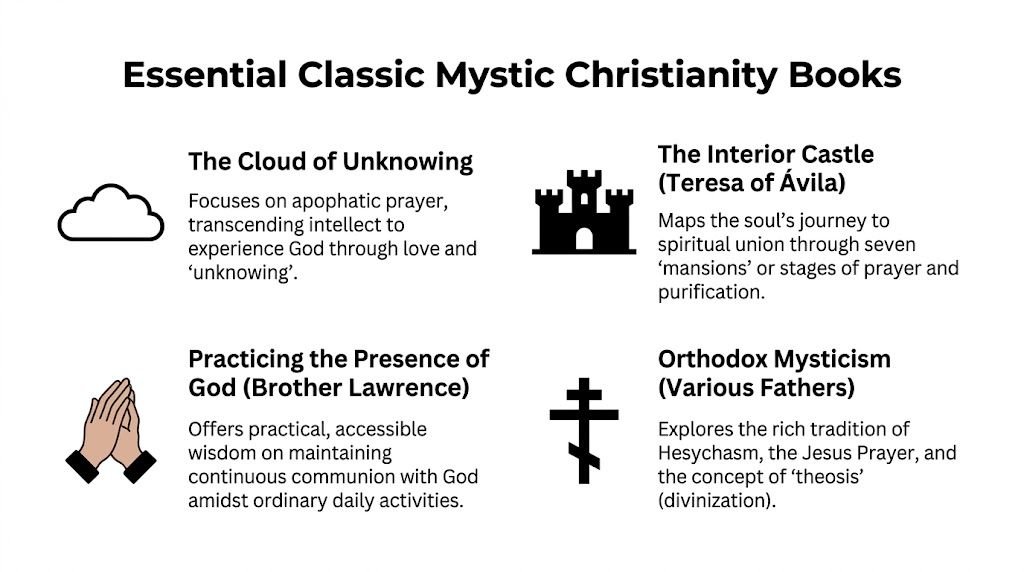
Four classics that still guide readers
The Cloud of Unknowing is for readers who keep trying to think their way into God. Its central insight is that love can go where intellect cannot. This is a demanding but freeing book if your prayer life has become overly mental.
The Interior Castle by Teresa of Ávila helps readers who want a map. Teresa describes the soul as a castle with many rooms, moving inward toward deeper union. If you like stages, interior discernment, and careful spiritual observation, this one rewards patience.
Practicing the Presence of God by Brother Lawrence is the most approachable for daily life. It teaches that communion with God can happen while washing dishes, walking, cooking, or working. Readers who feel intimidated by mystical language often find relief here.
Orthodox mystical writings on Hesychasm and the Jesus Prayer offer a strong path for people drawn to sacred repetition, inner stillness, and the idea of theosis, or participation in divine life. This stream feels especially grounded and prayer-centered.
One helpful bridge between classic voices is an anthology. Andrew Harvey’s Teachings of the Christian Mystics gathers writings spanning 19 centuries and includes figures such as Francis of Assisi, Meister Eckhart, Julian of Norwich, and Teresa of Ávila, making the tradition easier to enter through one volume, as described on Shambhala’s page for the anthology.
Classic Mystic Christianity Books At-a-Glance
| Book Title | Author | Core Concept | Best For Readers |
|---|---|---|---|
| The Cloud of Unknowing | Anonymous | God is approached through love and surrender rather than analysis | Overthinkers and contemplative beginners |
| The Interior Castle | Teresa of Ávila | The soul moves inward through stages of prayer | Readers who want a structured inner map |
| Practicing the Presence of God | Brother Lawrence | Daily life can become continuous prayer | Busy people who want simple practice |
| Orthodox mystical writings | Various Fathers | Stillness, the Jesus Prayer, and theosis | Readers drawn to devotional repetition and sacred silence |
A few selection tips help here:
- Choose for readability: If you’re spiritually tired, begin with Brother Lawrence.
- Choose for depth of method: If you want a mature inner framework, read Teresa.
- Choose for apophatic prayer: If words often fail you, start with The Cloud of Unknowing.
Modern Guides to the Mystic Path
Modern writers matter because many readers need translation before they need intensity.
Ancient mystical books can be luminous, but they can also feel remote. A modern guide can name the same inner movements in language that sounds closer to lived experience now.
Modern writers as translators
Some authors serve as bridges. They don’t replace the older voices. They help you hear them.
Richard Rohr is often useful for readers drawn to non-dual awareness and contemplative Christianity. Cynthia Bourgeault helps readers connect mystical theology with actual contemplative practice. Jason M. Baxter’s An Introduction to Christian Mysticism is another good option for readers who want a historical sweep with accessible framing.
These authors are especially valuable if you’re carrying spiritual wounds. They tend to write with more psychological awareness than many older texts, which can help readers distinguish healthy surrender from self-erasure, and silence from suppression.
How to read Alan Watts with discernment
Alan Watts is one of the most interesting modern cases.
His Behold the Spirit challenged the spiritual dryness he perceived in organized Christianity after the war years. Many readers still find him vivid, lucid, and refreshing. He can make Christian themes feel open and alive.
But he also divides readers. Goodreads data discussed in a Patheos analysis shows that 60% of over 1,200 reviewers praised the book’s accessibility, while 25% questioned its orthodoxy, reflecting a real split in reception around clarity versus syncretism in this discussion of Alan Watts and mystical Christianity.
That split is useful.
It reminds you not to ask only, “Is this book inspiring?” Ask, “What kind of inner life does this book produce in me?” A book may expand your imagination while also blurring distinctions that matter to you.
Use discernment like this:
- Read for resonance: Notice what opens your heart toward prayer, humility, and compassion.
- Read for drift: Notice when a writer’s language becomes so broad that the Christian center fades.
- Read in balance: Pair a bold modern interpreter with an older mystical text.
If your broader spiritual work includes energy language or subtle-body practices, this article on how to raise your vibration may help you notice where modern spiritual vocabulary overlaps with, and differs from, classic contemplative language.
A modern guide is doing its job when it makes you more grounded, more prayerful, and more honest. Not just more impressed.
Integrating Mystic Wisdom with Modern Rituals
At this point, many readers feel both excited and unsure.
They may love contemplative Christianity and also feel drawn to crystals, cleansing rituals, sacred baths, candle work, or moon-based reflection. What they rarely find is careful guidance on how to combine those worlds without making the practice shallow or confused.
Why this blending makes sense
Interest in this blend is real. Google Trends data from late 2025 to early 2026 showed a 28% surge in searches for “Christian mysticism + crystals” in the US and UK, yet few resources offer structured guidance, as noted in this discussion of the gap around Christian mysticism and crystals.

The reason the blend can work is simple. Mystical Christianity is concerned with inner alignment, purified attention, loving presence, and surrender to God. Many integrative rituals aim at something adjacent on the human level. They help the body slow down, focus intention, and mark sacred space.
The ritual object is not the source of divine power. It is a support for attention.
That distinction keeps the practice grounded.
A candle can help you settle. A crystal can help you remember an intention. The prayer is still the center.
Simple pairings for real life
Here are a few ways to connect classic mystical themes with modern ritual practice without forcing them together.
- Brother Lawrence and household ritual: While making tea or cleaning your space, hold the simple intention “I am here with God.” If you use cleansing herbs or incense, let the action become a bodily cue for returning to presence.
- Teresa of Ávila and journaling with crystals: Before prayer, place a chosen crystal beside your journal, not as a guarantee of spiritual power, but as a concrete symbol of your intention to move inward with honesty.
- The Cloud of Unknowing and moonlit silence: If moon phases already help you mark inner rhythms, use that time for wordless prayer. Release the need to solve yourself. Sit, breathe, and consent to not knowing.
- Meister Eckhart and decluttering rituals: If you resonate with detachment, pair contemplation with the clearing of a room, altar, or work area. Let the outer act mirror the inward letting go.
A few safeguards matter:
- Keep Christ-centered intention clear: Ask what draws you toward love, humility, and prayer.
- Use tools lightly: Ritual supports the practice. It doesn’t replace inner surrender.
- Watch the fruit: If a ritual leaves you calmer, kinder, and more present, it may be serving your path well.
If you enjoy building practices around rest and renewal, this collection on self-care rituals offers ideas that can be adapted into a contemplative rhythm.
The point isn’t to make Christian mysticism trendy. It’s to let ancient wisdom become embodied enough to live in your real day.
Your Next Steps on the Mystic Journey
Reading mystics can stir a beautiful longing. It can also leave you scattered if you try to read everything at once.
A calmer approach works better. Pick one accessible guide, one classic text, and one simple daily practice. Let depth come from repetition.
A gentle reading order
This sequence works well for many beginners:
- Start with a modern bridge text. Choose a contemporary author whose language feels clear and welcoming.
- Move to Brother Lawrence. Let daily-life prayer become concrete.
- Read Teresa or The Cloud slowly. Don’t rush. These books are companions, not assignments.
- Use an anthology for breadth. If you want a wider sense of the tradition, dip into a collected volume after you’ve found your footing.
If you’re drawn to a single mystic christianity book right now, choose the one that answers your present need. Do you need simplicity, structure, silence, or discernment? Let that answer guide the pick.
Three practices to begin this week
One minute of consent prayer each morning
Sit down before your phone takes your attention. Breathe slowly. Say, “God, I am here.” Stay with that for a minute. This trains receptivity.
A physical cue for presence
Choose one object for prayer time. It might be a candle, journal, cross, or stone. Use it consistently. The repetition teaches your body when it’s time to become inwardly still.
A short evening review
Before bed, write down where you felt close to peace and where you felt pulled away from it. Don’t judge. Notice. Mystical growth often begins with gentle awareness.
One more thing helps many readers. Keep expectations low and consistency high.
Remember: Mystical life usually grows quietly. You may notice fewer dramatic experiences and more steadiness, tenderness, and inner clarity.
If a book confuses you, set it aside for a while. If a practice feels performative, simplify it. If a ritual helps you become more prayerful, keep it.
The path doesn’t ask you to become someone else. It asks you to become more available to the sacred presence already meeting you.
If you want a structured way to turn spiritual reading into daily practice, Spiritual Method offers a gentle step-by-step guide for grounding, energy renewal, intention-setting, sacred bathing, crystal and herb work, and simple rituals that support clarity, peace, and consistency. It’s a practical companion for readers who feel called to mystical depth and want supportive tools for living it each day.