
Spiritual grounding is defined as the practice of anchoring your awareness, energy, and presence to the physical body and the Earth to achieve mental, emotional, and spiritual stability. The term “earthing” describes the physical dimension of this practice, while spiritual grounding covers the broader energetic and psychological work of staying present and embodied. Tools like Black Tourmaline crystals, grounding mats, and the 5-4-3-2-1 sensory technique each serve this same core purpose: connecting you to the present moment so that higher-frequency spiritual experiences do not overwhelm your daily functioning. At Spiritualmethod, this practice forms the foundation of inner healing across mind, body, and soul.
What is spiritual grounding vs. physical earthing?
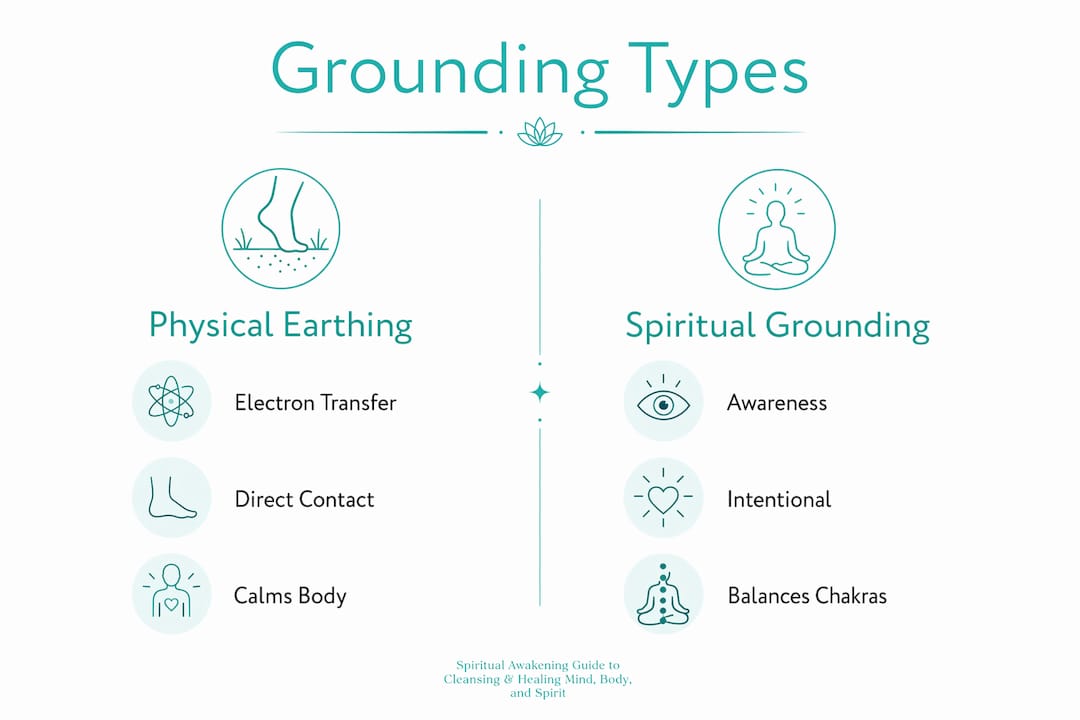
Earthing and grounding are distinct practices: earthing refers specifically to direct skin contact with the Earth’s surface, while spiritual grounding encompasses the broader psychological and energetic work of staying present and stable. Both serve the same underlying goal, but they operate through different mechanisms.
Physical earthing works through direct electron transfer. When bare skin contacts damp grass, sand, or soil, the body absorbs free electrons from the Earth’s surface. Grounding may reduce inflammation, stress, and improve sleep patterns through this process. That means a 20-minute walk on wet grass is not just pleasant. It is a measurable physiological event.
Spiritual grounding, by contrast, works through awareness and intention. It balances the upper chakras, which govern spiritual insight and higher consciousness, with the lower chakras and physical body, which govern embodiment and practical functioning. Think of it as maintaining a vertical axis: spiritual insight flows downward into lived experience, and earthly stability supports upward spiritual growth.

| Dimension | Physical earthing | Spiritual grounding |
|---|---|---|
| Primary mechanism | Electron transfer through skin contact | Awareness, breath, and intentional presence |
| Common tools | Bare feet on grass, grounding mats, sand | Crystals, breathwork, visualization, sensory techniques |
| Measurable effects | Reduced inflammation, improved sleep | Reduced anxiety, emotional regulation, mental clarity |
| Duration needed | 20–30 minutes of direct contact | Varies; even 5 minutes of breathwork is effective |
| Risk factors | Electrical shock from poor-quality indoor devices | Spiritual bypass if practiced without embodiment focus |
One critical misconception deserves direct correction. Grounding is not the opposite of transcendence. True spiritual depth integrates both presence and transcendence. Grounding does not pull you away from spiritual growth. It gives that growth a stable foundation to stand on.
What are the mental and emotional benefits of spiritual grounding?
Spiritual grounding produces concrete, well-documented benefits for mental and emotional health. Grounding techniques use different brain and body parts to reestablish regulation and centered presence by focusing on the physical environment. That regulation is the starting point for every other mental health benefit.
The psychological benefits of a consistent grounding practice include:
- Reduced anxiety. Sensory focus and breathwork interrupt the nervous system’s stress response before it escalates.
- Improved emotional regulation. Grounding creates a pause between stimulus and reaction, giving you space to choose your response.
- Greater mental clarity. Presence reduces the cognitive noise of rumination and future-focused worry.
- Deeper sleep. Physical earthing supports the body’s natural circadian rhythms by reducing cortisol and systemic inflammation.
- Stronger sense of identity. Grounding anchors you in your body, which prevents the dissociation that often accompanies intense spiritual or emotional experiences.
Spiritual grounding anchors your energy to Earth to stay stable during high-vibration spiritual work and prevents energetic overwhelm. This is especially relevant for people going through a spiritual awakening, when the influx of new awareness can feel destabilizing without a grounded foundation.
“True grounding provides a foundation that allows higher-frequency spiritual experiences to be integrated harmoniously into daily life.” — Thalira, Quantum Codex
Grounding also connects the individual to something larger than personal experience. Grounding is relational, connecting the individual to the more-than-human world and providing moral clarity and stability to navigate societal turmoil. That relational quality is what separates grounding from simple relaxation techniques. It is not just calming. It is orienting.
How to practice spiritual grounding: techniques that work
Effective grounding practice draws from both physical and mental methods. Experts distinguish physical grounding as skin contact with the Earth and mental grounding as sensory or breathwork techniques used to manage anxiety. A well-rounded practice uses both.
Physical grounding methods
- Walk barefoot outdoors. Damp grass, sand, or soil conducts the Earth’s charge most effectively. Aim for 20–30 minutes of direct skin contact for measurable physiological benefit.
- Garden with bare hands. Direct soil contact while tending plants combines physical earthing with focused, present-moment attention.
- Lie on the ground. Full-body contact with the Earth maximizes electron transfer and encourages deep physical relaxation.
- Immerse in natural water. Rivers, lakes, and the ocean all conduct Earth energy and provide a powerful sensory reset.
- Use a grounding mat indoors. These devices connect to the grounding wire in a wall outlet to simulate outdoor earthing. Use them with caution. Indoor grounding equipment carries risks including electrical shock, especially with poor-quality devices or for people with medical implants.
Spiritual and mental grounding techniques
The 5-4-3-2-1 sensory method is one of the most effective mental grounding tools available. Name 5 things you can see, 4 you can touch, 3 you can hear, 2 you can smell, and 1 you can taste. This sequence pulls attention out of abstract thought and into the body within minutes.
Breath awareness is equally direct. A slow, deliberate exhale activates the parasympathetic nervous system and signals safety to the body. Four counts in, six counts out, repeated for three minutes, produces a measurable shift in nervous system state.
Visualization grounds through imagery. Picture roots extending from the base of your spine deep into the Earth. Hold that image while breathing slowly. This practice balances the root chakra and reinforces the sense of physical embodiment that spiritual work can sometimes erode.
Grounding crystals like Black Tourmaline, Hematite, and Smoky Quartz are used in many spiritual traditions to support energetic stability. Holding one during meditation or placing it at the base of your spine during breathwork adds a tactile anchor to the practice.
Pro Tip: Pair any grounding technique with a consistent daily time slot. Morning grounding before checking your phone sets a stable foundation for the day. Evening grounding after intense spiritual practice helps integrate experiences before sleep. Consistency matters more than duration.
For readers managing anxiety alongside their spiritual practice, Spiritualmethod’s guide on grounding for anxiety relief provides a structured framework for building these routines.
What are the signs you are ungrounded?
An ungrounded person may be highly spiritual but dysfunctional in practical daily life due to lack of embodiment. This is one of the most common and least discussed challenges in spiritual development.
Common signs of being ungrounded include:
- Persistent anxiety or a sense of floating that does not resolve with rest
- Difficulty making decisions or following through on practical tasks
- Chronic fatigue that is not explained by physical illness
- Emotional overwhelm in ordinary situations
- Spaciness, forgetfulness, or feeling disconnected from your body
- Difficulty being present in conversations or relationships
- Heightened sensitivity to other people’s emotions without clear boundaries
These symptoms share a common root: disconnection from the physical body and the present moment. Spiritual practices that emphasize transcendence, visualization, or energy work without balancing physical embodiment can intensify this disconnection over time.
| Sign | What it indicates | Grounding response |
|---|---|---|
| Anxiety and spaciness | Nervous system dysregulation | 5-4-3-2-1 sensory technique or breathwork |
| Decision paralysis | Disconnection from instinct and body wisdom | Barefoot walking, physical activity |
| Emotional overwhelm | Lack of energetic boundaries | Crystal work, visualization of roots |
| Chronic fatigue | Depletion from unintegrated spiritual energy | Physical earthing, sleep hygiene |
| Social disconnection | Overemphasis on inner world at expense of relationships | Relational grounding, nature immersion |
Pro Tip: If you notice three or more of these signs consistently, treat grounding as a daily non-negotiable rather than an occasional practice. Pair it with releasing negative energy to clear what accumulates when you are ungrounded.
Restoring balance does not require dramatic intervention. Even five minutes of barefoot contact with the Earth or a single round of the 5-4-3-2-1 technique can shift the nervous system toward regulation. The key is recognizing the signs early and responding with a consistent, structured practice.
Key takeaways
Spiritual grounding is the most reliable method for integrating spiritual growth into stable, functional daily life without losing the depth of that growth.
| Point | Details |
|---|---|
| Core definition | Spiritual grounding anchors awareness and energy to the body and Earth for mental and emotional stability. |
| Physical vs. spiritual | Earthing uses skin contact for electron transfer; spiritual grounding uses breath, intention, and sensory focus. |
| Proven benefits | Grounding reduces inflammation, anxiety, and emotional overwhelm while improving sleep and mental clarity. |
| Key techniques | The 5-4-3-2-1 method, barefoot earthing, breathwork, and crystals like Black Tourmaline each serve distinct grounding functions. |
| Warning signs | Spaciness, decision paralysis, and chronic fatigue signal a grounding deficit that daily practice can correct. |
Why grounding changed how I think about spiritual growth
I used to treat grounding as the least interesting part of spiritual practice. Breathwork, visualization, energy work, those felt like the real work. Grounding felt like maintenance.
That view was wrong, and it cost me. After a period of intense spiritual exploration, I found myself increasingly anxious, scattered, and unable to function well in ordinary life. I was, in the language of the field, highly spiritual and deeply ungrounded. The vertical axis was open. The horizontal one had collapsed.
What I learned from that experience is that balancing vertical consciousness with horizontal rootedness is not optional. It is the actual work. Spiritual insight without embodiment produces dissociation, not wisdom. The most grounded people I have encountered in this field are also the most practically effective. They can hold a high-frequency spiritual experience and then go make dinner, have a real conversation, and sleep well. That integration is the goal.
The other thing I would tell anyone starting this practice: do not wait until you are overwhelmed to ground. Build it into your daily spiritual practices before you need it. Grounding is far more effective as a preventive structure than as a crisis response. Five minutes every morning is worth more than an hour once a week when things fall apart.
— Sean
Deepen your grounding practice with Spiritualmethod
Spiritual grounding becomes most effective when it is part of a broader, structured approach to inner healing. Spiritualmethod offers practical guides designed to support exactly that kind of reflective, routine-based practice.

One of the most recommended starting points is the Journaling for Soul Healing guide, which pairs written reflection with grounding work to help you process and integrate what surfaces during practice. For readers who want to explore how sacred rituals support healing, Spiritualmethod provides structured frameworks that make these practices accessible and consistent. Every resource at Spiritualmethod is built around one principle: practical methods toward inner healing for mind, body, and soul.
FAQ
What does grounding mean spiritually?
Spiritually, grounding means anchoring your energy and awareness to the physical body and the Earth to maintain stability during spiritual or emotional experiences. It prevents energetic overwhelm and supports the integration of higher-frequency insights into daily life.
How long does it take for grounding to work?
Physical earthing produces measurable effects with 20–30 minutes of direct skin contact with conductive surfaces like damp grass or sand. Mental grounding techniques like the 5-4-3-2-1 method or breathwork can shift nervous system state within minutes.
Is grounding meditation the same as spiritual grounding?
Grounding meditation is one method within the broader practice of spiritual grounding. It typically uses breath awareness, visualization, or body scanning to anchor attention in the present moment and restore a sense of physical embodiment.
Can grounding help with anxiety?
Grounding techniques directly interrupt the stress response by redirecting attention to the physical environment. Harvard Health’s Mindscape program identifies sensory focus and breathwork as effective tools for managing anxiety through grounding.
Are grounding mats safe to use indoors?
Grounding mats can be effective but carry risks, including electrical shock from improper installation. People with pacemakers or other medical implants should consult a physician before using any indoor grounding device connected to electrical wiring.
Pingback: Grounding Exercises for Healing: A Practical Guide