
Inner peace is defined as a low-arousal positive emotional state characterized by internal balance and calm, maintained despite external pressures. Psychologists and philosophers call this condition Ataraxia, a Greek term meaning “without disturbance.” This is not a fleeting mood or a temporary feeling of happiness. It is a deliberate mental and emotional condition built through consistent practice. Understanding what inner peace truly means, where it comes from, and how to build it gives you a practical foundation for lasting mental well-being and personal growth.
What is inner peace explained through philosophy and psychology?
Inner peace has two distinct but complementary definitions. Classical philosophy describes it as Ataraxia, a state of being free from mental disturbance, not free from life’s challenges. Modern psychology frames it as a low-arousal positive emotional state, meaning calm, steady contentment rather than excitement or euphoria. Both definitions point to the same core truth: peace is about your internal condition, not your external circumstances.
Psychology also connects inner peace to psychological homeostasis, the mind’s ability to function well and maintain balance regardless of outcomes. This is why two people can face the same difficult situation and respond completely differently. One person has built the internal condition for peace; the other has not.

The most important distinction is that inner peace is a condition, not a feeling. Feelings pass. Conditions are built. Practitioners who study this concept emphasize that peace is built gradually through cyclical disturbance audits: naming tension, separating events from judgment, and responding from a calm mind rather than a reactive one. That process takes time and daily commitment.
Key elements that define the inner peace condition include:
- Low-arousal positive affect: Contentment and calm, not excitement or high energy
- Ataraxia: Freedom from self-generated mental disturbance
- Psychological homeostasis: Stable mental functioning under pressure
- Disturbance awareness: The ability to notice and name internal tension before it escalates
Pro Tip: Start a simple disturbance journal. Each evening, write down one moment when you felt tension, what triggered it, and whether the trigger was the event itself or your judgment of it. This single habit builds the self-awareness that inner peace requires.
Common misconceptions about inner peace
The most widespread misconception is that inner peace means feeling nothing. Many people believe that a peaceful person has no worries, no anger, and no difficult thoughts. That belief is incorrect. Inner peace involves maintaining balance while experiencing the full range of natural human emotions, not suppressing or avoiding them.
A second misconception is that peace requires a perfect life. People often tell themselves they will feel at peace once their finances improve, their relationships stabilize, or their workload decreases. This thinking keeps peace permanently out of reach. External conditions do not create inner peace. Your relationship with those conditions does.
A third misunderstanding is that peace is passive. Many people picture a calm, detached person sitting quietly and doing nothing. The reality is the opposite. Peace is not passive serenity. It is active robustness, the ability to hold steady under pressure. That kind of strength is built, not inherited.
The four most common misconceptions, corrected:
- Peace means no emotions. Peace means you experience emotions without being controlled by them.
- Peace requires no problems. Peace is the condition you bring to your problems, not the absence of them.
- Peace is permanent once achieved. Peace requires ongoing maintenance through daily practice and reflection.
- Peace is passive. Peace is an active, practiced state of mental and emotional stability.
“Peace is not found by adding techniques but by removing resistance, control, and attachment that mask the calm already present within you.”
What are the real benefits of inner peace?
Inner peace fosters resilience, clarity, and contentment, helping you handle life’s stresses with greater skill. These are not abstract benefits. They show up in concrete, measurable ways in daily life. Your decisions improve because you are not reacting from fear or frustration. Your relationships deepen because you are not projecting unresolved tension onto others.
Therapist Sandy ElChaar identifies alignment between actions, values, and words as the core driver of mental harmony. When what you do matches what you believe, internal conflict drops significantly. That reduction in conflict frees up mental energy for focus, creativity, and genuine connection.
The documented benefits of building inner peace include:
- Emotional stability: You respond to difficulty rather than react to it
- Stress reduction: Lower internal resistance means less chronic tension
- Improved decision-making: Calm minds assess situations more accurately
- Stronger relationships: Reduced reactivity improves communication and empathy
- Greater resilience: You recover from setbacks faster and with less damage
- Sense of meaning: Inner peace supports joy, contentment, and purpose as lived experiences
Peace also supports what psychologists call human flourishing. This means living with a sense of meaning, positive emotion, and engagement, not just the absence of distress. The difference between surviving and flourishing often comes down to whether a person has built this internal condition.
How to cultivate inner peace through daily practice
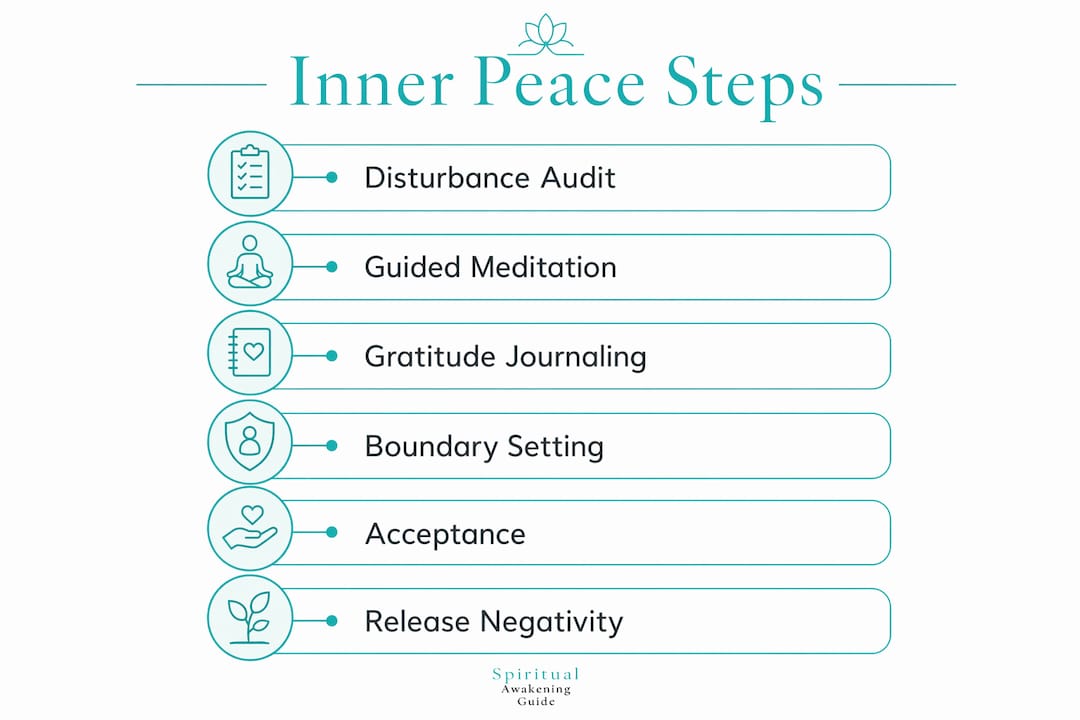
Guided meditation, gratitude journaling, and clear boundary-setting are the three most accessible and well-supported practices for building inner calm. Each one targets a different layer of the disturbance cycle. Meditation trains the mind to observe thoughts without reacting. Gratitude journaling shifts attention from threat to appreciation. Boundary-setting removes the external conditions that repeatedly trigger internal conflict.
The Zen approach adds a fourth layer: acceptance. Zen philosophy teaches that peace emerges by removing self-generated disturbances rather than adding new habits or external fixes. This means identifying where you are fighting reality, where you are trying to control outcomes you cannot control, and releasing that grip. Releasing control is not giving up. It is redirecting energy toward what you can actually influence.
Building inner peace also requires addressing four foundational human motivations: safety and support, emotional fulfillment, authenticity, and meaningful purpose. When these needs go unmet, inner disturbance grows regardless of how many techniques you practice.
| Practice | What it targets | Frequency |
|---|---|---|
| Disturbance audit | Naming and separating tension from judgment | Daily, evening |
| Guided meditation | Reducing mental reactivity and building calm | Daily, 10–20 minutes |
| Gratitude journaling | Shifting attention from threat to appreciation | Daily, morning |
| Boundary-setting | Removing recurring external triggers | Weekly review |
| Acceptance practice | Releasing resistance to uncontrollable outcomes | As needed, ongoing |
| Values alignment check | Reducing internal conflict through congruent action | Weekly reflection |
You can also explore releasing negative energy as a complementary practice. Letting go of accumulated resistance clears the mental space that peace requires.
Pro Tip: Do not add all six practices at once. Start with the disturbance audit for two weeks. Once it feels natural, add a 10-minute guided meditation. Build the structure one layer at a time so each practice becomes a genuine habit rather than a temporary experiment.
Key Takeaways
Inner peace is a condition you build through daily practice, not a permanent feeling you reach by eliminating problems or suppressing emotions.
| Point | Details |
|---|---|
| Inner peace is a condition | It is a stable mental state built over time, not a temporary mood or feeling. |
| Ataraxia is the foundation | Classical philosophy defines peace as freedom from self-generated disturbance, not external stress. |
| Misconceptions block progress | Peace does not mean no emotions; it means experiencing emotions without being controlled by them. |
| Benefits are concrete | Peace improves decision-making, resilience, relationships, and sense of meaning in daily life. |
| Practice builds the condition | Disturbance audits, meditation, journaling, and boundary-setting are the core daily tools. |
Peace is active, not passive: my honest reflection
Most people come to the idea of inner peace looking for relief. They want the noise to stop. They want to feel less anxious, less reactive, less overwhelmed. That desire is completely understandable. But the framing is backward, and it took me years to see that clearly.
Peace is not the absence of noise. It is the capacity to remain steady while the noise continues. The moment I stopped chasing a quiet life and started building a quiet mind, everything shifted. The external circumstances did not change much. My relationship with them did.
The biggest trap I see is what I call the suppression mistake. People confuse peace with control. They push difficult emotions down, maintain a calm exterior, and call it peace. Then something small breaks the surface and the reaction is completely disproportionate. That is not peace. That is pressure building behind a closed valve.
The Zen approach to accepting emotions as data changed how I work with difficult feelings entirely. Anger tells you a boundary was crossed. Fear tells you something feels uncertain. Sadness tells you something mattered. None of those signals need to be silenced. They need to be heard, understood, and then released. That process is the practice. And the practice, done consistently, is what builds the condition.
The other insight worth naming is that values alignment is not optional. When your actions contradict your values, the internal friction is constant and exhausting. You can meditate for an hour every morning and still feel unsettled if your daily choices are out of sync with what you actually believe. Peace requires congruence. That is the part most personal development content skips.
— Sean
Deepen your inner peace practice with Spiritualmethod
Spiritualmethod provides structured, practical methods for healing the mind, body, and soul, built specifically for people who want to move beyond surface-level calm into genuine inner stability.
If you are ready to go deeper, the 7-step inner peace guide at Spiritualmethod walks you through disturbance audits, daily rituals, and mindset practices in a structured sequence. For those working through emotional wounds, the soul retrieval healing examples offer a practical look at how deeper healing supports lasting peace. You can also explore journaling for soul healing as a daily writing practice that processes emotion and builds self-awareness over time. Spiritualmethod’s resources are designed to meet you where you are and give you a clear path forward.
FAQ
What is the inner peace definition in psychology?
Inner peace is defined in psychology as a low-arousal positive emotional state characterized by calm, contentment, and psychological balance. It is also described as psychological homeostasis, the mind’s ability to function well regardless of external outcomes.
What does inner peace feel like in daily life?
Inner peace feels like steady calm rather than excitement. You experience emotions without being overwhelmed by them, make decisions without excessive anxiety, and recover from setbacks without prolonged distress.
How do you achieve inner peace practically?
Disturbance audits, guided meditation, gratitude journaling, and clear boundary-setting are the core daily practices. The key is consistency over time, not intensity in a single session.
Is inner peace the same as happiness?
Inner peace and happiness are related but distinct. Happiness is often a high-arousal positive emotion tied to specific events. Inner peace is a low-arousal stable condition that persists regardless of whether external events are positive or negative.
Can inner peace be lost once you build it?
Yes. Inner peace requires ongoing maintenance through daily practice. Practitioners describe it as a condition strengthened weekly, not a permanent achievement. Regular disturbance audits and reflective practices keep the condition stable over time.