
Soul alignment is defined as the state of coherence between your inner truth and your outer life, where your values, intuition, emotions, and actions work together without friction. When that coherence exists, internal conflict drops and self-trust rises. Spiritual traditions across cultures describe this state as living in accordance with your conscience, your higher self, or a deeper moral order. Spiritualmethod defines it as the practical integration of mind, body, and soul so that your daily choices reflect who you genuinely are. Understanding what soul alignment means is the first step toward building a life that feels grounded and real.
What does soul alignment mean, and why does it matter?
Soul alignment is the coherent integration of inner truth with external life, closing the gap between your core self and your outward actions. That gap is where most internal suffering lives. When your decisions contradict your values, your nervous system registers the conflict even when your conscious mind tries to rationalize it away.
The soul alignment definition used by spiritual practitioners centers on authenticity, not perfection. It means your relationships, work, and daily habits reflect what you actually believe and feel, not what you think you should believe or feel. The importance of soul alignment becomes clear when you notice how much energy it takes to maintain a life that does not match your inner reality.

Spiritual clarity guides describe alignment as a return to the self beneath layers of conditioning. That framing matters because it removes the pressure to become someone new. You are not building a better version of yourself from scratch. You are clearing away what was never truly yours to begin with.
What are the signs of soul alignment?
Recognizing soul alignment requires paying attention to subtle, steady signals rather than waiting for dramatic revelations. Alignment often feels softer and quieter than people expect. The signs show up as relief, steadiness, and ease rather than fireworks.
Common signs that your soul is aligned include:
- Clearer decisions. Choices feel less agonizing because your internal compass is consistent.
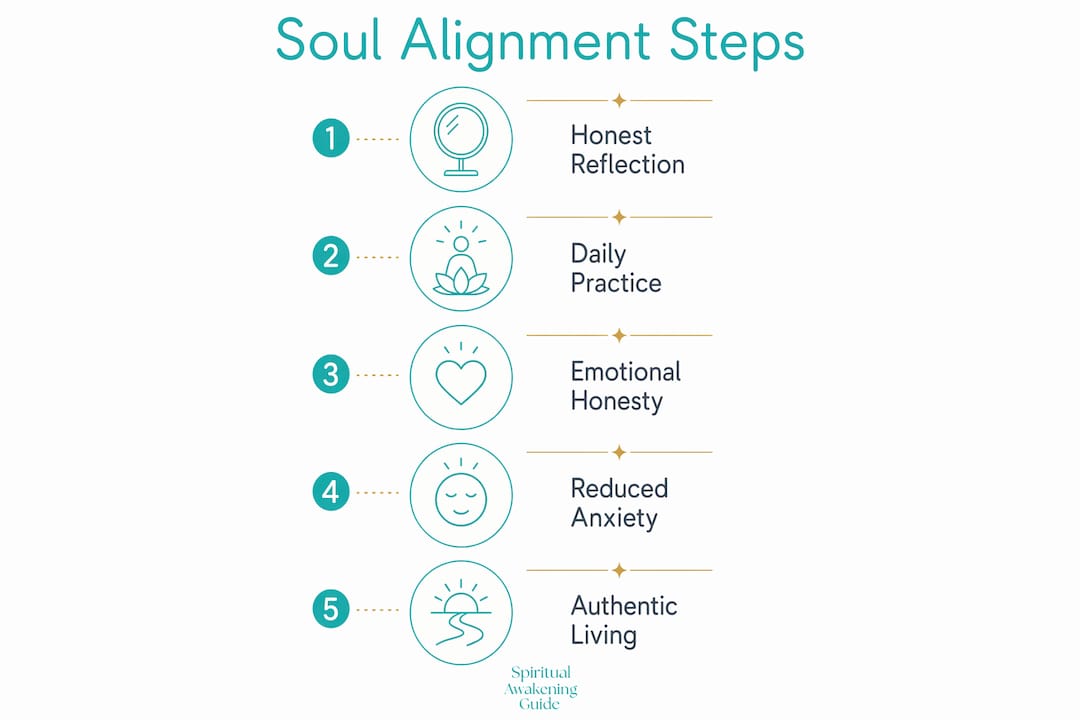
- Reduced anxiety. When your outer life matches your inner values, the nervous system calms.
- Healthier boundaries. You say no without excessive guilt because your limits reflect genuine needs.
- Emotional honesty. You feel your emotions without suppressing or performing them.
- Less internal conflict. The inner argument between what you want and what you do quiets down.
- Stronger intuition. You trust your gut more readily because you have practiced listening to it.
The nervous system often registers alignment before the conscious mind does. Increasing calm, less fragmentation, and a stronger connection to bodily intuition are physical signals worth tracking. Many people overlook these because they are waiting for a peak spiritual experience that may never arrive.
Pro Tip: Keep a brief daily log of moments when a decision felt easy and right. Over two weeks, patterns will emerge that reveal where your alignment is strongest and where it needs attention.
Common misconceptions about soul alignment
The most widespread misconception is that soul alignment is a destination you reach once and maintain effortlessly. Spiritual practitioners consistently describe it as an ongoing, evolving relationship with truth that shifts as your life changes. Treating it as a fixed state sets you up for disappointment every time life gets complicated.
Three other misconceptions deserve direct correction:
- Alignment means constant ease. Real alignment sometimes produces disruption. Old habits, relationships, and structures that no longer fit begin to fall away. That process can feel like loss, not progress.
- Alignment is a self-improvement project. Many people approach it as a performance, adding more practices and habits to become a better person. Alignment is a return to your innate truth, not a construction project.
- Misalignment is a personal failure. Misalignment is information. It signals a gap between where you are and where your inner truth is pointing. Shame about that gap makes it wider, not smaller.
“Alignment is not about becoming someone new. It is about returning to who you already are beneath the conditioning, the expectations, and the noise.” — Align With Caitlin
The period before alignment often looks like disruption or loss as old structures fall away. Recognizing that phase as necessary rather than catastrophic changes how you move through it. Presence and honesty do more work here than effort or willpower.
How to achieve soul alignment through daily practice
Achieving soul alignment begins with acknowledging the contradictions between your inner values and your current behaviors, without shame. Small, consistent choices that close that gap over time produce more lasting alignment than dramatic overhauls. The process is gradual and cumulative.
Practical approaches that support alignment include:
- Meditation. Even ten minutes of stillness daily trains you to hear your inner voice beneath the noise of obligation and habit.
- Journaling. Writing without a goal surfaces patterns, contradictions, and desires that stay hidden in ordinary thinking. Spiritualmethod’s guide to journaling for soul healing offers a structured framework for this practice.
- Setting daily intentions. A morning ritual that connects your planned actions to your core values keeps alignment active rather than theoretical. Spiritualmethod’s guide on setting daily intentions provides a practical morning structure.
- Listening to intuition. Intuition is not mystical noise. It is your nervous system processing information faster than conscious thought. Practice following small intuitive nudges to build trust in larger ones.
- Establishing emotional boundaries. Boundaries are not walls. They are expressions of what you value. Setting them consistently is one of the most direct acts of self-alignment available.
- Grounding practices. Physical awareness, time in nature, breathwork, and body-based rituals reconnect you to present-moment experience, which is where alignment actually lives.
Daily spiritual practices work best when they are routine-based rather than occasion-based. Alignment built on daily habits is more stable than alignment pursued only during crises or retreats.
Pro Tip: When you feel resistance to a practice, treat that resistance as data. Ask what the resistance is protecting. The answer usually points directly to where alignment work is needed most.
Managing resistance is part of the process. Alignment does not mean eliminating discomfort. It means choosing discomfort that moves you toward your truth rather than away from it.
How does soul alignment benefit your overall well-being?
Soul alignment produces concrete, measurable improvements in daily life. Alignment fosters coherence across mind, body, and soul, which reduces inner fragmentation and the burnout that fragmentation causes. When your life reflects your values, you spend less energy managing the internal contradiction between who you are and how you live.
The mind, body, and soul connection is foundational to understanding why alignment affects physical health as well as emotional health. Chronic misalignment produces stress responses that wear on the body over time. Alignment stabilizes inner energy by reducing friction, creating more flow without necessarily removing all life challenges.
| Benefit | What it looks like in practice |
|---|---|
| Reduced inner conflict | Fewer moments of second-guessing decisions you have already made |
| Greater clarity | Knowing what you want and why, without prolonged deliberation |
| Steadiness under pressure | Maintaining your sense of self during uncertainty or change |
| Healthier relationships | Attracting and sustaining connections that reflect your actual values |
| Spiritual harmony | Feeling connected to a larger sense of purpose or moral order |
Alignment also supports living authentically, which research in positive psychology links to higher life satisfaction and stronger social bonds. The benefits of soul alignment are not abstract. They show up in how you handle conflict, how you make decisions, and how rested you feel at the end of a day.
Key Takeaways
Soul alignment is an ongoing, honest relationship with your inner truth that produces steadiness, clarity, and reduced internal conflict when practiced consistently through daily reflection and authentic choice.
| Point | Details |
|---|---|
| Soul alignment defined | It is the coherence between inner values and outer actions, not a fixed state of perfection. |
| Signs of alignment | Look for reduced anxiety, clearer decisions, and emotional honesty rather than dramatic peak experiences. |
| Misconceptions to release | Alignment is a return to your true self, not a self-improvement project or a permanent destination. |
| How to practice it | Use meditation, journaling, daily intentions, and boundary-setting as consistent, routine-based tools. |
| Core benefit | Alignment reduces inner fragmentation and builds self-trust, which supports every area of life. |
What living soul-aligned has taught me
Soul alignment is not a straight line. That is the most honest thing I can say after years of working with people on inner healing. Most people come to this work expecting that once they find their alignment, life will feel smooth and clear indefinitely. What actually happens is more interesting and more demanding than that.
The moments that felt most like regression, the relationships that ended, the careers that no longer fit, the beliefs I had to let go of, were often the moments when alignment was doing its deepest work. Disruption is not the opposite of alignment. It is frequently the evidence of it. When something that no longer fits your truth starts to crack, that is your inner compass working correctly.
What I have found actually helps is cultivating presence over effort. Sitting with what is true right now, even when it is uncomfortable, moves you forward faster than any amount of striving toward an imagined future self. Self-compassion is not a soft add-on to this process. It is the condition that makes honest self-examination possible at all.
Trust your inner guidance even when the path is unclear. Clarity is not always available at the start. Sometimes you take the next honest step and clarity follows. That is how alignment actually works in a real life, not in a theory.
— Sean
Spiritualmethod’s resources for your alignment practice
Spiritualmethod offers practical, structured resources for people ready to move from understanding soul alignment to actively practicing it.
The soul retrieval healing guide at Spiritualmethod walks through eight concrete examples of how healing fragmented parts of the self supports deeper alignment. For those who want a body-based entry point, the spiritual awakening and energy guide covers grounding rituals that anchor alignment in physical awareness. Spiritualmethod’s approach centers on practical methods for mind, body, and soul integration, giving you tools that work in daily life, not just in retreat settings. Each resource is designed to support gradual, sustainable progress rather than overnight change.
FAQ
What is the soul alignment definition in simple terms?
Soul alignment is the state where your values, emotions, and daily actions reflect your authentic inner truth. When that coherence exists, internal conflict decreases and self-trust grows.
How do I know if my soul is aligned?
Signs of soul alignment include reduced anxiety, clearer decision-making, emotional honesty, and a steady sense of self. The nervous system often registers alignment first as increasing calm and less inner fragmentation.
How long does it take to achieve soul alignment?
Soul alignment is an ongoing process rather than a single achievement. Small, consistent daily choices that reflect your values produce alignment gradually over weeks and months, not overnight.
Can soul alignment be lost?
Alignment shifts as life circumstances and personal truths evolve. Periods of disruption or loss are a normal part of the process and often signal that old structures no longer fit your current truth.
What is the difference between soul alignment and self-improvement?
Self-improvement focuses on adding new qualities or behaviors. Soul alignment is a return to your innate truth beneath layers of conditioning, requiring honesty and presence rather than effort or performance.