
Pick one prompt category below and write for 5 to 10 minutes. That is the entire first step. Short entries count as real progress, and a structured framework works better than staring at a blank page hoping inspiration arrives. Once you’ve tried one prompt, the categorized bank in the next section gives you dozens more to rotate through as your practice grows.
TL;DR:
- Categorized prompts tied to specific attention skills and intentions help users tailor their journaling practice to their current needs and avoid decision fatigue.
- Short, structured sessions such as five to ten minutes daily or weekly reviews significantly improve adherence and insight over open-ended writing.
- Grounding techniques like body scans or sensory descriptions are essential for managing distress during deep shadow work or emotional prompts.
- Combining journaling with meditation, prayer, or visualization enhances reflection by capturing fleeting insights and connecting with broader spiritual practices.
- A curated, organized system of prompts and rituals offers a more sustainable and effective approach than random, unstructured journaling attempts.
Table of Contents
- Spirituality Journal Ideas Organized by Purpose
- Seven Journaling Methods and How Often to Use Them
- A 7-Day Starter Plan for New Journal Keepers
- When Journaling Triggers Distress, and How to Re-Anchor
- Why These Methods Draw on Mindfulness and Expressive-Writing Research
- Personalizing Prompts to Your Own Beliefs and Path
- Turning Entries Into Insight, Not Just Records
- Pairing Journaling With Meditation, Prayer, and Visualization
- What Most Advice on This Topic Gets Wrong
- A Structured Guide for Readers Who Want More Than a Prompt List
- Sources
- FAQ
Spirituality Journal Ideas Organized by Purpose
A scattered list of prompts is hard to use consistently. Grouping prompts by what they train, mindfulness, gratitude, intention, shadow work, dream recall, dialogue, and quick check-ins, makes it easier to grab the right tool for the moment you’re actually in. Categorizing prompts by the attention skill they build, whether that’s breath awareness, emotional processing, or forward planning, helps writers choose the prompt that matches what they need right now instead of defaulting to whatever feels easiest.
Mindfulness prompts (quick check-in, best for mornings or mid-day resets):
- What sounds can you notice right now without naming them as good or bad?
- Describe one physical sensation in your body at this exact moment.
- What is your breath doing without you controlling it?
- Name three things you can see, hear, and feel right now.
- Where in your body do you feel today’s emotion most strongly?
Gratitude prompts (quick check-in to deeper session, best for evenings):
- What surprised you today, even in a small way?
- Who showed you unexpected kindness this week?
- What part of your body are you grateful for and why?
- What ordinary object made your day slightly easier?
- What lesson from a hard season are you now thankful for?
For a longer rotation built around senses, mood, and moment, the gratitude journal prompts organized by moment, mood, and senses collection gives you thirty more to draw from.
Intention and ritual prompts (ritual, best paired with a candle or moon phase):
- What do you want to release before this month ends?
- If this intention were already true, how would you act differently today?
- What small ritual would anchor this intention in your body, not just your mind?
- What are you calling in, and what habit is blocking it?
Shadow work prompts (deeper session, best for evenings with open time, not before sleep):
- What trait in others irritates you most, and where does that trait live in you?
- What childhood rule are you still obeying without questioning it?
- What would you do differently if you weren’t afraid of judgment?
Shadow work opens material that can feel heavy, so pace it. SpiritualMethod’s shadow work prompts collection of 75+ journal questions exists precisely because this category deserves its own contained space rather than a rushed five minutes between other prompts.
Dream and intuition prompts (quick check-in, best right after waking):
- What is the strongest image left from last night’s dream?
- What emotion did the dream leave behind, separate from its plot?
- What is your gut telling you about a decision you’re avoiding?
Dialogic prompts (deeper session, best for processing conflict or grief):
- Write a letter to your younger self at a specific age.
- Write as if a wiser future version of you is answering today’s biggest question.
- Have a written conversation with a fear, letting it speak first.
Crisis or low-capacity check-ins (quick check-in, best when overwhelmed):
- Name one thing that is true right now, nothing more.
- What does the next five minutes need from you?
Seven Journaling Methods and How Often to Use Them
The prompts above only work if you pair them with a format that fits your schedule. Here are seven proven approaches, what each one asks of you, and how often it makes sense.
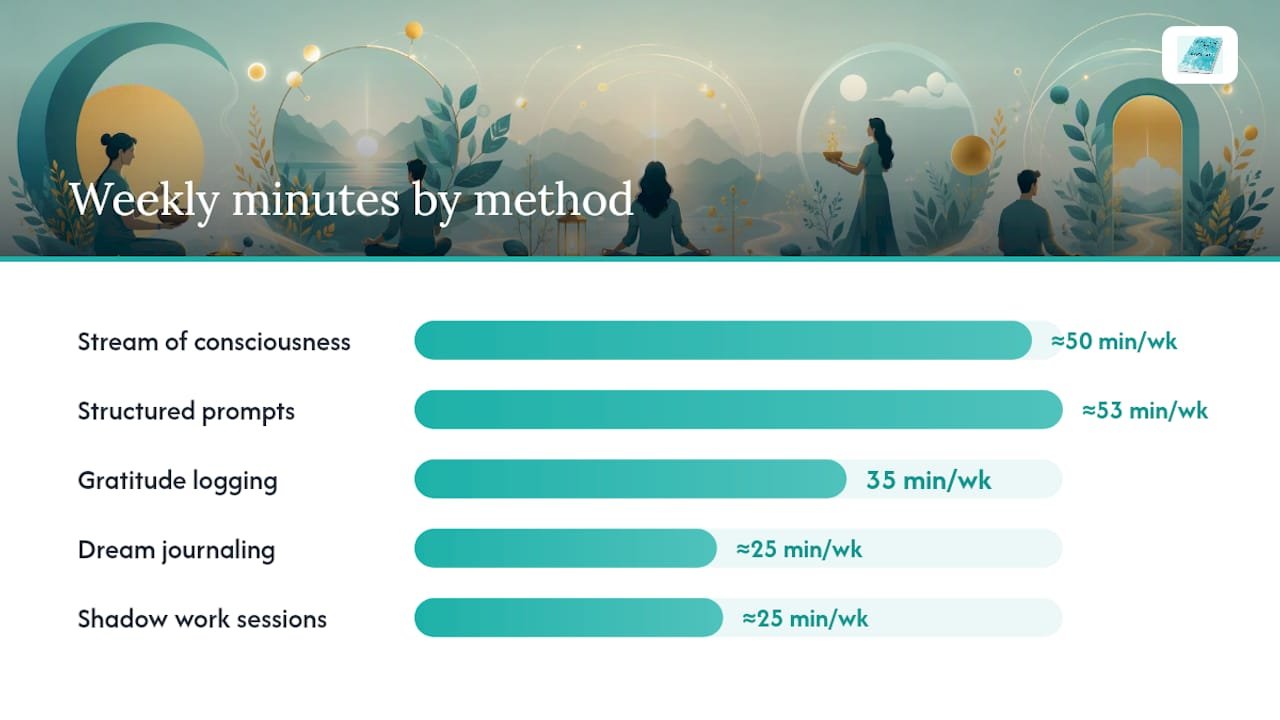
- Stream of consciousness: unfiltered, timed writing with no editing. Best for clearing mental clutter. Recommended: 10 to 15 minutes, 3 to 5 times a week.
- Structured prompts: answering a specific question from the categories above. Best for beginners who need direction. Recommended: 5 to 10 minutes daily.
- Gratitude logging: short lists or sentences noting specific positives. Best for shifting mood in the evening. Recommended: 5 minutes nightly.
- Dream journaling: capturing images and emotions immediately on waking. Best for intuition work. Recommended: 2 to 5 minutes each morning, as dreams arise.
- Shadow work sessions: deeper excavation of patterns, triggers, and inherited beliefs. Best when you have uninterrupted time and emotional bandwidth. Recommended: once weekly, 20 to 30 minutes.
- Dialogic writing: letters to yourself, a fear, or a future self. Best for processing relationships or big decisions. Recommended: as needed, 15 to 20 minutes per session.
- Moon-phase journaling: aligning intention-setting and release work with new and full moons. Best for readers who like ritual markers on a calendar. Recommended: twice monthly.
Structure amplifies the benefit of writing about meaningful experiences more than free-form diary entries do, according to expressive-writing research reviewed in clinical literature, which is part of why prompt-based sessions tend to outperform vague “just write” advice.
Pro Tip: Combine methods instead of picking one forever. Morning pages (stream of consciousness) pair well with a single weekly shadow work session, giving you daily release plus one deeper excavation instead of forcing every entry to carry equal emotional weight.
A 7-Day Starter Plan for New Journal Keepers
Momentum beats intensity. Short, consistent sessions tend to build a lasting habit better than long entries you can’t sustain past week one, so this plan keeps each day under 10 minutes.
- Day 1: Choose one category (mindfulness is the gentlest entry point) and write for 5 minutes with a timer set.
- Day 2: Repeat the same category. Date the entry. Notice if the words came easier.
- Day 3: Try a gratitude prompt in the evening instead of mindfulness in the morning.
- Day 4: Add a ritual element, light a candle or take one slow breath before you write.
- Day 5: Try a dialogic prompt, writing a short letter to your younger self.
- Day 6: Do a five-count body scan before writing, then journal whatever arises.
- Day 7: Do a 20-minute weekly review: write one lesson from the week and three priorities for the next.
That seventh-day structure isn’t arbitrary. A short weekly reflection template capturing one lesson and three priorities gives you a lightweight but effective way to track patterns over time without turning review into another chore.
Pro Tip: End every session with three-noticing wind-down: name one thing you noticed in your body, one in your mind, and one in your surroundings. It signals to your nervous system that the session is closing, not spiraling open.
Keep entries dated from day one. A dated journal becomes a map of your own patterns within a few months, something a scattered pile of loose notes never gives you.
When Journaling Triggers Distress, and How to Re-Anchor
Journaling is not always calming, and deeper prompts can surface more than you expected. Watch for these signs that a session has crossed from reflection into rumination:
- You’ve reread the same paragraph or memory more than three times without new insight.
- Your writing speed increases while your breathing gets shallow or fast.
- You feel worse after writing than before you started.
- You’re spiraling into blame, either at yourself or someone else, without resolution.
Clinicians who work with expressive writing generally recommend a containment sequence when this happens: stop writing, take three slow breaths, then shift to a body-scan prompt for a minute. If the intensity holds, switch to a sensory-writing prompt, describing exactly what you see, hear, and feel in the room, for two to three minutes. Mindfulness-based prompts exist for this reason: they train present-moment noticing instead of problem-solving, which lowers the risk of spiraling further into rumination.
If distress continues after grounding, pause the session entirely and reach out to a licensed therapist or a crisis line. Journaling is a self-reflection tool, not a substitute for clinical support. For grounding techniques beyond writing, the spiritual grounding and centering guide from Black Witch Coven offers additional body-based practices worth keeping on hand.
Why These Methods Draw on Mindfulness and Expressive-Writing Research
The prompt categories and rituals throughout this guide are not invented wisdom. They’re grounded in two overlapping bodies of work: expressive writing research and mindfulness practice.
- Short, structured writing sessions about meaningful experiences produce measurable well-being benefits according to clinical research reviews, which supports the 5 to 10 minute session lengths recommended above.
- Categorized, labeled prompt lists reduce the friction of deciding what to write, and that lower friction is linked to better long-term adherence than unlabeled, open-ended lists.
- SpiritualMethod’s own resources, including a practical guide to types of spiritual journaling prompts and a journaling for soul healing guide, extend these same categories into deeper, structured formats for readers ready to go further.
Sean, who writes and researches for SpiritualMethod, built this framework around the same principle behind clinical expressive-writing protocols: structure helps more than volume.
Personalizing Prompts to Your Own Beliefs and Path
None of these prompts are meant to be recited word for word. A prompt about “intention” can mean prayerful surrender for a Christian reader, energetic alignment for someone working with chakras, or simple goal clarity for a secular reader who just wants better self-awareness. Swap the vocabulary, not the structure.
If you follow a specific tradition, translate prompts into its language. “What do you want to release?” becomes “What am I asking my ancestors or guides to help me release?” for someone working with ancestral practice, or “What am I surrendering to God this week?” for a reader with a prayer-centered practice. If you don’t follow an organized tradition, keep prompts in plain, personal terms: “What am I ready to let go of?” works fine on its own.
Shadow work prompts especially benefit from this adjustment. A prompt asking what childhood rule you’re still obeying can be reframed around family, culture, or religious upbringing, whatever actually shaped the belief you’re examining. The goal isn’t matching someone else’s spiritual vocabulary. It’s finding language that makes a prompt feel like your own question, not a borrowed one. If a prompt from any category feels off, rewrite one or two words until it does. That small edit is often the difference between a prompt you dread and one you return to for months.
Turning Entries Into Insight, Not Just Records
A journal that only accumulates entries without review is a diary, not a spiritual practice. The value comes from looking back.
Try reading one week’s entries in a single sitting and circling any word or phrase that repeats. Recurring language, “stuck,” “waiting,” “tired,” “grateful for,” points to a pattern your daily self might miss but your written self keeps naming. This is different from rereading a single entry obsessively, which risks the rumination pattern covered earlier. Weekly review, not daily rereading, is where insight tends to surface.
Another technique: after writing a shadow work or dialogic entry, wait 24 hours, then reread it and write a single follow-up sentence answering “What does this ask me to change?” That delay matters. Writing and reflecting in the same sitting often just repeats the same emotional loop; a day’s distance tends to produce a clearer, less reactive read.
Color-coding or tagging entries by theme (relationships, career, body, spirit) also helps if you keep a physical journal. Flip through a few months of entries tagged the same way, and you’ll often see a trajectory you couldn’t see one entry at a time. That’s the actual purpose of tracking dates and categories: not organization for its own sake, but the ability to notice change over a timespan longer than a single week.
Pairing Journaling With Meditation, Prayer, and Visualization
Journaling works best as one piece of a broader practice, not a standalone habit competing with everything else you do.
Before meditation, a two-minute mindfulness prompt (what does your breath feel like right now?) can settle a racing mind faster than sitting down cold. After meditation, a short prompt capturing whatever image, sensation, or thought surfaced during the sit turns a fleeting experience into something you can revisit later.
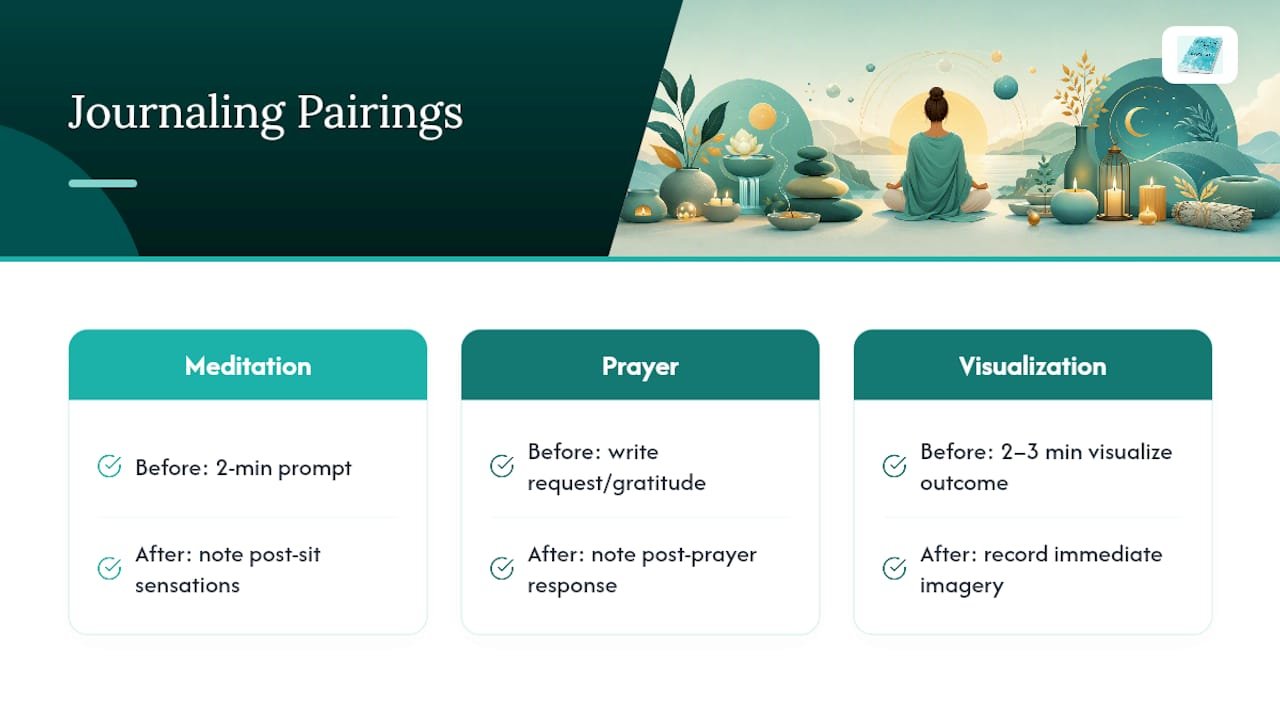
For prayer-centered practice, journaling can bookend the prayer itself: write the specific request or gratitude beforehand, then write anything that surfaced afterward, a sense of peace, an unexpected thought, silence. That before-and-after structure gives prayer a written record without turning the prayer itself into a performance.
Visualization pairs naturally with intention and ritual prompts. Visualize the outcome you’re working toward for two or three minutes, eyes closed, then immediately journal what you saw, felt, or heard during that visualization. Writing right after visualizing, rather than hours later, captures details that fade quickly otherwise.
None of these pairings require elaborate setup. A single candle, five quiet minutes, and one prompt from earlier in this guide is enough to link journaling with almost any existing spiritual practice you already have.
What Most Advice on This Topic Gets Wrong
Most journaling advice treats consistency as a willpower problem. It isn’t. The real barrier is almost always decision fatigue, standing in front of a blank page with no prompt, no time limit, and no sense of what “good” journaling even looks like. That’s why categorized prompts and short rituals outperform vague encouragement to “just write more.”
The other blind spot is safety. Plenty of spiritual content pushes readers toward shadow work and deep excavation without ever mentioning that some sessions will surface more than the writer can process alone. A grounding sequence should sit right next to any shadow prompt, not buried in a separate wellness article. That pairing matters more than which specific prompt you choose.
If you’re serious about building this practice past the first few weeks, prioritize structure over inspiration. A downloadable, organized set of prompts and rituals will carry you further than waiting for motivation to write.
— Sean
A Structured Guide for Readers Who Want More Than a Prompt List
Free prompts get you started, but a scattered collection of tips across different articles is exactly the kind of decision fatigue that stalls a practice before it takes hold. SpiritualMethod’s journaling for soul healing guide packages structured prompts, short ritual scripts, and weekly review templates into one downloadable resource, so you’re not rebuilding your practice from scratch every week.

This guide fits readers who already know they want more than a one-off blog list, people ready to commit to a structured, repeatable practice without spending hours designing their own system. It includes prompt sets organized by depth and mood, ritual scripts for pairing journaling with grounding practices, and a printable weekly review format similar to the one outlined earlier in this guide. If you’re also drawn to deeper inner work alongside journaling, SpiritualMethod’s inner child healing practices guide extends the same structured approach into that territory.
Download the journaling for soul healing guide today and start your next session with a plan instead of a blank page.
Sources
- Expressive writing and health: A review of clinical research (PMC review)
- Mindfulness journal prompts for present-moment awareness
- Ready, set, journal: 64 journaling prompts for self-discovery — Psych Central
FAQ
What is the 3-3-3 journaling method?
The 3-3-3 method typically asks you to write three things you’re grateful for, three things bothering you, and three goals for the day, giving a quick, balanced check-in in under five minutes.
What is the 3/2-1 method of journaling?
The 3-2-1 method has you write three things from the day, two feelings tied to those events, and one insight or lesson, similar in spirit to the weekly review format covered earlier in this guide.
What are the 7 levels of spirituality?
Definitions of spiritual “levels” vary widely across traditions and authors, and there’s no single agreed-upon framework, so it’s more useful to focus on the prompt categories in this guide than to chase a fixed hierarchy.
What are some good journal ideas for beginners?
Start with mindfulness or gratitude prompts, both quick check-ins under five minutes, before moving into deeper categories like shadow work or dialogic writing once the habit feels steady.