
Spirit guide communication steps are a series of intentional practices that open a direct channel between your conscious awareness and the intuitive guidance available to you through spiritual connection. Whether you are new to spiritual practice or deepening an existing one, this guide covers every stage of the process: preparation, intention setting, channelled writing, receiving signs, and interpretation. The tools required are minimal. A journal, a quiet space, and a willingness to listen are the foundation. What follows is a structured framework that makes communicating with spirit guides accessible, repeatable, and genuinely useful for personal growth.
What are the spirit guide communication steps?
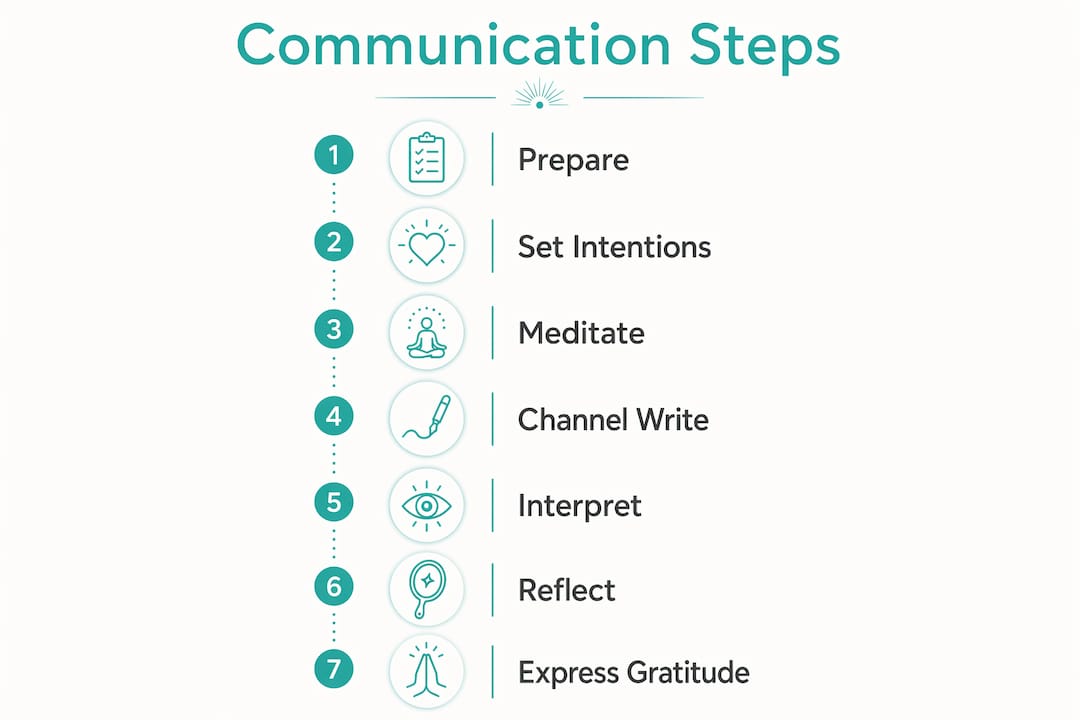
Spirit guide communication is a learnable skill, not an exclusive gift reserved for psychics or mediums. The process follows a clear sequence: prepare your environment, set a focused intention, ask a specific question, write freely without editing, and then read back what you have written to identify patterns and insights. Meditation, clear intention, and quiet space prepare the mind to receive spirit guide messages effectively. This sequence works because it moves attention away from analytical thinking and toward intuitive knowing, which is where genuine guidance tends to surface.
The term most practitioners use for this practice is channelled writing, sometimes called automatic writing. It differs from journaling in one key way: you write without pausing to evaluate, correct, or direct the content. The result is often surprising, and that surprise is the signal that something beyond habitual thought has come through. Gabby Bernstein, a widely recognized spiritual teacher, identifies asking, listening, gratitude, and releasing attachment to outcomes as the core pillars of effective spirit guide connection. These pillars map directly onto the steps covered in this guide.

What tools and preparation do you need before starting?
Effective spirit guide communication begins with the right conditions, not the right talent. The physical environment matters more than most beginners expect. A distraction-free space signals to the nervous system that it is safe to slow down, and that physiological shift is what makes receptivity possible.
The core tools you need:
- A dedicated journal or notebook (physical is preferable to digital for most practitioners, as handwriting slows the analytical mind)
- A pen or pencil
- A quiet space where you will not be interrupted for at least 15 to 20 minutes
- Optional: a candle, soft music, or a grounding object that signals the start of practice
Mental readiness is equally important. Before writing, spend three to five minutes in breathwork or simple meditation. Inhale for four counts, hold for four, exhale for four. This pattern activates the parasympathetic nervous system and quiets the mental chatter that blocks intuitive access. A morning intention ritual can serve as a natural entry point into this state, particularly for those who prefer structure.
Patience is the most underrated prerequisite. Many beginners expect immediate clarity and abandon the practice after two or three sessions. Regular practice of channelled writing strengthens intuitive connection over time, eventually allowing guidance to surface without pen and paper at all. Treat the first two weeks as calibration, not confirmation.
Pro Tip: Set a consistent time each day for your practice, ideally in the morning before the demands of the day crowd your attention. Consistency trains your nervous system to enter a receptive state more quickly with each session.
How do you ask questions and use channelled writing to receive guidance?
The quality of your question determines the quality of the guidance you receive. Vague questions produce vague answers. Specific, open-ended questions produce specific, usable insights. This is the most practical skill in the entire process.
Follow these steps each time you sit down to practice:
- Settle your environment. Sit comfortably, close your eyes, and complete three to five rounds of the four-count breathwork described above. Let your shoulders drop and your jaw unclench.
- Set your intention aloud or in writing. A simple statement such as “I am open to receiving clear guidance from my spirit guides” is sufficient. Intention setting is not ceremonial. It is a cognitive cue that shifts your attention from problem-solving mode to receptive mode.
- Write your question at the top of the page. Examples of effective questions include: “What do I need to understand about this situation?” or “What is holding me back from moving forward?” or “What would serve my highest good right now?” Avoid yes/no questions. They close the channel rather than open it.
- Begin writing without stopping. Do not edit, correct spelling, or pause to evaluate what is appearing on the page. Relaxed, unforced writing is the mechanism that bypasses the analytical mind and accesses intuitive knowing. Write for a minimum of five minutes without lifting the pen.
- Write through resistance. If nothing comes, write “nothing is coming” repeatedly until something shifts. The act of writing itself breaks the block.
- Stop when the energy shifts. You will notice a natural sense of completion, a feeling that the flow has slowed or concluded. This is your signal to stop.
The most common beginner challenge is the inner critic, the voice that says “I’m just making this up.” Alex Besson, writing for the publication Know Thyself, Heal Thyself on Medium, notes that spirit guide impressions come through intuition in the moment, bypassing the thinking mind entirely. The feeling of “making it up” is actually the sensation of intuition working. Trust it.
Pro Tip: Date every entry and number your pages. When you review your journal after several weeks, patterns become visible that are impossible to see in a single session. The cumulative record is where the real insights live.
How do you recognize and interpret messages from your spirit guides?
Reading back your channelled writing is a distinct skill from writing it. Approach the review with the same relaxed attention you brought to the writing itself. Do not analyze line by line. Read the full entry once, then sit quietly for a moment before identifying what stood out.
Several markers indicate genuine guidance rather than habitual thought patterns:
- Unexpected language or phrasing. If a sentence uses words or constructions you would not normally choose, pay attention to it. This is a common signal that the content originated outside your habitual mental patterns.
- Emotional resonance. Genuine guidance typically produces a feeling of relief, clarity, or quiet recognition. Spirit guides communicate in unconditional love, and their messages bring clarity rather than anxiety.
- Symbolic language. Guidance is often delivered through metaphor, imagery, or symbols that are personally meaningful. A reference to water, for example, might carry a specific meaning tied to your current life circumstances. Spirit guides use symbols and feelings filtered through your own consciousness, which is why the same symbol can mean different things to different people.
One reliable filter for discernment is the emotional quality of the message. Negative, fearful, or forceful messages are not from your spirit guides. Negative or forceful messages should be set aside entirely. If a message creates urgency, pressure, or fear, it is a product of the ego or anxiety, not spiritual guidance.
“Practicing discernment and releasing attachment to specific outcomes improves the quality and trustworthiness of spirit guide communication.” — Gabby Bernstein
Gratitude is the final step in each session. Before closing your journal, write two or three sentences of appreciation for whatever came through, even if it felt unclear. Staying in gratitude energy facilitates clearer communication in subsequent sessions. This is not a formality. It is a functional practice that sustains the receptive state over time.
How do you maintain and deepen your connection over time?
Building a lasting connection with your spirit guides requires the same consistency you would bring to any meaningful practice. The relationship deepens through repetition, reflection, and a willingness to act on the guidance you receive.
- Set a daily intention. Each morning, write one sentence stating your openness to guidance. This takes less than sixty seconds and keeps the channel active between formal sessions. A structured daily intention practice creates the mental conditions for ongoing receptivity throughout the day.
- Review your journal weekly. Look for recurring themes, symbols, or phrases across multiple entries. Patterns that appear three or more times are worth treating as significant. Growth becomes visible in the record, and that visibility builds trust in the process.
- Expand beyond writing. As your practice matures, guidance begins arriving through channels other than the journal. Dreams, synchronicities, and sudden intuitive knowing during a nature healing walk are all valid forms of spirit guide communication. Note these experiences in your journal alongside your formal sessions.
- Manage skepticism with evidence. Doubt is natural and does not disqualify you from receiving guidance. The most effective response to skepticism is to document your experiences and review them after thirty days. The cumulative record tends to be more persuasive than any single session.
- Develop your intuitive capacity. Strengthening your intuitive awareness directly improves the clarity and frequency of spirit guide communication. Practices like body scanning, mindful observation, and reflective journaling all contribute to this development.
Pro Tip: When a message from your journal proves accurate or useful in your daily life, mark that entry with a star or a specific symbol. Over time, these marked entries become a personal evidence base that dissolves doubt and strengthens trust in your practice.
Key takeaways
Effective spirit guide communication follows a structured sequence of preparation, channelled writing, and mindful interpretation, practiced consistently over time.
| Point | Details |
|---|---|
| Preparation is foundational | A quiet space, breathwork, and clear intention set the conditions for receptive communication. |
| Channelled writing is the core method | Write freely without editing for at least five minutes to bypass analytical thinking. |
| Discernment protects the process | Messages bringing clarity and relief are genuine; fearful or forceful messages are not from spirit guides. |
| Gratitude sustains the connection | Closing each session with written appreciation improves the quality of future communications. |
| Consistency builds the relationship | Daily intention setting and weekly journal review deepen the connection over weeks and months. |
What I have learned from years of channelled writing practice
When I first attempted channelled writing, I spent the first three sessions writing nothing but “I don’t know what I’m doing” in various forms. The breakthrough came not from a dramatic moment of clarity but from a single sentence that appeared in the fourth session, one that used phrasing I would never have chosen myself. That sentence answered a question I had been carrying for months. I did not recognize it as guidance until I read it back two days later.
What changed my practice most was releasing the expectation of immediate, obvious answers. Spirit guides do not communicate in headlines. They communicate in impressions, in the quiet shift of a word choice, in the unexpected image that surfaces mid-sentence. The analytical mind wants a clear directive. Genuine guidance tends to arrive as a felt sense of direction that only becomes clear in retrospect.
The practitioners I have seen struggle most are those who treat each session as a test. They write, read back immediately, find nothing obvious, and conclude the practice does not work for them. The journal is not a vending machine. It is a record of a developing relationship. The guidance that seemed cryptic in week one often reads as precise and accurate by week six. Perseverance is not a spiritual virtue in this context. It is a practical requirement.
If you are experiencing self-doubt or receiving unclear messages, that is not failure. That is the beginning of the process. Every person’s experience is unique, and the timeline for clarity varies. What does not vary is the outcome for those who stay with it.
— Sean
Deepen your spiritual practice with Spiritualmethod

Spiritualmethod offers a structured library of resources designed to support every stage of your spiritual development, from first steps in awareness to advanced practices in inner healing. If the spirit guide communication steps in this article have opened a new direction for you, the spiritual healing practices available through Spiritualmethod provide the next layer of support. These resources cover mind, body, and soul integration, offering practical methods that complement and extend your channelled writing practice. Whether you are working through personal growth, seeking clarity, or building a daily spiritual routine, Spiritualmethod’s guides are designed to meet you where you are and move you forward.
FAQ
What are spirit guide communication steps?
Spirit guide communication steps are a structured sequence of practices including environment preparation, intention setting, channelled writing, and message interpretation that enable individuals to access intuitive guidance for personal growth.
How long does it take to receive clear messages from spirit guides?
Most practitioners begin noticing meaningful patterns within two to four weeks of consistent daily practice. Clarity improves significantly when sessions are reviewed cumulatively rather than evaluated one at a time.
What is channelled writing and how does it work?
Channelled writing involves writing freely in response to a focused question without pausing to edit or evaluate. This unforced approach bypasses the analytical mind and surfaces intuitive knowing that reflects spirit guide guidance.
How do you know if a message is genuinely from a spirit guide?
Genuine spirit guide messages produce feelings of clarity, relief, or quiet recognition. Messages that create fear, urgency, or pressure are not from spirit guides and should be disregarded.
Can you communicate with spirit guides without meditation?
Meditation is not required, but brief breathwork or stillness before writing significantly improves receptivity. Even three to five minutes of focused breathing creates the mental conditions that make spirit guide communication more consistent and clear.
Pingback: Developing Spiritual Discernment When Working With Spirits – Black Witch Coven