
The fastest, most sustainable way to build a daily spiritual practice is a compassion-first tracker, either a minimal app or a printable page, paired with a brief weekly reflection. This approach works because it forgives missed days instead of punishing them and because it pairs simple checkmarks with a moment of honest reflection. The next step takes under two minutes: open a notes app or grab paper, and write down the one habit you want to track this week.
TL;DR:
- Choosing the right tracker depends on your practice time, with apps suited for short bursts and paper better for evening rituals; hybrid setups work well for many.
- Prioritize forgiving streaks, strong privacy, and reflection fields over flashy features or analytics, as these support sustained habit development.
- To maintain momentum, keep daily routines short, with quick check-ins and reflections, and review a full week to identify pattern changes or improvements.
- Resetting after missed days is less harmful than abandonment, as returning without guilt counts more for growth than perfect streaks.
- Download ready-made templates that incorporate forgiving tracking, privacy, and reflection prompts to implement a compassionate spiritual habit practice easily.
Table of Contents
- What Does Habit Tracking Spiritual Practice Actually Look Like?
- Which Features Actually Support Spiritual Growth?
- How Do You Choose a Tracker That Fits Your Life?
- How Should You Actually Use a Tracker Day to Day?
- Why Tracking and Journaling Actually Support Growth
- Coming Back After You Fall Off Is the Whole Point
- Ready-Made Templates for a Compassion-First Practice
- Sources
What Does Habit Tracking Spiritual Practice Actually Look Like?
Habit tracking spiritual practice means logging the disciplines that matter to you, meditation, prayer, sacred reading, gratitude, and reviewing that log often enough to notice patterns. The tool matters less than the format. Apps, printables, and paper journals each serve a different rhythm of life, and choosing the wrong one can contribute to early abandonment of the practice.
Apps work best for people who practice in short bursts throughout the day. They send reminders, chart trends automatically, and many now offer offline modes so your spiritual data never leaves your device. Mindful Journal, for example, combines habit and mood tracking with gratitude prompts entirely offline, with no account required.
Printables and paper journals suit an evening ritual better than a commute. There’s no notification pulling you out of the moment, and the physical act of writing tends to slow the mind down before sleep. A printable spiritual practice journal typically pairs a quick top-of-page tracker with several lines for open reflection below it.
Hybrid setups split the difference:
- A 30-second app check-in during the day to log what you practiced and for how long.
- A printable weekly review page on Sunday evening to look back across all seven days.
- One notebook page per month for longer reflections tied to the seasons or moon cycles.
Most people land on hybrid once they realize daily logging and deep reflection require different kinds of attention.
Which Features Actually Support Spiritual Growth?
Not every feature marketed toward habit tracking spiritual growth actually helps. Some designs quietly work against the reader by making a single missed day feel like failure. Here’s what to prioritize instead:
- Elastic streaks or forgiving progress rules. Rather than resetting a counter to zero after one missed day, a good tracker treats the streak as still intact, sometimes described as “no shame” notifications, which prevents the common abandonment cycle where one bad day turns into a bad month.
- Real privacy. Offline functionality, no advertising, and no reselling of personal spiritual data. Several apps, including ease, now advertise offline use specifically because readers don’t want prayer logs treated as marketing data.
- Reflection fields, not just checkboxes. A 1 to 10 inner-peace rating, a duration field, and one line for an insight or gratitude note turn a tracker into something closer to a journal.
- Export or print options. Seasonal reviews are easier when you can pull three months of entries onto paper rather than scrolling an app screen.
Pro Tip: If an app’s onboarding flow pushes you toward a public profile or a leaderboard before it asks about your actual practice, that’s a signal it was built for engagement metrics, not spiritual growth.
How Do You Choose a Tracker That Fits Your Life?
The right spiritual habit tracker matches your energy patterns, not the other way around. Before downloading anything or printing a template, work through this short checklist.
- Match the format to when you actually practice. Commuters and people with fragmented days lean toward apps; anyone building an evening ritual usually does better on paper.
- Rank privacy and forgiveness above flashy analytics. A tracker with beautiful charts but a punishing streak counter will get abandoned faster than a plain checklist that never shames you for a missed Tuesday.
- Check the cost model. Free apps often monetize attention through ads or upsells; a one-time printable purchase has no recurring cost and no data-sharing risk.
- Confirm export or print options exist if you plan to do quarterly or seasonal reviews.
A quick decision flow: if you practice mainly during a commute or lunch break, start with an offline app and a weekly printable review layered on top. If your practice happens at home in the evening, skip the app entirely and start with a printable or a bound journal. If you’re not sure yet, start with paper. It’s the format hardest to abandon because it doesn’t require unlocking your phone.
How Should You Actually Use a Tracker Day to Day?
A tracker only works if the routine around it stays short enough to survive a busy week. Here’s a compact structure that takes under 15 minutes total, split across the day.
Daily check-in (2 to 5 minutes): Check off the habits you completed, log minutes practiced, rate your inner peace from 1 to 10, and write one sentence of insight or gratitude.
Evening reflection (5 to 10 minutes): Note what landed well and name one small change for tomorrow, nothing more elaborate than that.
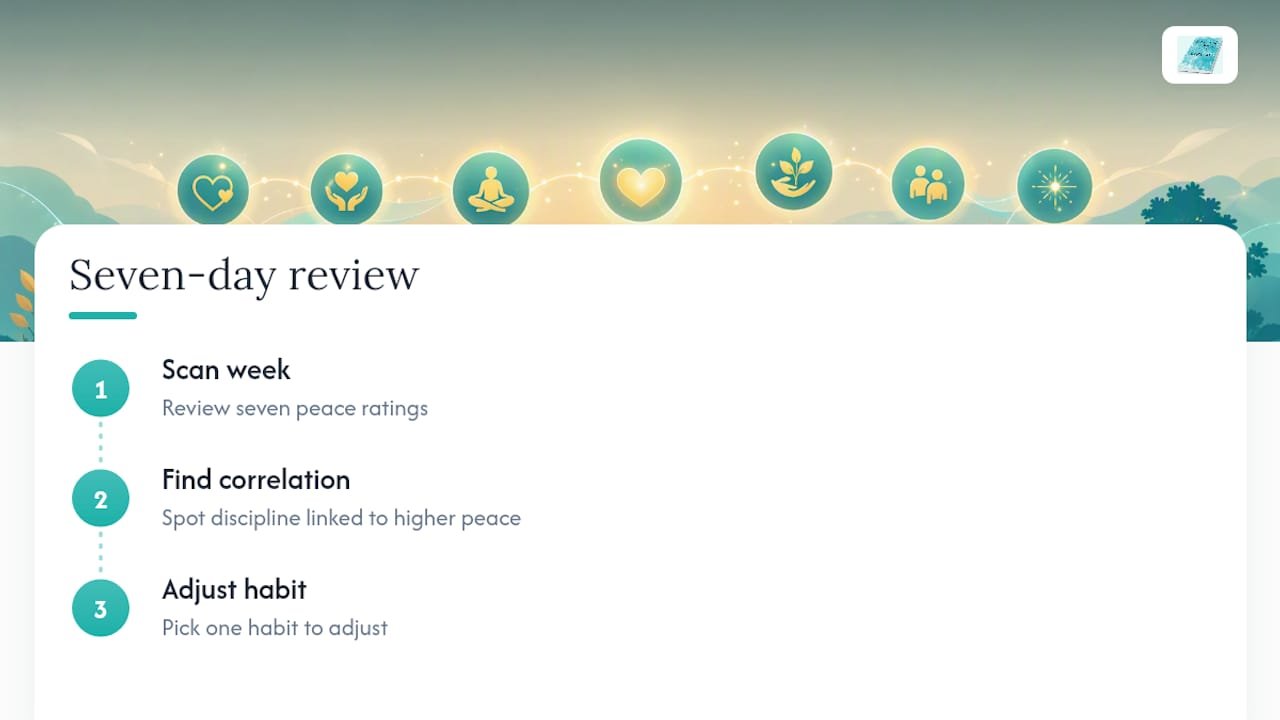
Weekly review: Scan seven days of peace ratings for patterns. Weekly review practices are disproportionately effective because scanning a full week at once reveals which specific discipline, prayer versus sacred reading versus gratitude, correlates with your higher peace ratings, something a single day’s entry never shows. Pick one habit to adjust, and celebrate the fact that you returned to practice rather than counting the days you missed.
A sample template needs only these fields: date, habits practiced (checkboxes for up to eight), minutes logged, inner-peace rating (1 to 10), and a one-line insight or gratitude note. Add a weekly summary strip at the bottom of the page, and you have a complete printable in a short time of design work. For a ready-made version of this structure, journaling for soul healing walks through a six-week guided version.
Why Tracking and Journaling Actually Support Growth
Contemplative-practice research summarized in Altered Traits, the work of psychologist Daniel Goleman and neuroscientist Richard Davidson, found that consistent contemplative practice strengthens self-regulation and attention over time. That finding is the entire argument for tracking in the first place: change accumulates through repetition, and repetition is easier to sustain when you can see it.
Design trends back this up in practice, not just theory. Elastic streaks and offline privacy modes exist because app makers noticed that shame-based tracking drives people away faster than inconsistency ever does.
If you want to build this routine without starting from a blank page, a few Spiritualmethod resources implement it directly:
- Daily spiritual practices for inner peace covers the reflective prompts and gratitude logging referenced above.
- The weekly reflection ritual turns the review step above into a repeatable 20-minute practice.
Coming Back After You Fall Off Is the Whole Point
Every tracker eventually gets a blank week. What matters is what happens next, and the honest answer is that returning without guilt beats a perfect streak nearly every time. The approach treats a missed week as data, not failure, because the discipline that actually builds a spiritual life is the return, not the unbroken chain. If you’re just starting, pick one habit, not five, and give yourself permission to log a bad day honestly instead of skipping the entry altogether.
— Sean
Ready-Made Templates for a Compassion-First Practice
If the daily and weekly structure above sounds right but you’d rather not design a tracker from scratch, Spiritualmethod’s downloadable guides already implement it. The spirituality planner and journal includes the checkbox habit tracker, the inner-peace rating scale, and the weekly review page described in this article, laid out as printable PDF pages you can use immediately after purchase.

The planner pairs naturally with the main inner-healing guide, which covers grounding, energy clearing, and intention-setting practices to log alongside meditation and prayer. Every template follows the same compassion-first design principle covered above: forgiving progress tracking, private, offline-friendly formats, and reflection prompts instead of bare checkboxes. If gratitude tracking is your entry point, the partner guide on gratitude journaling rituals offers additional prompts worth pairing with your daily check-in.
To get started, visit the journaling guide page, download the PDF, and print the weekly review page before your next Sunday reflection.