
Ego death is typically a temporary dissolution of subjective self-identity, in which the ordinary sense of being a separate, bounded “I” falls away, often catalyzing profound spiritual awakening and lasting personal transformation. If you are currently in an intense, disorienting experience, read the safety note below first. If you are here to understand the phenomenon more deeply, this guide covers definitions, stages, neuroscience, risks, and a structured preparation and integration plan.
Safety TL;DR: Ego dissolution experiences are usually temporary and self-limiting. They differ from psychosis in that insight and self-awareness typically remain accessible, even when the sense of a personal self feels absent. If you are experiencing prolonged terror, inability to function, or thoughts of harming yourself or others, contact a mental health professional or emergency services immediately.
If you are in an intense experience right now:
- Sit or lie down in a safe, quiet space and breathe slowly: four counts in, hold four, out four.
- Place both feet flat on the floor and press your palms against a solid surface to reestablish physical grounding.
- Contact a trusted person, a sitter, or a trained guide who can stay with you.
- If you feel unsafe, call or text 988 (Suicide and Crisis Lifeline, U.S.) or call 911.
Table of Contents
- What is ego death, and where does the concept come from?
- What does ego death feel like, and what are the stages?
- What triggers ego death, and in what contexts does it occur?
- What does neuroscience say about ego dissolution?
- Is ego death permanent, and what are the real risks?
- How do you prepare for and safely approach ego-dissolution states?
- How do you integrate an ego-death experience into lasting change?
- Key Takeaways
- Why ego death is misunderstood, even by serious seekers
- Spiritualmethod’s guides support your preparation and integration
- Useful sources and further reading
What is ego death, and where does the concept come from?
Ego death, as defined by Britannica, is a complete, often temporary, loss of subjective self-identity in which ego functions — reality-testing, sense-perception, memory, reason, and self-representation — become suspended or repressed. The experience ranges from a mild softening of self-boundaries to a total disappearance of the sense of being a distinct person. The term itself entered modern discourse through psychedelic research in the mid-twentieth century, but the underlying phenomenon has been documented across spiritual traditions for millennia.
How different traditions describe the same experience
Every major contemplative lineage has a name for it. The mapping below shows how closely these accounts align, despite arising in entirely separate cultural contexts.
- Buddhism (anatta and kenshō): — The doctrine of anatta (non-self) holds that a fixed, permanent self is a cognitive construction. Kenshō and satori in Zen practice describe sudden glimpses of this selfless nature, often precipitated by intensive sitting or koan work.
How related terms differ
| Term | Core meaning | Key distinction |
|---|---|---|
| Ego death | Complete, often temporary, loss of self-identity | Implies full dissolution; used in both spiritual and clinical contexts |
| Ego loss | Partial or gradual weakening of self-boundary | Degree is less complete; often a stage on the way to full dissolution |
| Self-surrender | Intentional release of ego-driven control | Volitional; the person chooses to let go rather than being overtaken |
| Temporary dissociation | Detachment from thoughts, feelings, or body | Pathological framing; self-awareness is typically reduced, not expanded |
| Fana (Sufism) | Annihilation of the ego in the divine | Tradition-specific; carries theological meaning beyond psychology |
The distinction between ego death and temporary dissociation is clinically significant. In a genuine ego dissolution experience, awareness itself often feels expanded or unified; in pathological dissociation, awareness tends to feel narrowed, numbed, or fragmented.
What does ego death feel like, and what are the stages?
The phenomenology of ego dissolution is remarkably consistent across traditions, substances, and meditation depths. The core experience involves a loss of the felt boundary between self and world, a collapse of linear time perception, a sense of unity or “cosmic consciousness,” and a marked reduction in self-referential thought. Research on psychedelic states links these reports to disruption of the cognitive processes that normally bind self-relevant information into a coherent self-model.

What triggers ego death, and in what contexts does it occur?
Ego dissolution does not require a specific substance or technique. It arises across a range of contexts, each carrying its own risk profile and preparation requirements. The main triggers are intensive meditation practice, breathwork, kundalini activation, psychedelic substances, spontaneous spiritual emergencies, and, less commonly, traumatic life events.
Common triggers and what to expect
- Silent meditation retreats: Extended periods of intensive sitting practice, particularly Vipassana or Zen sesshins lasting seven to ten days, can produce ego-dissolution states without any substance. The gradual nature of retreat-based dissolution often makes integration more manageable.
- Intensive breathwork: Practices such as holotropic breathwork, developed by Stanislav Grof, can induce non-ordinary states within a single session. These experiences can be powerful and require a trained facilitator.
- Kundalini activation: Spontaneous or practice-induced kundalini experiences can produce sudden, overwhelming dissolution states. They are often accompanied by physical sensations (heat, trembling, energy moving up the spine) and can be destabilizing without proper guidance.
- Psychedelic substances: Psilocybin, LSD, DMT, and ayahuasca are the most commonly reported pharmacological triggers. In the U.S., psilocybin is currently a Schedule I substance federally, though Oregon and Colorado have established regulated therapeutic frameworks. Clinical trials at institutions such as Johns Hopkins and NYU are studying psilocybin-assisted therapy under FDA oversight. Outside of approved research settings, use carries significant legal and medical risk.
- Spontaneous spiritual emergencies: Some people experience sudden ego dissolution with no identifiable trigger, often during periods of intense stress, grief, or life transition. These can be the most disorienting because there is no prepared context.
- Traumatic events: Major loss, near-death experiences, or severe illness can precipitate ego-death-adjacent states. Psychological perspectives describe these as potential catalysts for identity rebirth when properly integrated.
When to seek a supervised or professional setting
- If you have a personal or family history of psychosis, bipolar disorder, or schizophrenia spectrum conditions, avoid pharmacological triggers entirely and consult a psychiatrist before pursuing intensive meditation retreats.
- If you are drawn to psychedelic contexts, prioritize FDA-approved clinical trials or, where state law permits, licensed therapeutic programs over unregulated settings.
- If you have experienced a spontaneous spiritual emergency, contact a therapist trained in transpersonal psychology or spiritual emergence before attempting further practice.
- If a previous experience was traumatic or unresolved, work with a licensed mental health professional before re-entering deep states.
Pro Tip: When vetting a retreat or guide, ask three specific questions: What is your training and lineage? What is your protocol if a participant becomes destabilized? Do you have a licensed mental health professional on call? A reputable program answers all three without hesitation. The Spiritual Emergence Network is a useful starting point for finding transpersonally trained therapists in the U.S.
What does neuroscience say about ego dissolution?
The subjective experience of ego death corresponds to measurable changes in brain network organization and neurochemistry. The most consistent finding across imaging studies is disruption of the default mode network (DMN), a set of midline brain regions associated with self-referential thought, autobiographical memory, and the construction of a continuous personal narrative.
Key research findings
| Study / Source | Finding | Implication for ego dissolution |
|---|---|---|
| Carhart-Harris et al. (2016), Frontiers in Human Neuroscience | Psychedelics decrease within-network DMN connectivity and increase cross-network connectivity | Reduced DMN coherence correlates with reports of ego dissolution and unity experiences |
| Nour et al. (2016), psilocybin/glutamate study, Neuropsychopharmacology | Region-dependent glutamate changes: higher mPFC glutamate linked to negatively experienced dissolution; lower hippocampal glutamate linked to positively experienced dissolution | Neurochemical context shapes whether dissolution feels blissful or terrifying |
| Letheby & Gerrans, Phenomenology and the Cognitive Sciences | Predictive-processing account: psychedelics disrupt self-binding, revealing the self-model as a functional representation | Ego death is not destruction of a self but disruption of the processes that construct the self-model |
The DMN connectivity research is particularly significant because it provides a network-level explanation for why ego dissolution feels like a loss of the “center.” When the DMN’s internal coherence drops and its connections to other networks increase, the brain’s usual self-referential anchor loosens, and the boundary between self and world becomes experientially permeable.
The glutamate findings add a neurochemical layer: the subjective quality of dissolution, whether it feels like grace or terror, is partly predicted by regional glutamate dynamics in the medial prefrontal cortex and hippocampus. This helps explain why set and setting matter so much — psychological preparation and environmental safety influence the neurochemical context of the experience.
The predictive-processing framework, developed in detail by Letheby and Gerrans, offers perhaps the most conceptually precise account:
This framing matters for spiritual seekers because it reconciles the neuroscience with the contemplative insight. The self was never a fixed thing; it was always a dynamic construction. Ego death, whether induced by meditation or pharmacology, makes that construction temporarily visible as a construction.
- Journals publishing this research include Neuropsychopharmacology, Frontiers in Human Neuroscience, Psychological Medicine, and PNAS.
- Study designs range from double-blind placebo-controlled trials to longitudinal observational studies of meditators.
- Validated instruments such as the Ego Dissolution Inventory and the Mystical Experience Questionnaire allow researchers to quantify subjective reports reliably.
Is ego death permanent, and what are the real risks?
Ego dissolution experiences are almost always temporary. The sense of a personal self reconstitutes, typically within hours. What can persist, and what distinguishes a genuinely transformative experience from a merely dramatic one, is the gradual integration of insight into daily life. Permanent personality change, when it occurs, tends to be slow, cumulative, and built through sustained practice rather than a single event.
That said, the risks are real and deserve honest treatment.
Red flags that require immediate professional attention
- Persistent inability to distinguish self from environment lasting more than 24 hours
- Auditory or visual hallucinations that continue after the acute experience has passed
- Thoughts of self-harm or harm to others
- Complete inability to perform basic self-care (eating, sleeping, hygiene)
- Grandiose beliefs that feel unquestionable (e.g., a conviction of special cosmic mission that overrides all other judgment)
- Severe panic that does not respond to grounding techniques
Recommended U.S. resources:
- 988 Suicide and Crisis Lifeline (call or text 988)
- SAMHSA National Helpline: 1-800-662-4357
- Spiritual Emergence Network (spiritualemergencenetwork.org) for transpersonally trained therapists
- A licensed psychiatrist or psychologist for evaluation of prolonged dissociation or psychotic symptoms
- Emergency services (911) for immediate safety concerns
For readers navigating the grief and loss that often accompanies identity dissolution, spiritual grief resources can provide additional context and support.
How do you prepare for and safely approach ego-dissolution states?
Preparation matters more than technique. The research on psychedelic-assisted therapy and the long history of contemplative practice both point to the same conclusion: the conditions surrounding an experience, the psychological readiness, the physical environment, the quality of support, and the integration plan, shape the outcome far more than the specific method used.
A stepwise preparation and practice plan
- Physical preparation: — In the week before any intensive practice, prioritize sleep (seven to nine hours), reduce alcohol and stimulants, eat regularly, and spend time in nature. Physical stability supports psychological resilience during intense states.
Integration journal prompts
Use these in the hours and days following an intense experience:
- “What did I believe about myself before this experience that no longer feels entirely true?”
- “What quality or capacity felt most present when my usual sense of self was absent?”
- “What one small change in my daily life would honor what I understood during this experience?”
Pro Tip: When vetting a therapist for integration support, look specifically for training in transpersonal psychology, somatic therapy, or psychedelic-assisted therapy (where legally applicable). The transpersonal healing framework provides a useful orientation to the therapeutic approaches best suited to spiritual emergence work. Licensed mental health professionals should always be prioritized over coaches or guides who lack clinical credentials when psychological symptoms are present.
How do you integrate an ego-death experience into lasting change?
Integration is where spiritual transformation becomes durable. A dissolution experience, however profound, is a signal, not a destination. Scholars and clinicians consistently caution that pharmacological or peak experiences alone rarely produce lasting change without sustained follow-up practice and structured reflection. The days and weeks after an intense experience are, in many ways, more important than the experience itself.
Daily integration habits
- Morning grounding: Begin each day with five to ten minutes of physical grounding: bare feet on earth or floor, slow breath, and a brief body scan. Grounding exercises help the nervous system consolidate rather than dissociate.
- Structured journaling: Daily writing, even ten minutes, externalizes and organizes the material that surfaces after dissolution. Journaling for soul healing provides a structured framework for this process.
- Embodiment practices: — Yoga, tai chi, qigong, or slow walking in nature reconnect the post-dissolution mind with physical reality. The body is the most reliable anchor during identity reorganization.
Key Takeaways
Ego death is a temporary dissolution of self-identity that can catalyze genuine spiritual transformation, but only when approached with preparation, appropriate support, and a structured integration practice.
| Point | Details |
|---|---|
| Definition and scope | Ego death is a typically temporary loss of subjective self-identity, ranging from mild boundary softening to complete dissolution of the personal self. |
| Safety first | Prolonged terror, inability to function, or psychotic symptoms require immediate professional help; call 988 or 911 in the U.S. if safety is at risk. |
| Preparation matters most | Psychological screening, intention-setting, physical readiness, and a trusted sitter shape outcomes more than any specific technique. |
| Integration is the work | Lasting transformation comes from daily grounding, structured journaling, embodiment practice, and professional support, not from the experience alone. |
| Spiritualmethod’s structured guides | Spiritualmethod’s downloadable ebooks, planners, and journaling guides provide a structured framework for preparation, grounding, and post-experience integration. |
Why ego death is misunderstood, even by serious seekers
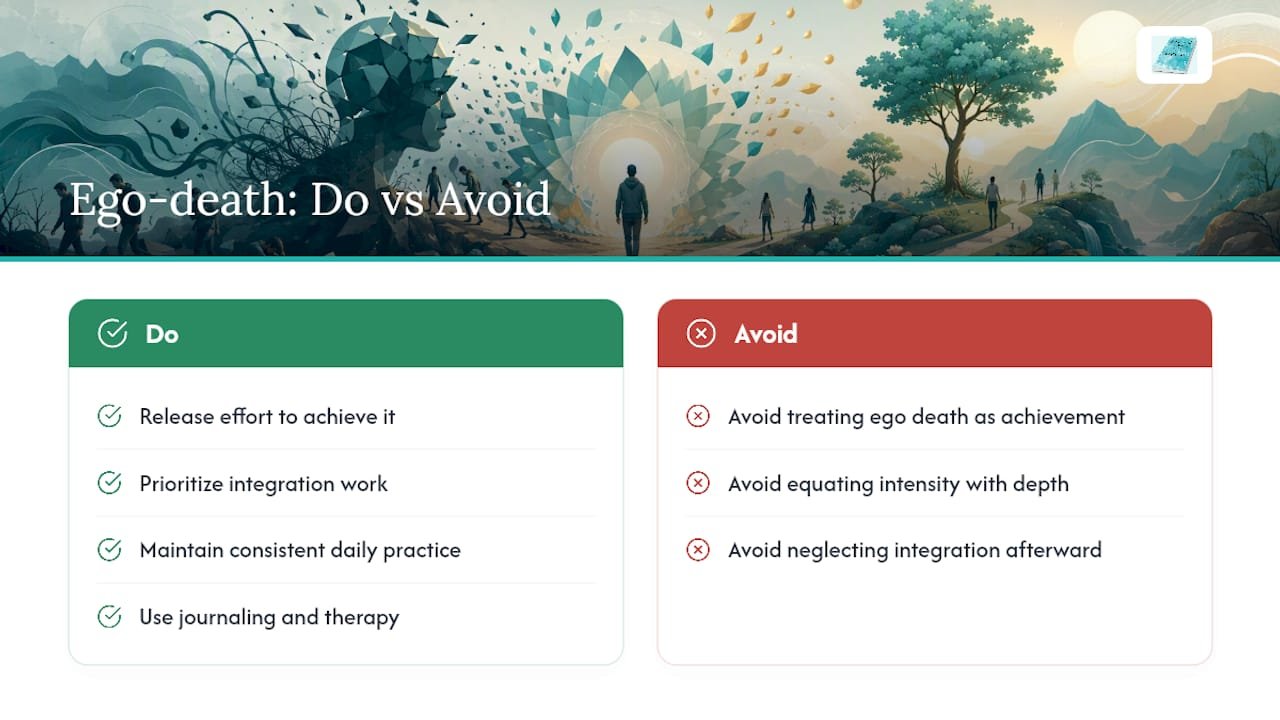
The conventional framing of ego death tends to treat it as an achievement, something to attain, a peak to summit. That framing is almost always counterproductive. The experiences most commonly described as ego death arrive precisely when the effort to achieve them is released. Zen teachers have said this for centuries. The neuroscience, in its own language, says the same thing: dissolution occurs when the predictive self-model loses its grip, not when it is forcibly dismantled.
What serious seekers often underestimate is the weight of the return. The dissolution itself can feel like liberation. The days and weeks afterward, when ordinary identity reconstitutes and the insights of the experience must be translated into the friction of daily life, are where most people struggle. The experience opens a door. Integration is the work of actually walking through it and furnishing the room on the other side.
There is also a tendency, particularly in Western spiritual culture, to conflate intensity with depth. A terrifying ego-dissolution experience is not more spiritually significant than a quiet, gradual softening of self-boundary through years of meditation practice. The Britannica definition is precise on this point: the phenomenon ranges from mild softening to complete disappearance. Both ends of that spectrum can carry genuine insight. Neither is superior.
The most durable transformations this guide’s research points to are not the dramatic ones. They are the ones followed by consistent, unglamorous daily practice: the morning grounding routine, the journal kept through the difficult weeks, the therapy appointment that felt unnecessary but turned out to be the most important hour of the month.
Spiritualmethod’s guides support your preparation and integration
Structured preparation and consistent daily practice are the two factors that most reliably determine whether an ego-dissolution experience becomes a lasting catalyst for growth. Spiritualmethod’s downloadable guides are built around exactly that structure.
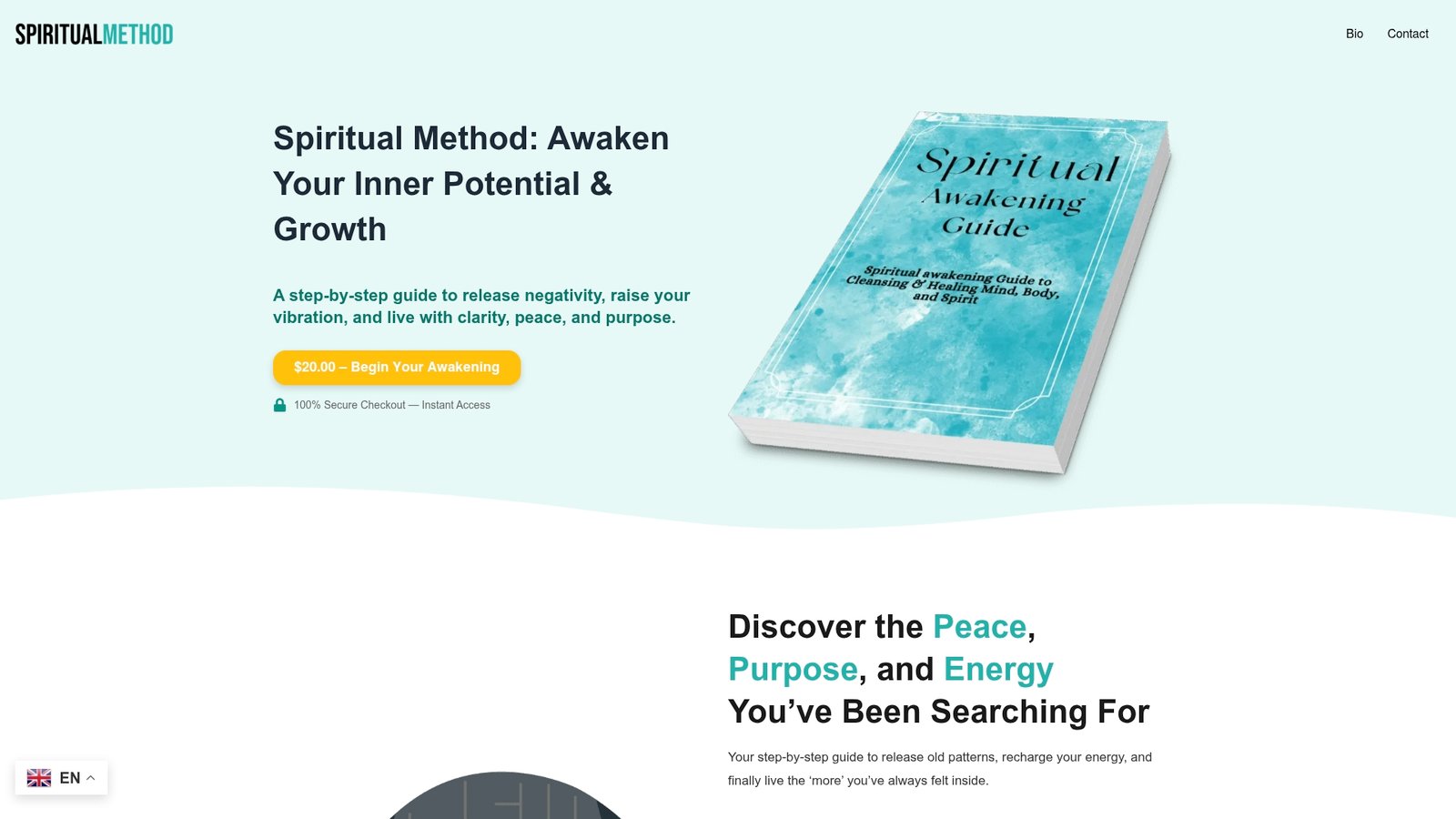
The Spiritualmethod self-help guide bundle includes a 50+ page spiritual awakening ebook, a spirituality planner and journal, and a moon manifesting ritual guide. Together, they provide a concrete framework for grounding practices, energy clearing, sacred bathing rituals, intention-setting, and progress tracking, all of which directly support the preparation and integration phases described in this guide. The journaling for soul healing guide is particularly well-suited to the post-experience integration work outlined in the 7-day plan above.
These are one-time purchase, instantly downloadable resources. There is no subscription, no ongoing commitment, and no prerequisite experience level. They are designed for self-guided use, though they complement professional therapeutic support rather than replace it.
These guides are educational tools for personal development and spiritual growth. They are not a substitute for psychiatric care, emergency medical services, or licensed mental health treatment. If you are experiencing a mental health crisis, contact 988 or 911 immediately.
Useful sources and further reading
The following sources support the claims in this guide and provide pathways for deeper study. U.S.-relevant clinical and crisis resources are included at the end.
| Source | What it covers | Why it is useful |
|---|---|---|
| Britannica: Ego Death | Scholarly definition, historical traditions, and caution about pharmacology vs. practice | Authoritative starting point for definitional and traditional context |
| PMC: Self Unbound (Letheby & Gerrans) | Predictive-processing and self-binding account of ego dissolution | Best conceptual framework for understanding the neuroscience without reductionism |
| Neuropsychopharmacology: Psilocybin/Glutamate Study | Region-dependent glutamate changes and subjective valence of dissolution | Explains why set and setting influence whether dissolution feels positive or difficult |
| Frontiers in Human Neuroscience (2016) | DMN connectivity changes during psychedelic states | Core network-level evidence for the neuroscience of ego dissolution |
| Wikipedia: Ego Death | Broad cultural and terminological overview across traditions | Useful for cross-tradition mapping; pair with academic sources for credibility |
| The Narrow Path: Ego Death and Identity Rebirth | Psychological and spiritual perspectives on integration and identity rebirth | Practical counseling-oriented view of risks and post-crisis growth |
Annotated further reading:
- Ego death | Britannica
- Self unbound: ego dissolution in psychedelic experience – PMC
- Me, myself, bye: regional alterations in glutamate and the experience of ego dissolution with psilocybin | Neuropsychopharmacology
- Frontiers in Human Neuroscience article (2016)
- Ego death — Wikipedia
- Ego death and identity rebirth: Psychological and spiritual perspectives on losing the self – The Narrow Path
U.S. clinical and crisis resources:
This article is for general informational purposes only and does not constitute medical, psychiatric, or legal advice. Confirm current laws, clinical options, and treatment suitability with a qualified professional.